
Notting Hill Carnival at 60: Europe's Biggest Street Party
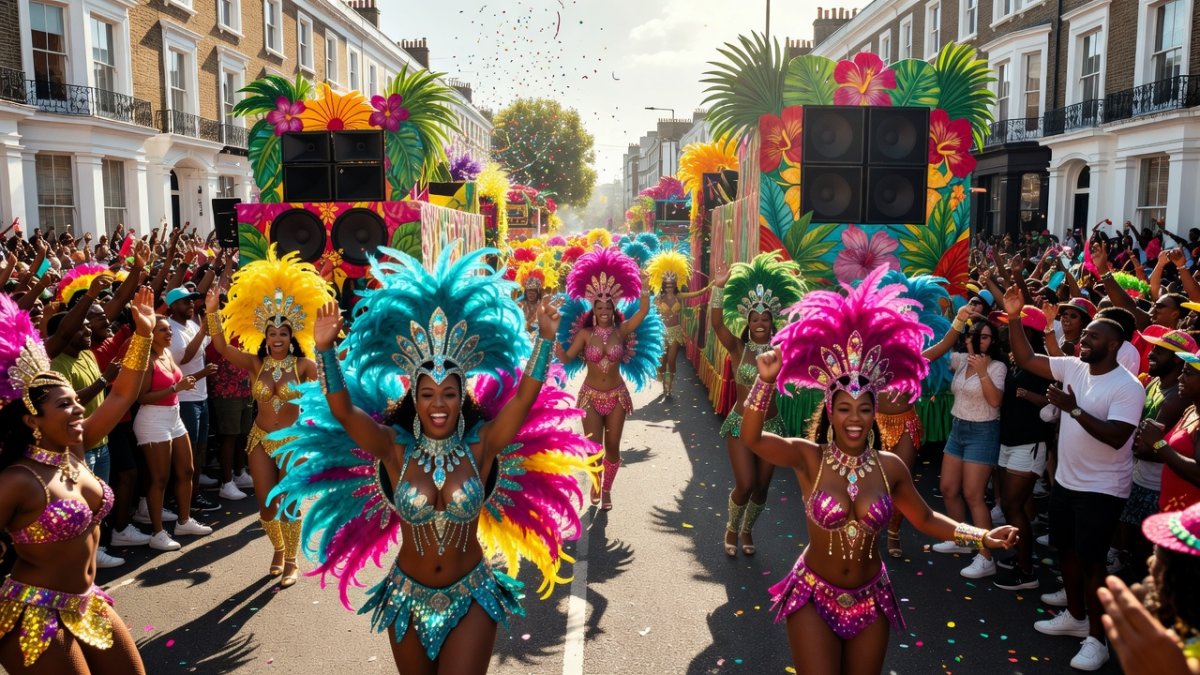
Sixty years after a handful of steel bands first wound their way through the terraced streets of North Kensington, Europe’s biggest street festival has returned to West London with a roar.
Sixty years after a handful of steel bands first wound their way through the terraced streets of North Kensington, Europe’s biggest street festival has returned to West London with a roar. This bank holiday weekend, more than one million people are expected to flood the narrow roads of Notting Hill for the 60th anniversary of a carnival born from the ashes of racial violence — a celebration that has become as much a fixture of the British summer as Wimbledon or the Proms, yet remains perpetually at war with the city that hosts it.
As the final day of the 2026 programme unfolds today, the air is thick with the smell of jerk chicken and the bass-heavy pulse of sound systems. But beneath the sequins and the soca, a more serious rhythm plays out: a debate about funding, policing, and whether this beloved institution can survive its own success.
Notting Hill Carnival at 60: Europe's Biggest Street Festival Returns
London, UK – 31 August 2026 — The 60th anniversary Notting Hill Carnival reaches its climax today, with organisers expecting record crowds of up to two million people across the weekend. The Met Police reported 169 arrests on the first adults’ day (Sunday 30 August, as of 7.45pm), the vast majority within the event perimeter, with 27 on approaches to the site, for offences including possession of weapons, drugs and sex offences. Scotland Yard described the mood as “overwhelmingly positive and celebratory”.
Yet even as the parade snakes through the streets, the festival’s long-term future hangs in the balance. This year’s event was saved from cancellation only by an emergency £1m bailout in July 2025, followed by a record £4.66m security grant from City Hall for 2026. The question now is not whether the carnival can throw a party — it demonstrably can — but whether London has the political will to sustain it.
From riot-scarred streets to global stage: how the carnival began
To understand the carnival’s significance, one must return to the summer of 1958, when race riots tore through Notting Hill. White youths attacked Black residents in a series of violent incidents that shocked the nation and exposed the deep racism embedded in post-war British society. The following January, Trinidadian journalist and activist Claudia Jones — herself a victim of McCarthy-era persecution in the United States — organised an indoor Caribbean Carnival at St Pancras Town Hall, broadcast by the BBC. It was a defiant act of cultural assertion: a statement that Caribbean people in Britain would not be cowed.
Seven years later, in 1966, the carnival took to the streets of Notting Hill, led by community organiser Rhaune Laslett, beginning with steel bands. Laslett, a Londoner of mixed heritage, envisioned a festival that would bring together the area’s diverse communities — a healing gesture after the trauma of the riots. What began as a modest neighbourhood gathering, with a few dozen musicians and curious onlookers, has since grown into a global phenomenon that draws revellers from every continent.
The irony is not lost on historians that a festival born from racial conflict now occupies the very streets where that conflict erupted. The carnival has effectively reclaimed the geography of violence and transformed it into a space of joy — a reclamation that remains politically potent six decades on.
A soundtrack of resistance: steel pan, sound systems and the culture that built it
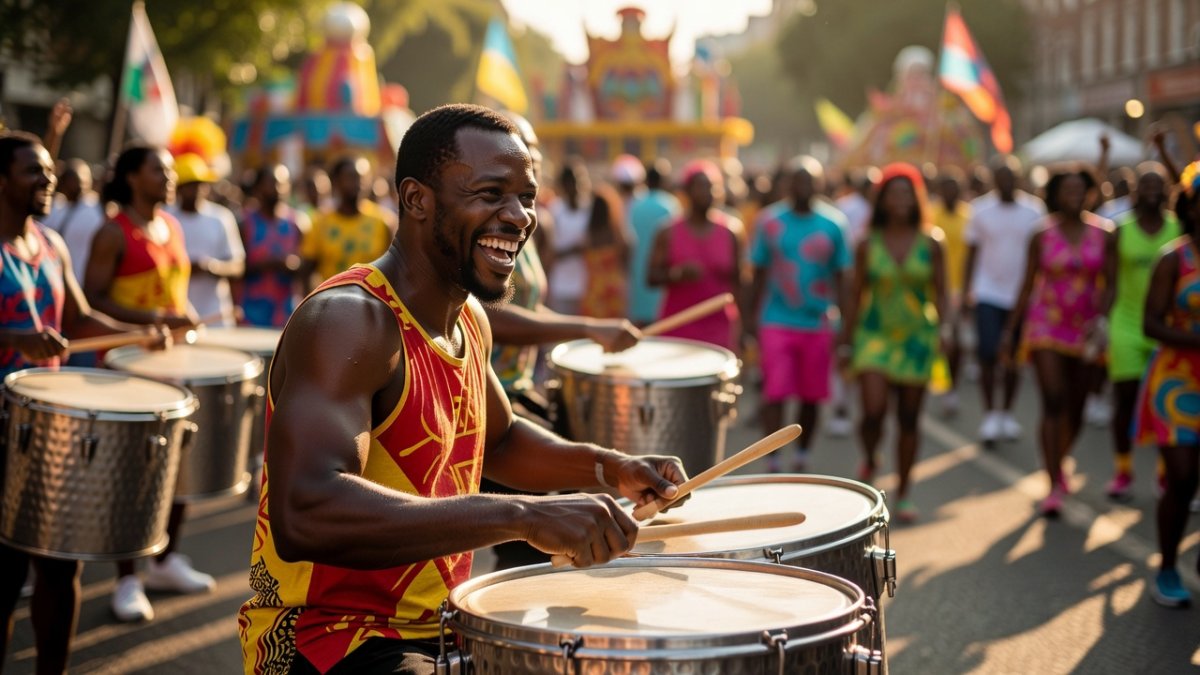
At the heart of the carnival lies its music, and at the heart of that music lies the steel pan — an instrument invented in Trinidad in the 1930s, forged from discarded oil drums. When those first steel bands paraded through Notting Hill in 1966, they brought with them a tradition of resistance and ingenuity that had been honed in the Caribbean for decades. The pan is not merely an instrument; it is a symbol of turning the detritus of empire into art.
As the carnival grew, so too did its sonic palette. Sound systems — mobile DJ units with towering speaker stacks — became the festival’s beating heart, pumping out reggae, soca, calypso and, later, jungle and grime. These sound systems were not just entertainment; they were community institutions, providing a platform for MCs and selectors to speak directly to their audiences. In the 1970s and 1980s, the carnival became a crucible for British Caribbean identity, a place where second-generation immigrants could assert a cultural identity that was neither fully British nor fully Caribbean, but something new and powerful.
The food stalls — jerk chicken, roti, ackee and saltfish — added another layer of cultural expression. To walk through the carnival is to experience the entire Caribbean diaspora in a few hundred metres: the flavours of Jamaica, Trinidad, Barbados and Grenada all competing for attention alongside the music. It is, in effect, a living museum of Caribbean culture, displayed not behind glass but in the open air.
60 years on: what the 2026 carnival looks like
This year’s event, which began on Saturday 29 August with Family Day, has been billed as the biggest yet. The Family Day — a calmer, more accessible precursor to the main parade days — was designed to welcome younger revellers and families, with a reduced sound level and more space for children’s activities. Sunday 30 August and Bank Holiday Monday 31 August have been given over to the full Adults’ Parade, with mas (masquerade) bands in elaborate feathered costumes, floats, and the relentless pulse of the sound systems.
Google even marked the occasion with a Doodle, a rare honour that underscores the carnival’s status as a national institution. More than one million people were expected to attend over the weekend; some estimates put attendance as high as two million. That would make this year’s carnival the largest in its history, a remarkable achievement for an event that nearly collapsed just twelve months ago.
For the uninitiated, the scale is difficult to comprehend. The parade route winds through approximately three miles of streets, but the crowds spill far beyond the official boundaries, filling every side street, garden square and balcony. The atmosphere is chaotic, overwhelming and, for many, transcendent. It is a rare moment in London’s calendar when the city’s usual reserve is abandoned entirely, replaced by a collective, unapologetic exuberance.
The policing question: arrests, facial recognition and the £15.7m bill
Yet the carnival’s scale brings with it immense challenges, not least for the Metropolitan Police. The force reported 169 arrests on Sunday alone, the vast majority within the event perimeter, with 27 on approaches to the site. Offences included possession of weapons, drugs and sex offences. While Scotland Yard described the mood as “overwhelmingly positive and celebratory”, the arrest figures remain a point of contention.
Live facial recognition technology is being used again this year by the Met, a controversial measure that civil liberties groups have condemned as an intrusion on privacy. More than 330 individuals are banned from this year’s carnival due to bail conditions, and ahead of the event, police seized dozens of blades — 76 zombie knives, The Telegraph reported — in pre-carnival operations aimed at limiting serious violence.
The policing bill is staggering. The Met spent £15.7m policing the carnival in 2025, up from £11.7m in 2024. That figure — equivalent to the annual budget of a small hospital — has fuelled an ongoing debate about whether the carnival should move from West London’s narrow streets to a larger, more manageable venue. The comparison with 2025 is instructive: the Met made 528 arrests across the two main days, with 500+ arrests mainly for drug offences. In 2024, there were eight stabbings, including the murder of 32-year-old mother Cher Maximen. In 2025, there were four stabbings and 55 people arrested for assaulting a police officer, two of whom required hospital treatment.
The trend is cautiously positive — stabbings fell from eight in 2024 to four in 2025 — but the perception of danger persists. Many residents and businesses board up their homes and shopfronts each year, a practice that has become as much a part of the carnival ritual as the parade itself. The boarded windows are a visual reminder that the carnival’s relationship with its host community remains fraught.
The funding fight: bailouts, the £4.66m security grant and the battle to keep the carnival alive
Perhaps the most existential threat to the carnival is financial. In July 2025, the event was saved from cancellation by an emergency £1m bailout from City Hall, Kensington & Chelsea council and Westminster council. The crisis was averted, but barely. For 2026, Mayor of London Sir Sadiq Khan allocated an additional £4.66m on top of nearly £950,000 already pledged by City Hall, earmarked for crowd safety and managing overcrowding ahead of the 60th anniversary.
Khan has described the carnival as “much more than a party” and promised “record amounts” of investment. Matthew Phillips, chief executive of Carnival Village Trust which organises the festival, said the 2026 event “could not have gone ahead safely” without the £4.66m grant. That statement is both a relief and a warning: the carnival is now dependent on the goodwill of City Hall, and that goodwill must be renewed every year.
The funding crisis has reignited the debate about the carnival’s future. Some ministers have suggested the event should move to a purpose-built site, such as a large park or stadium, where crowd control and sanitation could be better managed. But organisers and many revellers argue that moving the carnival would destroy its character. The carnival is not just a parade; it is a takeover of the streets, a temporary reclamation of urban space by a community that has historically been marginalised. To move it to a sanitised venue would be to strip it of its meaning.
What this means for the UK: identity, community, and the economy
The carnival’s significance extends far beyond West London. It is a barometer of race relations in Britain, a test case for how the country handles its multicultural identity. The fact that a festival born from the 1958 riots now attracts two million people — the vast majority of them not of Caribbean descent — is a testament to how far Britain has come. But the persistent funding crises and the annual debates about policing and relocation suggest how far it still has to go.
Economically, the carnival is a boon. It generates millions of pounds in revenue for local businesses, from food vendors to transport providers, and attracts tourists from around the world. But the economic benefits are unevenly distributed, and many local residents see little upside to having their streets blocked and their homes boarded up for three days. The tension between the carnival’s cultural value and its practical costs is unlikely to be resolved anytime soon.
For the wider UK, the carnival serves as a reminder of the country’s Caribbean heritage — a heritage that is often overlooked in mainstream narratives. The Windrush generation, whose members arrived in Britain from 1948 onwards, faced immense hardship and discrimination. The carnival is their legacy, a living monument to their resilience and creativity. To let it fail would be a national disgrace.
The bottom line: what comes next
As the final floats make their way down Ladbroke Grove this evening, the immediate crisis is over. The 60th anniversary carnival has been a success, by all accounts. But the longer-term questions remain unanswered. Will the funding be sustained? Will the policing bill continue to rise? Will the debate about relocation ever be resolved?
What is clear is that the carnival is not going anywhere quietly. Its organisers have shown remarkable tenacity in the face of financial and logistical challenges, and its supporters are fiercely protective of its traditions. The 60th anniversary is a milestone, but it is also a warning: without sustained investment and political will, Europe’s biggest street festival could become a victim of its own success.
For now, though, the music plays on. The smell of jerk chicken fills the air. The steel pans ring out across the rooftops of West London. And for one weekend, at least, the city belongs to the carnival.
By Erica Thornton, Staff Writer
This article was produced with AI-assisted research and editorial support. Sources: Channel 4 News, Metropolitan Police, Mayor of London, Carnival Village Trust, The Telegraph, The Independent, The Evening Standard, BBC.
What's Your Reaction?
 Like
0
Like
0
 Dislike
0
Dislike
0
 Love
0
Love
0
 Funny
0
Funny
0
 Wow
0
Wow
0
 Sad
0
Sad
0
 Angry
0
Angry
0

US Politics and Policy Correspondent at Global1.News. Based in Washington DC, covering American politics, policy, elections, and the courts. Knows how the system works and tells you what it actually means.












Comments (0)