
The Goat That Stole a Graduation: A Nigerian Mother’s Viral Gift
Nekede, Nigeria — The air at Federal Polytechnic Nekede in Imo State was thick with the usual chaos of "signing-out" day. Music blared from speakers, friends screamed and danced, and white shirts were being scribbled with well-wishes.
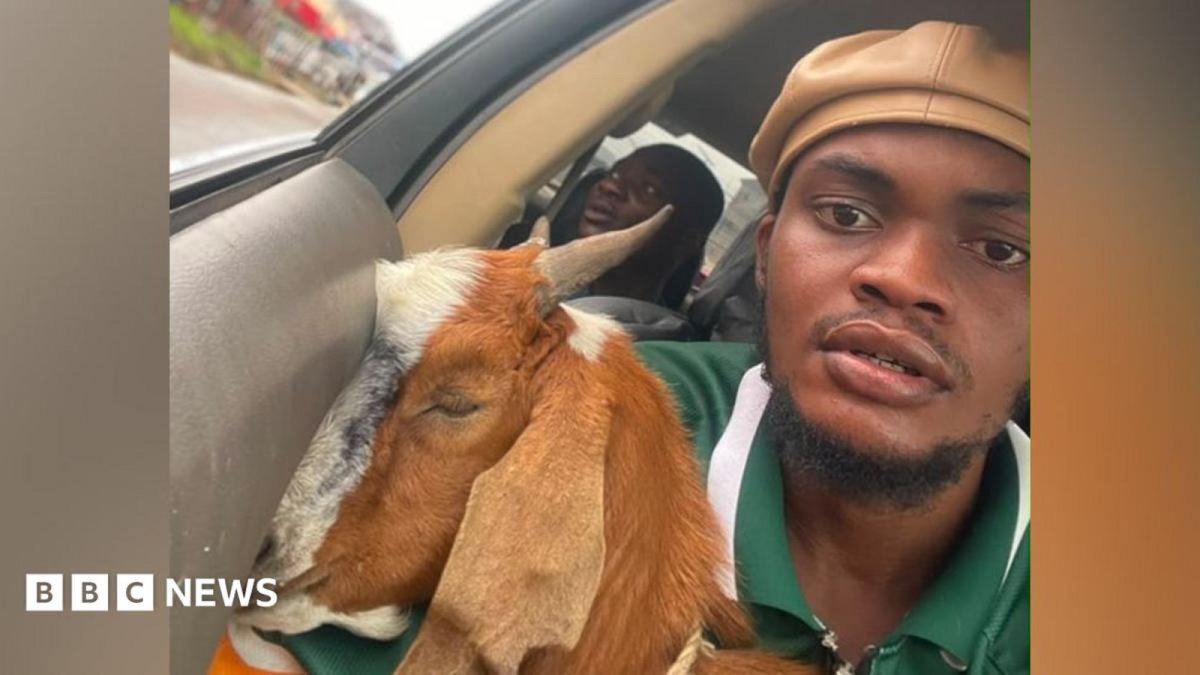
Nekede, Nigeria — The air at Federal Polytechnic Nekede in Imo State was thick with the usual chaos of "signing-out" day. Music blared from speakers, friends screamed and danced, and white shirts were being scribbled with well-wishes. For 23-year-old Promise Okoro, it was the moment he had worked toward for years. But as the crowd parted, he saw something that stopped him cold: his mother, Chinyere, walking toward him with a rope in her hand, leading a brown goat.
“I was so happy. I felt so emotional,” Promise told BBC Pidgin, recalling the moment that would soon be watched by thousands across the world. The screams he initially thought were for a marriage proposal were actually for him — and for the goat. In a region where livestock carries deep cultural weight, this was not a joke. It was a statement of love, sacrifice, and a promise kept.
A Mother’s Journey From Ubaha-Eze
Chinyere Okoro is a trader. She sells consumer goods — food, drinks, and local snacks — in the small farming community of Ubaha-Eze, more than an hour’s drive from the polytechnic campus. Business has been difficult, she admits, but she had made a vow when Promise first entered university: if he stayed away from violent gangs and other bad influences, and if he did not drop out, she would reward him.
He did exactly that. And so, on the day of his final exams, she made the journey to Nekede with a gift that cost 120,000 naira (about $88 or £66). It was not the shiny Mercedes-Benz SUV she had dreamed of giving him — the “4Matic Jeep” she loves — but it was what she could afford. “I did not have money for a 4matic Jeep,” she said, “so I said let me buy this little gift.”
For Chinyere, the gesture was about more than the animal. “People love my son, I want[ed] to prove that he is [loved],” she explained. “As I walked in and met loud celebrating and shouting, it gladdened my heart knowing that my son will rejoice together with us all when he comes out.”
The Cultural Weight of a Goat
To many outside south-east Nigeria, a goat might seem like an unusual graduation present. But among the Igbo people, goats are far more than livestock. They are valuable gifts, often given to show respect, appreciation, and goodwill. They appear at traditional weddings, family celebrations, and ceremonies honouring elders or special guests. To give a goat is to say: you matter, and your achievement is worthy of something real and substantial.
This cultural context is something I recognise deeply as a Senegalese journalist. In many parts of West Africa, livestock — whether goats, sheep, or cattle — are not merely economic assets. They are symbols of dignity, markers of important life transitions, and gifts that carry the weight of family honour. A young man in Dakar might receive a ram for Tabaski, or a family might offer a cow at a wedding. The animal is not just a thing; it is a message.
So when Promise’s classmates saw the goat, they did not laugh at him. They cheered. They understood, perhaps instinctively, that this was a mother’s love made visible — a sacrifice from a woman who had little, giving what she could to honour her son’s achievement.
From Student to Pet Owner
Promise has not named the goat. But he has made one thing clear: this animal is not destined for the pot. “It’s now my pet, it’s too precious to me, I have no intention of killing it,” he said. Instead, he has plans. “I will get a female goat and start breeding the pair.”
The goat now roams freely at the student halls, and Promise has noticed some surprisingly human-like habits. “I have noticed it loves fried rice a lot! The way he eats up my fried rice leftovers - very voracious,” he said with a laugh. The animal has become a companion, a living reminder of his mother’s sacrifice and his own perseverance.
And the goat has adapted to fame. When Promise took it to a nearby supermarket, fans clambered to take photos. “It got on a car ride with me from my hostel to the mall... it was calm [even though] it's now a celebrity - more popular than me,” he said. He also takes it for evening walks around his street, a sight that has surely become a local attraction in its own right.
A Promise Kept, A Son Grateful
For Promise, the goat is not just a pet or a viral sensation. It is a symbol of his mother’s trust in him. “My mom is very cool. There is nothing I can hide from her and whenever she is confused about something, she always calls me to ask of my opinion or idea,” he said. Their bond is evident — a mother who travelled over an hour to surprise her son, and a son who speaks of her with warmth and respect.
“The way she has shocked me, I will make sure I reciprocate,” Promise said. It is a promise of his own, one that suggests the goat may be the beginning of a larger story of family loyalty and mutual support.
His gratitude extends beyond the gift itself. Promise is acutely aware of the struggles his mother faces as a trader in a difficult economy. He knows that her business has not been easy, and that the 120,000 naira she spent on the goat represents a significant sacrifice. That awareness seems to fuel his own ambitions.
Looking Ahead: A Future in Nigeria’s Health Sector
Promise is a pharmaceutical technology student, and he has clear goals for his future. He wants to help sick people in Nigeria. He knows that many health professionals have left the country for opportunities abroad, and that those who remain often work in difficult conditions. But he wants to stay. He wants to contribute to improving Nigeria’s strained health system.
“If there is a list of the top 50, I will say that I am one of them,” he said about his exam performance. It is a confident statement, but one backed by the discipline his mother demanded of him. He stayed away from the violent gangs that plague some parts of the region. He stayed in school. He finished.
His story is a reminder that behind the statistics — Nigeria’s tertiary education completion rate is 11.3 out of every 100 people, according to BBC News, slightly higher than the 10.5 average across sub-Saharan Africa but below the 17.6 average for lower middle-income countries — there are real people making real sacrifices. Every graduate has a story. Promise’s just happens to involve a goat.
A Viral Moment, A Shared Joy
The video of Promise walking out of his exams to find his mother and the goat has spread rapidly online, drawing thousands of warm reactions. It is easy to see why. In a world often dominated by bad news, here is a story of pure, uncomplicated joy — a mother’s love, a son’s achievement, and a goat that has become an unlikely celebrity.
For many across Africa, the image resonates deeply. It speaks to the importance of family, the value of education, and the creativity of parents who find ways to celebrate their children even when resources are scarce. It also speaks to the power of community — the classmates who cheered, the neighbours who took photos, the strangers online who shared the moment and smiled.
The goat, brought from their village with love and determination, has become a simple gift that has united thousands of people who have watched the moment unfold online. It is a reminder that sometimes the most meaningful gifts are not the most expensive ones, but the ones that carry the most heart.
More Than a Meme
It would be easy to dismiss this as a feel-good viral story, a momentary distraction from the serious challenges facing Nigeria and the continent. But that would be a mistake. This story is about the lengths parents will go to for their children. It is about the importance of education as a family project, not just an individual pursuit. And it is about the dignity of giving, even when you have little to give.
Chinyere Okoro did not have money for a Jeep. But she had a goat, and she had a promise to keep. In giving that goat to her son, she gave him something far more valuable: proof that his hard work was seen, that his choices were honoured, and that his mother believed in him.
Promise, for his part, seems to understand this. He has not named the goat, but he has given it a place in his life. He feeds it fried rice, takes it for walks, and plans to breed it. He has turned a gift into a companion, and a viral moment into a lasting bond.
As he looks to the future — a career in pharmaceutical technology, a contribution to Nigeria’s health system, a way to reciprocate his mother’s love — he carries with him the memory of that day. The music, the screams, the crowd parting to reveal his mother and the goat. It was not the celebration he expected. It was better.
This article was produced with AI-assisted research and editorial support. Sources: BBC News.
By Amara Diop, Staff Writer
What's Your Reaction?
 Like
0
Like
0
 Dislike
0
Dislike
0
 Love
0
Love
0
 Funny
0
Funny
0
 Wow
0
Wow
0
 Sad
0
Sad
0
 Angry
0
Angry
0

West Africa/Sahel Correspondent at Global1.News. Dakar-based journalist covering politics, security, climate, and development across Francophone and Anglophone West Africa. Tells the stories of a region undergoing profound transformation.














Comments (0)