
World Dolls Museum: Rabat's Hidden Cultural Gem
In the heart of Rabat's ancient medina, behind an unassuming door on a quiet alley, lies a treasure that spans the entire globe: the Poupées du Monde museum, where roughly 2,500 dolls from 90 countries stand frozen in glass cases, each one a tiny ambassador of its culture.
In the heart of Rabat's ancient medina, behind an unassuming door on a quiet alley, lies a treasure that spans the entire globe: the Poupées du Monde museum, where roughly 2,500 dolls from 90 countries stand frozen in glass cases, each one a tiny ambassador of its culture. For a continent that has long understood the power of storytelling through craft, this private collection offers a profound reminder that heritage lives not only in grand monuments but in the smallest, most intimate objects of human creation.
World Dolls Museum: Rabat's Hidden Cultural Gem
Rabat, Morocco — Tucked away in the labyrinthine streets of Rabat's old medina, a Franco-Moroccan couple has spent a lifetime gathering the world's traditions in miniature form, creating a museum that speaks to the universal language of childhood and culture. The Poupées du Monde museum, which opened its doors to the public in 2019, has quickly become a beloved stop for those seeking something beyond the typical tourist trail, offering a peaceful haven where every doll tells a story of heritage, craftsmanship, and human connection.
A Hidden Treasure in Rabat's Old Medina
Finding the Poupées du Monde museum requires a bit of intention, a willingness to wander off the main thoroughfares and into the quieter arteries of Rabat's historic quarter. The museum sits at 3 impasse Nakhla, Rue Bouqroune, a location that feels more like a secret shared among friends than a public institution. Visitors often describe the moment of discovery as a happy accident, stumbling upon the entrance after getting delightfully lost in the medina's winding passages.
The museum is housed in a traditional Moroccan riad, a architectural form that has sheltered families for centuries with its inward-facing design and central patio. As you step through the threshold, the noise of the bustling souk fades away, replaced by the gentle trickle of a fountain and the cool shade of a garden courtyard. This patio garden, with its fragrant plants and tiled surfaces, sets the tone for the entire experience: contemplative, serene, and deeply rooted in Moroccan domestic tradition.
The contrast between the museum and its surroundings could not be more striking. Outside, the medina pulses with the energy of daily commerce — vendors calling out prices for spices, textiles, and leather goods, the clatter of metalworkers, the aroma of street food wafting through narrow lanes. Inside the riad, time seems to slow down. The thick walls that once protected a family's privacy now protect a collection that spans continents, creating a sanctuary of stillness in the heart of urban life.
This is a private, family-run establishment, and that character infuses every corner of the space. There is no corporate polish here, no institutional distance between the collection and the visitor. Instead, the museum feels like an extension of the Haffar family home, a place where guests are welcomed into a personal world of accumulated memories and cross-cultural appreciation. The intimacy of the setting makes the experience feel less like visiting a museum and more like being invited into someone's living room to admire their most treasured possessions.
Rabat itself provides a fitting backdrop for such a cultural institution. The city has been Morocco's capital since 1912 and is known for landmarks like the Hassan Tower, the Kasbah of the Udayas, and the Chellah necropolis. Yet the medina, with its organic layout and centuries of layered history, offers something the grand monuments cannot: a living, breathing sense of continuity. The Poupées du Monde museum, hidden within this ancient fabric, adds another layer to Rabat's rich cultural tapestry.
Two Thousand Five Hundred Windows on the World
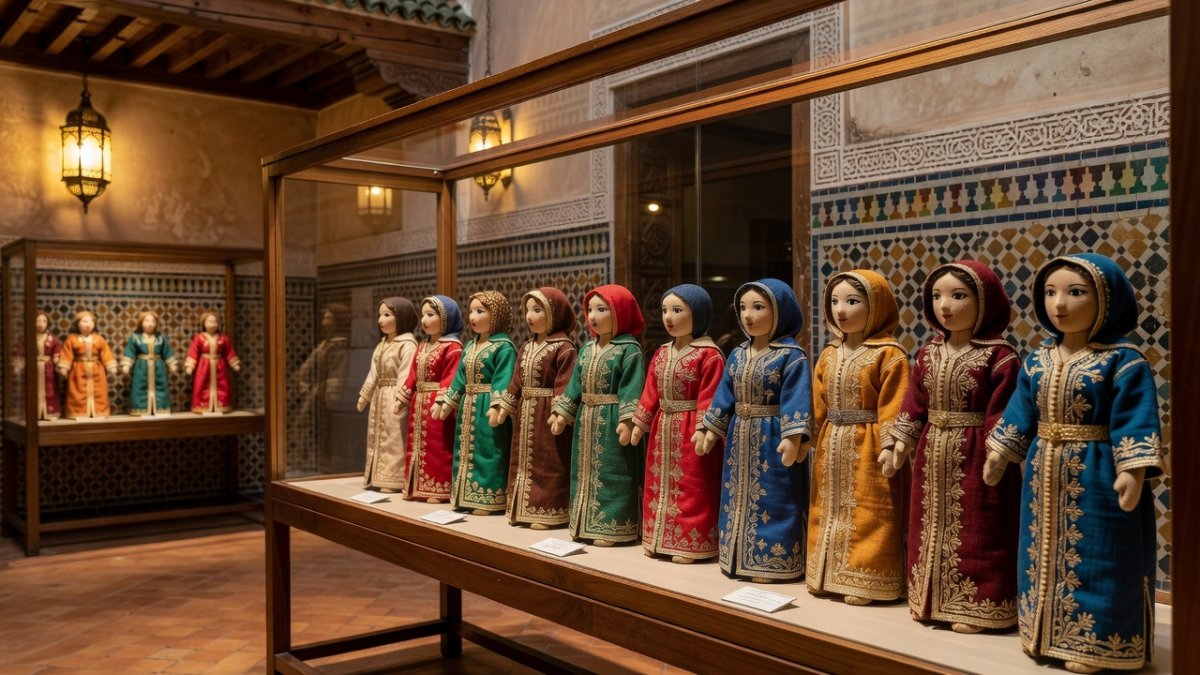
Step into the main exhibition rooms of the riad, and you are immediately confronted with the sheer scale of the collection. Roughly 2,500 dolls fill the display cabinets, each one dressed in traditional attire that captures a snippet of culture, tradition, and way of life from every corner of the globe. From the intricate embroidery of Eastern European folk costumes to the vibrant textiles of Latin American fiestas, from the flowing robes of the Middle East to the distinctive silhouettes of Asian ceremonial dress, the collection is a whirlwind tour of human creativity.
The dolls represent 90 countries, a number that speaks to decades of travel, exchange, and patient accumulation. Each figure is a miniature study in cultural identity, and as the museum's owner Abdeljalil Haffar explains, these dolls "tell a lot just by standing still in display cabinets through their outfit, their headdress and even what they are carrying." A doll from one region might hold a tiny musical instrument; another might carry a miniature basket or tool, each object adding another layer of meaning to the overall portrait.
What makes this collection particularly special is its attention to the details of everyday life rather than just ceremonial occasions. While many dolls wear festive or formal attire, others depict ordinary people going about their daily routines — farmers, traders, mothers, children. This democratic approach to representation means that the museum offers not just a collection of beautiful objects but a sociological record of how people across the world have dressed, worked, and celebrated throughout recent history.
The museum's official French name, "Poupées Du Monde," translates simply to "World Dolls," and that simplicity is part of its charm. There is no grand thesis being argued here, no complex curatorial statement. Instead, the collection operates on a more fundamental level, appealing to the universal human instinct to create miniature versions of ourselves and our world. Children instinctively understand this; adults rediscover it when they enter the museum's quiet rooms.
Haffar's own words capture the essence of the project: "This museum represents heritage as well as the diversity of the world." That dual mission — preserving heritage while celebrating diversity — gives the collection a significance that extends far beyond its aesthetic appeal. In an era of globalization and cultural homogenization, the museum stands as a testament to the persistence of distinct traditions and the beauty of human difference.
A Family Story, A Lifetime of Collecting
Behind every great collection lies a personal story, and the Poupées du Monde museum is no exception. The museum is the creation of Abdeljalil and Marie Michèle Haffar, a Franco-Moroccan couple whose shared passion for dolls began in the most personal of ways. The oldest doll in the collection is not a rare antique purchased at auction or a museum-quality artifact acquired from a dealer; it is a gift to Haffar's wife from her grandmother, presented when she was just 5 years old.
That single doll, given in love and received with childhood wonder, planted the seed for what would become a lifelong collecting journey. As the couple traveled the world, they began acquiring dolls from the places they visited, each one serving as a tangible memory of their journeys and the people they encountered along the way. What started as a personal memento collection gradually grew into something far more significant, a comprehensive survey of global dress and tradition.
The collection expanded through a wonderfully organic process. The couple's children, growing up surrounded by dolls from every continent, added their own contributions. Friends and coworkers, aware of the family's passion, began bringing back dolls from their own travels. Over the years, this network of family, friendship, and professional connection transformed what might have remained a private collection into something approaching a comprehensive cultural archive.
Opening the museum to the public in 2019 was a natural next step for the Haffars, a way of sharing their accumulated treasures with a wider audience. The decision reflected a generosity of spirit that characterizes the entire project — a desire not to hoard beauty but to share it, not to keep the world's diversity locked away but to put it on display for anyone who cares to look. The museum thus became a gift from one family to the world.
The personal and emotional dimension of the collection is palpable throughout the museum. These are not cold artifacts displayed for scholarly analysis; they are objects with biographies, each one connected to a specific moment of acquisition, a specific person, a specific memory. Visitors often sense this warmth, responding to the collection not just as an exhibition but as an act of love made tangible.
Education and Discovery for Young Visitors
Among the many visitors who have found their way to the Poupées du Monde museum is Mohammed Lahrach, who came with his teenage son Haytham. For Lahrach, the visit was an opportunity for his son to "discover the whole world" through a very particular exhibition — one that presents global culture in a form accessible to young people. The museum's approach to education is gentle and intuitive, allowing children to learn through visual exploration rather than didactic instruction.
The museum actively supports this educational mission through hands-on activities designed for younger visitors. Children are invited to engage in drawing or crafting simple dolls, activities that connect the act of looking with the act of making. This pedagogical approach recognizes that understanding comes not just through observation but through creation, and that children learn best when they are actively involved in the process.
Accessibility is clearly a priority for the museum's founders. Entry costs about 20 Moroccan dirhams for adults and 10 for children — roughly two dollars and one dollar respectively — making it one of the most affordable cultural experiences in Rabat. The museum is open Monday to Thursday from 10:00 to 19:00 and on weekends during the same hours, closed on Fridays, a schedule that accommodates both tourists and local families.
The response from visitors has been overwhelmingly positive. The museum consistently earns ratings of about 4.9 out of 5 stars from hundreds of online reviews, a remarkable achievement for any cultural institution. Reviewers frequently comment on the warmth of the welcome, the beauty of the collection, and the unique atmosphere of the riad setting. Many describe the museum as a highlight of their visit to Rabat, a hidden gem they feel privileged to have discovered.
For young visitors like Haytham, the museum offers something increasingly rare in the digital age: a direct, unmediated encounter with physical objects from around the world. In an era when children can access images of anything instantly on a screen, there is something profoundly valuable about standing before a doll from a distant country, examining the stitches in its clothing, wondering about the hands that made it. That tangible connection is what makes the museum's educational mission so important.
Morocco's Cultural Heritage Moment
The Poupées du Monde museum does not exist in isolation; it is part of a broader cultural heritage momentum that has been building across Morocco in recent years. Rabat's medina belongs to the UNESCO World Heritage Site "Rabat, Modern Capital and Historic City," a designation that recognizes the unique layering of history visible throughout the city. The museum adds to this heritage landscape, offering a different kind of cultural experience than the monuments and archaeological sites that typically draw visitors.
Morocco has been particularly active in securing international recognition for its cultural traditions. The Moroccan caftan, a garment of extraordinary artistry and significance, has been inscribed on UNESCO's Intangible Cultural Heritage list, acknowledging the art, traditions, and skills involved in its creation. This recognition matters because it validates the importance of living traditions, the crafts and practices that continue to shape Moroccan identity in the present day.
Initiatives like Morocco's Night of Museums have further strengthened the country's cultural sector, inviting young people to explore their roots free of charge. These programs recognize that heritage preservation requires active engagement from younger generations, and that making cultural institutions accessible and appealing to youth is essential for long-term sustainability. The Poupées du Monde museum, with its family-friendly atmosphere and affordable entry, aligns perfectly with this vision.
Across the African continent, similar conversations are taking place about the importance of cultural preservation and the growth of cultural tourism. From Dakar to Lagos to Accra, museums and heritage spaces are being reimagined as dynamic centers of education and community engagement rather than static repositories of the past. The Poupées du Monde museum offers a model of how private collections can contribute to this movement, preserving traditions that official institutions might overlook.
The museum's significance extends beyond Morocco's borders. In a continent where many cultural artifacts were taken during colonial periods and remain in European museums, the act of preserving and displaying heritage on African soil carries particular weight. The Poupées du Monde museum, while international in its scope, participates in this broader project of cultural self-determination, demonstrating that Africans can be custodians of world heritage, not just subjects of it.
What to Watch For
The Poupées du Monde museum's reputation as a hidden gem continues to grow, drawing cultural tourists who seek authentic experiences beyond the standard itinerary. The museum was featured by Africanews with the Associated Press, bringing its story to an international audience and cementing its status as a must-visit destination for those interested in the intersection of craft, culture, and collection. As word spreads, the museum seems poised to become an essential stop on any cultural tour of Rabat.
The success of this family-run institution raises intriguing possibilities for similar private heritage collections across Africa. Across the continent, families and individuals have accumulated collections of textiles, masks, musical instruments, and other cultural objects that could form the basis of new museums. The Haffars' example demonstrates that such collections can be transformed into public resources, preserving traditions that official institutions might miss and offering intimate, personal perspectives on cultural heritage.
Family-run museums like this one play a crucial role in the broader heritage ecosystem. They preserve traditions that might otherwise be lost, they offer alternative narratives to those presented by larger institutions, and they create spaces for personal connection with cultural objects. The Poupées du Monde museum embodies all of these qualities, standing as a testament to what can be achieved when passion, persistence, and generosity combine.
The couple's ongoing mission to share their collection shows no signs of slowing. Each visitor who walks through the riad's door becomes part of the museum's continuing story, adding to the network of connections that radiates outward from this quiet corner of Rabat's medina. The museum is not a finished project but a living one, growing and evolving with each new encounter.
Why do dolls in traditional dress matter as a record of human culture? Because they capture something essential about how people present themselves to the world, how they mark their identities, how they celebrate their distinctiveness. In an age of increasing uniformity, these tiny figures preserve the beautiful diversity of human expression. They remind us that the world's richness lies in its differences, and that those differences deserve to be celebrated, preserved, and shared.
For African readers, the invitation is simple: visit this museum if you find yourself in Rabat, and support local heritage spaces wherever you are. The Poupées du Monde museum demonstrates that cultural preservation does not require vast resources or institutional backing — it requires vision, dedication, and the willingness to share what you love. In that sense, the museum is not just a collection of dolls; it is a model for how we might all engage with the heritage that surrounds us, preserving the past for the benefit of future generations.
By Amara Diop, Staff Writer
This article was produced with AI-assisted research and editorial support. Reporting is based on sources cited in the article.
What's Your Reaction?
 Like
0
Like
0
 Dislike
0
Dislike
0
 Love
0
Love
0
 Funny
0
Funny
0
 Wow
0
Wow
0
 Sad
0
Sad
0
 Angry
0
Angry
0

West Africa/Sahel Correspondent at Global1.News. Dakar-based journalist covering politics, security, climate, and development across Francophone and Anglophone West Africa. Tells the stories of a region undergoing profound transformation.












Comments (0)