
Nepal-China Floods Death Toll Tops 1,000 as Mass Burials Begin and Rescue Crews Search Hydropower Tunnels
Nepal-China flash floods death toll tops 1,000 with 4,400 missing. Mass burials underway, 900 workers missing in hydropower tunnels, and 80 Americans unaccounted for as climate-driven glacial avalanche devastates the region.
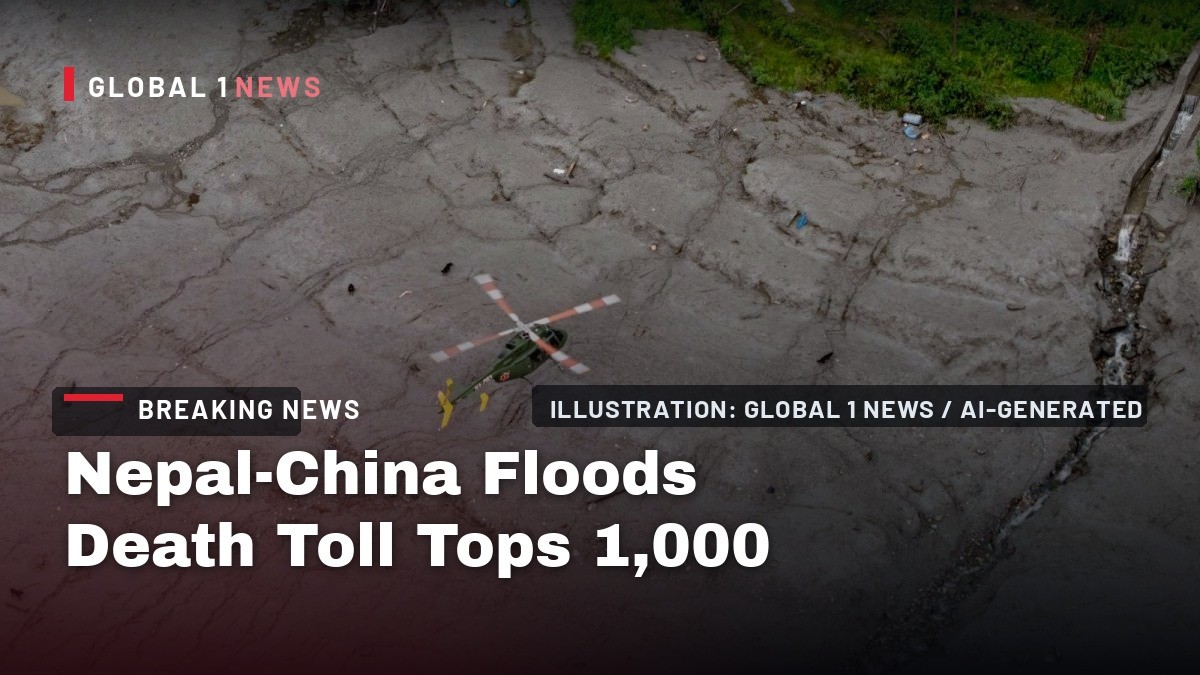
The death toll from last week's catastrophic flash floods along the Nepal-China border has surpassed 1,000, with more than 4,400 people still unaccounted for across both countries, according to officials. In Nepal alone, the death toll has risen to 987, as confirmed Tuesday morning by Nepal's National Disaster Risk Reduction and Management Authority (NDRRMA). The number of missing in Nepal has fallen to 3,916, while 11,814 people have been rescued so far. On the Chinese side of the border, at least 16 people have died, state broadcaster CCTV reported Sunday, with at least 546 people still missing.
The disaster, triggered by what Nepal's Prime Minister Balendra Shah described as "a glacial avalanche involving ice and rock in the Himalayan area," unleashed a wave of ice, mud, and water that obliterated border facilities, swept away entire communities, and left families desperately searching for loved ones. The scale of destruction is staggering: a single water tower is the only structure still standing in the Gyirong port area on the China-Nepal border, according to Chinese state media, and satellite imagery shows the border facility was largely destroyed by the force of the surge.
Mass Burials Underway as Morgues Overwhelmed in Nepal
Authorities in Nepal have begun burying hundreds of unidentified victims in a mass grave deep in the jungle outside Bharatpur, after catastrophic flooding overwhelmed morgues and left families unable to reach their loved ones. The policeman in charge of the mass grave site told CNN that more than 200 bodies had been buried there that day alone. The grim task reflects the immense challenge of identifying victims who spent days in the river, leaving many bodies in a condition that makes identification extremely difficult.
At the Nepal Poultry Entrepreneurs Forum office in Bharatpur, Sub Inspector Hari Sharan Dhakal faces the heartbreaking task of reuniting families with the bodies of their missing loved ones. There are 837 names on his list, along with addresses and family contact details. Dhakal told CNN that sometimes the photos of the deceased are "totally different" from the photos authorities have taken, and many victims have lost their clothes, making tattoos more important identifiers. In a small mercy, school ties found on the bodies of some children have provided a first clue to tracking down their families. Recovery teams are searching along 70 kilometers of riverbank, coordinating with hospitals around the country and taking DNA samples. "People come to us crying. We feel their pain," Dhakal said.
24 Bodies Recovered From a Single House in Bidur
In a particularly harrowing discovery, authorities have recovered 24 bodies from a single house in Nepal's flood-hit Bidur area, according to Superintendent of Police Bipin Regmi. "We suspect still more bodies buried there," Regmi said. Among the bodies buried under the mud was one child, while the rest were adults, according to Mangal Tamang, a Betrawati municipal official. Six bodies had been airlifted to Kathmandu. The recovery underscores the sudden and violent nature of the flooding, which trapped people inside their homes with little or no warning.
Rescue Crews Race Against Time Inside Hydropower Tunnels
Rescue crews and foreign specialists have been racing to find workers feared trapped inside tunnels at hydropower projects along the Trishuli river. Around 900 workers remain missing overall, with thick mud burying the facilities after the avalanche-triggered flood surge. At least 93 people are missing at the Rasuwagadhi Hydropower Project, according to Nepal's Independent Power Producers' Association. However, crews on Monday reported "no signs of human presence" at the site, according to the prime minister's office, raising fears that the workers may have been entombed in the mud.
The tunnels, which run deep into mountainsides along the river, were inundated with a thick slurry of ice, mud, and debris that hardened as it settled. Foreign specialists have been brought in to assist with the technical challenges of tunneling through the hardened material, but progress has been slow. The disaster has also disrupted power supply — in Nepal's badly-hit Rasuwa District, power has been restored to only around 30% of households, according to the prime minister's statement.
China Sends DNA Experts to Aid Identification Efforts
China will send DNA identification experts to Nepal, foreign ministry spokesperson Guo Jiakun said during the ministry's regular press briefing on Tuesday. China will also be sending DNA testing equipment, drones, and water purification equipment among other items needed urgently. The assistance comes as both countries grapple with the challenge of identifying victims and accounting for the missing — a task made harder by bodies that have been in the river for days.
On the Chinese side of the border, the destruction at the Gyirong crossing has been total. CCTV reported late Monday night that emergency repair works remain challenging — excavators are finding it difficult to maneuver due to narrow paths, days of constant rainfall has caused rockfalls, and observation posts with safety officers have been set up every 10 meters to monitor the unstable terrain. The destruction at Gyirong, a major transit point for pilgrims and traders, has effectively severed a key land route between the two countries.
Over 1,000 Foreign Nationals Missing, Including Roughly 80 Americans
Nepal's tourism department has published a list of the names of 583 foreigners who are missing following the devastating flash floods. Citizens of 38 countries, including the US, are represented among the missing. At least 461 foreigners from 23 countries are unaccounted for on the Chinese side of the border. Combined, the numbers represent over 1,000 foreign nationals. Approximately 80 Americans remain missing in "the Nepal/China cross-border region," a State Department spokesperson told CNN on Monday, adding that 13 American citizens have made their way to safety in Nepal.
The missing include many who were on religious pilgrimages to Mount Kailash in Tibet. Bina Parikh, an avid traveler, is among the dozens of American citizens missing, according to her daughter Kavita, who joined a WhatsApp group of Americans whose loved ones are unaccounted for. Srishti Agrawal, a Purdue University PhD student in Indiana, is holding onto hope that her 14-year-old cousin Rashi and her aunt Rekha will be found. "It feels like the days are longer than ever. I don't think I've slept more than three hours every day," Agrawal told CNN. None of the pair's fellow travelers have been found.
Australian Victim Confirmed Among Those Killed
The partner of an Australian man who was in Nepal at the time of the flash flooding has confirmed his death. Michael Keats, from New South Wales, is believed to have been returning from a trip to Mount Kailash in Tibet when he was killed. His partner Emily Boyd said Keats was "an incredibly important part of our family" and "his loss has changed everything" for her and her young son. Keats was a follower of Indian spiritual leader Jagadish Vasudev, known as Sadhguru, and is believed to have been one of 11 Australians on a trip organized by the Isha Foundation.
The group was at the Gyirong immigration center when floodwaters surged through the building and much of the town. The group consisted of 77 foreigners, including 22 Americans, 12 Canadians, nine Britons and others from Germany, France and other nations, as well as three Nepali volunteers. Keats was one of 43 Australians caught in the disaster, according to Australian Foreign Minister Penny Wong, who said confirming any deaths was "challenging at this time."
Prime Minister Shah: 'One of the Largest Disasters in This Region'
Nepal's Prime Minister Balendra Shah said Monday that relief efforts are intensifying and that thousands of people have so far been rescued. "As of a short while ago, 11,379 people had been rescued, while 3,925 people remain unaccounted for. The number of missing or unaccounted-for people continues to fluctuate," Shah said. Supplies had reached nearly 3,700 people. Shah described last week's flooding as "one of the largest disasters in this region," triggered by "a glacial avalanche involving ice and rock in the Himalayan area," and directly linked the disaster to the changing climate, stating that "the risks we face in the Himalayan region are increasing alongside climate change."
Nepal — home to thousands of glaciers which are melting and becoming increasingly unstable as the region rapidly warms — is particularly vulnerable to climate change. The country accounts for less than 0.1% of global planet-warming gases, yet it is bearing the brunt of a warming world. Scientists have long warned that the Hindu Kush Himalaya region is warming faster than the global average, making glacial lakes and ice formations increasingly unstable. The avalanche that triggered this disaster is a stark example of the new risks emerging in the world's highest mountain range.
UN: Tens of Thousands Require Urgent Aid, Children at Risk
Tens of thousands of people in Nepal require urgent aid, according to figures announced by the United Nations. "Some 65,000 people require emergency water, sanitation, hygiene support. More than 22,000 children need protection. 2,600 children under five are expected to need treatment for severe wasting. And around 10,500 pregnant and breastfeeding women need nutrition assistance," UN Spokesperson Stephane Dujarric told a press conference in New York on Monday.
At least 107 children have been separated from their parents or caregivers in the flood's aftermath, and 10,000 require "psychosocial support," according to the UN. "Family tracing and reunification is now an urgent priority," Dujarric said. The floods damaged at least nineteen schools in Nepal, destroying nine completely, which will have long-term implications for children's education and recovery.
Stories of Resilience Amid the Devastation
Amid the tragedy, stories of survival and heroism have emerged. Priya Adhikari, Nepal's first female helicopter pilot, has flown around 100 missions in less than a week to rescue survivors from hard-hit areas. She spoke to CNN's Anderson Cooper about the search effort: "We are trained for this." Her efforts have been instrumental in reaching communities cut off by destroyed roads and bridges.
Five-year-old Manisha Magar was presumed dead after she was swept away by the catastrophic flooding. Then her parents saw video footage of her rescue. Her father Lok Bahadur Uchai Magar wiped away tears and told CNN's Will Ripley, "She's my child. That's all I can say." She was rescued more than two days after their home was swept away. As the search continues and the death toll rises, the people of Nepal and the international community are left to grapple with the scale of the tragedy and the growing reality of a warming Himalaya.
This article was produced with AI-assisted research and editorial support. Sources: CNN, BBC, Reuters, Al Jazeera, The Guardian, DW, France 24, Nepal's National Disaster Risk Reduction and Management Authority, United Nations.
By Jessica Ali, Staff Writer
What's Your Reaction?
 Like
0
Like
0
 Dislike
0
Dislike
0
 Love
0
Love
0
 Funny
0
Funny
0
 Wow
0
Wow
0
 Sad
0
Sad
0
 Angry
0
Angry
0

Editor-in-Chief at Global1.News. Atlanta-based journalist who cuts through the BS and tells it like it is. Lead anchor, host, and the voice you hear when the spin stops and the truth starts.











Comments (0)