
Microsoft's $280 Billion Just Bought 2.2 Million Chips — Here's Where the Rest Went
A Guardian investigation into Microsoft's internal documents found roughly 2.2 million AI chips installed after $280 billion in spending — far fewer than its public capacity claims imply. A hosting founder on the announced-versus-installed gap and where the money actually went.
Microsoft's $280 Billion Just Bought 2.2 Million Chips — Here's Where the Rest Went
Let me tell you something that's been rattling around my head since the Guardian's investigation landed on Monday. Microsoft — the company that has spent more money on AI infrastructure than almost anyone on earth — has roughly 2.2 million AI chips installed worldwide, according to its own internal documents. Two point two million. After about $280 billion in spending since 2022. Do that division in your head and you'll get the same number I got: that's about $127,000 per chip. And a brand-new H100 doesn't cost $127,000. Neither does a B200.
I've been running hosting infrastructure for over a decade. I've priced servers, built data centers, waited on power upgrades, and watched capital get poured into concrete. So when I see a number like that — $280 billion against a couple of million chips — I don't conclude that Microsoft overpaid for GPUs. I conclude that the GPUs are the smallest part of the story. And that's the part this industry refuses to talk about.
The News — A Leak From Inside the Machine
Here's what the Guardian reported Monday, citing internal Microsoft documents it reviewed: the company has approximately 2.2 million AI chips installed across its global fleet after spending roughly $280 billion since 2022 on land, buildings, computing infrastructure, and related expansion — including more than $41 billion in the past quarter alone.
Two details give the number its shape. An internal target reportedly called for 1.8 million chips installed by the end of 2024 — which means the fleet grew by only about 400,000 in the year and a half since. And the newest parts are thinner on the ground than planned: fewer than 500,000 Blackwell accelerators installed, against roughly a million anticipated. An Nvidia specialist quoted in the piece said the figures were lower than expected.
Microsoft's response was that the calculations are inaccurate and draw the wrong conclusions from incorrect assumptions. Notice what the company did not say. It did not say which figures are wrong. When a company disputes a number without correcting it, that's not the same thing as the number being wrong.
The Math That Doesn't Divide — $280 Billion vs 2.2 Million Chips
Set the dispute aside and look at the ratio, because that's where the real story lives. Two hundred eighty billion dollars of capital expenditure against a couple of million accelerators does not divide into anything resembling a chip price. Even at the most generous per-unit assumptions, the accelerators are a minority of that spend.
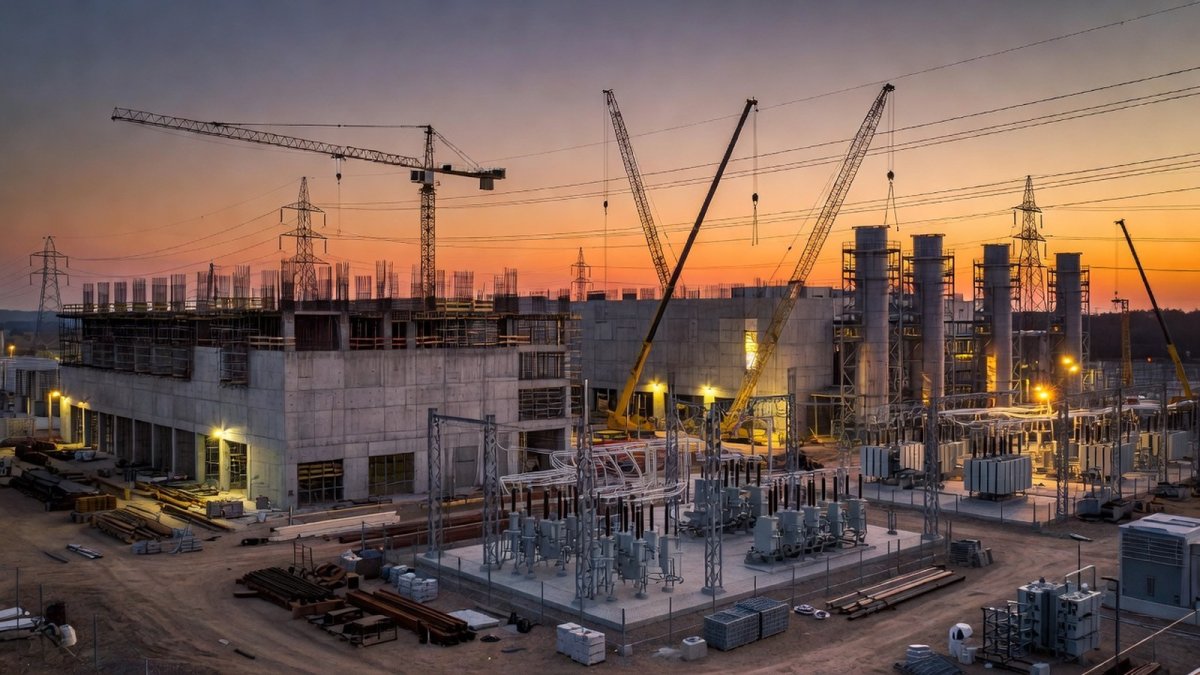
So where did the rest go? Land. Buildings. Substations. Cooling plant. Fiber. Backup power. Networking. Security. The boring, unglamorous, slow-moving physical layer that every chip has to sit inside before it can do a single calculation. The chips are the part everyone counts because they're the part with a name and a launch date. They are not the part that takes the time.
That's the insight hiding inside this story, and it inverts three years of conventional wisdom. The intuitive narrative has been that accelerators are scarce and everything else is a formality. The operational reality is closer to the opposite. Fabs can respond to demand in quarters. A substation, an interconnection agreement, a commissioned building, and a cooling loop respond in years — and they respond to regulators and utilities, not to purchase orders.
The Two Readings — Vocabulary, or Inflated Claims
There are two ways to read this, and both are defensible.
The first reading is the charitable one: the gap is vocabulary, not fraud. In this industry, "capacity" can mean five different things — announced capacity, contracted capacity, built capacity, energized capacity, and commissioned IT capacity — and those numbers can differ by a factor of several. Press releases almost never specify which one they mean. Microsoft says it added roughly five gigawatts of data center capacity in two years. A 2024 internal presentation reportedly indicated five gigawatts already installed at that point, which would put the total near ten gigawatts today. Maybe that's all true, and the chip count just reflects reality: power and buildings gate deployment, not chip supply. Satya Nadella has said as much on the record — the biggest issue is not a compute glut but power, and the company can end up with chips sitting in inventory it cannot plug in for lack of warm shells.
The second reading is the one that should worry you. Microsoft's own sustainability reporting, according to the Guardian, points to something closer to 1.2 gigawatts of AI capacity in 2024 — not five, not ten. Professor Shaolei Ren, quoted in the piece, argues the sustainability filings are the more credible source, because they are prepared for regulators rather than for a keynote. If that's right, the public capacity claims are overstated by a factor of four or five, and the market has been financing announced capacity while installed capacity lags far behind. That's not a rounding error. That's the "riskier phase" Todd Ahlsten warned about last week, suddenly given a hard number.
The Secondary Bottleneck Nobody's Talking About — Concrete and Copper, Not Silicon
Here's the angle nobody's covering: the binding constraint on the AI buildout was never really the chips. It's civil engineering. The slowest element in the entire supply chain is not a fab — it's a substation. It's a transmission interconnection. It's a building shell with power, cooling, and fiber actually commissioned and turned on.
That's why chips end up sitting in inventory. That's why a fleet can grow more slowly than the capital spend suggests. And it's why the announced-versus-installed gap matters: the market has been pricing the buildout on announcement dates, while the buildout itself moves at the pace of permit hearings, utility studies, and construction crews. Every gigawatt of "announced" capacity is really a multi-year pipeline of concrete, copper, and regulatory approvals — and only a fraction of it is ever energized on schedule.
Think about what that means for the financing machine. When Nvidia and the big money funds are lending against data center projects, they're underwriting announced capacity. The Guardian's reporting just showed, from inside one of the biggest spenders, that installed reality trails announced ambition by a wide margin. That gap is the hidden risk in every AI infrastructure loan, every lease, every power purchase agreement — and it's not priced into any of them.
What This Means for Independent Hosting Providers
If you run an independent hosting or cloud business, this story is a gift. Here's what I'd do with it.
First, when any provider quotes you capacity, ask which of the five capacities they mean — announced, contracted, built, energized, or commissioned. Then ask specifically what is energized and commissioned today, in the region you need. The answer is usually available. It is rarely volunteered.
Second, plan on the assumption that large contiguous accelerator allocations stay scarce and regionally uneven through the next planning cycle. The constraint is being built out of concrete and copper, not silicon — and nobody is pouring concrete faster because you asked nicely.
Third, recognize that power and building access are your moat. If you have energizable power, a commissioned shell, and cooling, you have the scarcest resource in the AI economy — regardless of what GPU generation is in fashion. That's the asset to protect and the asset to sell.
Fourth, watch the announced-versus-installed gap as the honest scoreboard of this buildout. Every time an internal number leaks or a sustainability filing contradicts a press release, the market reprices the announced backlog. The operators who plan on installed reality — not announced ambition — are the ones who survive the repricing.
The Bottom Line
Microsoft's $280 billion didn't go missing. It went into the ground — into the substations, the shells, the fiber, the cooling, the land that every chip has to sit inside before it's worth anything. The chips were never the bottleneck. They were just the part with the launch date.
That's the truth this industry has been avoiding: the AI buildout is a civil engineering project wearing a technology costume. The sooner investors, lenders, and operators start measuring it in commissioned megawatts instead of announced gigawatts, the fewer surprises there will be when the next internal document finds its way to a reporter.
Check your own capacity math before someone checks it for you. That's not paranoia. That's just good infrastructure sense.
— Allan Ali, Founder
This article was produced with AI-assisted research and editorial support. Sources: The Guardian (Aug 17, 2026), PeopleAreGeek analysis of the Guardian reporting (Aug 17, 2026), insidetelecom (Aug 18, 2026), Aroged (Aug 18, 2026).
What's Your Reaction?
 Like
0
Like
0
 Dislike
0
Dislike
0
 Love
0
Love
0
 Funny
0
Funny
0
 Wow
0
Wow
0
 Sad
0
Sad
0
 Angry
0
Angry
0

Publisher of Global1.News. Automation architect, systems builder, and the guy making sure the truth gets published.














Comments (0)