
Mexico's Foreign Trade Shatters Records in July, Powered by AI-Driven Electronics Boom
Mexico's Foreign Trade Shatters Records in July, Powered by AI-Driven Electronics Boom Mexico's foreign trade reached an unprecedented milestone in July 2026, with both monthly exports and imports surpassing US$80 billion for the first time in the nation's history. According to data released Thursday by INEGI, the National Institute of Statistics and Geography, merchandise exports hit a record US$81.42 billion, a...
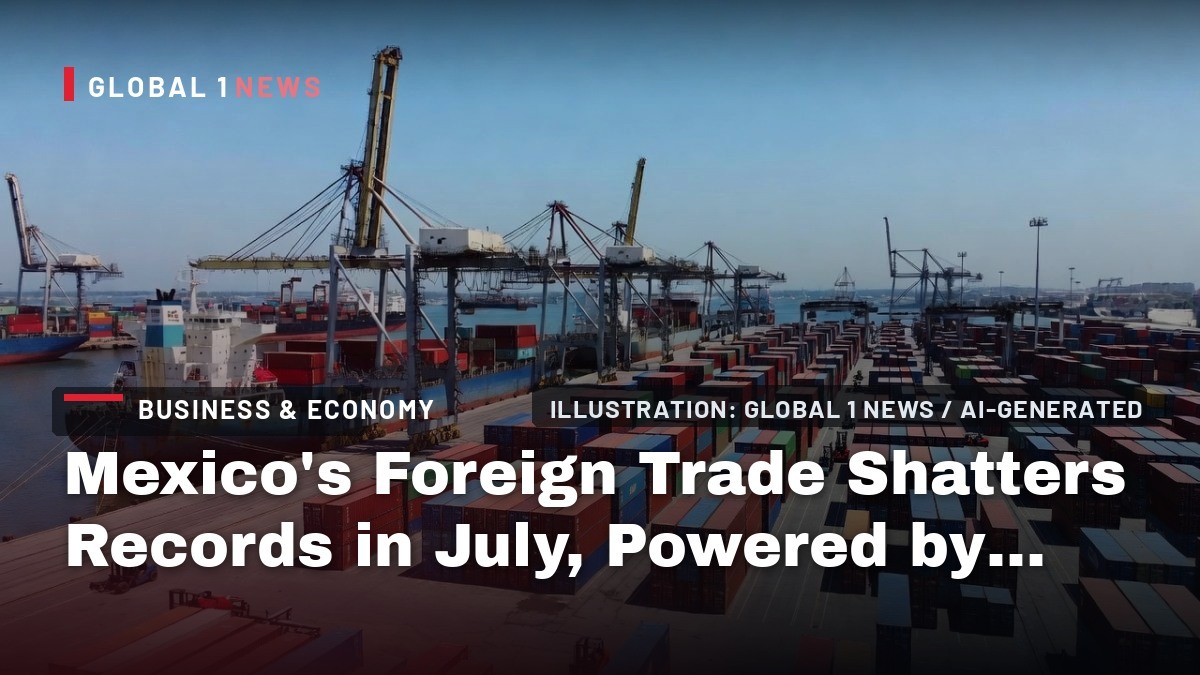
Mexico's Foreign Trade Shatters Records in July, Powered by AI-Driven Electronics Boom
Mexico's foreign trade reached an unprecedented milestone in July 2026, with both monthly exports and imports surpassing US$80 billion for the first time in the nation's history. According to data released Thursday by INEGI, the National Institute of Statistics and Geography, merchandise exports hit a record US$81.42 billion, a staggering 43.7% increase compared to July 2025. This marks the strongest annual expansion since June 2021 and the largest increase since at least 1993, when excluding the statistical rebounds of 2021 and May 2010.
The numbers tell a story of a nation transformed by the global race to build artificial intelligence infrastructure. Imports also reached a historic high of US$82.27 billion, up 45% year-over-year, creating a rare monthly trade deficit of US$847.5 million. This shift comes after a robust trade surplus of US$4.06 billion was recorded in June 2026. For families and workers across the republic, from the maquiladora corridors of the north to the industrial parks of the Bajío, these figures represent real wages and real economic activity, even as the deficit raises questions about the sustainability of this explosive growth.
The data arrives at a critical moment for Mexico's economy, as officials prepare for the fourth round of joint negotiations for the review of the USMCA, scheduled for the first week of September in Washington. The talks proceed against a backdrop of breakdown in negotiations between the United States and Canada within the same framework, plus an escalation of implemented and announced tariffs between those two nations. For Mexico, the record trade numbers provide both leverage and a reminder of the deep integration that now defines North American commerce.
Manufacturing Leads the Charge with Historic Gains
Manufacturing was the undisputed core engine of Mexico's export surge, totaling US$76.31 billion in July, a 45.7% increase year-over-year. Within this sector, the non-automotive manufacturing segment surged an extraordinary 64.9% to nearly US$60 billion, accounting for about 73% of total foreign sales. This is not merely a statistical blip; it reflects a structural shift in what Mexico produces and sells to the world, moving beyond traditional assembly into higher-value components and finished goods.
The most dramatic growth came from electrical and electronic equipment and appliance exports, which soared 134.0% compared to July 2025. This category, which includes everything from semiconductors to data center components, is the clearest evidence of the AI investment boom reshaping global supply chains. Other sectors also posted solid gains: mining and metallurgy rose 27.3%, machinery and special equipment increased 13.9%, and plastic and rubber products grew 13.3%. Even the automotive industry, long the crown jewel of Mexican manufacturing, managed a modest 2.4% expansion, though its performance lagged far behind the electronics juggernaut.
Enrique Covarrubias, chief economist and director of analysis at Actinver investment bank, told El Financiero that the data reflects a profound shift in North American production dynamics. "This data reflects a context wherein U.S. companies are demonstrating high demand for inputs to develop data centers associated with artificial intelligence," Covarrubias said. "It also comes at a time when the United States is tightening trade restrictions on the import of such inputs from Asian partners." Analysts at Grupo Financiero Monex concurred, saying the advance was driven by greater dynamism in non-automotive manufacturing, where shipments of electrical and electronic equipment and machinery stood out.
US Market Dominance Deepens as Non-Oil Exports Surge
Mexico's reliance on and integration with the United States market deepened further in July. Non-oil exports to the United States, which account for 84.5% of total exports, surged 49.8% year-over-year, improving on the already strong 35.9% growth recorded in June. This acceleration suggests that U.S. companies are increasingly turning to Mexican suppliers as they diversify away from Asian sources, a trend that has been building since the trade tensions of the previous administration but has now reached a fever pitch with the AI infrastructure buildout.
The concentration of exports to the U.S. market carries both opportunities and risks for Mexican workers and businesses. For the thousands employed in electronics plants in cities like Guadalajara, Monterrey, and Tijuana, the surge means more shifts, more hiring, and more economic security. But it also means that Mexico's economic fortunes remain tightly tied to the health of the U.S. economy and the political winds in Washington. The upcoming USMCA review talks will be crucial in determining whether this trade relationship remains stable or faces new frictions.
Automotive exports to the United States rose 3.7%, while shipments to non-US markets contracted 3.9%. This divergence highlights the growing importance of the North American market relative to the rest of the world. For Mexican auto workers in states like Guanajuato, Puebla, and Coahuila, the modest growth is a reminder that even the most established industries are being reshaped by the broader forces of trade policy and technological change.
Oil Sector Slows While Agriculture Faces Headwinds
Not all sectors shared in the July boom. Oil exports slowed dramatically to just 6.8% year-over-year growth, down from 42.6% the previous month. Oil exports totaled US$1.99 billion, comprising US$1.19 billion in crude and US$800 million in other petroleum products. The average price of the Mexican crude export mix was US$75.12 per barrel, down US$7.18 from June 2026 but still up US$12.12 versus July 2025. Export volume averaged 510,000 barrels per day, down from 648,000 in June and 692,000 in July 2025, reflecting ongoing challenges at PEMEX and the broader decline in Mexican oil production.
The oil trade deficit widened from US$3.40 billion in June to US$3.66 billion in July, as Mexico continues to import more refined products than it exports. This persistent imbalance remains a structural weakness for the Mexican economy, even as other sectors surge. For the communities dependent on PEMEX operations in states like Tabasco, Campeche, and Veracruz, the declining volumes are a source of concern, even as the rest of the economy booms.
Agriculture was the only major category to decline, with agricultural and fishing exports falling 8.6% year-over-year to US$1.32 billion. However, there were bright spots within the sector: fresh vegetables and legumes rose 20.2%, and peppers increased 16.5%. For campesinos and agricultural workers across the country, these mixed results reflect the ongoing challenges of climate variability, water scarcity, and competition in international markets. The decline in overall agricultural exports, even as other sectors surge, underscores the uneven nature of Mexico's economic transformation.
Import Surge Reflects Industrial Appetite for Inputs
The record import figures tell a complementary story of industrial expansion. Intermediate goods — the inputs, components, and materials used in manufacturing — rose 56.3% year-over-year to US$67.13 billion, representing more than 80% of all goods imported. Non-oil intermediate goods grew 57.7%, indicating that Mexican factories are importing more components to feed their export machines. This pattern is typical of a country deeply integrated into global supply chains, where goods cross borders multiple times before reaching final consumers.
Despite the monthly deficit, the year-to-date picture remains strongly positive. From January through July 2026, Mexico has accumulated a trade surplus of US$9.26 billion, nearly eight times the US$1.18 billion surplus recorded in the same period last year. This suggests that the July deficit may be a temporary phenomenon, driven by a surge in investment-related imports rather than a fundamental deterioration in Mexico's competitive position. For policymakers in the Palacio Nacional, the challenge will be to ensure that these imported inputs translate into lasting productive capacity.
The non-oil trade surplus narrowed from US$7.46 billion in June to US$2.81 billion in July, reflecting the surge in intermediate goods imports. This narrowing is not necessarily a negative sign; it often indicates that companies are stocking up on components to meet future export orders. For the Sheinbaum administration, which has made nearshoring and industrial development central pillars of its economic strategy, the July data provides powerful evidence that the strategy is working, even as it brings new challenges of managing trade balances and ensuring that growth translates into broad-based prosperity.
USMCA Review Looms Over Record Trade Numbers
The record trade figures come at a delicate moment for North American trade relations. Officials are preparing for the fourth round of joint negotiations for the review of the USMCA, scheduled for the first week of September in Washington. The talks follow a breakdown in negotiations between the United States and Canada within the same framework, plus an escalation of implemented and announced tariffs between those two nations. Mexico, for now, appears to be the favored partner, but the volatility of the situation demands caution.
For Mexican businesses and workers, the stakes could not be higher. The USMCA review will determine the rules of the game for years to come, affecting everything from automotive rules of origin to digital trade provisions. The AI-driven boom in electronics manufacturing has made Mexico more valuable to the United States than ever before, but it has also made Mexico more dependent on continued U.S. demand. The negotiations will test whether this interdependence translates into a more stable and predictable trading relationship.
As the September talks approach, the record trade numbers provide a powerful backdrop. Mexico can point to its role as a reliable, high-quality supplier of the components that power the AI revolution. But the challenges remain significant: the persistent oil trade deficit, the decline in agricultural exports, and the concentration of trade with a single partner all represent vulnerabilities. For the communities across Mexico that depend on trade for their livelihoods — from the electronics workers of Jalisco to the farmers of Sinaloa — the outcome of these negotiations will shape their economic futures for years to come.
Tags: Mexico trade record, INEGI July 2026, AI manufacturing boom, Mexico exports, Mexico imports, electronics exports, USMCA review, non-oil exports, trade deficit, Actinver analysis, nearshoring, Mexican economy
By Rosa Martinez, Staff Writer
This article was produced with AI-assisted research and editorial support. Sources: Mexico News Daily, Mexico Business News, Rio Times, INEGI, El Financiero.
What's Your Reaction?
 Like
0
Like
0
 Dislike
0
Dislike
0
 Love
0
Love
0
 Funny
0
Funny
0
 Wow
0
Wow
0
 Sad
0
Sad
0
 Angry
0
Angry
0

Latin America/Andes Correspondent at Global1.News. Based in Bogota, covering politics, environment, energy, and social movements across the Andean region. Passionate about environmental journalism and communities protecting their land.















Comments (0)