
Mexican Navy Rescues Two Fishermen After 5 Days Adrift on a Cooler
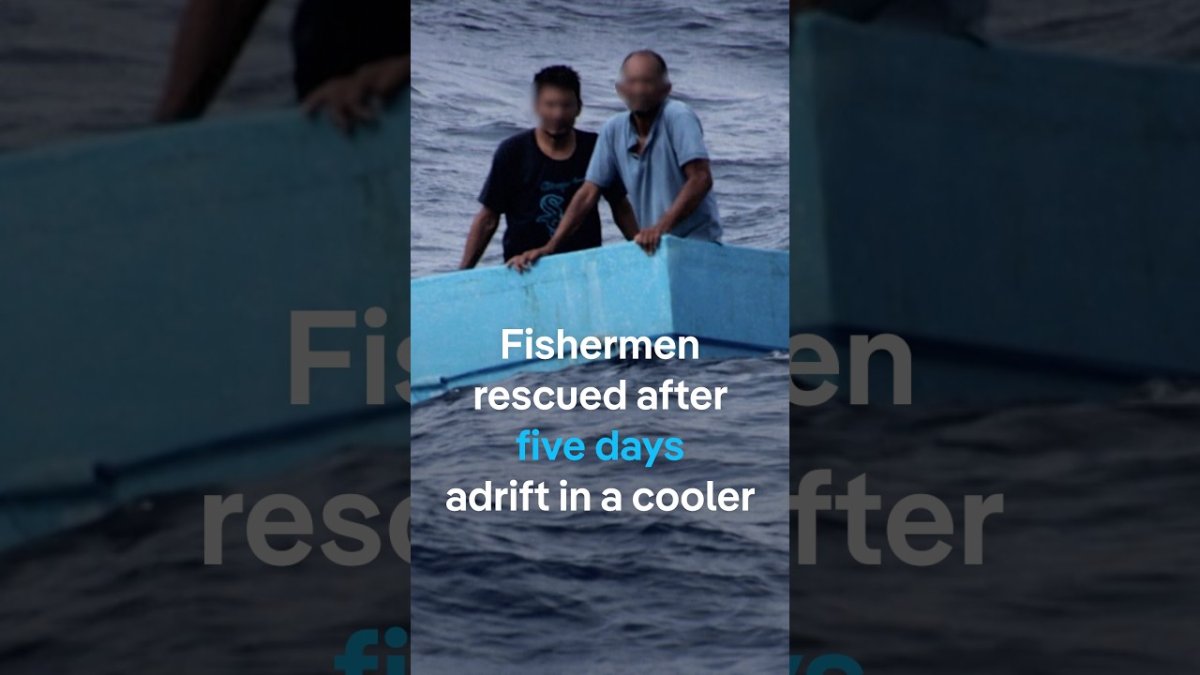
In a recent DW News video report titled "Fishermen rescued after five days adrift in a cooler," the world saw a sight that chills and warms the heart in equal measure: a large turquoise cooler bobbing in the dark, endless swells of the Pacific Ocean, carrying two men who had given up hope. The video, released by the Mexican Navy, captures the moment rescue crews from a Patrulla Oceánica move in, turning a desperate prayer into a miracle.
In a recent DW News video report titled "Fishermen rescued after five days adrift in a cooler," the world saw a sight that chills and warms the heart in equal measure: a large turquoise cooler bobbing in the dark, endless swells of the Pacific Ocean, carrying two men who had given up hope. The video, released by the Mexican Navy, captures the moment rescue crews from a Patrulla Oceánica move in, turning a desperate prayer into a miracle. This is the story of Daniel Guerrero Martínez, 53, and José Luis Portela Villegas, 32, two fishermen from Bahía de Paredón, in the municipality of Tonalá, Chiapas, who survived five days with no food and no water, clinging to a floating ice chest after their boat went down.
A Floating Cooler, a Fading Hope, and a Rescue That Defied the Sea
Puerto Chiapas, Chiapas – Mexico — The rescue, executed on Wednesday this week, was not just a routine operation. It was a testament to the coordination, training, and unwavering commitment of the Armada de México, acting as the country's Guardia Costera. For the families waiting on the shores of Chiapas, it was the difference between a funeral and a reunion. For the men themselves, it was a second chance at life, pulled from the jaws of the Pacific by the very institution they trusted when all seemed lost.
The rescue, executed on Wednesday this week, was not just a routine operation. It was a testament to the coordination, training, and unwavering commitment of the Armada de México, acting as the country's Guardia Costera. For the families waiting on the shores of Chiapas, it was the difference between a funeral and a reunion. For the men themselves, it was a second chance at life, pulled from the jaws of the Pacific by the very institution they trusted when all seemed lost.
The Disappearance: A Routine Trip Turns into a Nightmare
The ordeal began on Thursday, August 13, when Guerrero Martínez and Portela Villegas set out from Bahía de Paredón aboard the fishing vessel "Camaronera." Their mission was simple: a standard fishing trip into the rich waters of the Pacific, a livelihood that has sustained generations of families in the Soconusco region. The last communication with their families and the local fishing cooperative came on Friday, August 14, when they reported their position approximately 120 kilometers from the coast. Then, silence.
When the men failed to return, the tight-knit community of Bahía de Paredón did what it has always done in times of crisis: it organized. The local fishing cooperative, the backbone of the town's economy, immediately requested help from the Secretaría de Marina (SEMAR) and local Protección Civil. The alarm was raised, and the search began. For the families left behind, every hour without news was an eternity. The cooperative's swift action was crucial, transforming a community's worry into a formal, coordinated search effort that would eventually span international waters.
The Search: A Coordinated Effort Across the Pacific
The search operation was a massive undertaking, coordinated through the Vigésima Segunda Zona Naval, headquartered in Puerto Chiapas. Under the direct orders of Admiral Raymundo Pedro Morales Ángeles, the Secretary of the Navy, the operation deployed surface and air units under the "trinomio" concept—a strategic combination of a ship, an interceptor patrol, and an aircraft. This approach was designed to maximize coverage of the vast search area, a critical factor when every hour counts in the open ocean.
The operation was not confined to Mexican waters. In a display of regional cooperation, Mexican authorities coordinated with their Honduran counterparts, sharing information and expanding the search grid. The Pacific is unforgiving, and the search area was immense. The "trinomio" concept, a hallmark of the current naval administration, proved its worth, allowing the Navy to scan hundreds of nautical miles of ocean. The search was a race against time, dehydration, and the elements, with the men's survival hanging in the balance.
The Rescue: 130 Nautical Miles from Hope
On Wednesday, after five agonizing days, the men were located approximately 130 nautical miles (240.76 kilometers) off the coast of Chiapas. Their vessel had become disabled, and they had been forced into the water, using the large fishing cooler as a makeshift life raft. The video released by the Navy shows the stark reality of their situation: two men, exposed to the sun and the salt, huddled inside a turquoise box that had become their only barrier against the abyss.
The rescue maneuvers were carried out by the crew of a Mexican Navy oceanic patrol vessel. The approach was careful and deliberate, a testament to the training of the naval personnel. One of the fishermen, in a video released by the Navy, captured the raw emotion of the moment: "We didn't think we were going to survive these days. The only thing we could do was pray to God and wait for the help of all of you here from the Navy." The other added, "It was the hardest thing imaginable. I wouldn't wish it on anybody — not even my worst enemy." They had eaten and drunk "absolutely nothing" for the entire five days.
From the Brink: Medical Care and a Family Reunion
Immediately after being pulled from the water, the fishermen were evaluated by Sanidad Naval, the Navy's health service. Their condition, after five days without food or water, was critical. They were airlifted by helicopter to port, where they received comprehensive medical attention. The speed and efficiency of the medical response were as crucial as the rescue itself, addressing the severe dehydration and exposure they had suffered.
The reunion with their families was an emotional climax to a week of terror. For the community of Bahía de Paredón, it was a collective sigh of relief. The Navy's statement following the rescue highlighted its "commitment to the public to safeguard human life at sea," a phrase that carries immense weight for the thousands of Mexican families who depend on the ocean for their livelihood. This rescue was not just a professional success; it was a deeply personal victory for a community that lives and breathes the sea.

A Pattern of Survival: Echoes from Veracruz
This remarkable survival story is not an isolated incident. Just weeks earlier, the nation was captivated by the case of Erasto Crisanto Valdez, a 31-year-old fisherman who was found alive after spending 15 days lost in a cenote in southern Veracruz. In that case, Navy divers played a crucial role in the search. These back-to-back stories highlight a troubling reality: the dangers faced by Mexico's fishing communities are ever-present, and the margin for error is razor-thin.
However, they also highlight the resilience of the human spirit and the critical role of the Armada de México. From the cenotes of Veracruz to the open Pacific, the Navy's search and rescue capabilities are being tested and proven. For the Sheinbaum administration, these successful operations reinforce the narrative of a government that is present and effective in protecting its citizens, even in the most remote and dangerous corners of the country. The "trinomio" strategy, championed by Admiral Morales Ángeles, is delivering tangible results.
Why This Matters for Mexico's Coastal Communities
For the fishing cooperatives of Chiapas, Guerrero, and Oaxaca, this rescue is more than a news story. It is a reassurance that when they go to sea, they are not alone. The men of Bahía de Paredón, like thousands of others in towns like Mazatlán, Acapulco, and Veracruz, risk their lives daily to provide for their families. The vastness of the Pacific is their workplace, and its dangers are a constant companion.
The success of this operation underscores the importance of a strong, well-equipped naval force. It is a matter of national security, economic stability, and human dignity. When a fisherman is lost, it is not just a personal tragedy; it is a blow to the local economy and the social fabric of a community. The Navy's ability to respond effectively, as demonstrated this week, is a vital safety net for the men and women who harvest the sea. The "hielera" that saved their lives is a common tool in their trade, but it was the Navy's vigilance that turned it into a lifeboat.
The story of Daniel Guerrero Martínez and José Luis Portela Villegas will be told in the tianguis and plazas of Tonalá for years to come. It is a story of faith, endurance, and the unbreakable bond between a community and its protectors. As they recover in the care of Sanidad Naval, their families can finally breathe easy. The Pacific, which almost claimed them, has given them back. And the Armada de México has once again proven that its promise to safeguard life at sea is not just words—it is a mission carried out with courage and precision, from the shores of Puerto Chiapas to the vast, unforgiving horizon.
By Rosa Martinez, Staff Writer
What to Watch For
In the coming days, attention will focus on the recovery of Daniel Guerrero Martínez and José Luis Portela Villegas as they regain their strength under medical supervision, and on whether the Navy publishes additional details about how the "Camaronera" became disabled. For the fishing cooperatives of Chiapas, the rescue is likely to renew calls for stronger safety equipment, better communication tools, and clearer emergency protocols for vessels working far from shore. The Sheinbaum administration has made maritime security a priority, and this week’s operation under Admiral Morales Ángeles reinforces that commitment. For the men of Bahía de Paredón, the question is simpler: after five days on the open Pacific, they are home — and their community is watching to make sure every fisherman who goes to sea comes back.
By Rosa Martinez, Staff Writer
This article was produced with AI-assisted research and editorial support. Reporting is based on sources cited in the article.
What's Your Reaction?
 Like
0
Like
0
 Dislike
0
Dislike
0
 Love
0
Love
0
 Funny
0
Funny
0
 Wow
0
Wow
0
 Sad
0
Sad
0
 Angry
0
Angry
0

Latin America/Andes Correspondent at Global1.News. Based in Bogota, covering politics, environment, energy, and social movements across the Andean region. Passionate about environmental journalism and communities protecting their land.















Comments (0)