
Mecca Pact Signals New Sunni Security Alignment in Volatile Middle East
The Mecca Joint Defence Agreement signed on August 7 2026 establishes a collective defense framework among Saudi Arabia, Turkey and Pakistan at a time of heightened regional tensions involving Iran and disruptions to energy routes. The pact arrives as Gulf states pursue economic diversification while facing threats from non-state actors and great power competition. It reflects efforts by three major Sunni powers to coordinate without reliance on external actors.
The Mecca Joint Defence Agreement signed on August 7 2026 establishes a collective defense framework among Saudi Arabia, Turkey and Pakistan at a time of heightened regional tensions involving Iran and disruptions to energy routes. The pact arrives as Gulf states pursue economic diversification while facing threats from non-state actors and great power competition. It reflects efforts by three major Sunni powers to coordinate without reliance on external actors.
Mecca Pact Signals New Sunni Security Alignment in Volatile Middle East
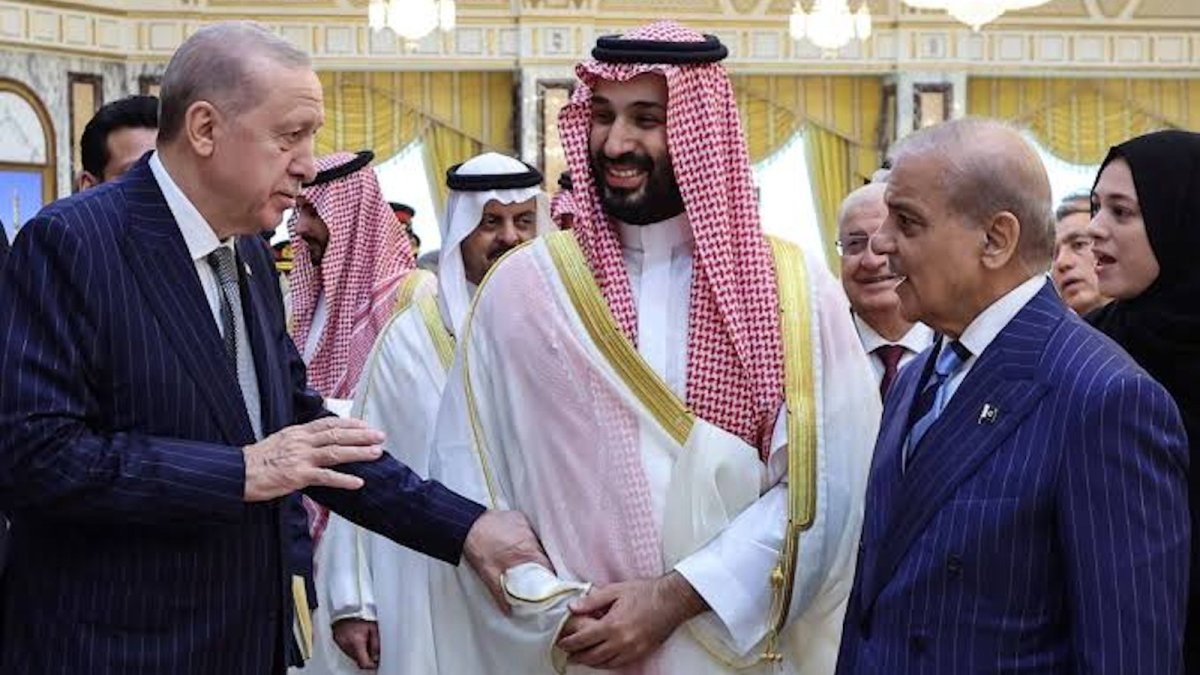
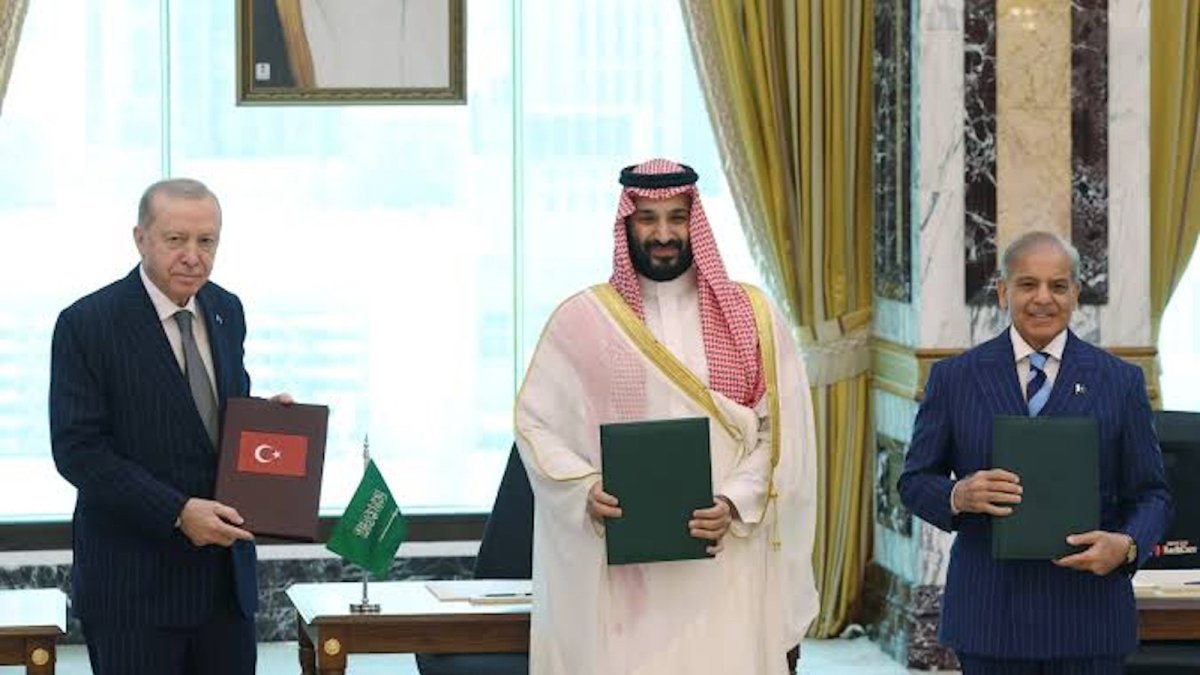
Riyadh, Saudi Arabia – August 9, 2026 — Saudi Crown Prince and Prime Minister Mohammed bin Salman, Turkish President Recep Tayyip Erdogan and Pakistani Prime Minister Shehbaz Sharif signed the Mecca Joint Defence Agreement at Al Safa Palace in Mecca. The core clause states that an armed attack on any one signatory shall be regarded as an attack on them all. Turkish Foreign Minister Hakan Fidan described the mechanism as technically equivalent to NATO's Article 5 yet without naming any common enemy.

Geopolitical Context
The agreement forms a trilateral bloc of Sunni Muslim states that maintain alliances with the United States while confronting regional upheaval that has triggered a global energy crisis. Saudi Arabia has endured attacks by Yemen's Houthi rebels, while the regional war included Iranian closure of the Strait of Hormuz and strikes on Gulf neighbors. Pakistan has mediated between the United States and Iran toward a comprehensive ceasefire. The US-Saudi civil nuclear cooperation deal remains linked to Saudi-Israeli normalization and Riyadh's potential entry into the Abraham Accords, with Gaza peace talks urging major Muslim countries to assume larger roles.
The timing of the signing on Friday, the most sacred day of the week for Muslims, in Islam's holiest city of Makkah, carries deep symbolic weight that underscores the religious and cultural legitimacy the three nations seek to project. This choice frames the pact not merely as a security instrument but as a covenant rooted in shared Islamic identity, potentially resonating across Muslim populations from North Africa to Southeast Asia. At the same time, the agreement's emphasis on self-reliance directly counters the influence of external hegemons, which Fidan noted only make regional problems more acute rather than resolving them.
With Saudi Arabia as a major oil exporter and the Arab world's dominant military spender, Turkey as a NATO member fielding one of the alliance's largest armies, and Pakistan as a nuclear-armed power with one of Asia's largest standing armies, the bloc combines economic leverage, conventional military depth, and strategic deterrence in ways that could recalibrate power balances. The structure incorporates political and military committees involving foreign and defence ministers alongside military chiefs, plus a secretariat headquartered in Saudi Arabia to coordinate joint training, intelligence sharing, logistics, threat assessments, and military interoperability. Fidan stressed that no country is a target as long as it does not attack member states, and that Türkiye, Saudi Arabia, and Pakistan are not expansionist countries, positioning the pact as defensive rather than aggressive.
Historical Background
The Mecca agreement builds directly on the Strategic Mutual Defense Agreement signed between Saudi Arabia and Pakistan in September 2025. Preparations for the trilateral pact had been underway for nearly two years and eight months, according to Hakan Fidan. The summit followed invitations extended by King Salman bin Abdulaziz Al Saud to Erdogan and Sharif. The resulting structure includes political and military committees of foreign and defense ministers plus military chiefs, a secretariat based in Saudi Arabia, and provisions for joint training, intelligence sharing, logistics, threat assessments and military interoperability.
Fidan clarified that the response mechanism depends on circumstances, with the attacked country requesting assistance and specifying the type of support needed, which could range from intelligence and logistics to ammunition or deployment of military units. This flexible approach mirrors NATO Article 5 in principle while allowing tailored contributions that respect each nation's domestic constraints and strategic priorities. Preparations spanning nearly two years and eight months demonstrate that the pact was not hastily assembled in reaction to recent Iran tensions but reflects long-term strategic planning among the three capitals.
The inclusion of defence-industry cooperation within the committees opens avenues for joint production and technology transfers, particularly benefiting Turkey's growing defence sector and Pakistan's need for modern equipment. A secretariat in Saudi Arabia provides an institutional anchor that could evolve into a permanent coordination hub, facilitating regular threat assessments and interoperability exercises. Fidan indicated that under the president's vision the framework should not remain limited to three countries but should grow and, if necessary, bring all countries under this umbrella once technical issues are resolved.
Regional Dynamics
Iranian Foreign Minister Abbas Araghchi urged regional states to rely on themselves and pursue true brotherhood while highlighting the strength of Iran's armed forces. Iranian parliamentary commission members Mahmoud Nabavian and Ebrahim Rezaei warned that cooperation with Turkey and Pakistan would not guarantee Saudi security and dismissed the pact as a paper agreement. Turkish Vice President Cevdet Yilmaz stated the agreement targets no specific country. Saudi Foreign Minister Faisal bin Farhan called it a milestone that unifies efforts against regional challenges and embodies shared political will.
Fidan's assertion that external hegemons coming into the region do not solve problems but make them more acute directly addresses long-standing Iranian concerns about foreign military footprints, even as the pact itself avoids naming adversaries. This rhetorical alignment may create limited space for de-escalation talks, though Iranian skepticism voiced by parliamentary figures suggests deep mistrust persists. The emphasis on self-reliance could encourage other regional actors to explore similar intra-Muslim security arrangements rather than defaulting to external patrons.
Egypt emerges as a natural partner whose eventual accession Fidan anticipates once technical issues are resolved, following the June 21, 2026 meeting between Egypt's Foreign Minister Badr Abdelatty and Fidan. Such expansion would broaden the pact's geographic reach and demographic weight, potentially linking North African security dynamics with Gulf and South Asian theatres. The absence of any named target reinforces the defensive posture, allowing member states to maintain existing relationships with Washington while asserting greater autonomy in local affairs.
Strategic Calculus
Each party brings distinct leverage. Saudi Arabia supplies major oil exports and remains the Arab world's dominant military spender. Turkey contributes NATO membership and one of the alliance's largest armies while seeking to expand its defense-industrial footprint through joint production and technology partnerships, as noted by RUSI researcher Burcu Ozcelik. Pakistan offers nuclear status and one of Asia's largest standing armies in exchange for financial support and external assistance. Fidan emphasized that external hegemons entering the region intensify problems rather than solve them and positioned Turkey, Saudi Arabia and Pakistan as core countries that could eventually encompass additional partners such as Egypt once technical issues are resolved.
Pakistan's economy depends heavily on external assistance, bailouts, and financial inflows from friendly states, making Riyadh's financial backing a critical incentive that complements the security guarantees flowing in the opposite direction. This mutual dependence could stabilize Pakistan's fiscal position while giving Saudi Arabia access to additional manpower and nuclear deterrence credibility. Turkey's NATO membership provides an indirect bridge to Western security structures without subordinating the new pact to external command.
Defence-industry cooperation stands out as a practical pillar that could reduce reliance on foreign suppliers and foster indigenous capabilities across the three nations. Joint training and logistics arrangements would enhance interoperability, allowing forces to operate together more effectively in future contingencies. Fidan reiterated that the pact carries no expansionist intent, framing growth as an inclusive umbrella rather than a vehicle for territorial or ideological dominance.
What It Means for the Gulf and Beyond
The pact does not specify exact military commitments or binding obligations for each state. A Pakistan Defence Ministry representative described it as a commitment to strengthen collective security and promote peace in the region and beyond. Riyadh's Vision 2030 economic transformation faces risks from prolonged insecurity, as Houthi threats to Red Sea shipping and the Strait of Hormuz closure have already disrupted trade, energy exports and investor confidence. Asia Times analysis indicates Pakistan could supply manpower while Riyadh gains additional deterrence options.
Prolonged insecurity directly threatens Vision 2030 by undermining investor confidence and exposing energy export routes to disruption, making the pact a hedge that could safeguard Saudi Arabia's diversification timeline. If commitments translate into deployments beyond Saudi territory, Pakistan could be drawn into conflicts in Yemen, Syria or other theaters, raising questions about the sustainability of its contributions given domestic economic pressures. The flexible response model outlined by Fidan allows each capital to calibrate involvement according to its own risk tolerance and national interests.
Intelligence sharing and threat assessments conducted through the new committees could improve early warning against non-state actors and maritime threats in the Red Sea and Arabian Sea. Logistics cooperation would facilitate rapid movement of supplies and personnel, enhancing the credibility of collective deterrence. The overall architecture signals a shift toward regional ownership of security, consistent with Fidan's critique of external interventions that exacerbate rather than alleviate tensions.
Regional Implications
If implemented, the agreement could foster greater military interoperability and defense-industry cooperation among the three states while opening pathways for broader Sunni coordination. Fidan expressed the expectation that the umbrella would expand beyond the initial three signatories. The absence of detailed commitment mechanisms leaves open questions about the depth of future military integration, yet the political signal of three major regional powers aligning on collective defense marks a notable development in Middle East security architecture.
Broader Sunni coordination could emerge through the political and military committees, potentially influencing positions on issues ranging from Yemen reconstruction to counter-terrorism financing. The secretariat in Saudi Arabia offers a neutral institutional base that could attract additional members seeking a voice in collective decision-making. Yet the lack of automatic deployment triggers means effectiveness will depend on political will at moments of crisis rather than treaty obligations alone.
Over time, successful joint exercises and intelligence fusion could build habits of cooperation that extend into economic and diplomatic spheres, reinforcing the three nations' collective leverage in global energy and trade forums. Fidan’s vision of gradual expansion positions the Mecca agreement as an open platform rather than a closed club, inviting future partners to contribute to regional stability under shared principles of non-aggression and mutual assistance.
By Malik Hassan, Staff Writer
This article was produced with AI-assisted research and editorial support. Reporting is based on sources cited in the article.
What's Your Reaction?
 Like
0
Like
0
 Dislike
0
Dislike
0
 Love
0
Love
0
 Funny
0
Funny
0
 Wow
0
Wow
0
 Sad
0
Sad
0
 Angry
0
Angry
0
Middle East Correspondent at Global1.News. Based in Beirut, covering politics, conflict, energy, and society across the Middle East. Brings context and depth to a region often reduced to headlines.












Comments (0)