
Mecca Defence Alliance Takes First Institutional Steps as Turkey, Saudi Arabia and Pakistan Forge New Regional Security Order
Istanbul, Türkiye — The Islamic world’s most consequential security experiment in decades moved from paper to practice on Monday, as senior officials from Turkey, Saudi Arabia, and Pakistan convened the first meeting of the Strategic Political and Defence Committee under the Makkah Joint Defence Agreement.
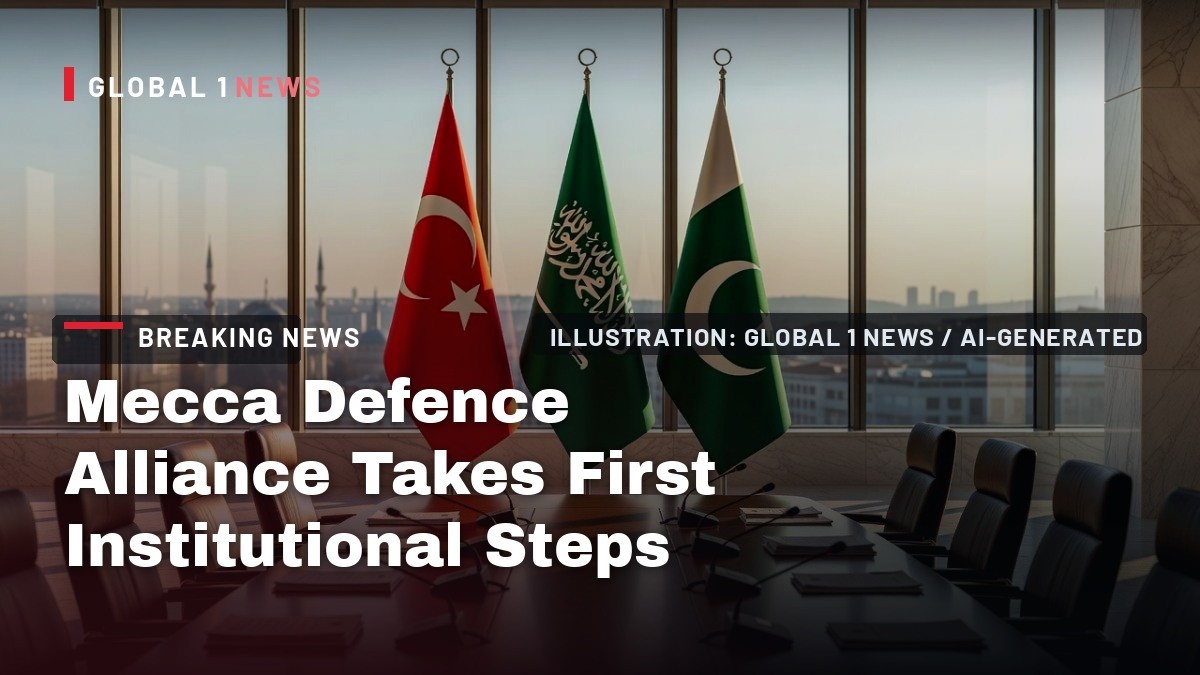
Istanbul, Türkiye — The Islamic world’s most consequential security experiment in decades moved from paper to practice on Monday, as senior officials from Turkey, Saudi Arabia, and Pakistan convened the first meeting of the Strategic Political and Defence Committee under the Makkah Joint Defence Agreement. The meeting in Istanbul produced the alliance’s first institutional decisions, a roadmap for expansion, and a pointed reaffirmation that the pact is defensive—even as it was announced against a backdrop of renewed US-Iran hostilities and a parallel $3.5 billion Israeli-Greek air defense mega-deal signed the same day.
This is not a photo-op alliance. The three signatories—two of them nuclear-armed states, all three commanding critical geography from the Red Sea to the Arabian Sea to the Bosporus—are building a mutual defense structure that Turkish officials say is technically equivalent to NATO’s Article 5. The question is no longer whether this bloc exists, but what it becomes, who joins, and how it reshapes a region already bristling with new fault lines.
The First Institutional Steps
Monday’s meeting in Istanbul was the first formal gathering of the committee established under the Makkah Joint Defence Agreement, which was signed into force on August 7, 2026. Turkish Foreign Minister Hakan Fidan confirmed that the alliance took its first institutional decisions at the session, attended by senior officials from all three capitals. The committee is the operational backbone of the pact—the mechanism through which the three governments will coordinate defense policy, threat assessments, and, presumably, joint military planning.
Fidan’s public remarks after the meeting were calibrated to project both strength and reassurance. He emphasized that the Mecca Joint Defense Agreement is defensive in nature and not directed against any specific country. He also took care to frame the pact as complementary to existing commitments, explicitly stating that it “complements the NATO alliance.” That phrasing matters: Turkey remains a NATO member, and Ankara is signaling that this new bloc is not a rival to the Western alliance but a parallel track for regional security.
The institutionalization of the committee is significant in itself. Agreements get signed; committees meet. The fact that the three countries convened within weeks of the pact’s entry into force—and produced concrete decisions—suggests a level of seriousness that often eludes multilateral defense arrangements in the region. The joint statement issued after the meeting underscored the trio’s commitment to “reducing tensions, promoting restraint, and encouraging peaceful solutions to crises.” That language is diplomatic boilerplate, but in the current environment, it carries weight.
What the Mecca Alliance Is
To understand what happened in Istanbul, you have to understand the architecture of the pact itself. The Makkah Joint Defence Agreement builds on the Strategic Mutual Defence Agreement signed between Pakistan and Saudi Arabia on September 17, 2025. That bilateral pact was then extended to include Turkey, creating a trilateral framework that was signed into force on August 7, 2026.
The core principle is mutual defense: an attack on any one of the three countries is considered an attack on all three. Turkish officials have described this as technically equivalent to NATO’s Article 5, the collective defense clause that underpins the Atlantic alliance. That is not a casual comparison. Article 5 has been invoked only once in NATO’s history—after the September 11 attacks—and it remains the gold standard for binding mutual defense commitments.
The alliance brings together three very different military powers. Turkey operates the second-largest standing army in NATO and has demonstrated a willingness to project force across Syria, Libya, and the Caucasus. Pakistan is a nuclear-armed state with a large, battle-tested military and deep experience in counterterrorism. Saudi Arabia has the region’s most advanced defense procurement budget and controls the world’s most critical energy chokepoints. Together, they span a strategic arc that includes the Red Sea, the Persian Gulf, the Arabian Sea, and the Eastern Mediterranean.
What the pact does not do—at least not yet—is establish a standing joint force, a unified command structure, or a permanent secretariat. Those are the kinds of institutional trappings that turn a treaty into a functioning alliance. Monday’s meeting suggests the three governments are moving in that direction, but the roadmap for expansion will be the first real test of whether this is a genuine security order or a diplomatic gesture with military trappings.
A Roadmap for Expansion
Fidan announced that Turkey, Saudi Arabia, and Pakistan are working on a roadmap for other countries to join the pact and are considering establishing a mechanism to add new members. That is the clearest signal yet that the founding trio intends for this to be a growing bloc, not a closed club.
The obvious candidate is Egypt. Ankara has already signaled that Cairo could join the alliance, according to reporting from Al Jazeera. Egypt brings the Arab world’s largest military, control of the Suez Canal, and a strategic position that bridges the Mediterranean and the Red Sea. Its inclusion would dramatically expand the alliance’s geographic reach and give it a foothold in North Africa.
But expansion is not without complications. The alliance’s founding members have overlapping but not identical threat perceptions. Turkey’s primary security concerns include Kurdish separatist groups, instability in Syria, and its ongoing disputes with Greece in the Aegean. Pakistan’s focus is on its eastern border with India and the volatile situation in Afghanistan. Saudi Arabia’s priorities are Iran, Yemen, and the security of its energy infrastructure. A mechanism for adding members will have to reconcile these divergent interests—or at least establish a threshold for consensus that prevents paralysis.
The roadmap also raises questions about the alliance’s relationship with existing security frameworks. Turkey is in NATO. Saudi Arabia and Pakistan are both major non-NATO allies of the United States. Egypt has its own defense relationships with Washington. The more members the Mecca Alliance adds, the more complex the web of overlapping commitments becomes. Fidan’s insistence that the pact complements NATO suggests the founders are aware of this tension and are trying to manage it proactively.
The Iran Question
No discussion of the Mecca Alliance can avoid the elephant in the room: Iran. The pact was signed and institutionalized against a backdrop of renewed US-Iran hostilities, including a tanker struck in the Strait of Hormuz as Washington weighed new attacks on Tehran. The timing is not coincidental.
Iran has reportedly been invited by Turkey, Saudi Arabia, and Pakistan to join the pact, according to a Jerusalem Post report. That is a remarkable development, given that Saudi Arabia and Iran spent decades as regional adversaries and only recently restored diplomatic relations. Turkey has previously said the pact does not target Iran, and Fidan’s remarks on Monday reinforced that position.
But the invitation—if it is real—creates a paradox. The alliance’s core principle is mutual defense. If Iran joins, an attack on Iran would trigger a collective response from Turkey, Saudi Arabia, and Pakistan. That would put the alliance on a collision course with the United States, which has been conducting strikes against Iranian targets and weighing further military action. It would also complicate the alliance’s relationship with Israel, which views Iran as its primary existential threat.
The more likely scenario is that the invitation is a diplomatic signal rather than a concrete offer. By publicly floating the possibility of Iranian membership, the three founders can claim the alliance is inclusive and defensive, not a anti-Iranian bloc. At the same time, they can use the prospect of Iranian membership as leverage in negotiations with Tehran over its nuclear program and regional behavior. It is a classic diplomatic gambit: offer the thing you know the other side cannot accept, and use the offer to shape the narrative.
Fidan’s language on Monday was carefully chosen. He stressed that the Mecca Joint Defense Agreement is defensive and not directed against a specific country. He did not name Iran. But the context—renewed US-Iran hostilities, a tanker strike in the Strait of Hormuz, and the alliance’s first meeting taking place in that environment—makes it impossible to separate the pact from the Iran file.
The Israel-Greece Countermove
While the Mecca Alliance was holding its first committee meeting in Istanbul, a different kind of security architecture was being cemented in Athens. On the same day, Israel and Greece signed a €3 billion ($3.5 billion) air defense deal—the largest defense agreement between the two countries and one of the biggest in Israel’s history.
The deal is part of Greece’s €28 billion “Achilles Shield” air-defense program, a sweeping modernization effort designed to protect Greek airspace across the Aegean and beyond. The system is built around Israeli platforms, including David’s Sling, BARAK MX, and SPYDER. Israeli Prime Minister Benjamin Netanyahu hailed the agreement as the culmination of a decade-long Eastern Mediterranean partnership.
The timing is impossible to ignore. The Mecca Alliance meeting and the Israel-Greece deal happened on the same day. That is not a coincidence; it is a signal. The Eastern Mediterranean is becoming the stage for two competing security architectures: one anchored by Turkey, Saudi Arabia, and Pakistan, and another anchored by Israel and Greece, with the United States hovering in the background.
Israel’s defense industrial base is booming. According to a March 2026 SIPRI report, Israel surpassed the United Kingdom in global arms export share for the first time, becoming the world’s seventh-biggest supplier. That growth is driven by combat-proven systems like David’s Sling and SPYDER, which are now being integrated into European air defense architectures. The Greece deal is a flagship export—a validation of Israeli technology and a strategic foothold in the Eastern Mediterranean.
Fidan, for his part, used the occasion to sharpen his rhetoric against Netanyahu. He described the Israeli prime minister as a “perpetrator of genocide” and said “criminal Netanyahu must be stopped—he is harming Israel, too.” He called Netanyahu an “enemy of humanity.” That language is inflammatory, but it reflects the deep animosity between Ankara and the current Israeli government—an animosity that now has a military dimension on both sides.
What It Means for the Region
The emergence of the Mecca Alliance, combined with the Israel-Greece defense axis, is redrawing the security map of the Middle East and the Eastern Mediterranean. The old alignments—US-backed Gulf states, NATO’s southern flank, and the Abraham Accords—are being supplemented by new, more complex arrangements.
The Mecca Alliance gives Turkey, Saudi Arabia, and Pakistan a formal mechanism for collective defense that does not depend on Washington. That is a significant shift. For decades, the United States was the security guarantor of the Gulf and the broader region. The Mecca Alliance does not replace that guarantee, but it creates an alternative—one that is explicitly Islamic in its framing and independent in its decision-making.
The alliance also changes the calculus for Iran. Tehran now faces a bloc that includes two of its most capable regional adversaries—Saudi Arabia and Turkey—plus a nuclear-armed Pakistan. Even if the alliance is defensive in nature, its existence raises the cost of any Iranian military adventure. The invitation to join, whether sincere or not, puts Tehran in a difficult position: join a bloc that would constrain its freedom of action, or remain outside and face a coordinated defense establishment across its western and eastern flanks.
For Israel, the Greece deal is a strategic hedge. Israel is deepening its European partnerships at a time when its relations with Turkey are toxic and its position in the broader region is contested. The Eastern Mediterranean axis—Israel, Greece, and potentially Cyprus—provides Israel with a European foothold and a counterweight to Turkish influence. The fact that the deal was signed on the same day as the Mecca Alliance meeting suggests both sides are aware of the competition.
The Road Ahead
The Mecca Alliance has taken its first institutional steps, but the hard work lies ahead. The committee must now translate its decisions into concrete military cooperation: joint exercises, intelligence sharing, interoperability standards, and crisis response protocols. The roadmap for expansion will test whether the founders can agree on criteria for membership and whether potential members like Egypt are willing to accept the obligations of mutual defense.
The alliance’s relationship with NATO remains the key variable. Turkey is a NATO member, and its participation in the Mecca Alliance creates potential conflicts of interest. If a NATO member and a Mecca Alliance member were ever to come into conflict—a scenario that is not far-fetched given Turkey’s tensions with Greece—Ankara would face an impossible choice. Fidan’s insistence that the pact complements NATO is an attempt to preempt that problem, but it does not resolve it.
The Iran question will not go away. The invitation to Tehran, the renewed US-Iran hostilities, and the alliance’s defensive posture all point to a region where Iran remains the central security challenge. Whether the Mecca Alliance becomes a genuine deterrent to Iranian aggression or a diplomatic talking point depends on whether the three founders can sustain the momentum from Monday’s meeting.
What is clear is that the region is entering a new phase of security competition. The Mecca Alliance and the Israel-Greece axis are not just bilateral agreements; they are the building blocks of a new order. The old certainties—US primacy, NATO’s monopoly on collective defense, the Abraham Accords as the template for regional integration—are giving way to a more fragmented, multipolar landscape. The Mecca Alliance is the most significant expression of that shift to date.
The committee will meet again. The roadmap will be refined. New members may be added. But the fundamental question remains: can a defense pact built on mutual trust and shared interests hold together in a region where trust is scarce and interests diverge? Monday’s meeting was a step forward, but the road ahead is long—and the stakes could not be higher.
By Jessica Ali, Staff Writer
This article was produced with AI-assisted research and editorial support. Sources: Anadolu Agency, Al Jazeera, Al-Monitor, Reuters, Jerusalem Post, Defense News, Turkish Minute, World Israel News.
What's Your Reaction?
 Like
0
Like
0
 Dislike
0
Dislike
0
 Love
0
Love
0
 Funny
0
Funny
0
 Wow
0
Wow
0
 Sad
0
Sad
0
 Angry
0
Angry
0

Editor-in-Chief at Global1.News. Atlanta-based journalist who cuts through the BS and tells it like it is. Lead anchor, host, and the voice you hear when the spin stops and the truth starts.












Comments (0)