
Ranigunj underbridge renovation to disrupt traffic for 6-8 months
The Hyderabad Traffic Police have announced a large‑scale renovation of the Railway Under Bridge (RUB) at Ranigunj Junction on MG Road, set to begin on Saturday, 21 November 2026.
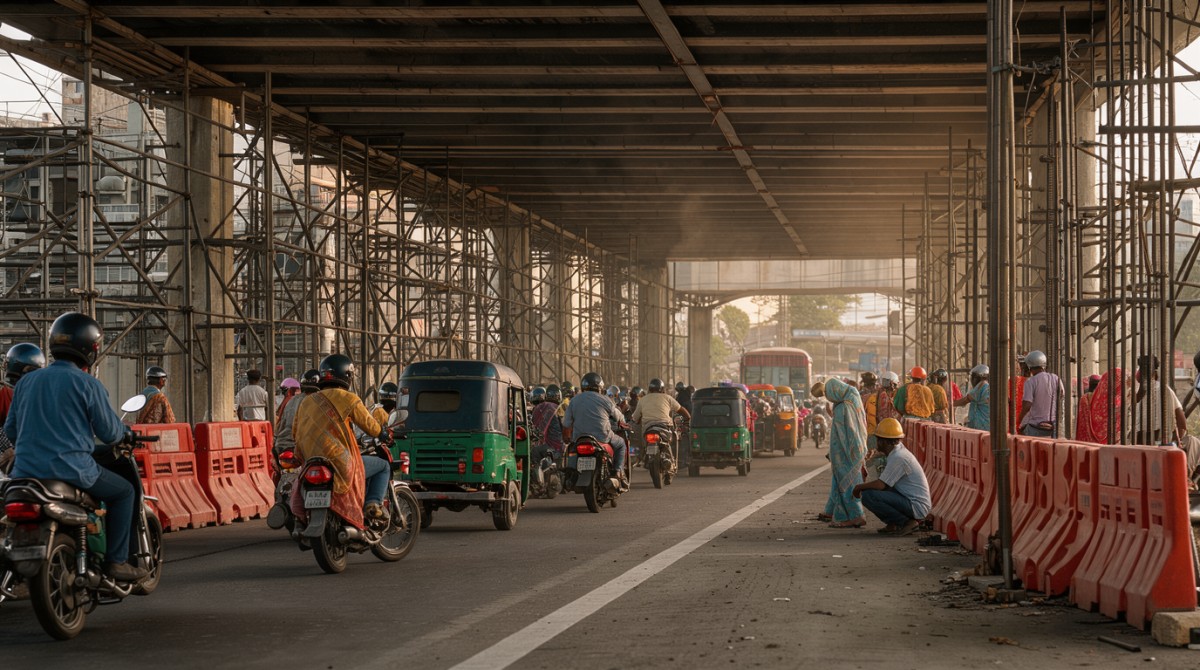
The Hyderabad Traffic Police have announced a large‑scale renovation of the Railway Under Bridge (RUB) at Ranigunj Junction on MG Road, set to begin on Saturday, 21 November 2026. The excavation work, which will cut across nearly three carriageway lanes and extend up to 1.5 metres in depth, will leave only a single lane open for light motor vehicles such as cars, auto‑rickshaws and two‑wheelers. Officials warn that the disruption is likely to persist for six to eight months, creating a prolonged period of congestion on one of the city’s busiest arterial corridors.
Scope of the renovation and immediate traffic impact
The renovation involves excavating a strip up to 1.5 metres wide across three of the four lanes that normally carry traffic on MG Road. By restricting the open carriageway to light motor vehicles, the under‑bridge work will force a substantial reduction in road capacity. The Hyderabad Traffic Police have already mapped out a detailed diversion plan for heavy vehicles, including goods trucks, private travel buses and RTC buses, to mitigate the bottleneck.
Heavy‑vehicle diversions will be routed through a network of alternate junctions—SBI Cross Roads, Rasoolpura, Begumpet, Clock Tower, and others—effectively reshaping traffic flows across a wide swathe of the city. The police have also warned commuters to avoid a long list of critical intersections, from SBI Cross Road to Old Ambedkar Statue, where congestion is expected to be most acute.
Detailed diversion routes for heavy vehicles
Vehicles approaching Ranigunj from the south via SBI Cross Roads will be redirected towards Rasoolpura and Begumpet. Those arriving from JBS Bus Stand via Sweekaar Upkaar, YMCA and SBI Cross Roads will be barred from proceeding towards SD Road, CTC and Paradise; instead they will be sent towards Clock Tower. Heavy traffic coming from Clock Tower will be diverted towards SBI Cross Roads, while vehicles from Plaza Junction will be steered to CTO, Rasoolpura and Begumpet.
Further north, heavy vehicles from Medchal‑Bowenpally on NH‑44 will be diverted at CTO Junction. Right‑turning traffic will head to Rasoolpura, Monappa, Nirankari and Lakdikapool, whereas left‑turning traffic will be funneled through SBI Cross Roads, YMCA, Sangeeth Cross Road, Rail Nilayam and Alugaddabavi Junction towards Musheerabad or Mettuguda. At Rasoolpura Cross Roads, the diversion will continue towards Begumpet, Monappa and Nirankari, while at Ranigunj Cross Roads vehicles will be routed to Adavaiah Cross Road, Distillery Road and Karbala Junction.
Diversions for vehicles approaching via Tank Bund and surrounding corridors
Heavy vehicles arriving at Ranigunj via Tank Bund will be diverted at the Sailing Club towards Kavadiguda. Those coming via Upper Tank Bund will be redirected at DBR Mills towards Gandhi Nagar T‑Junction, Kavadiguda, CGO Towers and Musheerabad Cross Roads. An additional diversion point at Old Ambedkar Statue or Telugu Talli Flyover Junction will send traffic towards Liberty, Himayatnagar, Narayanaguda and RTC Cross Roads.
Vehicles from the Telangana Thalli Flyover will be diverted at Katta Maisamma towards Indira Park Cross Roads, Ashok Nagar and RTC Cross Roads. At Karbala Cross Roads, entry for heavy vehicles will be prohibited altogether, with traffic directed to Bible House Junction, Jabbar Complex, CGO Towers and Musheerabad. These layered diversions illustrate the extensive re‑routing required to keep freight and public‑transport flows moving while the under‑bridge work proceeds.
Measures for light motor vehicles and height restrictions
Light motor vehicles—cars, auto‑rickshaws and two‑wheelers—will retain access to a single open lane on MG Road. However, specific routing changes are also in place. Vehicles coming from Paradise and Minister Road towards Ranigunj will be diverted at Ranigunj Cross Road towards Distillery Road and Karbala Junction. At Nallagutta Cross Road, traffic will be redirected towards Necklace Road, while light vehicles will still be permitted through Karbala Junction.
To prevent over‑height vehicles from entering the constrained lanes, height restrictors with a maximum clearance of 10 feet will be installed at Patny, Paradise, Park Lane, Rasoolpura and Karbala Cross Roads. This precaution aims to reduce the risk of accidental collisions with the under‑bridge structure and to keep the diversion network functioning smoothly.
Implications for commuters and emergency travel
The Hyderabad Traffic Police have urged commuters to plan journeys well in advance and to avoid the listed high‑congestion points wherever possible. They have also provided a dedicated traffic helpline—90102‑03626—for emergency travel assistance. Real‑time updates will be posted on the police’s social media platforms, offering a channel for commuters to receive the latest information on diversion changes or unexpected bottlenecks.
Given the six‑to‑eight‑month timeline, the disruption will affect daily commuters, logistics operators and public‑transport users alike. The extended period of reduced road capacity may push some commuters to seek alternative routes, increase reliance on public transport, or shift to rail and metro options where feasible. Businesses that depend on timely freight movement will need to factor in longer travel times and possible cost implications.
Policy context and broader urban mobility considerations
The Ranigunj under‑bridge renovation is part of a wider effort by the Telangana government to upgrade ageing railway‑road interfaces, improve safety and accommodate future traffic growth. However, the scale of the diversion plan underscores the challenges Indian cities face when undertaking infrastructure upgrades on already congested corridors. The need to maintain a single lane for light vehicles while rerouting heavy traffic reflects a balancing act between construction safety and urban mobility.
From a policy perspective, the episode highlights the importance of integrated transport planning. Coordination between the railways, municipal traffic authorities and the Hyderabad Traffic Police has been essential to design the multi‑point diversion network. Yet the sheer complexity of the routes—spanning dozens of junctions and cross‑roads—suggests that future projects could benefit from pre‑emptive traffic modelling, real‑time monitoring and perhaps temporary augmentation of public‑transport capacity to absorb displaced commuters.
Looking ahead: monitoring the impact and lessons for future projects
As the renovation progresses, authorities will need to monitor traffic flow, incident reports and commuter feedback closely. The Hyderabad Traffic Police have already set up a helpline and social‑media channels for real‑time communication, which can serve as a model for other Indian cities undertaking similar works. Continuous data collection on congestion levels, travel times and diversion effectiveness will be crucial for adjusting routes and mitigating bottlenecks.
In the longer term, the successful completion of the Ranigunj under‑bridge work could pave the way for smoother rail‑road integration across the city, reducing the risk of future disruptions. For now, commuters are advised to stay informed, respect the height restrictors, and use the prescribed diversion routes to minimise inconvenience during what is likely to be a challenging period for Hyderabad’s traffic ecosystem.
This article was produced with AI-assisted research and editorial support. Reporting is based on the source material cited below. Sources: The Hindu; thehindu.com; Global1.News (21 November 2026).
By Dr. Raj Patel, Staff Writer
What's Your Reaction?
 Like
0
 Dislike
0
 Love
0
 Funny
0
 Wow
0
 Sad
0
 Angry
0

India/South Asia Correspondent at Global1.News. Analytical voice with a background in science and health journalism. Based in New Delhi, covering Indian politics, education, healthcare, technology, and policy. Breaks down complex data into clear, actionable reporting.














Comments (0)