
Burnham Returns to Commons with Promise to Bring Back Hope
After sixteen years away from the despatch box, Andy Burnham returned to the Commons today with a message that was equal parts optimism and intervention. The new Prime Minister used his first statement since succeeding Sir Keir Starmer in July to set out a governing philosophy that would see the state take a far more assertive role in the everyday utilities that power British life.
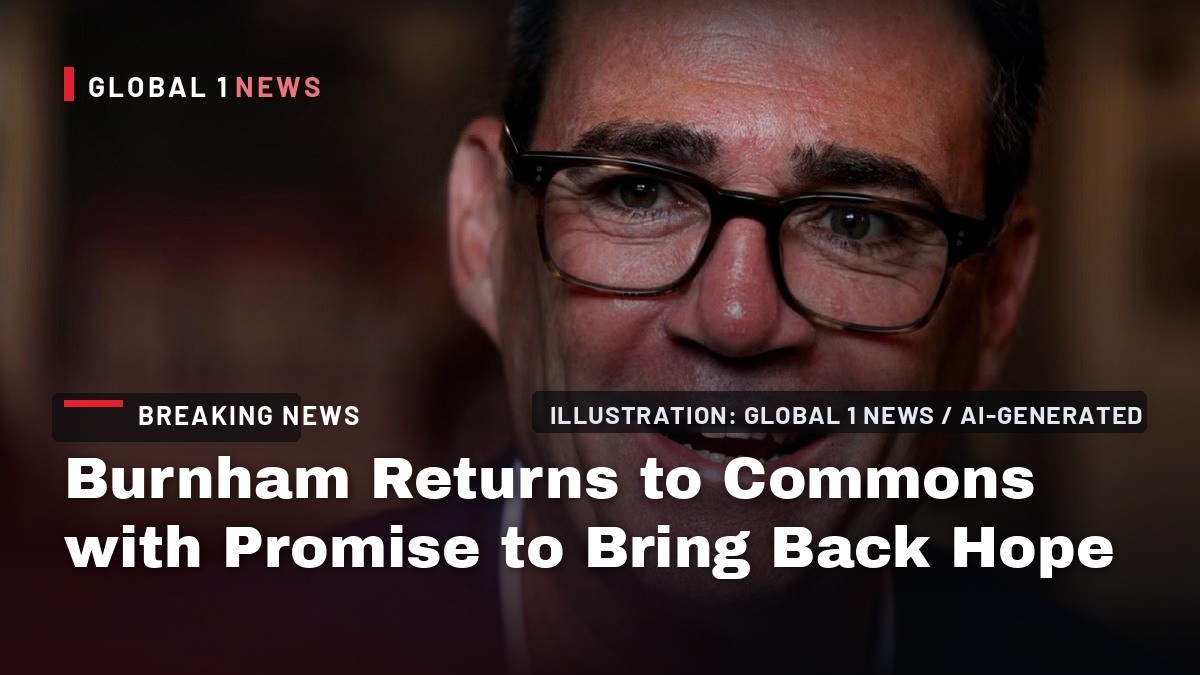
After sixteen years away from the despatch box, Andy Burnham returned to the Commons today with a message that was equal parts optimism and intervention. The new Prime Minister used his first statement since succeeding Sir Keir Starmer in July to set out a governing philosophy that would see the state take a far more assertive role in the everyday utilities that power British life. It was a deliberate, calculated pitch: not merely a defence of public ownership, but an argument that it is the missing engine for economic growth.
Public Control as an Economic Strategy
Mr Burnham’s central thesis, trailed extensively over the summer recess, is that essential services have been run for profit rather than purpose, leaving households and businesses exposed to volatile markets and creaking infrastructure. He is expected to argue that water, energy and transport have become neither reliable nor affordable, and that this failure is holding back the wider economy. The statement marks the first formal opportunity for MPs to scrutinise the raft of proposals announced while Parliament was in recess, and the Prime Minister did not shy away from the scale of his ambition.
The Guardian first reported that public control over these sectors would be a priority for the government in the coming months. A No 10 source framed the agenda in distinctly personal terms, telling reporters: “Andy is optimistic about our country’s future. He has a clear plan for how we turn things round. He is determined we make this the moment we bring back hope.” That phrase—‘bring back hope’—is set to become the defining slogan of this administration, deployed as a counterweight to the gloom that has settled over Westminster since the cost-of-living crisis first took hold.
But the Prime Minister will be under no illusion that the path is smooth. The immediate question is whether he can translate this rhetoric into legislative reality. Struggling utilities such as Thames Water, which has lurched from crisis to crisis under the weight of its debt, are the most obvious candidates for government intervention. Yet the mechanics of nationalisation—compensation, management, and the sheer cost of taking on such liabilities—remain fraught. Mr Burnham’s team insists the approach will be pragmatic, but the Treasury will be watching closely.
The ‘Bring Back Hope’ Agenda and the Cost of Living
The Prime Minister’s statement was always going to be about more than ideology. With households still feeling the squeeze from rising prices, Mr Burnham used the platform to double down on the measures he announced over the summer. Chief among these is the cut to VAT on energy bills, which comes into force in October. The policy is designed to offer immediate relief as the nights draw in and heating bills climb. Alongside this, the government has proposed slashing business rates for clubs and pubs, a move aimed at protecting the hospitality sector from the twin pressures of inflation and changing consumer habits.
These are targeted interventions, but they are also politically significant. They signal a government willing to use the tax system to shield voters from the worst of the economic headwinds, even if that means straining the public finances. The Chancellor, John Healey, has been clear that he sees this as a necessary investment in the country’s social fabric. The question is whether the Treasury can absorb the cost of intervention without unsettling the markets, a calculation that will be tested at the autumn spending review.
For Mr Burnham, the personal stakes are high. This is his first appearance at the despatch box in sixteen years, and he will have been acutely aware that every word would be parsed for signs of weakness or overreach. His allies say he is relishing the return to the bear pit, but the two-hour grilling he faces today will test his command of detail. He will need to demonstrate that the optimism he speaks of is grounded in a credible plan, not just a slogan.
A New Opposition, Old Battles
Across the aisle, the Conservative Party is also recalibrating. Kemi Badenoch, the Tory leader, used the Bank Holiday Monday to reshuffle her shadow cabinet, sacking big beasts such as Sir Mel Stride and Dame Priti Patel in a bid to sharpen her party’s attack lines. The move is a gamble. It suggests Badenoch is willing to break with the old guard, but it also risks alienating the moderate wing of her party at a time when unity is paramount. Tomorrow, she will face Mr Burnham at Prime Minister’s Questions for the first time, and the encounter is expected to be bruising.
The opposition will focus on the government’s vulnerabilities, and there are many. The future of the Rosebank and Jackdaw oil and gas fields in the North Sea remains unresolved, a decision that pits the government’s net-zero ambitions against its desire for energy security. Mr Burnham has been characteristically evasive on the subject, but he will not be able to dodge the question indefinitely. The issue is a lightning rod for internal Labour divisions.
Immigration is another flashpoint. A flagship bill to tighten the law is due to return to the Commons, and the government is facing pressure from both sides of the debate. Calls for changes to electoral law are also on the horizon, with some MPs pushing for reform of the voting system. These are not the easy wins of a honeymoon period; they are the hard yards of governance.
The £4.7 Billion Defence Dilemma
Perhaps the most pressing issue on the Prime Minister’s desk is the £4.7 billion funding hole in the defence investment plan, left behind by his predecessor. Sir Keir Starmer’s resignation earlier this year was precipitated by a dispute over this very shortfall, and Mr Burnham is now having to confront the consequences. Chancellor John Healey, who resigned as defence secretary over the funding row, has vowed that defence will be central to his plans at the Treasury. Speaking to The Times, he said: “For the first time at the spending review, we will set out a clear path about how we meet that Nato commitment in 2035, of 2.5 per cent of GDP.” He added that the government would also set a target date for reaching 3 per cent of GDP on defence.
This is a delicate balancing act. The commitment to Nato is non-negotiable for a Labour government that wants to be seen as credible on security, but the money has to come from somewhere. Last week, Mr Healey was unable to commit to a 2030 deadline for the 3 per cent target, a concession that will not have gone unnoticed in Washington or Brussels. The defence industry will be watching the spending review closely, as will the armed forces, who have grown accustomed to being the poor relation of the public finances.
Mr Burnham’s allies insist he is committed to closing the gap, but the options are unpalatable: tax rises, borrowing, or cuts elsewhere. None of these are attractive for a Prime Minister who wants to project optimism. The coming months will reveal whether he has the stomach for the fight.
Justice, Prison Overcrowding and the Andrew Harper Case
On the domestic front, the government is also grappling with a crisis in the justice system. Justice Secretary Alex Norris will announce plans to the Commons today for an early release scheme designed to alleviate prison overcrowding. The policy has already proved controversial. Over the weekend, the Prime Minister was forced to intervene after it emerged that Albert Bowers and Jessie Cole, the men convicted of the manslaughter of Thames Valley Police officer Andrew Harper in 2020, would be eligible for release under the scheme next year. Mr Burnham initially resisted calls to limit the scheme further, but the backlash was swift and fierce. He has now confirmed that the killers will not be eligible.
The episode is a reminder of the political minefield that is criminal justice. The government is also planning to build hundreds of new prison places with a £110 million investment, deport foreign prisoners, and release inmates serving indefinite sentences under imprisonment for public protection. These measures are necessary, but they are also deeply contentious. The public wants safer streets, but it also wants to see the state deliver on its promises. Mr Burnham will be hoping that the early release scheme does not become a symbol of government failure.
Analysis: A Government in a Hurry
Today’s statement was never going to be a quiet affair. Mr Burnham has set himself an ambitious agenda, and he is clearly in a hurry to deliver. The emphasis on public control over essential services is a return to Labour’s roots, but it is also a response to a very modern problem: the failure of privatised markets to provide basic security. The Prime Minister’s argument is that the state can be a better steward of these assets, not just for ideological reasons, but because it is more accountable to the public.
Yet the challenges are immense. The defence funding gap, the prison crisis, the unresolved questions over North Sea oil and gas, and the ever-present threat of inflation all loom large. Mr Burnham’s optimism is admirable, but it will need to be matched by a steely pragmatism. The next few months will be a test of whether he can turn his vision into reality, or whether the weight of office will prove too heavy.
For now, the Prime Minister has the benefit of the doubt, and the opposition is in disarray after its reshuffle. But the political landscape can shift quickly, and the public’s patience is not infinite. Mr Burnham has promised to bring back hope. The challenge is to make sure that hope is not just a slogan, but a deliverable outcome.
By Erica Thornton, Staff Writer
This article was produced with AI-assisted research and editorial support. Sources: The Independent, LBC News, BBC News, The Guardian, The Times.
What's Your Reaction?
 Like
0
Like
0
 Dislike
0
Dislike
0
 Love
0
Love
0
 Funny
0
Funny
0
 Wow
0
Wow
0
 Sad
0
Sad
0
 Angry
0
Angry
0

US Politics and Policy Correspondent at Global1.News. Based in Washington DC, covering American politics, policy, elections, and the courts. Knows how the system works and tells you what it actually means.












Comments (0)