
Liberia Burns US$336 Million in Cocaine as Boakai Purges Police, Airport and Spy Officials
From the smoke of a drug incineration in the Liberian capital to the financial corridors of Dubai and Beirut, the illicit economy binding West Africa to the Middle East has never been more visible.
From the smoke of a drug incineration in the Liberian capital to the financial corridors of Dubai and Beirut, the illicit economy binding West Africa to the Middle East has never been more visible. This week's destruction of 4.2 metric tons of cocaine in Monrovia is not merely a West African law-enforcement landmark—it is a window into how Gulf financial networks, Lebanese Captagon economics, and West African transit routes have become mutually embedded in the global drug trade.
Liberia's US$336 Million Cocaine Bonfire: Anti-Corruption Purge Reaches From Monrovia to the Gulf
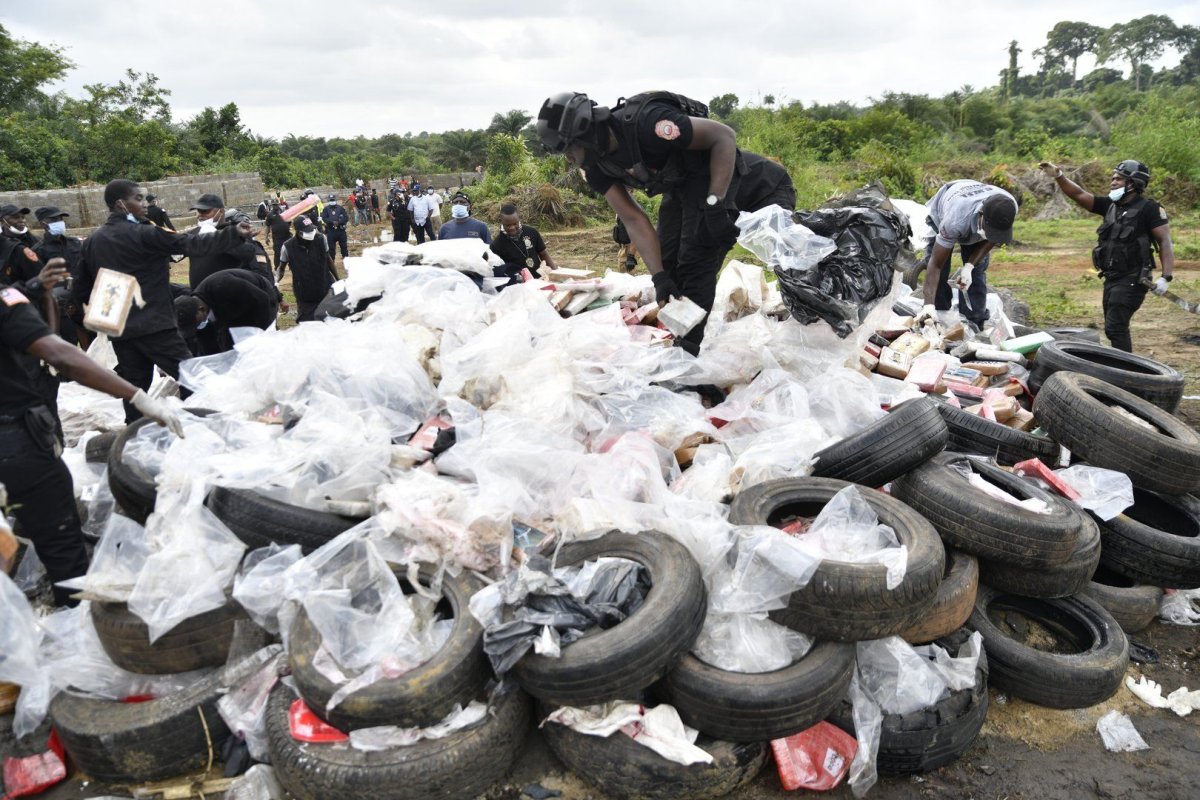
Monrovia, Liberia – July 31, 2026 — Liberian law enforcement agents on Thursday destroyed 4.2 metric tons of cocaine, valued at roughly US$336 million, in Caraysburg on the outskirts of Monrovia. The public incineration came days after authorities announced the largest drug seizure in the country's history and disclosed that senior police officials were implicated in the trafficking operation itself. The burning also consumed 237 kilograms (522 pounds) of cocaine, worth more than US$19 million, seized at Roberts International Airport in June.
Geopolitical Context: West Africa's Widening Role in the Cocaine Economy
The burning was a calculated act of enforcement theater. Police Inspector General Gregory O.W. Coleman said it sent "a clear message" that Liberia was no longer "a place of comfort" for drug traffickers. The message was directed both at Liberians, long inured to official impunity, and at the transnational networks that have increasingly treated West Africa as a soft underbelly of the Atlantic drug economy.
According to the Global Initiative Against Transnational Organized Crime, at least 30 percent of cocaine destined for European markets now transits West Africa. Porous borders, weak maritime enforcement, and overstretched judicial systems have made the region an attractive staging ground between South American producers and European consumers. The UN Office on Drugs and Crime has documented how West African hubs are now integrated into global trafficking chains that also move synthetic drugs, arms, and people.
The scale of the Liberian seizure suggests a mature logistics operation, not an accident of geography. Last week, authorities raided a property in Duazon, about 28 kilometers (17 miles) from Monrovia, and discovered nearly 4 metric tons (8,818 pounds) of cocaine with an estimated street value of approximately US$317 million. Two foreign nationals—a Serbian citizen and a dual Colombian-Spanish citizen—were detained. The Justice Ministry said the raid uncovered a sophisticated transnational trafficking network, confirming that Liberia had become a deliberate landing point for multi-ton shipments.

From Civil War and Fragile Institutions to a Narco-Corridor
Liberia's vulnerability is rooted in decades of institutional collapse. The country emerged from two civil wars—1989 to 1997 and 1999 to 2003—that dismantled the rule of law and left a security sector defined by patronage rather than professionalism. Rebuilding the Liberia National Police, the National Security Agency, and border control institutions has been slow, donor-dependent work, and corruption remains endemic across public administration.
The investigation now unfolding reveals how deeply trafficking penetrated the state itself. Investigators identified Liberian officers who allegedly helped escort the cocaine after it arrived in the country. Inspector General Coleman confirmed that the chief of the highway patrol and the head of the major crimes unit have been charged, while a deputy police commander at Roberts International Airport—the country's main international gateway—is a suspect in the operation.
The June interception of 237 kilograms at Roberts International Airport, followed by the Duazon raid, exposed the same institutional vulnerabilities at different points of the supply chain: airport security compromised, domestic transport facilitated by police vehicles, and senior officials allegedly aware of, or participating in, the movement of narcotics. The patterns mirror those observed in other fragile West African states where drug money has bought access to uniforms, badges, and border stamps.
Gulf Financial Hubs and the Transnational Money Trail
For Middle East analysts, the Liberian case holds particular significance because of where the money goes. The proceeds of multi-ton cocaine shipments do not remain in West Africa; they move through global financial systems that increasingly route through Gulf commercial hubs. Dubai and Abu Dhabi, with their expansive real estate markets, gold trade, and free-trade zones, have long been attractive destinations for laundering illicit capital. Trade-based money laundering—over-invoicing and under-invoicing shipments through third-party companies—is a favored technique.
The United Arab Emirates has strengthened its financial intelligence capacity in recent years, developing oversight institutions styled on the US Financial Crimes Enforcement Network (Fincen). Gulf Cooperation Council states have expanded anti-money-laundering coordination, and Gulf capitals have matched this with aggressive interdiction of Captagon shipments originating from Syria and Lebanon. Yet the sheer volume of legitimate wealth flowing through Gulf financial centers makes the detection of drug proceeds extraordinarily difficult—a reality traffickers exploit.
The Liberian case also resonates with Lebanon's experience in the Captagon trade. Captagon, an amphetamine-type stimulant manufactured primarily in Syria and Lebanon for Gulf consumer markets, operates on a different supply chain than South American cocaine. But the financial mechanics are strikingly similar: reliance on informal money changers and hawala networks, investments in real estate and precious metals, and the co-option of corrupt officials to move product across borders. Both trades have proven resilient because they are embedded in state fragility and benefit from weak financial oversight.
Strategic Calculus: Boakai's Purge and the Politics of Accountability
President Joseph Nyuma Boakai's decision to dismiss or suspend senior officials across five state institutions is the widest personnel purge of the investigation—and a calculated political gamble. Those removed include Mark Egon Kuiah, deputy director for operations at Roberts International Airport; Johnny Bolar Dean, police commissioner for criminal investigation, intelligence and Interpol, who admitted to taking US$10,000 to provide comfort to two suspects in the airport case; and Patrick Doe, deputy director for administration at the National Security Agency.
Two police officers, Anthony T. Blaye and Wadell W. Kwarbo, were dismissed for using official vehicles to move narcotics. Four others were ordered dismissed and turned over to the Ministry of Justice for prosecution: NSA agents Jammel V. Jallah, Christian L. Nyantee, and Albenigo Janior, along with Caycee Nelson, procurement director at the Ministry of Gender, Children and Social Protection. In total, nine named officials have been dismissed or ordered dismissed.
The Executive Mansion said the removals demonstrate resolve to ensure no public official engaged in criminal conduct remains in public service. The strategic calculus is clear: by sacrificing senior figures publicly, Boakai is signaling to domestic constituents and international partners that his administration will confront the corruption that has long defined Liberian governance.
The risk is equally apparent. Investigations of this depth often generate political fallout that extends beyond the targeted individuals. If the probe reaches into the upper echelons of the ruling coalition—or exposes institutional corruption that predates the Boakai administration—the president could face an entrenched backlash. The next phase of prosecutions will determine whether this is a genuine reform effort or a high-profile but temporary gesture.
The Limits of Incineration: Burning Drugs Does Not Dismantle Networks
Public destruction of narcotics sends a deterrent signal, but it does not by itself disrupt trafficking networks. The 4.2 tons of cocaine incinerated on Thursday—combined with the 237 kilograms seized in June—represent more than US$355 million in street value that will not reach European markets. The financial loss to the syndicates is real. But the operation's lasting value depends on the intelligence and prosecutions that follow.
Coleman's assertion that Liberia will no longer serve as "a place of comfort" for traffickers is an implicit acknowledgment that it long has been. The charging of the highway patrol chief and the major crimes unit head, the naming of the deputy commander at Roberts International Airport as a suspect, and the dismissal of nine officials are rare accountability measures in West African law enforcement. Whether they translate into lasting reform depends on the independence of the prosecutions and the protection afforded to investigators.
Regional Implications: From Monrovia to Beirut, a Shared Test
The destruction of a multi-ton cocaine shipment in a West African capital may seem remote from the Middle East. It is not. The financial networks that enable the cocaine economy are the same ones that have channeled Captagon profits through Lebanon and the Gulf, the same hawala systems that move money across borders without formal banking records, and the same free-zone trade routes that connect West African ports to Gulf commercial centers.
The West Africa Commission on Drugs has argued for years that the region's drug problem cannot be solved through interdiction alone; it requires governance reform, public health investment, and economic development. That analysis applies with equal force to the Middle East. Lebanon's Captagon economy will not be dismantled by border seizures alone, just as Liberia's cocaine corridor will not be closed by a bonfire.
If the Boakai administration follows through with prosecutions and institutional reform, Liberia could offer a rare model of a fragile state confronting transnational organized crime rather than accommodating it. If the momentum fades, the message to traffickers will be equally clear: West Africa remains open for business, and the Gulf financial hubs that absorb its proceeds remain part of the architecture.
The next twelve months will be decisive. The networks behind the Duazon raid and the Roberts International Airport seizure have been disrupted and exposed—but not dismantled. Whether Liberia, its West African neighbors, and their Gulf counterparts press the advantage will determine whether this bonfire marks the beginning of an enforcement era, or another theatrical gesture in the long and difficult war against narcotics.
By Malik Hassan, Staff Writer
This article was produced with AI-assisted research and editorial support. Reporting is based on sources cited in the article.
What's Your Reaction?
 Like
0
Like
0
 Dislike
0
Dislike
0
 Love
0
Love
0
 Funny
0
Funny
0
 Wow
0
Wow
0
 Sad
0
Sad
0
 Angry
0
Angry
0
Middle East Correspondent at Global1.News. Based in Beirut, covering politics, conflict, energy, and society across the Middle East. Brings context and depth to a region often reduced to headlines.











Comments (0)