
Kremlin Says Ukraine Talks on 'Deep Pause' as CIA Chief's Secret Moscow Visit Comes to Light
Kremlin spokesman Dmitry Peskov declared Ukraine peace talks on a 'deep pause' as CIA Director John Ratcliffe's secret Moscow visit surfaced this week — the first by a U.S. intelligence chief since the full-scale war began.
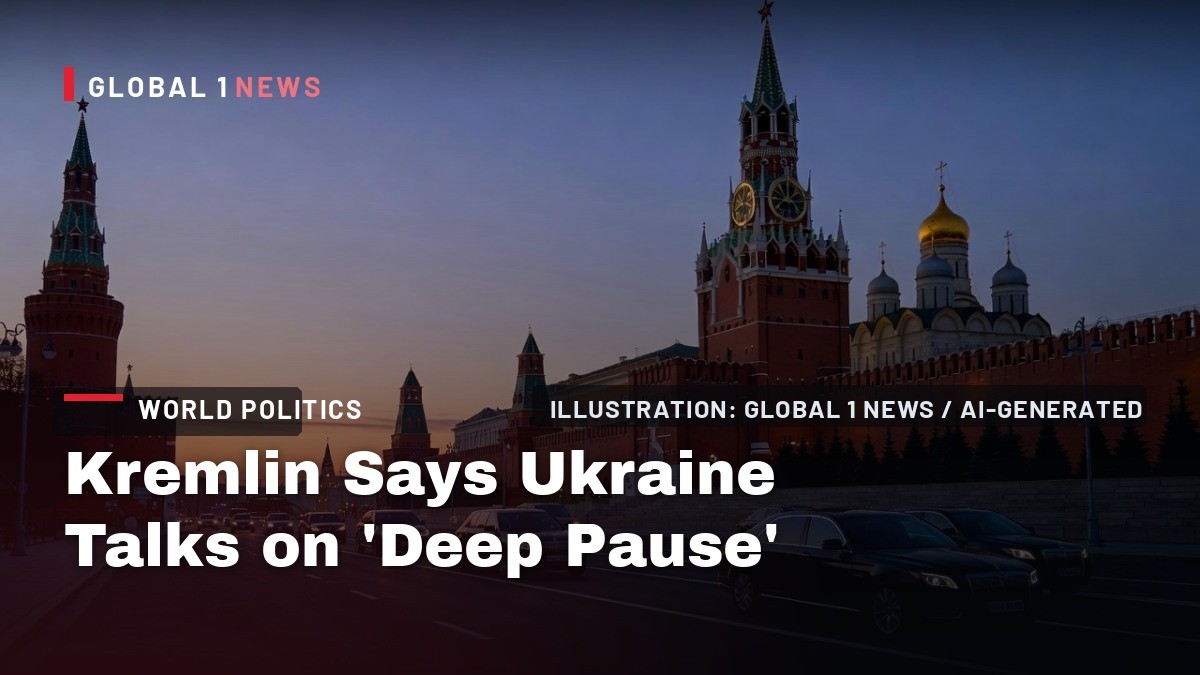
The Kremlin declared peace negotiations with Ukraine to be on a "deep pause" on Friday, even as it emerged that CIA Director John Ratcliffe had made a secret, unannounced visit to Moscow this week — the first trip by a U.S. intelligence chief to Russia since the full-scale war began. The simultaneous signals from Moscow and Washington underscore a profound contradiction: while the public rhetoric from the Kremlin points to a grinding military offensive, the private channels between the two capitals remain active, if deeply strained.
Kremlin Says Ukraine Talks on 'Deep Pause' as CIA Chief's Secret Moscow Visit Comes to Light
Moscow, Russia — Kremlin spokesman Dmitry Peskov told reporters on Friday that peace negotiations with Ukraine are on a "deep pause," a stark departure from his earlier statements this summer confirming ongoing dialogue with U.S. negotiators. The comments came just hours after The New York Times reported that CIA Director John Ratcliffe had visited Moscow this week, a trip shrouded in such secrecy that it was not announced in advance by either government.
Peskov's Defiant Stance on the Frontlines
"We're pressing forward with the special military operation and our troops are making gains on the frontlines," Peskov said during his daily press briefing. "As for peace talks, that topic is currently on a deep pause."
The spokesman's remarks signal a hardening of the Kremlin's position, which continues to demand that Ukraine cede full control of the Donetsk region as a prerequisite for any ceasefire agreement — a condition Kyiv has repeatedly rejected. "The Ukrainian side knows our demands full well. They just don't want to discuss them peacefully," Peskov added.
His comments come one day after the chief of Russia's General Staff claimed Russian troops were inching closer to the heavily fortified Donetsk region city of Slovyansk. Peskov said the Russian military was "intentionally destroying the Kyiv regime's military and military-adjacent infrastructure," adding, "Our forces know what they're doing and how to do it."
Ratcliffe's Secret Mission to Moscow
The CIA director's visit, which took place on August 25, marks the first known official trip to Russia by the head of a U.S. intelligence agency since the start of the full-scale war. According to the Kyiv Independent, a U.S. Air Force C-17 military transport plane departed Riga in the morning and landed at Moscow's Vnukovo Airport at around 10 a.m. local time. The plane, previously stationed at Andrews Air Force Base in Maryland, departed Moscow at about 5:30 p.m. and landed in Riga just over an hour later.
The Washington Post reported that Ratcliffe secretly visited Moscow to warn Russia not to exploit perceived U.S. weakness from the Iran war, saying escalation in Ukraine would push President Donald Trump toward Ukrainian President Volodymyr Zelensky. Several days after the visit, Ratcliffe was still not known to have met with Russian President Vladimir Putin.
Intelligence Channels Remain Open
Kremlin spokesman Peskov characterized the trip as a matter of "communication through intelligence service channels." According to Sergei Naryshkin, director of Russia's Foreign Intelligence Service (SVR), he and Ratcliffe "discussed a number of issues that fall within the purview of the intelligence services."
The CIA director has maintained contact with his Russian counterpart, Naryshkin, who has previously signaled readiness to meet the U.S. spy chief. Russian and foreign experts consider the CIA director's trip to Russia a highly unusual event, given the ongoing hostilities and the absence of official word from either Moscow or Washington on what was discussed.
Washington's Warning to Moscow
Politico reported that Ratcliffe warned Russian officials in Moscow this week not to escalate conflict with America's NATO allies, in particular Estonia, Latvia and Lithuania, in response to Moscow's stalemated invasion of Ukraine, according to two people familiar with the matter. The warning comes amid heightened tensions in the Baltic region, where NATO forces have been on alert since the start of the war.
U.S. President Donald Trump called Ratcliffe's trip routine, yet there has still been no official word from either Moscow or Washington on the substance of the discussions. The visit underscores the delicate balance the Trump administration is attempting to strike between maintaining diplomatic channels with Moscow and reassuring NATO allies of its commitment to their defense.
Kyiv's Restraint During the Visit
In a significant development, the U.S. asked Ukraine not to strike Moscow and St. Petersburg while Ratcliffe was visiting Russia, a person familiar with the situation told the Kyiv Independent on August 25. Kyiv agreed to pause strikes against the cities between August 24 and 26.
Moscow Mayor Sergey Sobyanin reported shortly before 2 a.m. local time on August 26 that Russian air defense units had shot down 10 drones bound for the capital. The timing of the drone attacks, just hours after Ratcliffe's departure, raises questions about the effectiveness of the pause agreement and the level of coordination between Washington and Kyiv.
Stalled Diplomacy Since Trump Took Office
The U.S. and Russia have seen intensified bilateral contacts since Trump took office last January and pledged to negotiate a peace settlement in Ukraine. Despite repeated visits by Trump's peace envoys, Steve Witkoff and Jared Kushner, to Moscow, the negotiations have effectively stalled as both Russia and Ukraine remain far apart on territorial issues.
Both Witkoff and Kushner were expected to make their first visits to Ukraine this week, but the trip was postponed. Ukraine's top negotiator, Rustem Umerov, spoke by phone with Witkoff on August 23, but no concrete progress has been reported.
Vatican's Peace Efforts and the Human Cost
Peskov's public dismissal of diplomacy also comes on the back of a senior Vatican diplomatic envoy meeting with Russian Foreign Minister Sergei Lavrov this week to call for peace in Ukraine. The Vatican's intervention highlights the growing international concern over the prolonged conflict and the lack of a clear path to negotiations.
Washington and Moscow continue to keep their diplomatic channels open, which on August 11 helped to broker the release of former U.S. Marine Robert Gilman, who had been imprisoned in Russia for four years. Such exchanges demonstrate that despite the public posturing, both sides recognize the value of maintaining communication lines.
Analysis: A Dangerous Game of Signals
The juxtaposition of Peskov's dismissive rhetoric with Ratcliffe's secret visit reveals a Kremlin that is simultaneously preparing for a prolonged military campaign and engaging in back-channel diplomacy. The "deep pause" in peace talks appears to be a calculated position, allowing Russia to continue its offensive in eastern Ukraine while keeping the door open for future negotiations.
For ordinary Russians, the continuation of the war means ongoing economic sanctions, isolation from the West, and the steady toll of casualties in the Donbas. The Kremlin's insistence on territorial demands, particularly regarding Donetsk, suggests that a negotiated settlement remains a distant prospect.
The secretive nature of Ratcliffe's visit and the lack of transparency from both governments raise concerns about the true state of U.S.-Russia relations. While the intelligence channel between Moscow and Washington remains functional, the public diplomacy has all but collapsed. The coming weeks will reveal whether this back-channel communication can translate into tangible progress or whether the "deep pause" becomes a permanent freeze.
By Irina Volkov, Staff Writer
This article was produced with AI-assisted research and editorial support. Sources: The Moscow Times, Kyiv Independent, Meduza, Politico.
What's Your Reaction?
 Like
0
Like
0
 Dislike
0
Dislike
0
 Love
0
Love
0
 Funny
0
Funny
0
 Wow
0
Wow
0
 Sad
0
Sad
0
 Angry
0
Angry
0
Russia/Eastern Europe Correspondent at Global1.News. Covering Russian politics, energy, security, and the shifting dynamics of the post-Soviet space. Provides clear-eyed analysis on one of the world's most opaque regions.












Comments (0)