
Canada's Economy Grows 3.3% in Q2, Led by Exports and Business Investment
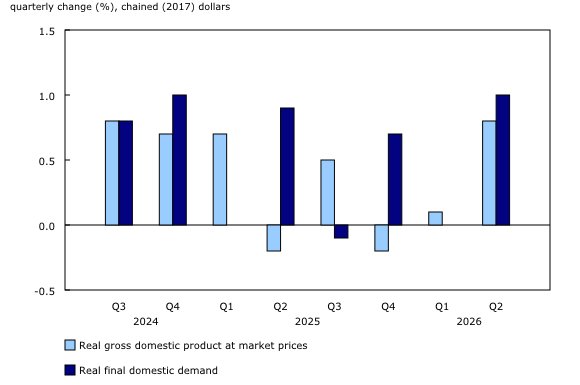
In a recent CBC News report, Statistics Canada revealed that the Canadian economy grew at a 3.3% annualized pace in the second quarter of 2026, a sharp rebound from the sluggish start to the year. The data, released on Friday, shows real GDP rose 0.8% in Q2, driven by higher exports, household spending, and business capital investment — a welcome sign for Canadians grappling with cost-of-living pressures and trade uncertainty.
In a recent CBC News report, Statistics Canada revealed that the Canadian economy grew at a 3.3% annualized pace in the second quarter of 2026, a sharp rebound from the sluggish start to the year. The data, released on Friday, shows real GDP rose 0.8% in Q2, driven by higher exports, household spending, and business capital investment — a welcome sign for Canadians grappling with cost-of-living pressures and trade uncertainty. The rebound offers a measure of relief after a winter of stalled growth, though economists caution that new U.S. tariffs and cooling momentum could temper the optimism in the months ahead.
Canada's Economy Rebounds with 3.3% Annualized Growth in Q2, Led by Exports and Business Investment
Ottawa, Ontario — Statistics Canada reported on Friday that the country's real gross domestic product rose 0.8% in the second quarter of 2026, translating to a 3.3% annualized gain — the strongest quarterly performance in over two years. The rebound was fuelled by a surge in exports, particularly passenger vehicles, as well as solid gains in household spending and business capital investment. The figures mark a decisive turnaround from the first quarter, when growth was revised up only marginally to 0.1% from an initial estimate of no growth, and from the fourth quarter of 2025, which contracted 0.2%. With two consecutive quarters of contraction avoided, Canada has officially sidestepped a technical recession.
The Numbers: What Statistics Canada Reported
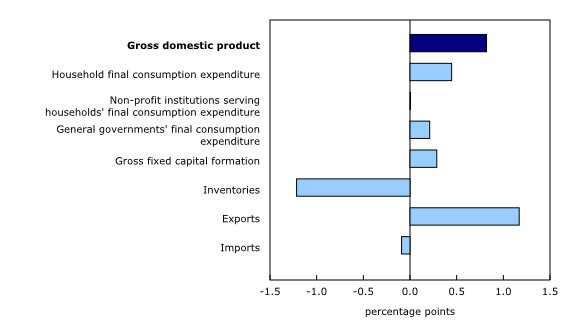
Statistics Canada's detailed breakdown shows real GDP expanded 0.8% on a quarterly basis, with final domestic demand rising 3.9% annualized, according to RBC Economics. The growth was broad-based: household spending rose 0.8%, led by mutual funds and other investment services, passenger vehicles, and rent, while households bought less gasoline and food, likely in response to higher prices. Business fixed investment jumped 9.5% annualized, with machinery and equipment spending up 22% — the strongest showing since the second quarter of 2024. Investment in computers and computer peripherals surged 16.7%, largely driven by data-centre processing units, reflecting continued demand for digital infrastructure.
Per capita real GDP rose 1.0% in the quarter, a notable improvement, as Canada's population declined for a third consecutive quarter. The household saving rate edged up to 3.7% from 3.3%, while household disposable income rose 2.1%, boosted in part by a one-time GST/HST credit payment delivered through the new Canada Groceries and Essentials Benefit. The federal program, introduced earlier this year, was designed to offset food and grocery inflation for lower- and middle-income families, and the data suggests it provided a measurable lift to household finances during the quarter.
The Trade Picture: Exports Surge, Autos Lead the Way
Exports rose 3.6% in the second quarter — the largest increase since the first quarter of 2023 — led by a 27.0% jump in passenger cars and light trucks as auto production rebounded after winter disruptions that had idled assembly plants across Ontario and Quebec. Energy products, intermediate metals, and industrial machinery also boosted export volumes, reflecting strong demand from the United States and other trading partners. Imports rose a more modest 0.3% after a 3.1% gain in the first quarter, meaning net trade added 4.4 percentage points to annualized growth — the single largest contributor to the quarter's expansion.
However, the trade picture is clouded by the latest round of U.S. tariffs, which took effect in recent weeks. RBC Economics noted that the 50% tariffs on Canadian goods add downside risk, with effects concentrated in plastics, electrical machinery, furniture, and wood products. The regional impact is expected to be most pronounced in Quebec, British Columbia, and Ontario, where those industries are heavily clustered. Still, more than 80% of Canadian exports continue to enter the U.S. duty-free under the Canada-United States-Mexico Agreement (CUSMA), providing a buffer against the worst-case scenarios. Canada's counter-tariffs and federal support measures, including business assistance programs and income supports, will shape how widely the effects spread across sectors and provinces.
Housing and Household Finances: A Modest Turnaround
Residential investment rose 2.5% in the second quarter after two consecutive quarterly declines, offering a glimmer of hope for a housing market that has struggled with affordability challenges. Resale activity — measured through ownership transfer costs — increased most in Ontario, Quebec, and British Columbia, while new construction rose 0.8%, led by apartment starts in British Columbia. The rebound comes as the Bank of Canada has held its policy rate steady in recent months, providing some stability for prospective buyers, though elevated prices and borrowing costs continue to strain household budgets in major urban centres.
Household finances showed signs of improvement, with disposable income rising 2.1% in the quarter and the saving rate edging up to 3.7%. The one-time GST/HST credit payment under the Canada Groceries and Essentials Benefit played a role, but economists caution that the boost is temporary. Meanwhile, households spent less on gasoline and food, a behaviour consistent with higher prices at the pump and grocery stores. The cost-of-living pressures remain a central concern for Canadian families, particularly in cities like Toronto and Vancouver, where housing costs consume a significant share of income. The modest uptick in residential investment suggests some buyers are re-entering the market, but affordability remains a structural challenge that federal and provincial governments have yet to fully address.
What Economists Say: RBC Analysis and Bank of Canada Expectations
RBC Economics described the second-quarter performance as a "solid rebound" but cautioned that momentum is already cooling. The bank's early estimate of July output was "essentially unchanged" from June, suggesting that the third quarter is off to a slower start. RBC expects growth to moderate but remain positive through 2026, with the Bank of Canada keeping its policy rate unchanged for the remainder of the year. The central bank has signalled that it is monitoring inflation and trade risks closely, and the current data — with core inflation hovering near the 2% target — gives it little reason to move in either direction.
Economists also noted that the composition of growth matters. The surge in business investment, particularly in machinery and equipment and data-centre infrastructure, points to confidence in the medium-term outlook, even as trade uncertainty persists. However, the reliance on exports — especially autos — leaves the economy vulnerable to disruptions in cross-border supply chains. The U.S. tariffs, which target specific sectors, could weigh on manufacturing activity in Quebec and Ontario, while British Columbia's exposure to wood products and furniture makes it particularly sensitive to trade policy shifts. RBC's analysis suggests that the overall impact will be manageable, but the distribution of pain across regions and industries will be uneven.
Provincial and Regional Impact: Quebec, B.C., Ontario Exposure, Alberta Energy
The regional picture is mixed. Ontario and Quebec, home to the bulk of Canada's auto and manufacturing sectors, stand to benefit from the rebound in vehicle exports but face the brunt of U.S. tariffs on plastics, electrical machinery, and furniture. British Columbia, with its significant wood products industry, is also exposed to tariff headwinds, though the province's housing market showed renewed activity in the second quarter. Alberta, meanwhile, continues to benefit from energy exports, which rose in the quarter, though the province's economy remains sensitive to global oil prices and pipeline capacity constraints.
The federal government's response to the tariffs — including counter-tariffs on U.S. goods and support measures for affected industries — will be critical in shaping the regional fallout. The Canada Groceries and Essentials Benefit, which provided the one-time GST/HST credit, is part of a broader effort to cushion households from cost-of-living increases. But economists argue that more structural measures, such as interprovincial trade liberalization and investments in export diversification, are needed to reduce Canada's reliance on the U.S. market. The current data underscores the resilience of the Canadian economy, but it also highlights the vulnerabilities that come with deep cross-border integration.
What Happens Next: Outlook, Risks, and Policy Implications
Looking ahead, the Bank of Canada's decision to hold rates steady through the remainder of 2026 reflects a cautious optimism. The central bank is balancing the need to support growth against the risk of renewed inflation, particularly if tariffs push up the cost of imported goods. RBC's forecast of continued positive growth, albeit at a slower pace, suggests that the economy is on a stable footing, but the risks are tilted to the downside. The full impact of the U.S. tariffs will not be known until later this year, and the federal government's fiscal position — including its ability to fund support measures — will be tested if the trade dispute escalates.
For Canadians, the second-quarter numbers offer a measure of reassurance. The economy is growing, jobs are being created, and household incomes are rising, even as cost-of-living pressures persist. But the underlying challenges — housing affordability, trade dependence, and regional disparities — remain unresolved. The coming months will reveal whether the rebound is sustainable or merely a temporary reprieve. With the Bank of Canada on hold and the federal government focused on affordability measures, the policy path is set, but the external environment remains unpredictable. As the CBC News report highlighted, the Canadian economy has shown remarkable resilience, but the road ahead is far from certain.
By Alex Thompson, Staff Writer
This article was produced with AI-assisted research and editorial support. Reporting is based on sources cited in the article.
What's Your Reaction?
 Like
0
Like
0
 Dislike
0
Dislike
0
 Love
0
Love
0
 Funny
0
Funny
0
 Wow
0
Wow
0
 Sad
0
Sad
0
 Angry
0
Angry
0

Canada Correspondent at Global1.News. Based in Toronto, covering Canadian politics, energy, trade, and US-Canada relations. Provides the Canadian perspective on North American and global affairs.














Comments (0)