
King Harald of Norway Dies Aged 89: Europe's Oldest Monarch Remembered
Norway's King Harald V has died at the age of 89 after more than 35 years on the throne, the Royal Palace has confirmed. The monarch, who had been on sick leave for several weeks, was admitted to Oslo National Hospital a week ago, with his health drastically deteriorating over the weekend.
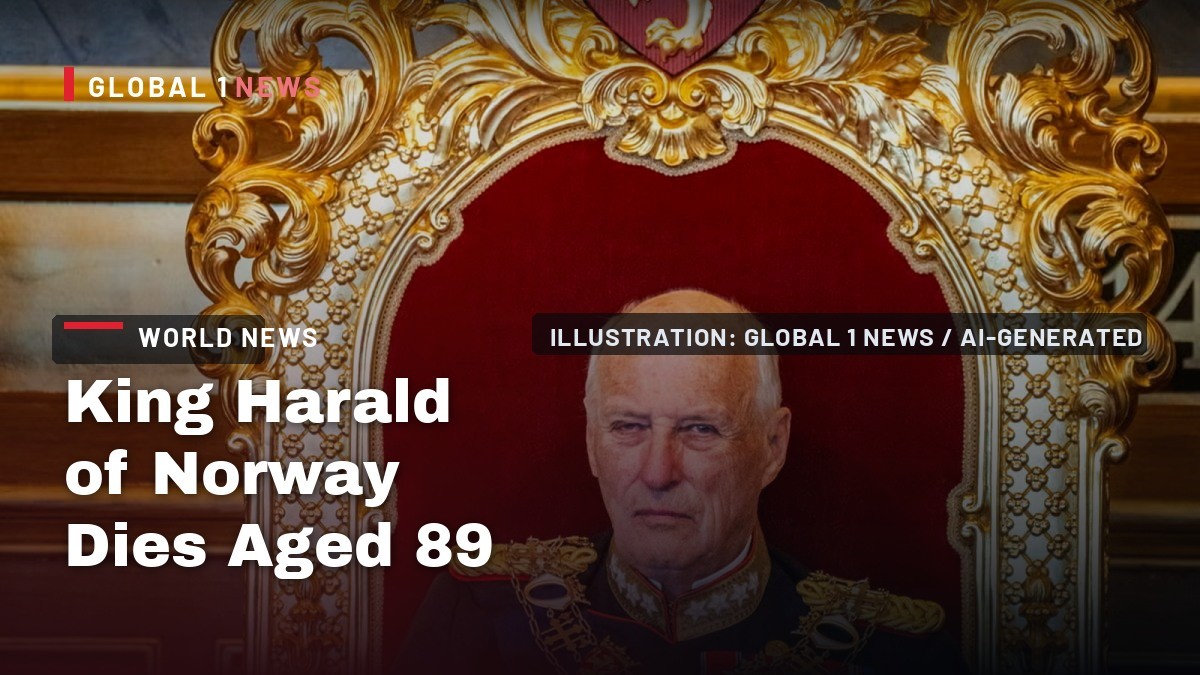
Norway's King Harald V has died at the age of 89 after more than 35 years on the throne, the Royal Palace has confirmed. The monarch, who had been on sick leave for several weeks, was admitted to Oslo National Hospital a week ago, with his health drastically deteriorating over the weekend. He passed away peacefully at Rikshospitalet on Friday at 06:35, according to a palace statement.
The king was receiving antibiotics for a bacterial blood infection and had responded to treatment, the palace said late on Sunday, adding that his condition was stable. He had also been treated for haemolytic anaemia during his final hospitalisation. His wife, Queen Sonja, and son, Crown Prince Haakon, had called off all royal engagements to gather at his bedside before his death on Thursday.
Harald became Europe's oldest reigning monarch after the death of Queen Elizabeth II. He leaves behind his wife, two children — Princess Märtha Louise and Crown Prince Haakon — and five grandchildren. His death marks the end of an era for a royal house that has weathered war, constitutional change and, in recent years, considerable reputational turbulence.
A Wartime Childhood and Exile
Born in Skaugum, Norway in 1937, Harald spent the first three years of his life in peaceful surroundings with his sisters until the German invasion in April 1940. The royal family fled the country by train to avoid being taken into custody by the occupying forces, ultimately travelling to the United States by invitation of President Franklin D. Roosevelt. They returned to Norway only in 1945.
That wartime exile left an indelible mark on the young prince, shaping a deep sense of duty and national service that would define his reign. After the war, Harald attended the Norwegian Cavalry Officers' Training School and the Military Academy in Norway, completing his studies in 1959. Between 1960 and 1962, he studied social science, history and economics at Oxford University, cementing the strong British connections that ran through his family line.
Harald was a second cousin to Britain's Queen Elizabeth II, sharing the same great-grandparents in King Edward VII and Queen Alexandra, who were the father and mother of Norway's Queen Maud. That familial link — and his own years at Oxford — kept the Norwegian and British royal houses closely connected throughout his reign.
The Commoner Marriage That Shook the Monarchy
While the king remained widely popular in Norway, his life within the monarchy was not always smooth sailing. In a major break with tradition, he married commoner Sonja Haraldsen in 1968 when he was still the Crown Prince. As heir to the throne, it was expected that he would marry someone from a European royal house, and his decision sparked considerable debate. Many even predicted the fall of the monarchy as a result.
The nine-year courtship that preceded the wedding was itself a test of endurance. Harald had met Sonja in 1959, but his father, King Olav, initially refused to sanction the union, hoping his son would choose a bride from a royal dynasty. The couple waited, and the eventual wedding at Oslo Cathedral was seen as a triumph of love over protocol. It proved to be a defining moment for the Norwegian monarchy, demonstrating an ability to adapt to modern sensibilities that would serve the institution well for decades.
That willingness to embrace change was evident again in 2017, when Harald used his largely ceremonial platform to deliver an impassioned speech in favour of LGBT rights and the plight of refugees in the country. "It is not always easy to say where we come from, to which nationality we belong. Home is where the heart is," he told an audience outside the Royal Palace in Oslo.
He continued: "Norwegians are girls who love girls, boys who love boys, and boys and girls who love each other." His closing words captured the essence of his vision for the nation: "My biggest hope for Norway is that we will manage to take care of each other, that we can build this country further on trust, solidarity, and generosity." The speech was widely praised across the political spectrum and reinforced his reputation as a unifying figure.
A Reign Marked by Resilience
Harald's later years were punctuated by significant health challenges. He suffered from numerous health issues in recent years and was eventually fitted with a permanent pacemaker. While refusing to abdicate, he was forced to make a "permanent reduction" to his public engagements "out of consideration for his age" in April 2024. He was hospitalised with an infection and dehydration in February this year during a holiday with Queen Sonja in Tenerife.
Despite these setbacks, Harald remained committed to his role. His refusal to step down, even as his health faltered, was seen by many Norwegians as emblematic of his steadfast dedication to the crown. The palace's careful management of his public appearances — balancing his desire to serve with medical advice — became a recurring theme of his final years.
The king's popularity in Norway remained remarkably robust throughout his reign. A poll published by Norway's Dagbladet newspaper in late 2022 showed 68% of respondents saying they wanted to keep the monarchy. When NRK asked the same question in 2017, support for the royal house stood at 81%. Those figures, while still comfortable, reflect a gradual erosion of enthusiasm that his successor will need to address.
King Haakon VIII: The Succession and Its Challenges
Norway now has a new king, whose tasks will include stabilising the Scandinavian country's monarchy and boosting the royal family's popularity after his wife's past contacts with deceased sex offender Jeffrey Epstein and his stepson's rape conviction. Crown Prince Haakon, 53, became King Haakon VIII upon his father's death on Friday. Haakon's oldest child now becomes Crown Princess Ingrid Alexandra and the heir to the throne.
Haakon knows the ropes. As his father aged and his health began to fail in recent years, the prince stepped in as the country's regent on several occasions. He holds a bachelor's degree in political science from the University of California at Berkeley and a master's degree in development studies from the London School of Economics and Political Science, with a specialisation in international trade and Africa. In 1995, he graduated from the Royal Norwegian Naval Academy, and he also completed the Foreign Ministry's trainee programme for diplomats.
An avid surfer, skier and sportsman, he told Norwegian broadcaster NRK that if he hadn't been a royal, he would have been a surfer. That down-to-earth sensibility has been a hallmark of his public persona, but it has also been tested by the controversies that have swirled around his family in recent years.
A New King Facing Old Problems
When Haakon met Mette-Marit Tjessem Høiby — a single mother whose son's father had been sentenced to prison for cocaine possession — at a popular music festival in Norway in 1999, he knew it was going to be an uphill battle. The country was divided. Some cheered for love, others were sceptical. The Norwegian newspaper VG wrote in 2000 that Haakon "lives closer to the people than any other heir to the throne before him."
They wed in August 2001 at Oslo Cathedral. The couple's popularity soared thanks to a carefully cultivated blend of the common touch and the glamour and grace demanded of royalty. They have two children, Ingrid Alexandra and Prince Sverre Magnus. Haakon also became the stepfather of Mette-Marit's son, Marius Borg Høiby, who has no royal title.
In June, Høiby was sentenced to four years in prison after being convicted of rape. He was found guilty of two of the four rape charges he was facing and acquitted of the other two. He was also convicted of assault and abuse in a close relationship. Høiby's lawyers said he will appeal the convictions. The trial unfolded amid renewed scrutiny of the royal family following disclosures about Mette-Marit's past contacts with Epstein. She has publicly apologised for the association and said she exercised poor judgment in maintaining contact with him. She isn't accused of any wrongdoing.
In a television interview in March, she said she was manipulated and deceived by Epstein and felt unsafe during a 2013 encounter with him at his Palm Beach, Florida, mansion. In 2018, the royal palace announced that Mette-Marit had been diagnosed with a rare form of chronic pulmonary fibrosis, meaning she sometimes must take a break from her official duties. She received a lung transplant in June.
One task for the new king will be to shore up popular support for the royal family. While a majority of people still support it, the proportion has declined in recent years and took a battering this year as Høiby's trial played out. Critics of Haakon's sister, Märtha Louise, who has written books in which she claimed to have contact with angels, also blame her for the family's reputational troubles. Märtha Louise, who was previously married for 14 years, in 2024 wed Durek Verrett, an American who describes himself as a shaman and a healer on his website. In 2022, she announced that she would no longer officially represent the Norwegian royal house.
Norway's monarchy has old roots, tracing its origins to King Harald Fairhair in the ninth century. When Norway regained its independence in 1905, three-quarters of voters in a national plebiscite approved restoring the monarchy. Today, the role is largely symbolic as the power lies with an elected parliament, but the country's royal family retains celebrity and a role in promoting the wealthy nation around the world. King Haakon VIII now inherits that legacy — and the considerable challenges that come with it.
By Erica Thornton, Staff Writer
This article was produced with AI-assisted research and editorial support. Sources: The Independent, Associated Press, Norwegian Royal Palace
What's Your Reaction?
 Like
0
Like
0
 Dislike
0
Dislike
0
 Love
0
Love
0
 Funny
0
Funny
0
 Wow
0
Wow
0
 Sad
0
Sad
0
 Angry
0
Angry
0

US Politics and Policy Correspondent at Global1.News. Based in Washington DC, covering American politics, policy, elections, and the courts. Knows how the system works and tells you what it actually means.












Comments (0)