
Mumbai cook earns ₹1.05 lakh a month, plans first Thailand trip as employer compares his finances with MBA friends
When a LinkedIn post by Mumbai resident Manuraaj Garg went viral, it sparked a broader conversation about how income, financial security and conventional measures of professional success intersect in India’s urban labour market.
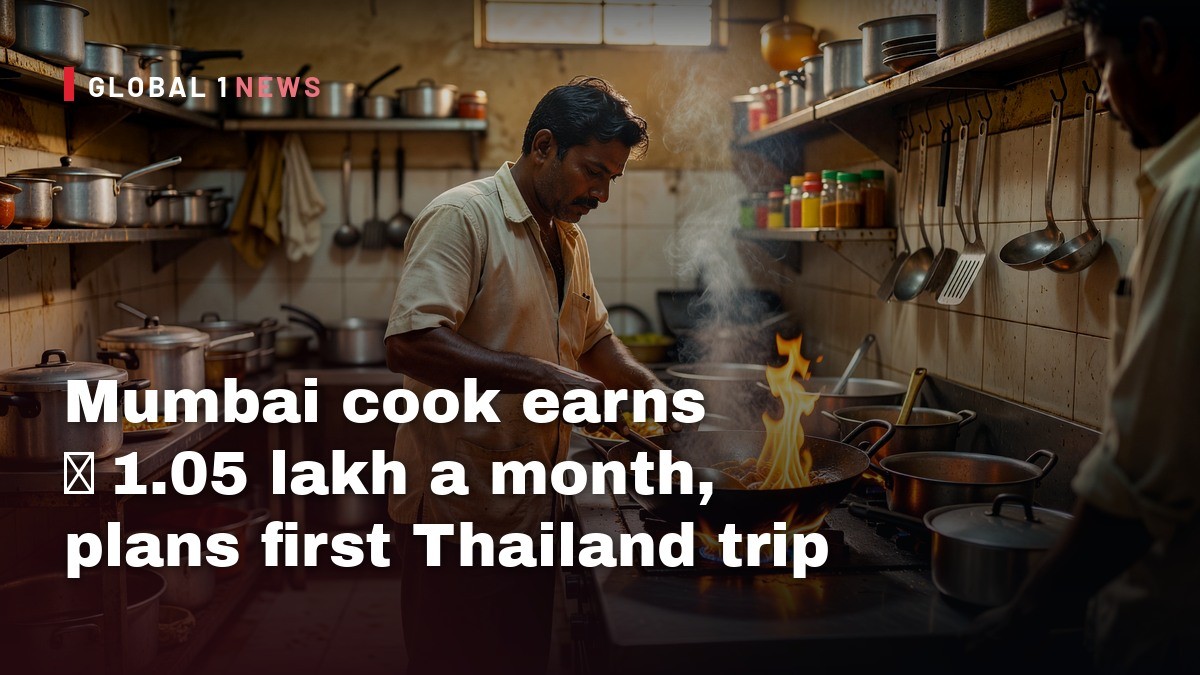
When a LinkedIn post by Mumbai resident Manuraaj Garg went viral, it sparked a broader conversation about how income, financial security and conventional measures of professional success intersect in India’s urban labour market. The post detailed the earnings of Garg’s cook, who, through a patchwork of assignments across households and film sets, pulls in roughly ₹1.05 lakh a month – a figure that, when combined with his wife’s ₹45,000 monthly salary, lifts the household total to about ₹1.5 lakh. While the sum may appear modest compared with the six‑figure salaries of many MBA‑educated professionals, Garg’s narrative underscores how diversified income streams, low commuting costs and restrained spending can produce a financial reality that challenges the traditional salaried‑employee model.
Fragmented Work, Consolidated Income
The cook’s earnings are derived from four distinct engagements, each situated within a two‑kilometre radius of his home. He charges ₹18,000 for preparing two meals a day at Garg’s residence, adds ₹16,500 for a flat in the same building, and secures ₹38,000 from a larger nearby family for cooking and kitchen management. In addition, he works Friday nights on a film set, feeding crew members during night shoots for ₹7,500 per night. This multi‑source approach spreads risk – the loss of any single assignment would affect only a portion of his total earnings, not the entire household income.
Such a fragmented work pattern reflects a broader trend in India’s informal sector, where gig‑based arrangements are increasingly common. Workers in this segment often juggle several part‑time contracts, leveraging proximity to reduce travel time and expense. Garg’s observation that the cook’s work is confined to a two‑kilometre radius highlights how urban density can enable a “micro‑gig economy,” allowing labourers to maximise earnings while minimising commuting costs – a factor that salaried professionals with longer commutes cannot ignore.
Expense Management and Lifestyle Choices
Beyond earnings, the cook’s financial picture is shaped by a disciplined spending habit. Garg notes that the cook avoids the social pressures that drive many middle‑class families to invest heavily in cars, branded schooling and conspicuous consumption. His only notable indulgence, according to the post, is an iPhone Pro purchased on an EMI plan. This restraint contrasts sharply with the lifestyle expectations often associated with MBA‑educated peers, who, as Garg points out, may face higher childcare costs, loan repayments and the need to maintain a certain status symbol.
The cook’s approach to spending aligns with a growing body of research suggesting that lower discretionary outlays can significantly boost disposable income, even when gross earnings are modest. By keeping his expenses limited to essentials and a single high‑value item, the cook retains a larger proportion of his earnings, a dynamic that challenges the conventional wisdom that higher salaries automatically translate into greater financial freedom.
Taxation, Formality and the “No Form 16” Reality
Garg emphasizes that the cook’s earnings never intersect with the formal tax and payroll systems: “No Form 16, no TDS, no CTC breakup, no ‘variable component’.” This absence of formal documentation means that the cook’s income is effectively untaxed, a circumstance that inflates his net take‑home compared with salaried professionals whose gross salaries are eroded by income tax, professional tax and statutory deductions. While this tax advantage is not a sustainable policy solution, it does illustrate how the informal sector can, paradoxically, provide higher effective earnings for workers who operate outside the tax net.
The lack of formal employment records also means the cook does not benefit from statutory protections such as provident fund contributions, gratuity or health insurance. This trade‑off between higher net earnings and reduced social security is a critical policy consideration, especially as India’s government seeks to broaden the tax base and extend social welfare to informal workers.
Comparative Perspective: MBA and IIT Alumni
Garg’s post juxtaposes the cook’s financial reality with that of his MBA‑educated friends, who, despite higher gross salaries, often grapple with substantial loan repayments, childcare expenses and lifestyle inflation. He also references IIT‑educated acquaintances who, despite strong academic credentials, sometimes struggle to secure interviews or receive timely responses from employers. This contrast highlights that higher educational qualifications do not guarantee superior financial outcomes, especially when fixed obligations and consumption expectations erode disposable income.
Such observations resonate with recent data from the National Sample Survey Office, which indicates that a sizable proportion of graduates in India are under‑employed or engaged in low‑paying jobs relative to their qualifications. The cook’s experience, therefore, serves as a micro‑case study of how skill, education and income are not always linearly correlated in the Indian context.
Financial Advice in Plain Language
Garg recounts the cook’s informal financial counsel: “Arre pagal hai kya, bahut mehenga hai.” In contrast, his friends receive advice that encourages spending – “Chalo yaar, let’s do it.” This divergence underscores a cultural shift where financial literacy is often conveyed through informal, experience‑based guidance rather than formal advisory services. The cook’s pragmatic stance, prioritising essential needs over aspirational consumption, reflects a lived‑in‑the‑moment financial strategy that many informal workers adopt out of necessity.
From a policy standpoint, the anecdote points to a gap in accessible, culturally relevant financial education for informal sector workers. While formal banking and credit institutions are expanding outreach, the need for tailored financial literacy programmes that respect the lived realities of gig workers remains acute.
First International Travel: A Symbolic Milestone
The cook’s upcoming trip to Thailand, his first flight and first passport, marks a symbolic milestone in his upward mobility. Travel, traditionally associated with higher‑income groups, is becoming more attainable for informal workers as disposable income rises and low‑cost airlines proliferate. Garg’s sharing of travel tips – from Maya Bay to street food – also reflects a subtle shift in social boundaries, where experiences once reserved for the middle and upper classes are diffusing across income strata.
However, the fact that the cook must rely on an EMI‑financed smartphone as his primary digital tool highlights the ongoing digital divide. While smartphones enable access to gig platforms and online marketplaces, the reliance on credit to acquire such devices can expose workers to debt cycles, especially in the absence of formal income verification.
Policy Implications and the Way Forward
The cook’s story, as narrated by Garg, offers a prism through which to examine India’s evolving labour market. It raises critical questions about how income diversification, low‑cost commuting, and restrained consumption can collectively enhance financial resilience, even in the absence of formal employment benefits. Policymakers could draw lessons for designing social protection schemes that recognise the fragmented nature of informal work – for instance, portable benefits linked to a worker’s identity rather than a single employer.
Furthermore, the narrative underscores the need for a nuanced approach to taxation and formalisation. While bringing informal earnings into the tax net can broaden revenue, it must be balanced against the risk of eroding the net income that currently sustains many households. Incentivising voluntary compliance through simplified filing processes, low‑cost insurance products and pension schemes could bridge this gap without imposing undue burdens.
Finally, the cook’s experience illustrates that financial well‑being cannot be reduced to a single spreadsheet column. As Garg concludes, the man “whose maths still works” challenges conventional metrics of success, urging a broader societal conversation about how we define prosperity in a rapidly changing Indian economy.
This article was produced with AI-assisted research and editorial support. Reporting is based on the source material cited below. Sources: Livemint; livemint.com; Global1.News (13 November 2026).
By Dr. Raj Patel, Staff Writer
What's Your Reaction?
 Like
0
 Dislike
0
 Love
0
 Funny
0
 Wow
0
 Sad
0
 Angry
0

India/South Asia Correspondent at Global1.News. Analytical voice with a background in science and health journalism. Based in New Delhi, covering Indian politics, education, healthcare, technology, and policy. Breaks down complex data into clear, actionable reporting.














Comments (0)