
Karnataka Food Safety Crackdown: Expired Food at Health Dept Canteen, Cockroaches at Vidhana Soudha, Zepto Warehouse Sealed
On August 12, 2026, the Karnataka Food Safety and Drug Administration (FSDA) did what no opposition party could: it walked into the state's most fortified corridors of power and found expired food on the plates.
On August 12, 2026, the Karnataka Food Safety and Drug Administration (FSDA) did what no opposition party could: it walked into the state's most fortified corridors of power and found expired food on the plates. The crackdown, ordered by Health Minister UT Khader, has now touched the canteen of the health department's own headquarters at Arogya Soudha, the kitchens feeding legislators at Vidhana Soudha, and the sprawling quick-commerce warehouses that deliver dinner to Bengaluru's tech corridors in ten minutes. For a state that prides itself on being India's startup capital, the findings are a sobering audit of who actually watches the watchers.
Karnataka's Food Safety Drive Reaches the Corridors of Power — Expired Suji at Arogya Soudha, Cockroaches at Vidhana Soudha, and a Zepto Warehouse Sealed in Hoskote
Bengaluru, Karnataka – August 13, 2026 — The Food Safety Division of the Karnataka FSDA resumed its surprise inspections on August 12, 2026, targeting eateries and food establishments across Bengaluru, including those operating within Arogya Soudha (the state health department headquarters on Magadi Road), Vidhana Soudha, Vikasa Soudha, the Legislators' Home, and the MS Building. What began as a routine enforcement drive under the Food Safety and Standards Act, 2006 has now become a political flashpoint, exposing systemic hygiene failures at the very institutions tasked with safeguarding public health.

The Raid Reaches the Health Department's Own Doorstep
The most symbolic finding came from the canteen of Arogya Soudha itself — the headquarters of the state's health and family welfare department. FSDA officials seized 500 grams each of expired suji rava (idli rava) and coconut powder from the premises. The inspection revealed that food products were not stored in accordance with FSSAI guidelines, and critically, pest control measures had not been carried out on the premises. An advisory notice was issued, and legal proceedings will now be initiated before the Adjudicating Officer under the Food Safety and Standards Act, 2006.
The irony is not lost on public health experts. Here is the department responsible for overseeing the state's food safety apparatus, and its own canteen cannot maintain basic cold-chain integrity or pest control schedules. The expired suji rava — a staple for idli preparation across Karnataka's government canteens — is a reminder that regulatory compliance is not a matter of geography or prestige. If the health department's own kitchen fails, what hope is there for the thousands of small eateries across Bengaluru Urban District that operate without any oversight whatsoever?
Inside Vidhana Soudha — Cockroaches Where Legislators Eat
The inspections extended to the state's legislative heart. At Vidhana Soudha and Vikasa Soudha premises, FSDA officials found cockroaches on eating plates and in kitchen areas — a finding that raises immediate questions about the hygiene protocols governing the food served to Karnataka's elected representatives. The Mallige Hotel, located inside the Legislators' Home adjacent to Vidhana Soudha and used by legislators, was found to have unhygienic conditions and cockroaches in the kitchen. An advisory notice was issued.
A Nandini dairy parlour on the premises was also found violating labelling requirements, resulting in an advisory notice. In total, four hotels operating within government building premises were inspected, with various deficiencies noted and advisory notices issued. One hotel in the MS Building was found to be so unhygienic that it was subsequently closed. The food business operator submitted an undertaking to rectify the deficiencies and will only be permitted to reopen after obtaining explicit permission from the Commissioner under the Food Safety and Standards Act, 2006.
This is not merely about aesthetics. The presence of cockroaches in kitchens serving legislators and senior bureaucrats indicates a failure of the Integrated Pest Management protocols that FSSAI regulations mandate. For a state that hosts the Global Investors Meet and positions itself as India's knowledge economy hub, the optics of cockroaches at Vidhana Soudha are damaging. But more importantly, it signals that the state's own institutions have been operating below the minimum standards they enforce on private businesses.
Quick Commerce Under the Lens
The crackdown has also trained its sights on the quick-commerce sector, which has become an integral part of urban India's food ecosystem. On August 11, 2026, FSDA officials inspected the Hyperpure by Zomato warehouse at Sakalawara in Bengaluru Urban district. The findings were alarming: 146 kg of chicken was found without the manufacturer's FSSAI licence number, 40 kg of garlic was linked to a manufacturer whose FSSAI licence was not in force, and mislabelling was detected in 300 kg of packed rice, 20 kg of dry fruits, and 15 kg of masala. Additionally, 10 kg of imported radish pickle was stored without refrigeration. A total of 40 samples were collected — 5 legal samples and 35 survey samples — and sent for laboratory analysis.
On the same day, the FSDA sealed a Zepto warehouse in Hoskote taluk, Bengaluru Rural district, operated in partnership with logistics firm Nippon Express. Officials found opened packets, bottles, garbage, and filth on the floor, along with misbranding and unhygienic storage conditions. A fine of Rs 25,000 was imposed, and the warehouse was sealed pending rectification.
The timing is significant. In Maharashtra the same week, the FDA suspended the food license of a Blinkit dark store in Malad West, Mumbai, after finding cockroaches on produce, expired items, and stock stored on the floor. India's quick-commerce sector is estimated at Rs 2 lakh crore, and these enforcement actions signal that regulators are no longer willing to treat dark stores as untouchable. The partnership model — where platforms like Zepto rely on logistics firms like Nippon Express — creates a diffusion of responsibility that regulators are now piercing.
What This Means for India
The Karnataka crackdown operates under the Food Safety and Standards Act, 2006 and the Food Safety and Standards (Licensing and Registration of Food Businesses) Regulations, 2011. These instruments give the FSDA broad powers to inspect, seize, and prosecute. But the real question is whether this enforcement drive represents a structural shift or a temporary political gesture.
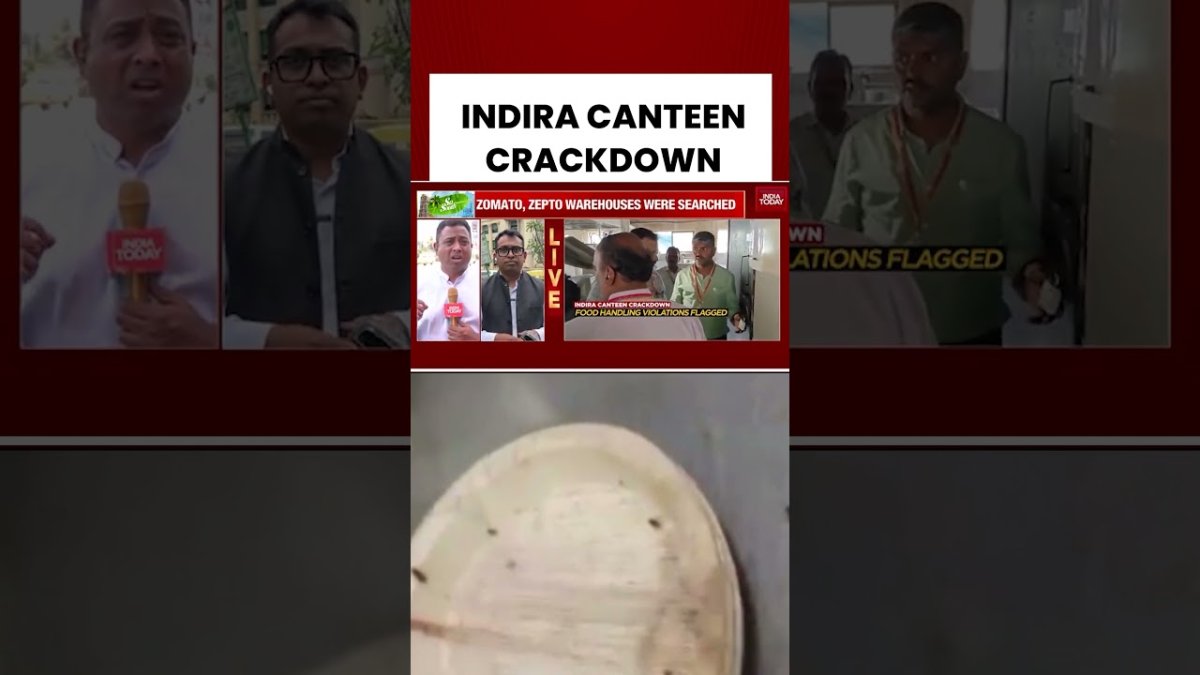
Health and Family Welfare Minister UT Khader has directed surprise inspections across Bengaluru and other major locations, telling NDTV he wants to "make the state healthier again." The mandate is clear, but the institutional capacity is strained. Earlier in the drive, 60 three-star and five-star hotels in Bengaluru Urban District were inspected, and 77 food samples were collected and sent to food laboratories for analysis. Three Indira Canteens — the state's subsidised food outlets that serve meals for Rs 5 — also received notices during the special enforcement drive.
For Indian citizens, the implications are profound. The Indira Canteen network is a lifeline for the urban poor, and its inclusion in the crackdown suggests that the state is serious about enforcing standards across all tiers. But it also raises questions about the state's own procurement and storage systems. If the Arogya Soudha canteen cannot maintain FSSAI compliance, how many of the 400-plus Indira Canteens across Karnataka are operating with expired ingredients?
The 11-point advisory issued for hotels and restaurants — covering kitchen hygiene, storage temperatures, and oil reuse — is a step toward standardisation. But advisories are only as effective as their enforcement mechanisms. The legal proceedings before the Adjudicating Officer, the closure of the MS Building hotel, and the Rs 25,000 fine on Zepto demonstrate that the FSDA is willing to use its full statutory toolkit. The question is whether this intensity can be sustained beyond the current news cycle.
Expert Perspectives
Enforcement officials within the FSDA describe the drive as a "zero-tolerance" approach. The advisory notices issued to the Arogya Soudha canteen, Mallige Hotel, and the Nandini parlour are not mere warnings — they trigger mandatory compliance timelines, and failure to rectify will result in escalated legal action. The requirement that the MS Building hotel obtain explicit permission from the Commissioner before reopening is a significant escalation, signalling that the state is willing to shut down non-compliant operators indefinitely.
Minister Khader's directive for surprise inspections across Bengaluru and other major locations suggests that the August 11-13 actions are the beginning of a sustained campaign rather than a one-off raid. The collection of 77 samples from 60 hotels in Bengaluru Urban District alone indicates a systematic sampling strategy designed to build a data-driven case for regulatory reform.
Stakeholders in the hospitality and quick-commerce sectors are watching closely. The sealing of the Zepto warehouse in Hoskote, in partnership with Nippon Express, sends a clear message: third-party logistics partnerships do not absolve platforms of their food safety obligations. Similarly, the Hyperpure findings — particularly the 146 kg of chicken without FSSAI licence numbers — raise questions about the traceability of meat products in India's rapidly scaling food delivery ecosystem.
The Bottom Line
Karnataka's food safety crackdown has achieved what years of parliamentary debate could not: it has forced the state's own institutions to confront their hygiene failures. The expired suji rava at Arogya Soudha, the cockroaches at Vidhana Soudha, and the sealed Zepto warehouse in Hoskote are not isolated incidents — they are symptoms of a systemic gap between India's food safety regulations and their enforcement.
For the Indian citizen, the takeaway is twofold. First, the regulatory framework exists and is being activated — the Food Safety and Standards Act, 2006 provides the legal teeth, and the FSDA is now using them. Second, the scale of the problem is vast. If the health department's own canteen fails inspection, the challenge of regulating India's estimated 5 million food businesses is monumental. The 11-point advisory, the 40 samples from Hyperpure, and the Rs 25,000 fine on Zepto are data points in a larger narrative: India's food safety transformation will require sustained political will, institutional capacity, and public vigilance.
Minister Khader's promise to "make the state healthier again" is a worthy ambition. But as the raid on Arogya Soudha demonstrates, the first step toward that goal is ensuring that the institutions responsible for public health are themselves healthy. The next few months will reveal whether this crackdown is a genuine reform or a political spectacle. For now, the cockroaches at Vidhana Soudha have done what no opposition leader could — they have forced Karnataka's corridors of power to look in the mirror.
— By Dr. Raj Patel, Staff Writer
This article was produced with AI-assisted research and editorial support. Reporting is based on sources cited in the article.
What's Your Reaction?
 Like
0
Like
0
 Dislike
0
Dislike
0
 Love
0
Love
0
 Funny
0
Funny
0
 Wow
0
Wow
0
 Sad
0
Sad
0
 Angry
0
Angry
0

India/South Asia Correspondent at Global1.News. Analytical voice with a background in science and health journalism. Based in New Delhi, covering Indian politics, education, healthcare, technology, and policy. Breaks down complex data into clear, actionable reporting.














Comments (0)