
Jingjiang Emerges as Global Shipbuilding Leader Amid Green Transition and Trade Tensions
In a recent CGTN report by Shi Chan, the departure of a 9,000-TEU container ship from dry dock in Jingjiang underscores how this county-level city in Jiangsu Province has become a central node in global maritime production. The footage captures the scale of operations at yards that now account for one-tenth of worldwide ship completions.
In a recent CGTN report by Shi Chan, the departure of a 9,000-TEU container ship from dry dock in Jingjiang underscores how this county-level city in Jiangsu Province has become a central node in global maritime production. The footage captures the scale of operations at yards that now account for one-tenth of worldwide ship completions. This development ties directly into China's broader push to strengthen its position in high-value manufacturing and marine equipment.
The 9,000-TEU Departure That Explains Jingjiang
The CGTN report by Shi Chan documents the departure of a 9,000-TEU container ship from dry dock at a Jingjiang yard, illustrating the city's role in meeting demand for cleaner tonnage. One in every 10 newly built ships worldwide originates from this hub within the Nantong-Taizhou-Yangzhou offshore equipment cluster. The event aligns with accelerating orders for vessels equipped with advanced propulsion systems as operators prepare for stricter emissions rules.
From County Seat to Shipbuilding Supercluster
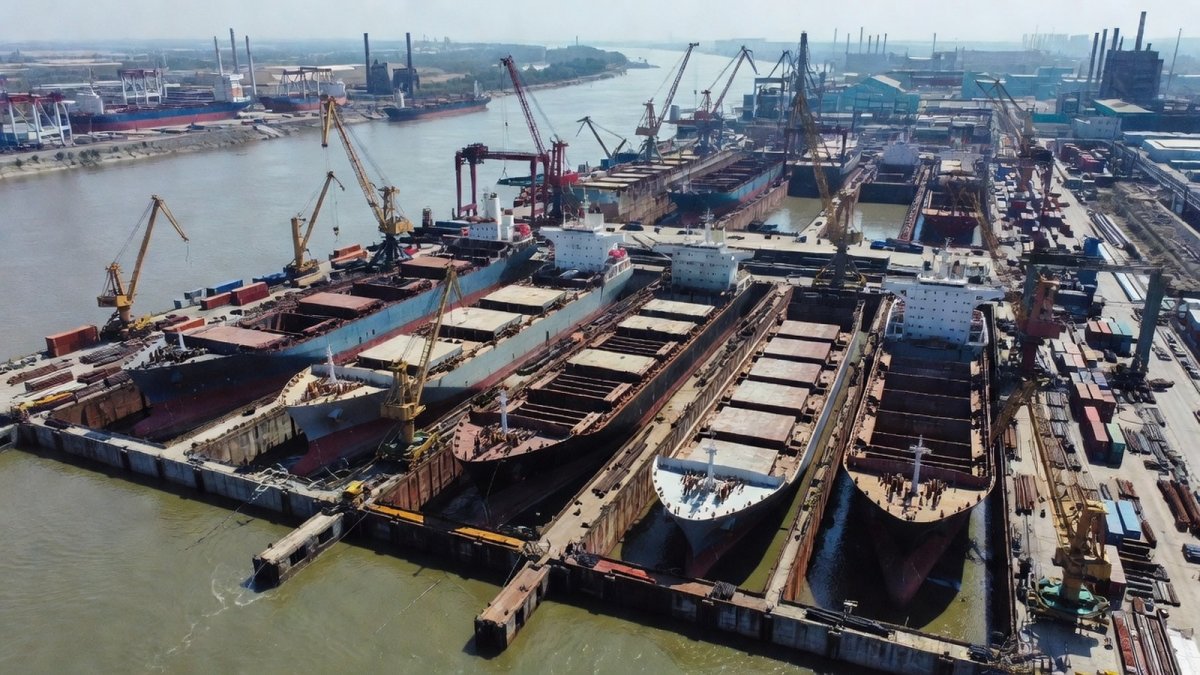
Jingjiang hosts 208 shipbuilding enterprises and supporting manufacturers, forming China's largest privately owned shipbuilding base. Yangzijiang Shipbuilding, headquartered there, maintains an order backlog of 254 vessels valued at $23.9 billion with production scheduled through 2030. Jiangsu New Times Shipbuilding delivered its 500th 10,000-ton vessel in late July 2025, while suppliers such as Jiangsu Asia Star Anchor Chain hold 200,000 tons of orders under chairman Tao Xing. These firms together represent one-quarter of China's total completions and half of Jiangsu's output, supported by more than 1,000 local products ranging from marine diesel engines to rudder shafts.
Jingjiang occupies a pivotal position within Jiangsu's Nantong-Taizhou-Yangzhou offshore equipment cluster, which itself forms a core segment of the Yangtze River Economic Belt's industrial corridor. This geographic embedding allows the county-level city to leverage upstream steel and component flows from the broader Yangtze basin while channeling finished vessels into export-oriented logistics networks. The cluster's integration under provincial coordination mechanisms has accelerated technology diffusion across municipal boundaries, enabling Jingjiang to specialize in high-tonnage construction without duplicating capabilities already concentrated in neighboring Nantong yards.
Yangzijiang Shipbuilding's status as a privately controlled group operating at the forefront of a state-prioritized strategic sector illustrates Beijing's selective tolerance for non-state actors in Dual Circulation upgrading. Unlike centrally administered shipyards under CSSC or CSIC, Yangzijiang has secured policy support for capacity expansion while retaining managerial autonomy that facilitates rapid adoption of dual-fuel and wind-assisted designs. This hybrid model demonstrates how industrial policy can harness private capital and entrepreneurial agility to meet national marine-power objectives without full state ownership.
The presence of 208 enterprises generating more than 1,000 distinct marine products, from anchor chains to diesel engines, has produced dense local supply chains that elevate export sophistication and stabilize employment in a region historically dependent on lower-value manufacturing. These linkages reduce import dependence for critical components and create skilled-labor pipelines that support sustained output growth, positioning Jingjiang as an exemplar of how county-level ecosystems can contribute to national resilience in high-value maritime industries.
The Green Shipping Wave Reshapes Demand
Yangzijiang launched a 274-meter methanol dual-fuel 9,000-TEU vessel for Maersk on July 22, 2026, equipped with Chinese-patented dual-fuel engines and membrane-type fuel tanks. Production lines remain at full capacity as carriers seek vessels compliant with IMO decarbonization targets. Order books extending through 2030 reflect sustained interest from European operators in green tonnage, reinforcing Jingjiang's position in high-end segments.
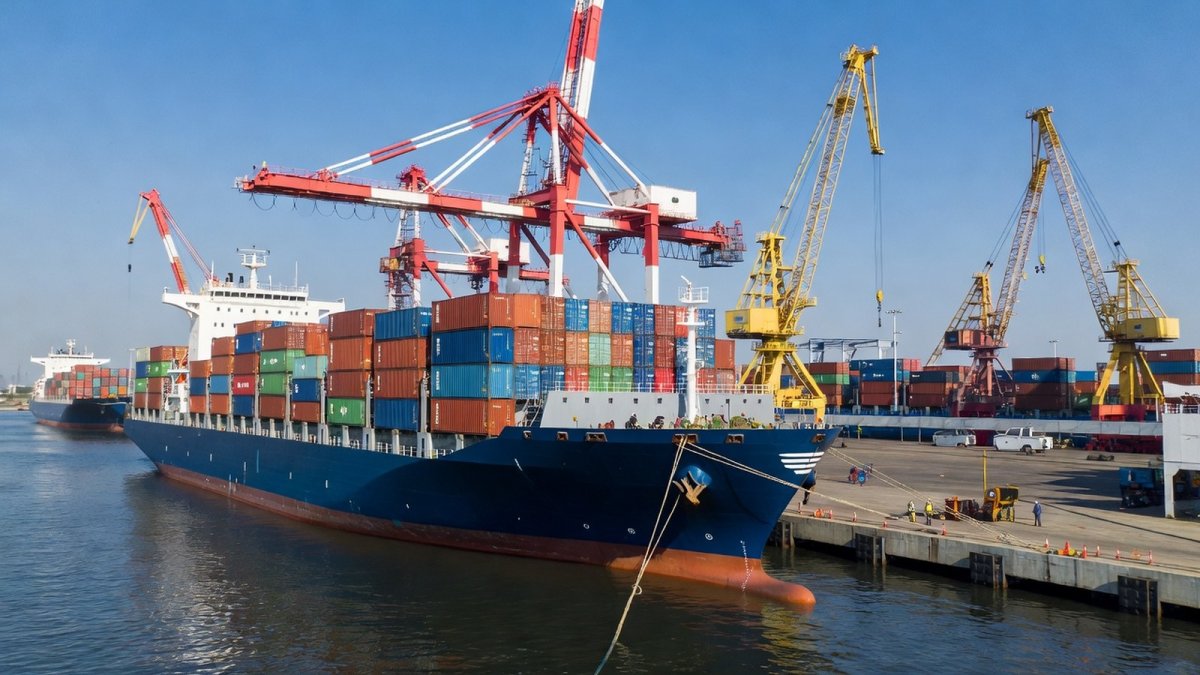
Methanol dual-fuel propulsion aligns with the IMO's phased decarbonization schedule, particularly the 2030 intensity targets and the 2050 net-zero ambition, by offering immediate compliance pathways while green-methanol production scales. Regulatory pressure from the FuelEU Maritime initiative and the EU ETS extension to shipping has compelled carriers to secure vessels capable of operating on lower-carbon fuels, even as questions persist regarding sustainable methanol feedstock availability and bunkering infrastructure outside major European hubs. Chinese yards have responded by embedding patented engine and tank technologies that meet these standards at competitive capital costs.
European carriers, led by Maersk and followed by MSC and other liner operators, have turned to Jingjiang yards because domestic European and Korean capacity remains constrained for large containership newbuildings, while Chinese facilities combine scale with demonstrated ability to integrate advanced propulsion systems. This sourcing pattern reflects a pragmatic trade-off between environmental compliance timelines and vessel availability, allowing operators to lock in slots years ahead of delivery rather than risk non-compliance penalties.
Order backlogs extending through 2030 illustrate how environmental regulation itself is constructing a competitive moat for Chinese shipbuilders. By front-loading demand for green tonnage, IMO and EU rules have effectively transferred pricing power to yards already equipped with the requisite engineering capabilities, reducing the window for competitors to catch up in the high-value green segment and reinforcing China's structural advantage in global fleet renewal cycles.
Washington's Section 301 Countermove
The United States initiated a Section 301 investigation into Chinese shipbuilding in early 2025 and proposed port fees on Chinese-built vessels, yet suspended the measures for one year amid trade negotiations. Senators Elizabeth Warren and Mark Kelly urged reinstatement in a letter to USTR Jamieson Greer, noting that orders at Chinese yards were down 23.5 percent in the first nine months of 2025. Chinese yards accounted for more than half of global commercial ship production last year, against a United States share of 0.1 percent, while Beijing's controls on critical minerals have factored into the pause. The measures remain under review as talks continue.
The one-year suspension of proposed port fees on Chinese-built vessels reveals the limits of unilateral trade measures when Beijing controls critical minerals essential to U.S. defense and clean-energy supply chains. This leverage compelled Washington to pause enforcement despite the investigation's initiation in early 2025, illustrating how economic interdependence in upstream materials can constrain downstream policy options in shipbuilding. The pause therefore functions less as a concession and more as a tactical recalibration pending broader negotiations.
The letter from Senators Warren and Kelly signals sustained bipartisan appetite for reinstating fees, framing Chinese shipbuilding dominance as a national-security concern rather than a purely commercial dispute. Their reference to the 23.5 percent order decline following the initial announcement underscores Washington's capacity to influence global booking patterns through credible threat alone, even before actual tariffs take effect. This dynamic highlights how signaling can extract short-term concessions from foreign yards and carriers.
Reinstatement of port fees would raise operating costs for any vessel calling U.S. ports, with pass-through effects likely to appear in container freight rates and ultimately consumer prices. Such escalation could accelerate diversification efforts among some operators while simultaneously testing the resilience of China's orderbook, particularly if European carriers face simultaneous pressure from both U.S. measures and tightening IMO compliance deadlines.
Why Shipbuilding Is Strategic for Beijing
Beijing views shipbuilding as essential to its marine power ambitions and the Yangtze River Economic Belt strategy. Industrial policy under the Dual Circulation framework prioritizes high-end upgrading, with private groups such as Yangzijiang advancing dual-fuel and wind-assisted technologies. These capabilities support domestic supply chain resilience while positioning Chinese yards to capture the bulk of new orders in containerships, bulk carriers, and tankers.
Second-Order Effects and What to Watch
South Korea retains roughly 17 percent of new orders, with Japan competing in specialized segments. European carriers continue to source green vessels from Chinese yards, exposing supply chains to potential tariff reinstatement. Any escalation could prompt further diversification among global operators while testing the resilience of China's dominant position in completions.
South Korea's roughly 17 percent share of new orders, concentrated among OECD-aligned yards, faces a strategic dilemma as Chinese green-vessel pricing undercuts traditional competitors in containership and tanker segments. Japanese builders, focused on specialized and high-efficiency niches, similarly confront volume erosion unless they accelerate dual-fuel offerings. Both nations must weigh deeper collaboration with Chinese supply chains against political incentives to diversify away from a single dominant production node.
European shipping lines' growing dependence on Chinese green tonnage creates concentrated risk in global supply chains, where one county-level jurisdiction now accounts for one-tenth of worldwide completions. Any disruption—whether from policy shocks or capacity constraints—would propagate quickly through liner schedules and charter markets, exposing the fragility of just-in-time fleet renewal strategies built around a geographically narrow supplier base.
Key indicators to monitor in the second half of 2026 include whether suspended Section 301 fees are reinstated, quarterly orderbook data from major yards, pricing trends for methanol-capable vessels, and the feasibility of U.S. shipyard capacity expansion given its current 0.1 percent global share. These variables will determine whether regulatory and geopolitical pressures fragment existing order flows or merely reinforce China's entrenched position in the green transition.
By Prof. Marcus Chen, Staff Writer
This article was produced with AI-assisted research and editorial support. Reporting is based on sources cited in the article.
What's Your Reaction?
 Like
0
Like
0
 Dislike
0
Dislike
0
 Love
0
Love
0
 Funny
0
Funny
0
 Wow
0
Wow
0
 Sad
0
Sad
0
 Angry
0
Angry
0

World Politics Analyst at Global1.News. Based in Beijing, covering US-China relations, global trade, and geopolitical strategy. Brings deep analytical perspective to the power dynamics shaping international affairs.














Comments (0)