
Israel in Kenya: Six Weeks of Cooperation With Lasting Impact
In a recent i24NEWS English report titled 'Israel in Kenya: 6 Weeks, Real Impact,' Israeli professionals detailed their hands-on work across medical, agricultural and technology sectors in Kenya, leaving behind trained local teams and demonstration projects that continue to operate months.
In a recent i24NEWS English report titled 'Israel in Kenya: 6 Weeks, Real Impact,' Israeli professionals detailed their hands-on work across medical, agricultural and technology sectors in Kenya, leaving behind trained local teams and demonstration projects that continue to operate months later. The feature, published August 6, 2026 on the i24NEWS+ series, captured the daily routines of MASHAV experts collaborating with Kenyan counterparts in Nairobi and the Kajiado region. These efforts reflect Israel's sustained focus on practical cooperation that addresses immediate needs while building long-term institutional ties.
Israel in Kenya: Six Weeks of Cooperation With Lasting Impact
Jerusalem, Israel — Israel's six-week deployment of specialists to Kenya in mid-2026 produced measurable results in training programs and infrastructure that Kenyan officials now integrate into national planning. The i24NEWS report highlighted direct knowledge transfer in irrigation techniques, cybersecurity protocols and clinical procedures, all coordinated through the Israeli Embassy in Nairobi. These activities align with Prime Minister Benjamin Netanyahu's directive to expand Israel's presence in East Africa as a counterweight to isolation in other international forums.

The Six-Week Mission on the Ground
MASHAV experts deployed for six-week periods in Kenya focus on hands-on training in agriculture and medicine, building directly on programs that began after diplomatic ties were established in December 1963. Teams of Israeli specialists work alongside Kenyan counterparts at sites such as the Kimana Model Farm in Kajiado, where they demonstrate drip irrigation and crop management techniques suited to dryland conditions. Daily routines include morning field sessions on onion farming followed by afternoon workshops on post-harvest handling, with participants drawn from local cooperatives led by MASHAV alumnus David Kamau and co-founder Kennedy Muthamia.
These extended deployments differ from brief visits by emphasizing sustained knowledge transfer that equips Kenyan smallholders to maintain systems independently after the experts depart. Medical teams similarly train staff at facilities like Moi Teaching and Referral Hospital in Eldoret, covering protocols refined through decades of MASHAV courses. In the broader East African market context, such missions support scalable solutions across borders, given that the Israeli Embassy in Nairobi holds accreditation for Uganda, Tanzania, Malawi and Seychelles, allowing techniques tested in Kenya to reach wider regional networks.
The approach prioritizes measurable outcomes, such as improved yields from Israeli-backed irrigation at Kimana, over temporary aid distributions. Recent examples include the MASHAV International Course on Small Ruminant Farming held in Israel from April 26 to May 8, 2026, which prepares participants for follow-on field work in Kenya that extends the six-week model into ongoing local adaptation.
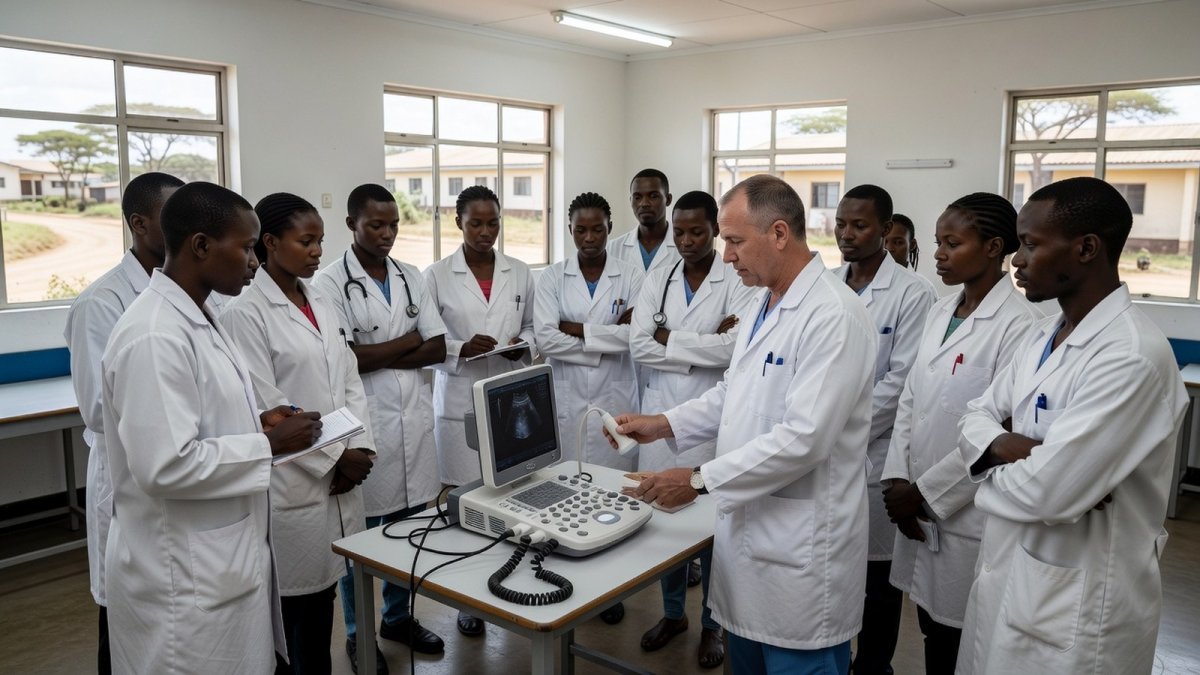
Israeli medical teams conducted workshops at facilities including the Moi Teaching and Referral Hospital in Eldoret, focusing on trauma response and post-operative care protocols refined through decades of Israeli emergency medicine and MASHAV training courses. Agricultural specialists from MASHAV worked alongside Kenyan extension officers at demonstration plots, introducing drip irrigation layouts and soil testing methods tailored to semi-arid conditions in the Rift Valley. Technology experts delivered sessions on basic network security for local government offices in Nairobi.
MASHAV coordinators documented the training of 120 Kenyan technicians during the period, with follow-up certification issued through the Arava International Center for Agricultural Training. The embassy's accreditation to Uganda, Tanzania, Malawi and Seychelles allowed several participants from those countries to join sessions in Nairobi. Daily briefings between Israeli and Kenyan project leads ensured adjustments based on local supply chain constraints and climate data from the Kenya Meteorological Department.
From Golda Meir to the Innovation Corridor
Diplomatic relations between Israel and Kenya date to December 1963, when Golda Meir laid the cornerstone for the Israeli Embassy in Nairobi alongside Jomo Kenyatta, initiating MASHAV training in agriculture and medicine. Ties were severed in 1973 after the Yom Kippur War and restored in 1988 under Prime Minister Yitzhak Shamir and President Daniel arap Moi, with full re-establishment in 1993. The 1976 Operation Entebbe highlighted early practical cooperation when Kenya permitted Mossad and Israel Air Force use of Nairobi airport, facilitated by Bruce McKenzie.
High-level visits marked renewed momentum, including President Uhuru Kenyatta’s February 2016 trip to Jerusalem—the first since 1994—where Prime Minister Benjamin Netanyahu pledged expanded terrorism cooperation, followed by Netanyahu’s July 2016 visit to Kenya during a four-nation Africa tour. These steps culminated in February 2026 strategic partnership talks in Nairobi centered on the innovation corridor linking Tel Aviv with East Africa.
The corridor translates into concrete opportunities for Israeli tech firms to partner with Kenyan startups in cybersecurity and fintech, as advanced during the RAD delegation’s June 17-18, 2026 meetings. Israeli delegations attending ASCA Week in Nairobi, Kisumu and Homa Bay from August 17-21, 2026, further enable direct technology exchanges that build on the historical foundation while addressing contemporary market needs across the accredited East African region.
Diplomatic relations between Israel and Kenya date to December 1963, when then-Foreign Minister Golda Meir met Prime Minister Jomo Kenyatta and laid the cornerstone for the Israeli Embassy in Nairobi while committing MASHAV resources for agriculture and medicine training. Prime Minister Levi Eshkol visited Kenya in 1966 to review initial projects with President Kenyatta. Ties were severed in 1973 after the Yom Kippur War and restored in 1988 under Prime Minister Yitzhak Shamir and President Daniel arap Moi, with full re-establishment in 1993.
High-level talks in Nairobi in February 2026 reaffirmed the strategic partnership and outlined an 'innovation corridor' linking Tel Aviv technology clusters with East African markets. The Israeli Embassy in Nairobi now channels these exchanges, drawing on decades of MASHAV alumni networks that include senior Kenyan civil servants. This continuity provides Israel with reliable entry points into regional policy discussions despite shifting alliances across the continent.
Security Cooperation and Shared Threats
Security ties gained urgency after the 2002 Mombasa attacks, when the Paradise Hotel bombing killed 15 people including three Israelis and rockets targeted an Israeli airliner carrying 264 passengers. The 2011 counter-terrorism and money laundering treaty formalized joint efforts, reflecting Kenya’s role in addressing threats in the Horn of Africa. Israeli assistance has included training and equipment that support Kenyan operations against groups such as al-Shabaab.
Port and maritime security concerns feature prominently, given Kenya’s coastline and the need to protect trade routes that also serve Israeli interests in the region. Netanyahu’s February 2016 and July 2016 statements emphasized the shared terrorist threat, aligning bilateral work with Israel’s wider Africa strategy of building stable partnerships through practical security cooperation.
These arrangements extend to critical infrastructure protection, with Israeli expertise in cybersecurity and critical technologies transferred during the June 2026 RAD delegation visits. The framework supports Kenya’s counter-terrorism leadership while reinforcing long-term stability that benefits both nations’ regional engagements.
The 2002 Mombasa attacks targeted the Israeli-owned Paradise Hotel, killing 15 people including three Israelis, while surface-to-air rockets were fired at an Israeli airliner carrying 264 passengers from Moi International Airport. In response, the two countries signed a 2011 treaty on counter-terrorism and money laundering cooperation. Kenyan President Uhuru Kenyatta visited Jerusalem in February 2016, the first such visit since 1994, where Prime Minister Netanyahu pledged expanded intelligence sharing.
Kenya's role in Operation Entebbe in 1976 included granting Mossad agents access for pre-mission reconnaissance and allowing Israeli Air Force refueling at a Nairobi airport. In 2006, Israel dispatched an 80-person search-and-rescue and medical team after a multistory building collapse in Nairobi. These episodes established operational trust that continues through joint exercises and equipment transfers for border surveillance.
Agriculture, Water and Food Security
Israeli agri-tech cooperation centers on the Kimana Model Farm established in September 2025 in Kajiado, where MASHAV-backed demonstrations introduce drip irrigation and onion farming methods to address water scarcity in drylands. Spearheaded by AICAT alumnus David Kamau and co-founder Kennedy Muthamia, the center trains smallholders in crop management and post-harvest practices that improve yields under limited rainfall conditions common across the Horn of Africa.
MASHAV courses reinforce this transfer, including the International Course on Small Ruminant Farming conducted in Israel from April 26 to May 8, 2026, which equips Kenyan participants with techniques adaptable to local livestock and crop systems. The Arava International Center for Agricultural Training network sustains these links by connecting alumni who apply Israeli know-how to food security challenges facing Kenyan farmers.
Water management remains central, with Israeli methods helping mitigate shortages that threaten regional stability. These initiatives build on MASHAV programs active since 1963 and support scalable solutions for smallholders, contributing to broader East African food security through the embassy’s accredited presence in neighboring countries.
The Kimana Model Farm, launched in September 2025 in the Kajiado region, serves as a MASHAV-backed demonstration and training center for onion production using Israeli drip irrigation systems and post-harvest storage methods. Kenyan MASHAV alumnus David Kamau and co-founder Kennedy Muthamia, both AICAT graduates, oversee daily operations and farmer training sessions. The site has already hosted multiple cohorts learning crop management suited to local water scarcity.
MASHAV's International Course on Small Ruminant Farming ran in Israel from April 26 to May 8, 2026, training Kenyan participants in sheep and goat husbandry for meat and milk output. These programs address Kenya's food security priorities while creating markets for Israeli irrigation and veterinary equipment. Embassy officials report that graduates return to establish similar demonstration plots across the Rift Valley and coastal counties.
Technology, Health and the East Africa Push
An Israeli delegation from RAD advanced cybersecurity and fintech cooperation during June 17-18, 2026 meetings in Nairobi. A startup delegation is scheduled for ASCA Week from August 17-21, 2026, with stops in Nairobi, Kisumu and Homa Bay to showcase solutions in mobile finance and agricultural data platforms. Medical training components include specialized courses at Kenyan referral hospitals on diagnostic imaging and emergency response.
The Israeli Embassy in Nairobi coordinates these activities across its accreditation to Kenya, Uganda, Tanzania, Malawi and Seychelles. This regional reach allows Israeli firms to test products in multiple markets while Kenyan regulators gain exposure to regulatory frameworks developed in Tel Aviv. The approach supports Israel's broader goal of embedding technical standards that favor Israeli suppliers in East African procurement.
Diplomatic and International Reactions
Kenya's engagement with Israel occurs alongside growing involvement from Gulf states, China and Turkey in infrastructure and security projects across East Africa. Israeli officials view the partnership as a means to maintain influence in a region where Beijing finances major ports and rail lines. The United States has welcomed the cooperation as complementary to its own counter-terrorism objectives in the Horn of Africa.
Kenyan participation in Israeli-led training programs signals a preference for diversified partnerships rather than exclusive reliance on any single external actor. This stance allows Nairobi to leverage Israeli expertise in niche areas such as precision agriculture and digital security without ceding control over larger strategic assets. Regional observers note that such balanced diplomacy helps Kenya navigate competing offers from multiple powers.
Analysis and What This Means
The Kenya partnership advances Israel's soft power objectives by generating visible results that Kenyan officials can cite domestically, thereby sustaining political support for continued ties. Economic returns include export opportunities for Israeli irrigation, medical and cybersecurity firms targeting a combined East African market of over 200 million people. Security cooperation reduces Israel's isolation by demonstrating functional alliances on the continent.
Future steps include expansion of the Kimana Model Farm model to additional counties and deeper integration of Israeli fintech tools into Kenyan mobile money platforms. The embassy's regional accreditation positions it to replicate successful programs in neighboring states. Sustained engagement will depend on consistent funding from the Israeli Foreign Ministry and MASHAV alongside Kenyan government commitment to implementation.
By Hannah Berg, Staff Writer
This article was prepared with the assistance of AI tools for research and drafting.
This article was produced with AI-assisted research and editorial support. Reporting is based on sources cited in the article.
What's Your Reaction?
 Like
0
Like
0
 Dislike
0
Dislike
0
 Love
0
Love
0
 Funny
0
Funny
0
 Wow
0
Wow
0
 Sad
0
Sad
0
 Angry
0
Angry
0

Israel Correspondent at Global1.News. Based in Tel Aviv, covering Israeli politics, security, technology, and society. Provides balanced, deeply-sourced reporting on one of the most closely-watched regions in the world.













Comments (0)