
Is Israel's new berm cementing Gaza's shrinking geography?
Israel advances a 23 km berm along Gaza's narrowed Yellow Line, confining the population to 40% of the Strip while Hormuz closure and Iran focus divert attention. The structure forms layered barriers that test the cease-fire and Board of Peace oversight.
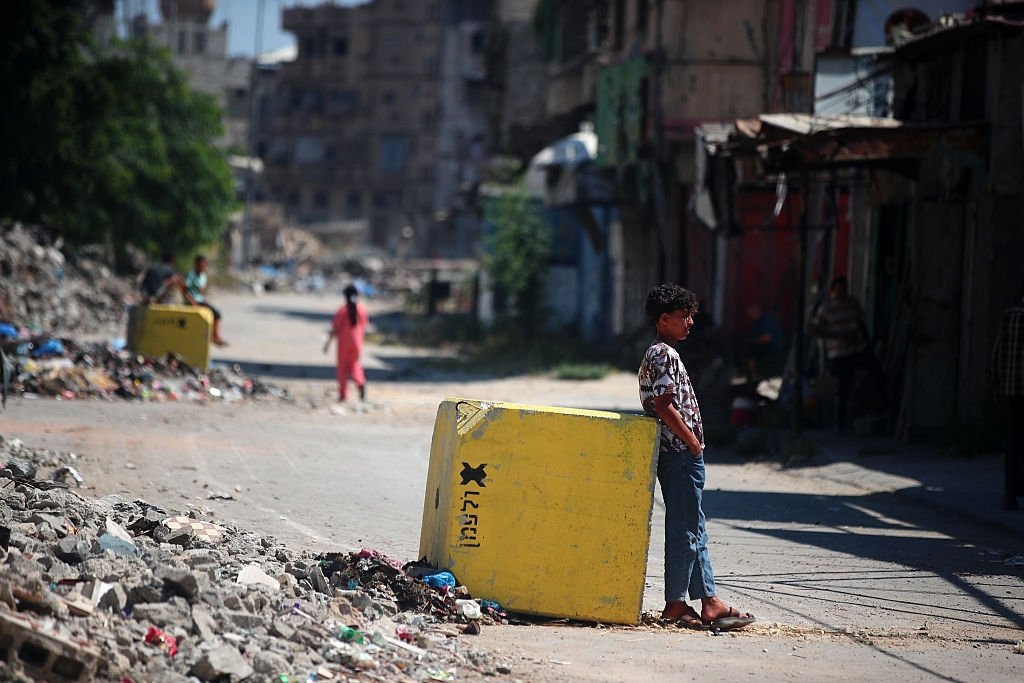
Is Israel's new berm cementing Gaza's shrinking geography?
Beirut, Lebanon - July 31, 2026 - Israel maintains the diplomatic appearance of commitment to the cease-fire while advancing a ground strategy that reduces available territory for Gaza's population. This approach exploits the current regional environment where U.S. attention centers on Iran. The resulting territorial changes create immediate pressure on the agreement's later phases.
The Berm Takes Shape
According to Associated Press reporting cited by Daily Sabah, construction of the earth berm accelerated during July and now exceeds 23 kilometers. The structure begins in al-Mawasi in the south, extends toward Khan Younis, and continues northwards in separate sections toward Beit Lahia. Israeli forces have installed reconnaissance and surveillance systems along the line.
Israeli earthworks in Gaza echo earlier buffer projects that gradually altered territorial realities without immediate formal declarations. The Philadelphi Corridor along the Egypt-Gaza border, established after 2005 disengagement, relied on similar excavation and surveillance to curb movement before any treaty adjustments. Post-2008 and 2014 fighting periods saw temporary security zones widen into semi-permanent patrol areas, where initial berms and fencing preceded negotiated shifts in access rights. These precedents show how physical barriers often create faits accomplis that later rounds of talks must accommodate rather than reverse. The current berm's alignment with the Yellow Line follows this pattern, embedding engineering decisions that constrain future boundary discussions before political agreements solidify.
Two Functions, One Strategy
The berm restricts above-ground movement, a purpose indirectly confirmed by the Israeli military. Excavation work simultaneously targets tunnels that could enable movement from the narrowed Yellow Line area to territory beyond it. These dual functions indicate preparation for longer-term control rather than temporary measures.

Satellite imagery from Planet Labs PBC via Associated Press shows a section of the earthen barrier under construction in Gaza, July 2026. (AP Photo)
Egypt confronts direct implications from the berm's tunnel-detection efforts, which target the longstanding Philadelphi smuggling routes that have strained Cairo's border control for decades. As a cease-fire mediator, Egypt must balance its role facilitating talks with the practical effects of Israeli excavation on its own frontier security. Cairo has historically managed tunnel networks through periodic flooding and military operations, yet the new barrier risks shifting smuggling pressures or necessitating coordinated monitoring that could expose Egyptian vulnerabilities. This positioning limits Egypt's leverage in enforcing withdrawal clauses, since any Israeli engineering gains along the border directly intersect with Cairo's domestic concerns over Sinai stability and economic leakage.
The Yellow Line and the Cease-Fire
Israel has narrowed the Yellow Line to confine Gaza’s population to approximately 40% of the Strip, according to the source op-ed. The cease-fire agreement requires uninterrupted aid delivery through Rafah and Israeli withdrawal from Gaza, yet both commitments remain unresolved beyond the first phase of the Comprehensive Plan. Targeted killings and intermittent strikes reinforce the territorial reduction on the ground.
Confining two million people to roughly 40 percent of Gaza territory intensifies pressure on already strained humanitarian infrastructure, particularly around displaced populations clustered near al-Mawasi and Khan Younis. The Rafah crossing's agreed role in the aid pipeline faces logistical bottlenecks when movement corridors shrink, complicating distribution to northern areas where first-phase commitments for sustained deliveries remain incomplete. Aid agencies must recalibrate routes and storage amid reduced space, raising risks of bottlenecks that could undermine the cease-fire's later stages. These constraints highlight how territorial limits translate into daily operational challenges for relief efforts, independent of political declarations about phased withdrawals.
A Multi-Layer Barrier System
The berm forms the first layer of separation between the central enclave and Israeli territory. Territories occupied by anti-Hamas groups, including factions linked to criminal activity and dependent on Israeli support, constitute a second layer. Israel’s existing high-technology border system provides the final layer, creating a stacked security arrangement around the reduced enclave.
Layered buffers around the reduced enclave undermine the territorial contiguity essential for any viable Palestinian entity under a two-state framework. The combination of the berm, anti-Hamas zones, and advanced border technology fragments remaining land into isolated pockets that limit internal connectivity and economic viability. Arab states monitoring the Abraham Accords normalization process may reassess engagement on Palestinian statehood when physical divisions appear entrenched rather than temporary. This erosion affects diplomatic incentives, as potential partners weigh whether fragmented geography can support sovereign institutions or merely perpetuate dependency arrangements that complicate broader regional integration.
Regional Distraction
Closure of the Strait of Hormuz has redirected global focus toward energy security and Iran-Gulf dynamics. U.S. President Donald Trump’s agenda prioritizes Iran, granting Israel greater room for maneuver in Gaza. This shift allows ground-level changes to proceed with reduced external scrutiny.
U.S. emphasis on Iran's maximum-pressure campaign, coupled with Gulf states' preoccupation with energy security amid Strait of Hormuz tensions and OPEC+ production quotas, has opened space for Gaza developments to proceed with limited external pushback. Russia's and China's restrained involvement in cease-fire monitoring further reduces multilateral scrutiny that might otherwise constrain ground-level changes. This diplomatic vacuum allows Israeli engineering to advance while major powers prioritize Strait dynamics and nuclear negotiations, illustrating how shifting regional priorities can sideline Palestinian territorial issues even within active agreement frameworks.
What the Guarantors Face
Unless the regional environment changes and the Board of Peace directs attention back to Gaza, the berm risks becoming the foundation of a wider barrier system. The agreement’s guarantors would face mounting pressure to enforce the original territorial terms. Restoring those terms grows harder as physical infrastructure embeds new lines into military routines.
Each guarantor evaluates enforcement through distinct interests that shape responses to the berm's expansion. Qatar balances its financial commitments and mediation prestige against risks of alienating parties if it presses territorial restoration too aggressively. Egypt weighs border security gains from reduced tunnel activity against the costs of prolonged Israeli presence near its frontier. Washington, focused on Iran containment, may deprioritize Gaza enforcement to maintain Israeli cooperation on broader regional objectives. These differing calculations determine whether guarantors can collectively restore original lines or whether individual priorities allow incremental shifts to persist.
Regional Implications
More than two million Palestinians would live within the increasingly restricted area under such an arrangement. Temporary lines acquire political durability once embedded in infrastructure, even without formal annexation. The cease-fire framework then confronts the question of whether it can still constrain facts created on the ground or whether those facts will redefine the framework itself.
Historical patterns after 1967 and 2005 demonstrate how provisional security lines often harden into enduring arrangements once infrastructure and patrol routines embed them. Reversing the berm would require coordinated international pressure and Israeli willingness to dismantle established systems, conditions that grow less likely as military logistics adapt to the new geography. Future negotiations must then address whether the cease-fire framework can still dictate territorial outcomes or whether accumulated facts on the ground will force acceptance of narrowed boundaries as the baseline for any subsequent talks.
By Malik Hassan, Staff WriterThis article was produced with AI-assisted research and editorial support. Reporting is based on sources cited in the article.
What's Your Reaction?
 Like
0
Like
0
 Dislike
0
Dislike
0
 Love
0
Love
0
 Funny
0
Funny
0
 Wow
0
Wow
0
 Sad
0
Sad
0
 Angry
0
Angry
0

Middle East Correspondent at Global1.News. Based in Beirut, covering politics, conflict, energy, and society across the Middle East. Brings context and depth to a region often reduced to headlines.










Comments (0)