
Indian-Origin Astronaut Anil Menon Harvests Space-Grown Vegetables, Cooks Meal On ISS
In a moment that blends the mundane with the monumental, Indian-origin NASA astronaut Dr. Anil Menon and his crewmate Jessica Meir sat down to a meal of freshly harvested kale and wasabi mustard greens aboard the International Space Station (ISS) on August 17, 2026.
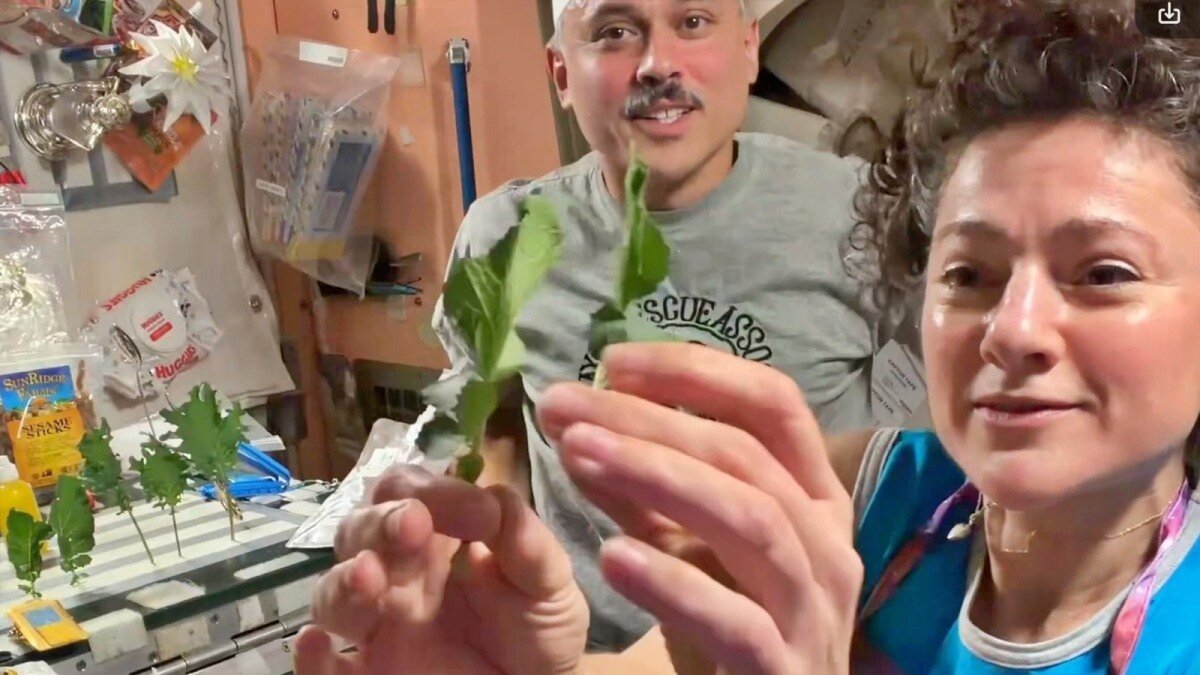
In a moment that blends the mundane with the monumental, Indian-origin NASA astronaut Dr. Anil Menon and his crewmate Jessica Meir sat down to a meal of freshly harvested kale and wasabi mustard greens aboard the International Space Station (ISS) on August 17, 2026. The vegetables, grown over a month in microgravity using NASA's Veggie plant growth system, represent a critical step toward sustainable deep-space exploration, transforming the ISS from a laboratory into a working farm-to-table kitchen.
Indian-Origin Astronaut Anil Menon Harvests Space-Grown Vegetables, Cooks Meal On ISS: A Milestone For Deep-Space Food Security
New Delhi, India – August 18, 2026 — The video, titled 'Chez ISS - Cooking on Space Station with Jessica and Anil', shows a rare moment of culinary creativity 400 kilometres above Earth, but the science behind it is anything but casual. Dr. Menon, a 49-year-old emergency medicine physician and US Space Force Colonel, documented the entire process on X, from harvesting the leafy greens to preparing a meal he called "might be the best meal we've prepared on the station." The demonstration is the latest data point in NASA's two-decade-long effort to master off-world agriculture, a capability that will determine the feasibility of crewed missions to the Moon, Mars, and beyond.
The Harvest in Orbit
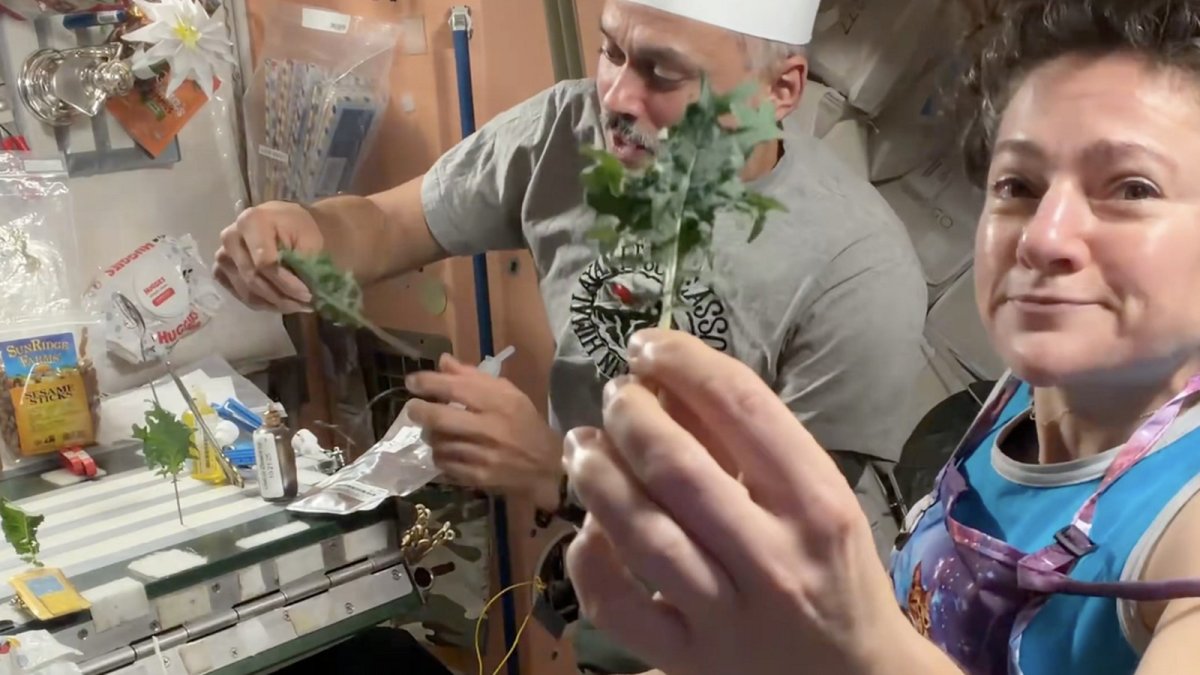
The vegetables were cultivated over a 30-day cycle using NASA's Veggie system, a deployable plant growth chamber that has been operational on the ISS since 2014. The system uses LED lighting and a passive wicking system to deliver water and nutrients to the plants, which in this case included kale, a relative of the 'Outredgeous' red romaine lettuce, and the pungent wasabi mustard greens. Dr. Menon's video, posted on August 17, 2026, shows the astronauts carefully cutting the mature leaves, a process that requires precision in microgravity to prevent water droplets and plant matter from floating away.
"This might be the best meal we've prepared on the station," Menon wrote in his post, thanking the NASA Veggie team for "providing simple skills that could help provide food for future space travel." The meal itself was a demonstration of the psychological and nutritional benefits of fresh produce, which provides essential vitamins like K and C that degrade in packaged foods over time. The harvest is part of an ongoing series of experiments designed to understand how crops respond to the altered gravity, radiation, and fluid dynamics of space, with data being relayed in real-time to ground teams at NASA's Kennedy Space Center in Florida.
Who Is Anil Menon: Doctor, Flight Surgeon, Space Farmer
Dr. Menon's path to becoming the first NASA astronaut of Malayali heritage is as unconventional as it is distinguished. Born to parents from Kerala, India, Menon is a colonel in the US Space Force, a board-certified emergency medicine physician, and a former NASA flight surgeon. Before his selection in NASA's 2021 Astronaut Candidate Class, he served as the Medical Director at SpaceX, where he was the lead flight surgeon for five launches and played a key role in developing the Crew Dragon's medical systems and the Starship's life support architecture.
His first space mission began on July 14, 2026, when he launched aboard the Soyuz MS-29 from the Baikonur Cosmodrome in Kazakhstan alongside two Russian cosmonauts. The 8-month expedition is focused on human health experiments, testing new medical technologies like portable ultrasound and DNA sequencing, and conducting semiconductor manufacturing research in microgravity. Menon's dual expertise in medicine and spaceflight makes him uniquely qualified to evaluate the physiological impacts of space agriculture, from the effects of fresh folate on astronaut blood counts to the psychological boost of tending a living organism in an otherwise sterile environment.
How NASA Grows Food in Microgravity
The Veggie system, developed by Orbital Technologies Corporation (ORBITEC) and launched to the ISS in 2014, is a collapsible, bellows-like chamber that fits in a standard ISS payload rack. It uses red, blue, and green LED lights to stimulate photosynthesis, while a capillary-driven watering system delivers moisture to the plant roots without the need for gravity. The first successful harvest came in August 2015, when astronauts ate 'Outredgeous' red romaine lettuce, followed by a crop of Zinnias in 2015-16 to study flowering in microgravity.
Since then, the program has expanded to include a variety of crops, from Chinese cabbage to the current kale and wasabi mustard greens. The science is clear: plants in microgravity exhibit altered gene expression related to cell wall formation and stress responses, but they are perfectly edible and nutritious. The data from these experiments is not just academic; it informs the design of larger, more advanced systems like the Advanced Plant Habitat, which uses 180 sensors to control temperature, humidity, and CO2 levels. For a crew of seven on the ISS, fresh produce supplements a diet that is 90% pre-packaged, providing a critical source of dietary fibre and reducing the monotony that can lead to menu fatigue and decreased caloric intake.
Why This Matters for Moon and Mars Missions
The implications of this harvest extend far beyond the ISS. A crewed mission to Mars, which NASA's Artemis programme is positioning as the next giant leap, will take approximately 9 months each way, with a surface stay of up to 500 days. At current resupply costs of roughly $10,000 per kilogram to low Earth orbit, and significantly more for deep space, shipping all food for a 3-year mission is logistically and financially prohibitive. The ability to grow a significant portion of caloric intake on-site is not an option; it is a requirement.
NASA's current roadmap calls for testing closed-loop life support systems on the lunar Gateway and the Artemis III surface missions, scheduled for the late 2020s. The Veggie system's successor, the Lunar Surface Plant Growth Module, is already in development, designed to operate in the partial gravity of the Moon. The data from Menon's harvest, particularly on water usage and nutrient uptake efficiency, will feed directly into these designs. Moreover, the psychological benefits are measurable: studies from the ISS have shown that crew members who interact with plants report lower stress levels and improved mood, a critical factor for the isolation of a Mars mission where communication delays of up to 22 minutes make real-time ground support impossible.
What This Means for India
For India, the sight of a Malayali-origin astronaut cooking space-grown vegetables is a powerful symbol of the Indian diaspora's contribution to global STEM, but it also carries practical lessons for ISRO's Gaganyaan programme. India's first crewed spaceflight, targeted for 2026-27, will place a crew of three in low Earth orbit for up to three days, but ISRO's long-term vision includes a sustained presence in orbit and, eventually, lunar exploration. The agency has already begun preliminary research on space agriculture, with the Indian Institute of Space Science and Technology (IIST) in Thiruvananthapuram conducting ground-based studies on crop resilience in simulated microgravity.
The Gaganyaan mission's crew module, developed with support from the Human Spaceflight Centre in Bengaluru, will include a basic plant growth experiment to study the effects of microgravity on Indian crop varieties like mung beans and spinach. The data from NASA's Veggie experiments, including the recent kale harvest, provides a valuable benchmark for ISRO's engineers. Furthermore, Menon's career path—from emergency physician to flight surgeon to astronaut—offers a template for India's own space medicine curriculum, which is currently being developed at the Institute of Aerospace Medicine in Bengaluru. As India prepares to send its own astronauts to space, the integration of medical expertise with spaceflight operations will be as critical as the rocket science itself.
The Bottom Line
The farm-to-table demonstration aboard the ISS on August 17, 2026, is more than a viral video moment; it is a proof-of-concept for humanity's future as a multi-planetary species. With a 30-day growth cycle, the Veggie system has shown that fresh, nutritious food can be produced reliably in the most hostile environment known to man. For Dr. Anil Menon, a physician who has spent his career at the intersection of medicine and spaceflight, the harvest is a personal milestone. For India, it is a reminder that the path to the stars is paved not just with rockets, but with the quiet, persistent science of growing a salad in zero gravity.
— By Dr. Raj Patel, Staff Writer
This article was produced with AI-assisted research and editorial support. Sources: NDTV, India Today, NewsBytes, NASA, Reuters.
What's Your Reaction?
 Like
0
Like
0
 Dislike
0
Dislike
0
 Love
0
Love
0
 Funny
0
Funny
0
 Wow
0
Wow
0
 Sad
0
Sad
0
 Angry
0
Angry
0

India/South Asia Correspondent at Global1.News. Analytical voice with a background in science and health journalism. Based in New Delhi, covering Indian politics, education, healthcare, technology, and policy. Breaks down complex data into clear, actionable reporting.










Comments (0)