
Huckabee Calls Settler Violence 'Acts of Terror' During West Bank Village Visit
The dusty hills of the central West Bank have long been a crucible of competing narratives. But on Saturday, September 5, 2026, the village of Turmus Ayya became an unlikely stage for a diplomatic paradox: a fiercely pro-settlement American ambassador, seated in a Palestinian living room, denouncing settler violence as “terror” while flanked by Palestinian-American flag-wavers who hoped his presence alone might deter the next attack.
The dusty hills of the central West Bank have long been a crucible of competing narratives. But on Saturday, September 5, 2026, the village of Turmus Ayya became an unlikely stage for a diplomatic paradox: a fiercely pro-settlement American ambassador, seated in a Palestinian living room, denouncing settler violence as “terror” while flanked by Palestinian-American flag-wavers who hoped his presence alone might deter the next attack. The visit, captured in part by Al Arabiya English video, exposed the raw contradictions of Washington’s policy in the occupied territories—where an evangelical envoy’s personal theology collides with the practical demands of protecting US citizens, and where the language of human rights is deployed selectively against a backdrop of expanding settlements.
In a West Bank Village of US Citizens, Huckabee Calls Settler Attacks ‘Acts of Terror’
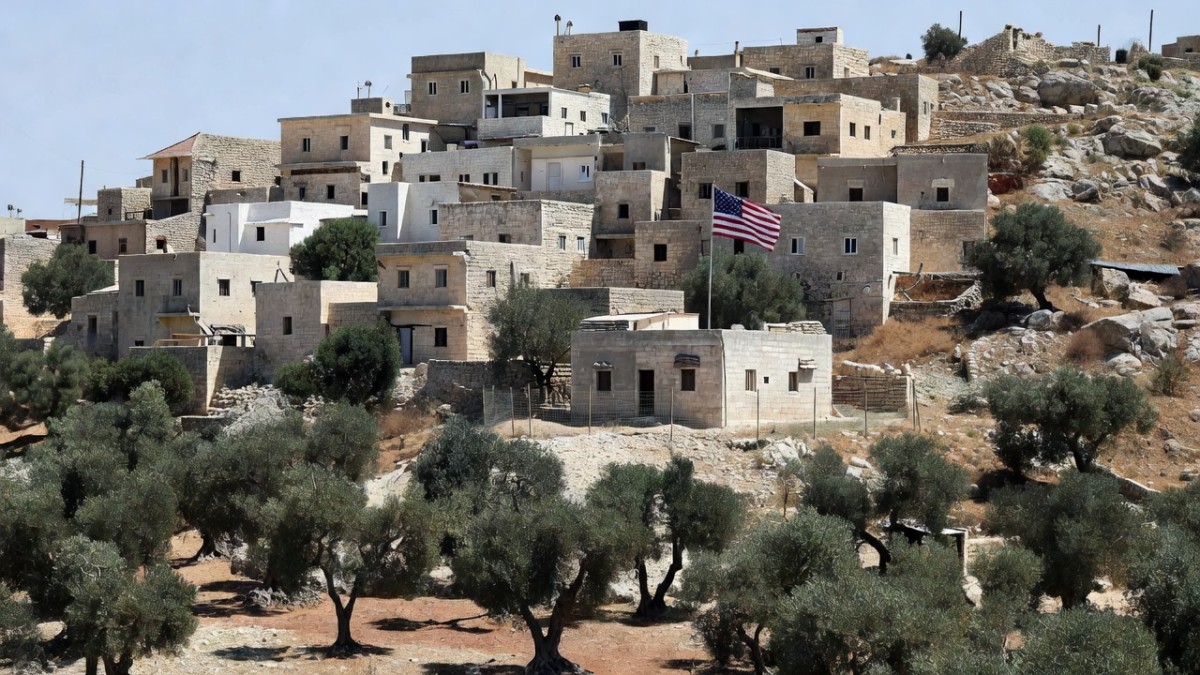
Turmus Ayya, occupied West Bank – September 6, 2026 — The American flag that flies over Samir Hazmeh’s home in Turmus Ayya is not a symbol of patriotism; it is a talisman against arson. Hazmeh, a Palestinian-American whose house has twice had its windows smashed by Israeli settlers, who also tried to force open its gates and set it alight, has installed barbed wire around his property. He hoped the stars and stripes would signal to nearby outpost residents that attacking this home would mean attacking the United States. On Saturday, that flag was joined by a motorcade of diplomatic vehicles as US Ambassador to Israel Mike Huckabee arrived for a two-hour lunch of maqluba, turning Hazmeh’s fortified living room into an unlikely venue for a high-stakes diplomatic confrontation.
Huckabee, a former Arkansas governor and evangelical Christian pastor, met with families inside the home, listening to accounts of nighttime raids, torched olive groves, and the constant hum of quad bikes from unauthorized settlement outposts. But the meeting was violently punctuated by reality: Al Arabiya English video captured the moment two Israeli settlers approached the area on a quad bike during the visit, a visual reminder that the threat was not a distant memory but an immediate presence. Israeli right-wing media later claimed the vehicle was a security patrol from a nearby farm, a characterization Huckabee himself disputed by posting footage on X and describing the men as trespassers. The incident crystallized the day’s central tension—an ambassador who has spent decades championing the settlement enterprise now using the full weight of his office to condemn its most radical actors.
A Pastor’s Epiphany or a Diplomat’s Calculus?
For those who have tracked Huckabee’s career, the scene was surreal. This is the same man who, before assuming his post, would not even utter the word “Palestinian,” preferring to refer to the West Bank by its biblical names Judea and Samaria. He has visited the nearby Israeli settlement of Shiloh twice since 2025, a community built on land that international law considers occupied territory. Yet here, in a village where roughly 80 percent of the 4,000 residents hold US citizenship according to Mayor Nawwaf Zaghoul, Huckabee deployed the most charged vocabulary in the Israeli-Palestinian lexicon. “I know that’s an uncomfortable word for some people, but when you try to create an atmosphere in which people feel uncomfortable living in their own homes... that’s terrorism by any definition,” he said, describing settler arson, vandalism, graffiti, and property seizures as acts that “extend beyond a criminal act. It’s an act of terror.”
The shift is less a theological awakening than a strategic recalibration. Huckabee’s mandate from the Trump administration appears to be twofold: maintain unwavering support for Israel’s right-wing government while simultaneously managing the political fallout of violence against American citizens. The United States has a unique lever here—an estimated tens of thousands of Palestinian-Americans reside in the West Bank, many holding dual citizenship and voting in US elections. In a closely divided Congress, the Palestinian-American constituency in states like Michigan and Illinois carries weight that transcends the region’s geography. By positioning himself as the protector of these citizens, Huckabee can burnish his credentials as a defender of American interests abroad without fundamentally challenging the settlement enterprise he has long championed.
Yet the ambassador’s words carry a subversive edge that his hosts in Jerusalem did not anticipate. When he told reporters that Israel’s government “has a responsibility” for the safety of Palestinians and should impose “severe consequences,” he was speaking a language rarely heard from American envoys in recent years. He went further, asserting that the United States has the power to pressure Israel to arrest settlers who are “known to the authorities... They can identify them, one by one, and arrest them, if they want to, with the right amount of pressure from the United States embassy and the United States administration.” This is not the rhetoric of a passive observer; it is the language of a man who believes he holds a whip hand, even as he acknowledges the embassy lacks investigative authority inside the West Bank and must rely on diplomatic suasion.
The Scripture and the Settler State
Huckabee’s invocation of biblical law to justify his stance was telling. “I think the Scripture is pretty clear — Thou shalt not steal, thou shalt not kill, and thou shalt not even covet,” he said, framing settler violence not merely as a legal violation but as a moral transgression against divine order. For an evangelical leader who has spent decades arguing that Jewish settlement of the West Bank fulfills prophecy, this selective application of the Decalogue reveals a profound cognitive dissonance. The same scriptures that sanctify the settlement of Shiloh are now being wielded to condemn the settlers who live there. This is not hypocrisy in the simple sense; it is a reflection of the internal contradictions of a movement that must reconcile its territorial ambitions with the need to maintain order and international legitimacy.
The context of the visit is critical. Last month, Huckabee intervened when settler extremists camped out and blocked supplies reaching another Palestinian-American home in the village of Qusra, an action that led to rare condemnation of settlers by Prime Minister Benjamin Netanyahu. That intervention signaled a red line: harming US citizens is unacceptable, even for a government that has otherwise turned a blind eye to settler violence. Last week, the stakes escalated further when a mosque in the village of Bizzariya was set on fire, with Hebrew graffiti reading “Regards to Huckabee from the terrorists” sprayed nearby. The message was unmistakable—the far-right settler movement views Huckabee’s recent statements as a betrayal, and they are willing to escalate to prove their defiance. Huckabee referenced the incident directly, noting that the perpetrators had identified themselves, a tacit acknowledgment that the threat is organized and ideological rather than random criminality.
Among those who met Huckabee was Hadeel Jabara, a Palestinian-American mother whose husband, Omar, a US citizen, was killed by settlers, according to Reuters. Her presence in that room was a stark reminder that the violence Huckabee condemned is not abstract. For Jabara and others like her, the American flag is both a shield and a curse—it offers a measure of diplomatic protection that their Palestinian neighbors lack, but it also marks them as targets for settlers who view US citizenship as a form of collaboration with an enemy. The ambassador’s visit, while symbolically powerful, cannot bring back Omar Jabara or restore the windows of Samir Hazmeh’s home. It can only, at best, deter the next attack through the implicit threat of American retaliation.
Washington’s Two-Faced Policy in the Occupied Territories
The strategic calculus behind Huckabee’s visit extends far beyond the dusty streets of Turmus Ayya. The Biden administration had imposed sanctions on far-right Israeli settler groups and individuals accused of violence against Palestinians, a policy that President Donald Trump rescinded in January 2025. That reversal sent a clear signal to the settler movement that Washington would no longer hold them accountable through financial measures. Huckabee’s verbal condemnation, therefore, operates in a vacuum of enforcement. He can call for arrests, but the Israeli government—described as the most right-wing in Israel’s history since late 2022—has shown little appetite for prosecuting settlers, many of whom are ideological allies of coalition partners. The ambassador’s admission that the embassy lacks investigative authority is a tacit acknowledgment that his power is limited to persuasion, not compulsion.
This creates a peculiar diplomatic dynamic. Netanyahu’s government, facing elections and reliant on far-right parties that have spoken openly of removing the Palestinian population, must balance its domestic coalition against the need to maintain American support. Huckabee’s public pressure provides Netanyahu with political cover—he can point to Washington’s demands as an external constraint, allowing him to take limited action against settlers without alienating his base. But the far-right ministers in his cabinet, including those who have advocated for annexation and population transfer, view Huckabee’s statements as an unacceptable infringement on Israeli sovereignty. The ambassador’s visit to Shiloh, a settlement that is a symbol of the religious-nationalist project, complicates the picture further. He is simultaneously the settlers’ champion and their critic, a position that is logically untenable but politically expedient.
The broader regional context adds another layer of complexity. Israel has occupied the West Bank since 1967, with more than 500,000 settlers living among roughly three million Palestinians. The settlements are considered illegal under international law, as affirmed by the Fourth Geneva Convention and the International Court of Justice’s advisory opinion of July 2024. Violence by settlers against Palestinians has persisted for years with little legal consequence, and international monitors report a surge in attacks since the Gaza war and the subsequent ceasefire. Huckabee’s denial of any Israeli plan to displace Gazans against their will—“I can tell you categorically there is no plan of the Israelis to displace people out of Gaza against their will”—is a direct rebuttal to Palestinian and international fears, but it does little to address the systemic violence in the West Bank, where the Palestinian Authority’s weakness has created a security vacuum that settlers and the Israeli military fill with impunity.
The Settler Movement’s Defiance and the Limits of American Leverage
The quad bike incident during Huckabee’s visit was not a random occurrence; it was a deliberate provocation. The settlers who approached the home of Samir Hazmeh knew exactly who was inside. Their presence was a message to the ambassador that the settlement movement does not recognize his authority to police their actions. The fact that Israeli right-wing media immediately sought to reframe the incident as a “security patrol” suggests a coordinated effort to undermine Huckabee’s narrative. The ambassador’s decision to post the footage on X, describing the men as trespassers, was a direct challenge to that narrative—a rare public rebuke of the settler movement by a US official who has historically been its most reliable ally in Washington.
This defiance is not new. The settler movement has long operated with a sense of impunity, believing that the Israeli state and its American patrons will ultimately protect them. The graffiti at the Bizzariya mosque—“Regards to Huckabee from the terrorists”—indicates that the movement now views the ambassador as an adversary, not a friend. This is a significant shift. For decades, settlers could count on American evangelical support as an unshakable pillar of their project. Huckabee’s condemnation, however qualified, cracks that pillar. It suggests that even the most sympathetic American administration has limits when violence threatens US citizens or destabilizes the region to the point of international embarrassment.
But the limits of American leverage are equally clear. Huckabee can call for arrests, but he cannot make them happen. He can cite scripture, but he cannot compel the Israeli justice system to act. The United States provides Israel with billions in military aid and diplomatic cover, but that support is not conditional on settler behavior. The Trump administration’s rescission of sanctions in January 2025 removed the most effective tool Washington had to influence settler conduct. What remains is moral suasion, which, as the quad bike incident demonstrates, carries little weight with those who believe they are fulfilling a divine mandate. The settlers who approached Hazmeh’s home were not deterred by the presence of the American ambassador; they were emboldened to test his resolve.
Palestinian-American Agency and the Politics of the Flag
For the residents of Turmus Ayya, the American flag is a complex symbol. It represents a lifeline—a path to citizenship, to education, to a future outside the confines of occupation. But it also represents a betrayal—a country that provides weapons to Israel while offering only words of condemnation for settler violence. The residents who welcomed Huckabee into their homes were not naive; they understood that his visit was as much about American domestic politics as it was about their safety. By flying the flag and inviting the ambassador to lunch, they were asserting their claim to American protection, leveraging their citizenship to force Washington to acknowledge their existence. This is a form of political agency that transcends the traditional Palestinian narrative of victimhood—it is a strategic use of dual nationality to create diplomatic friction.
Hadeel Jabara’s presence in that room was particularly poignant. Her husband, Omar, was a US citizen killed by settlers, a crime that has gone unpunished. Her meeting with Huckabee was not a social call; it was a demand for justice. The ambassador’s words about “severe consequences” may have been directed at the Israeli government, but they were also a promise to Jabara and others like her that their citizenship matters. Whether that promise will be fulfilled remains an open question. The history of US protection for Palestinian-Americans in the West Bank is checkered at best. There have been cases where the State Department issued stern statements but took no concrete action. There have been cases where families were evacuated but their homes were left to the mercy of settlers. The flag that flies over Hazmeh’s home is a fragile shield, and everyone in that room knew it.
Regional Repercussions and the Road to Elections
The implications of Huckabee’s visit extend far beyond the West Bank. In the broader Middle East, the United States is navigating a complex landscape of Arab-Israeli normalization talks, competition with Iran and its axis of proxies, and the fragile ceasefire in Gaza. Huckabee’s condemnation of settler violence, while significant, does little to address the underlying issues that fuel regional instability. The Palestinian Authority, weakened by years of corruption and ineffectiveness, is unable to provide security or hope to its people. The Israeli government, facing elections, is beholden to far-right parties that view settler violence as a legitimate tool of territorial expansion. The United States, distracted by domestic political battles and global competition with China and Russia, has limited bandwidth for the Israeli-Palestinian conflict.
Yet the visit to Turmus Ayya matters precisely because it highlights the contradictions that make a sustainable solution impossible. Huckabee can denounce settler violence while simultaneously supporting the settlement enterprise that creates the conditions for that violence. He can call for the arrest of known perpetrators while his administration has removed the sanctions that might have pressured Israel to act. He can invoke scripture to condemn theft and murder while ignoring the theft of land and the slow murder of Palestinian hope that settlements represent. This is not hypocrisy in the simple sense; it is the logical outcome of a policy that tries to have it both ways—supporting Israel’s right-wing government while protecting American citizens from that government’s most extreme elements.
For the residents of Turmus Ayya, the ambassador’s visit was a momentary reprieve, a brief acknowledgment that their suffering is seen. But as Huckabee’s motorcade departed and the quad bikes returned to the hills, the fundamental reality remained unchanged. The occupation continues. The settlements expand. The violence persists. The American flag still flies over Samir Hazmeh’s home, but it is no more effective against settler arson than it was before the ambassador’s lunch. The only difference is that now, for a few hours, the most powerful man in the room said the word “terror” out loud, and for a brief moment, the settlers who terrorize this village knew that someone in Washington was watching. Whether that watching leads to action is the question that will determine not just the fate of Turmus Ayya, but the credibility of American policy in the entire region.
This article was produced with AI-assisted research and editorial support. Sources: Reuters, The Associated Press, Agence France-Presse, Al Monitor, Al Arabiya English.
By Malik Hassan, Staff Writer
What's Your Reaction?
 Like
0
Like
0
 Dislike
0
Dislike
0
 Love
0
Love
0
 Funny
0
Funny
0
 Wow
0
Wow
0
 Sad
0
Sad
0
 Angry
0
Angry
0
Middle East Correspondent at Global1.News. Based in Beirut, covering politics, conflict, energy, and society across the Middle East. Brings context and depth to a region often reduced to headlines.










Comments (0)