
Israeli Strikes Kill Four in Southern Lebanon, Testing Fragile Ceasefire
Israeli strikes in southern Lebanon killed four people Sunday, including two women in Arab Salim, testing the US-brokered June ceasefire framework and straining Lebanese-Israeli direct talks that Hezbollah has rejected.
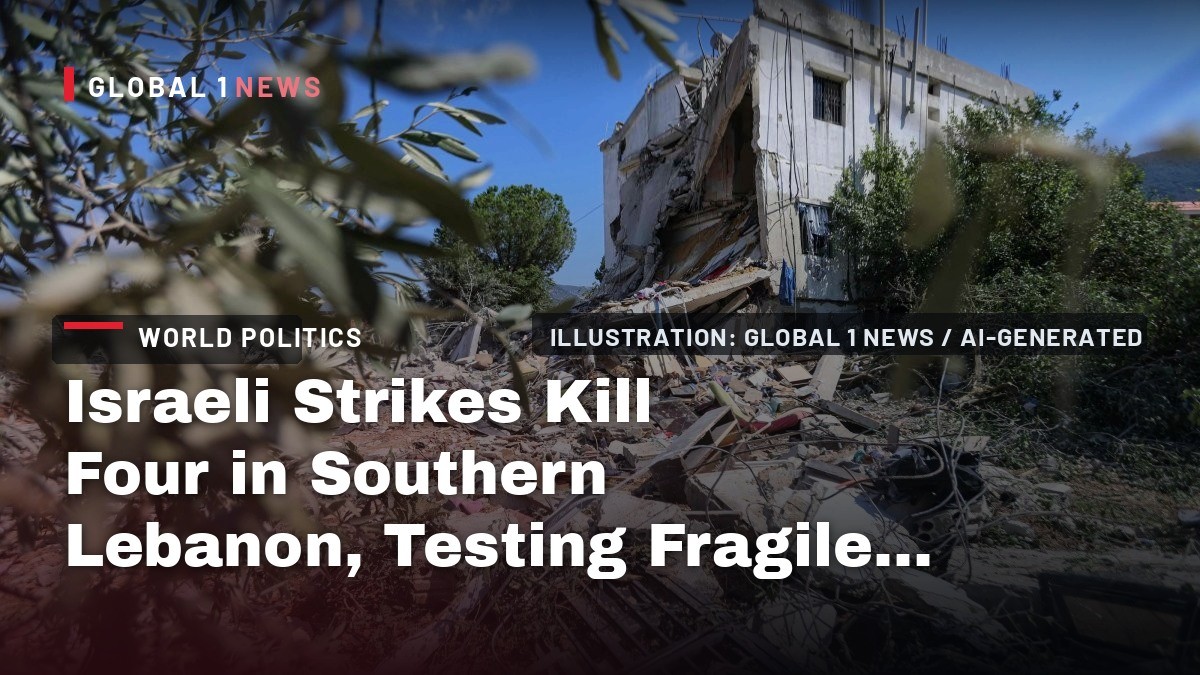
Sunday's Israeli strikes in southern Lebanon, which Lebanon's Health Ministry said killed four people, have exposed the fragility of the US-brokered ceasefire framework agreed in June. The violence comes as the Lebanese government pursues unprecedented direct talks with Israel under American auspices — negotiations that Hezbollah has rejected and which are now under mounting strain.
Israeli Strikes Kill Four in Southern Lebanon, Testing Fragile Ceasefire
Beirut, Lebanon – September 6, 2026 — The predawn silence of Arab Salim, a village well north of the Israeli-declared security zone, was broken Sunday by an Israeli airstrike that Lebanon's Health Ministry said killed two women and wounded six others, including two girls. In a separate strike on the edge of the occupied zone, two men were killed. The Israeli military said the operations were retaliation for Hezbollah drone launches against its soldiers stationed inside the territory it controls.
A Ceasefire Framework Under Duress
The June agreement between Israel and Lebanon, brokered by the United States alongside a separate US-Iran memorandum of understanding on the broader regional conflict, was meant to wind down the deadliest confrontation between Israel and Hezbollah since 2006. But three months on, the architecture of that deal is showing visible cracks. Israel continues to operate inside a self-declared security zone roughly 10 kilometres deep along the border, a reality that Lebanese officials privately acknowledge but publicly condemn.
Sunday's evacuation warning for Arab Salim was only the second issued since the June ceasefire announcement. The first came on August 5 for residents of Mansouri, near Tyre, though Israel had already dropped leaflets on that village just a week into the ceasefire. The pattern suggests a calibrated escalation: Israel is not seeking a full return to war, but it is asserting its right to strike targets it deems threatening, even beyond the security zone's nominal boundary.
The Human Toll and the Ministry's Accounting
Lebanon's Health Ministry reported that four people were killed and 23 injured across southern Lebanon on Friday in Israeli strikes launched without evacuation warnings. The Israeli military said those strikes targeted Hezbollah weapons storage facilities. The cumulative toll of Israeli strikes in Lebanon since March 2 — when Hezbollah fired at Israel in support of Iran — has surpassed 4,300 people killed, according to Lebanese authorities, a figure that underscores the scale of a conflict that began this spring.
Initial reports counted two girls among the dead in Arab Salim, while the Health Ministry's detailed toll identified the fatalities there as two women, with two girls among six people wounded in the strike. The shifting accounting highlights the fog of war that persists even in an era of instant communication. What is not in dispute is that civilians continue to bear the brunt of a confrontation that has repeatedly spilled beyond the front lines.
Hezbollah's Calculus: Rejection and Escalation
Hezbollah said Saturday that Israel's continued escalation aimed to pressure the Lebanese government, which has been engaged in direct talks with Israel under US auspices — negotiations that the Iran-backed group has rejected outright. The group's position has been consistent since the talks began following a landmark meeting between the Israeli and Lebanese ambassadors to the United States, the first such high-level contact in decades. Hezbollah and its allies denounced those direct negotiations as a "grave error," accusing the government of yielding to US wishes before a ceasefire had been consolidated.
For Hezbollah, the calculus is existential. The group's entire raison d'être as a resistance movement depends on maintaining its arsenal and its posture of armed confrontation with Israel. Direct talks between Beirut and Jerusalem, even under American mediation, threaten to marginalize Hezbollah within Lebanon's consociational political system, where it has long wielded veto power over matters of war and peace. By framing Israeli strikes as an attempt to pressure the government, Hezbollah is seeking to discredit the negotiating track and reassert its centrality to Lebanon's security calculus.
Beirut's Predicament: A Government Caught Between
The Lebanese government, led by President Joseph Aoun, faces an impossible balancing act. It has committed to the US-brokered framework and the direct talks, seeing them as the only viable path to ending Israeli strikes and securing a full Israeli withdrawal from the security zone. But every Israeli operation undermines the government's credibility, both domestically and in the negotiations themselves.
The government's leverage is limited. The Lebanese Armed Forces are no match for the Israeli military, and the state's authority does not extend to Hezbollah's weapons, which remain outside its control — the same structural dilemma that has defined Lebanon's politics since the 2006 war and the passage of UN Security Council Resolution 1701. That resolution, which called for the disarmament of militias and the withdrawal of Israeli forces, has never been fully implemented by either side. The current security zone is, in effect, a unilateral Israeli reinterpretation of the resolution's terms.
The US-Iran Dimension
The June US-Iran memorandum of understanding on the broader conflict was a landmark achievement, but it was always a fragile instrument. Iran's regional posture, including its support for Hezbollah, was not resolved by the memorandum; it was merely deferred. The drones that Hezbollah launched at Israeli soldiers in the security zone — the stated trigger for Sunday's strikes — are a reminder that Iran's proxies retain both the capability and the will to act independently when their interests demand it.
For Washington, the challenge is managing two parallel tracks that are increasingly intersecting. The US-brokered Israel-Lebanon framework depends on Hezbollah's restraint, but Hezbollah is not a party to that agreement. The US-Iran understanding depends on Tehran's willingness to restrain its proxies, but Tehran's influence over Hezbollah's tactical decisions is not absolute. Each Israeli strike, and each Hezbollah response, tests the durability of both arrangements simultaneously.
Regional Repercussions and the Gulf Factor
The Gulf states, which have watched the March 2026 war with deep concern, have a vested interest in stability along the Israel-Lebanon border. A renewed escalation would threaten the broader regional de-escalation that the June agreements were meant to secure, potentially disrupting Gulf economic diversification plans and energy markets. Saudi Arabia and the United Arab Emirates have quietly supported the Lebanese government's negotiating track, seeing it as a mechanism to curb Hezbollah's influence without triggering a full-scale war that would inevitably draw in Iran.
But the Gulf states' leverage over Hezbollah is minimal, and their influence over Israel is limited to what Washington chooses to transmit. The result is a regional architecture in which the key players — the United States, Iran, Israel, and Hezbollah — are all pursuing narrow tactical objectives that may not align with the broader goal of sustainable de-escalation.
What Comes Next
The immediate question is whether Sunday's strikes represent a one-off retaliation or the beginning of a new cycle of escalation. The Israeli military's decision to issue an evacuation warning — a practice it has used sparingly since June — suggests a desire to calibrate its operations and avoid mass civilian casualties that would trigger international condemnation. But the Friday strikes, which killed four people without any warning, indicate that Israel's restraint has limits.
For the Lebanese government, the path forward is narrowing. It can continue the direct talks and hope that Washington can deliver Israeli concessions, or it can distance itself from the negotiations in an attempt to rebuild domestic consensus — a move that would likely be read by Israel and the United States as capitulation to Hezbollah. Either choice carries significant political risk in a country where the state's authority is contested and its institutions remain fragile.
The deeper problem is structural. As long as Israel maintains its security zone, as long as Hezbollah retains its weapons, and as long as the Lebanese state lacks the capacity to enforce its sovereignty across its own territory, the June framework will remain a ceasefire in name only — a pause in hostilities rather than a resolution of the underlying conflict. Sunday's deaths in Arab Salim and on the edge of the occupied zone are a grim reminder that in the absence of a genuine political settlement, the guns will eventually speak again.
By Malik Hassan, Staff Writer
This article was produced with AI-assisted research and editorial support. Sources: Daily Sabah, Reuters, AFP.
What's Your Reaction?
 Like
0
Like
0
 Dislike
0
Dislike
0
 Love
0
Love
0
 Funny
0
Funny
0
 Wow
0
Wow
0
 Sad
0
Sad
0
 Angry
0
Angry
0

Middle East Correspondent at Global1.News. Based in Beirut, covering politics, conflict, energy, and society across the Middle East. Brings context and depth to a region often reduced to headlines.










Comments (0)