
Is India Extending Its Control Over Islamic Practice In Kashmir?
In the early hours of a Friday in Srinagar’s Khanyar district, Ghulam Sofi adjusts his skullcap before the call to prayer, his forehead marked by years of devotion.
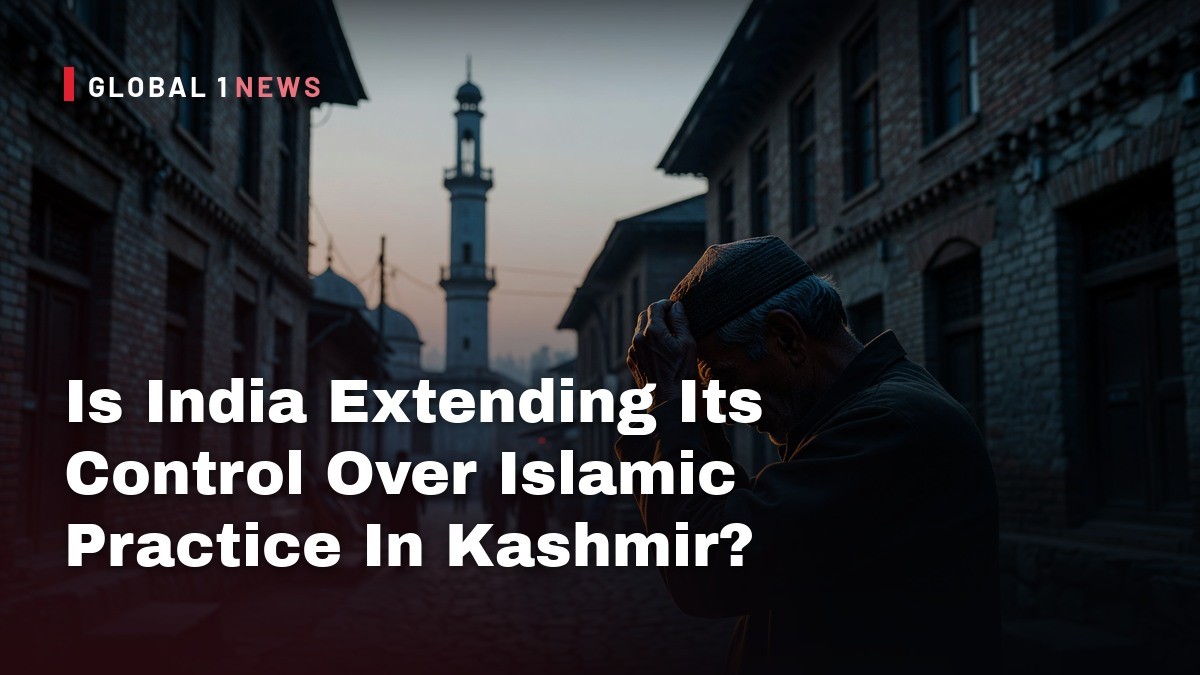
In the early hours of a Friday in Srinagar’s Khanyar district, Ghulam Sofi adjusts his skullcap before the call to prayer, his forehead marked by years of devotion. “In Kashmir, Islam and politics have always remained inseparable. We can smell the link this time too,” he tells us, pointing to a recent directive from the Jammu and Kashmir Waqf Board that seeks to standardise the themes of Friday sermons across the valley’s mosques and shrines. The proposal, announced on 10 October, has ignited a fierce debate over religious autonomy, state control, and the lingering impact of the 2019 revocation of Kashmir’s special constitutional status.
The Waqf Board’s Proposal and Its Immediate Backlash
The board, led by Dr Syed Darakhshan Andrabi—a Kashmiri figure closely associated with Prime Minister Narendra Modi’s Bharatiya Janata Party (BJP)—issued a notice inviting the development of common themes for Friday sermons. Andrabi’s profile on social media even features a photograph with Modi, underscoring the political alignment of the board’s leadership. While the notice framed the move as “coordination,” critics quickly labelled it a homogenising effort that threatens the diversity of Islamic discourse in the region.
Mirwaiz Umar Farooq, the senior religious authority in the valley, condemned the plan as an intrusion into the sacred domain of the mosque pulpit. He argued that the responsibility for religious guidance belongs to clerics and recognised Islamic institutions, not a government‑appointed body. “The pulpit is not an instrument of the state,” he warned, emphasizing that any attempt to dictate sermons, directly or indirectly, undermines religious autonomy. Jammu and Kashmir Chief Minister Omar Abdullah echoed this sentiment, describing the proposal as an “unacceptable attempt by the BJP to interfere in the religious affairs of Muslims.” Under pressure, Andrabi retreated, describing the notice as merely a proposal without binding authority.
Historical Context: The 2019 Abrogation and Its Institutional Fallout
The controversy cannot be understood without recalling the sweeping changes that followed the Modi government’s decision in August 2019 to revoke Article 370, stripping Jammu and Kashmir of its special constitutional status. The move transferred the region to direct central rule, prompting a cascade of legal and administrative reforms. Among the institutions reshaped was the Waqf Board, which in 2022 was reconstituted under a central framework and placed under the chairmanship of Andrabi, a BJP affiliate.
These reforms extended beyond bureaucratic reorganisation. The lieutenant governor’s administration, in the immediate aftermath of the abrogation, banned 215 community‑run Islamic schools that had served low‑ and middle‑income families for decades. Simultaneously, security forces were deployed outside mosques, Friday and Eid prayers at prominent shrines were barred, and clerics were summoned to army camps where they were instructed to discourage protest and avoid references to Article 370 in sermons. A police circular issued just before the August 5 crackdown also sought detailed information on mosques and their management committees, signalling a broader strategy to monitor Islamic institutions as potential sites of dissent.
Surveillance of Mosques: The 2026 Profiling Operation
In January 2026, the pattern of state scrutiny intensified with a systematic profiling of mosques across the valley. Clerics were required to complete extensive forms documenting the physical structure of each mosque, construction costs, sources of funding, monthly expenditures, and even the financial details of attendees—including bank, passport, ATM, and credit‑card information. While local officials claimed that mosque profiling was not a new practice, the depth and intrusiveness of the 2026 operation sparked alarm among religious leaders and ordinary worshippers alike.
The profiling exercise reflects a broader perception within the Indian administration that Islamic spaces could serve as conduits for political mobilisation. By gathering granular data on both the institutions and their congregants, authorities appear to be constructing a detailed map of religious activity that could be leveraged for security or political purposes. The response from the community has been one of unease, as the data collection blurs the line between legitimate security concerns and an encroachment on religious privacy.
Scale of Islamic Institutions in the Valley
Srinagar alone hosts at least 1,450 mosques, a figure that underscores the sheer scale of Islamic infrastructure in the region. The Waqf Board, however, directly administers fewer than 150 of these sites, highlighting a disparity between the board’s nominal authority and its actual jurisdiction. This limited reach does not diminish the symbolic weight of the board’s actions; rather, it amplifies concerns that a relatively small, politically appointed body is attempting to exert influence over a vastly larger religious landscape.
The demographic composition of the region further intensifies the stakes. Muslims constitute more than 97 percent of the population in the Kashmir Valley and roughly 68 percent of the broader Indian‑administered Jammu and Kashmir area. Any perceived interference in religious practice therefore touches the majority of the populace, making the issue not merely a matter of institutional policy but a flashpoint for broader communal sentiment.
Recent Restrictions on Shrine Practices
Beyond the sermon proposal, the Waqf Board has introduced other measures that affect everyday religious life. In September 2026, the board issued a directive prohibiting devotees from bringing and distributing food items or feeding birds within the premises of Waqf‑managed shrines. Such practices, deeply rooted in local tradition, have long been part of the devotional experience at sites like Dastgeer Sahib, a shrine dedicated to the 11th‑century Sufi saint Hazrat Sheikh Abdul Qadir Jeelani. The restriction sparked criticism for curtailing customary expressions of piety and hospitality, further feeding the narrative of state overreach into spiritual domains.
These actions, when viewed together, suggest a pattern of regulatory interventions that extend beyond administrative oversight into the realm of ritual practice. While the board frames these moves as efforts to maintain order or modernise management, opponents argue that they erode the organic, community‑driven character of Islamic worship in Kashmir.
Implications for Religious Autonomy and Regional Stability
The convergence of sermon standardisation, mosque profiling, and shrine restrictions points to a broader trajectory: the increasing centralisation of religious governance under a political framework aligned with the BJP’s ideological agenda. Critics, including Mirwaiz Farooq and Chief Minister Omar Abdullah, contend that such measures constitute an assault on religious autonomy, potentially alienating a population that already feels politically marginalised.
From a stability perspective, the perception of state intrusion into sacred spaces can fuel resentment and deepen mistrust between the community and the administration. Historical evidence from the immediate post‑abrogation period shows that heavy security presence at mosques and the detention of clerics contributed to an atmosphere of surveillance and tension. The 2026 profiling operation, with its detailed financial and personal data collection, risks reviving those anxieties, especially if the information is perceived as being used for punitive or coercive purposes.
For policymakers, the challenge lies in balancing security concerns with respect for religious freedom. International observers and human‑rights organisations have highlighted the importance of safeguarding the pulpit as a space for independent religious expression. Any further attempts to codify sermon content or to impose administrative controls on worship practices could attract heightened scrutiny and potentially strain India’s diplomatic relations with Muslim‑majority nations that monitor the treatment of Muslims in Kashmir.
Looking Ahead: Prospects for Dialogue and Reform
The recent backlash against the Waqf Board’s proposals indicates that there remains a robust civil and religious opposition capable of influencing policy. Andrabi’s retreat from the sermon‑standardisation plan, after facing criticism from both religious leaders and political figures, demonstrates that coordinated dissent can temper state‑driven initiatives. However, the underlying structural changes—centralised control of the Waqf Board, expanded surveillance capabilities, and a legislative environment favourable to the BJP’s vision—continue to shape the contours of religious governance.
Future developments will likely hinge on the ability of Kashmiri religious authorities, civil society, and moderate political actors to negotiate a framework that respects both security imperatives and the autonomy of Islamic institutions. Constructive dialogue, perhaps facilitated by neutral mediators, could pave the way for reforms that address administrative concerns without compromising the sanctity of the pulpit. As the valley’s Muslims navigate these evolving dynamics, the balance between state authority and religious freedom will remain a defining issue for the region’s social cohesion and its relationship with the broader Indian polity.
This article was produced with AI-assisted research and editorial support. Reporting is based on the source material cited below. Sources: The Diplomat; thediplomat.com; Global1.News (05 November 2026).
By Kenji Tanaka, Staff Writer
What's Your Reaction?
 Like
0
 Dislike
0
 Love
0
 Funny
0
 Wow
0
 Sad
0
 Angry
0

Japan Correspondent at Global1.News. Tokyo-based voice covering Japanese politics, technology, economy, and culture. Tracks the intersection of tradition and innovation in one of the world's most dynamic societies.











Comments (0)