
FSSAI Draft Rules: Fat, Sugar, Salt Limits for School Food
FSSAI's draft notification sets numeric limits on added fat, sugar and salt in school canteen foods: 4.2g fat, 3g sugar and 0.625g salt per 100g for solids, with stricter per-millilitre thresholds for liquids. The 60-day comment window targets 41 million obese Indian children.
The Food Safety and Standards Authority of India (FSSAI) has moved to replace vague "junk food" language with hard numbers. A draft notification published in the Gazette of India around August 11, 2026, proposes quantitative thresholds for added fat, sugar, and sodium — a move that would ban a wide swath of packaged snacks, sweetened beverages, and deep-fried items from school canteens across the country. The timing is no accident: with the World Obesity Atlas 2026 estimating that nearly 41 million (4.1 crore) Indian children aged 5-19 are already overweight or obese, the regulator is betting that measurable standards will finally make school food environments enforceable.
FSSAI Draft Notification Sets Hard Limits on Added Fat, Sugar, and Salt in School Canteens — A Landmark Shift from Subjective Bans to Objective, Testable Standards
New Delhi – August 18, 2026 — The FSSAI has issued a draft notification amending the Food Safety and Standards (Safe Food and Balanced Diets for Children in School) Regulations, 2020. The amendment inserts a new provision after the existing regulation on monitoring and surveillance, framing the rules under the Food Safety and Standards Act, 2006, with prior approval of the Central government. For the first time, the regulator has defined "high" in measurable terms: solid foods will be classified as high in added fat if they contain more than 4.2 grams per 100 grams; high in added sugar if they exceed 3 grams per 100 grams; and high in sodium if salt content surpasses 0.625 grams per 100 grams. For liquid products, the thresholds are stricter per volume: more than 1.5 grams of fat per 100 millilitres, more than 2 grams of added sugar per 100 millilitres, and more than 0.175 grams of salt per 100 millilitres. Items exceeding these benchmarks — including deep-fried snacks, packaged chips, sweetened biscuits, and flavoured milk — will be banned from sale in school canteens and cannot be advertised on school campuses.
The Scientific Backbone: ICMR Guidelines and a 60-Day Window
These benchmarks are not arbitrary. They draw directly from the Indian Council of Medical Research's (ICMR) Dietary Guidelines for Indians-2024, which established evidence-based cut-offs for what constitutes excessive intake of energy-dense, nutrient-poor foods. The draft notification opens a 60-day window for public and stakeholder comments from the date the gazette notification is made available. All representations received within this period will be considered before the rules are finalised. This is a critical juncture for the food industry, which has historically pushed back on regulatory tightening. The FSSAI's 2015 crackdown on Maggi noodles — where the regulator rejected approval for roughly 500 products — serves as a precedent that the authority is willing to act decisively when public health is at stake.
From Subjective Bans to Objective, Court-Defensible Standards
The 2020 regulations already restricted junk food in school canteens, but they lacked numeric thresholds. This was their fatal flaw. Enforcement officers had no objective measure to determine whether a product qualified as "junk food," making compliance checks inconsistent and legal challenges difficult. The new draft changes that calculus entirely. A food safety officer in Chennai or Lucknow can now test a product at the point of sale, measure its fat, sugar, and salt content against the published benchmarks, and take action with confidence that the standard will hold up in court. This is a significant upgrade in regulatory architecture. The measurable definitions transform what was a subjective, often contested determination into a straightforward laboratory test. For a country with 1.4 billion people and a vast, fragmented food retail landscape, this objectivity is not a luxury — it is a necessity.
What This Means for India: The 41 Million Children at Stake
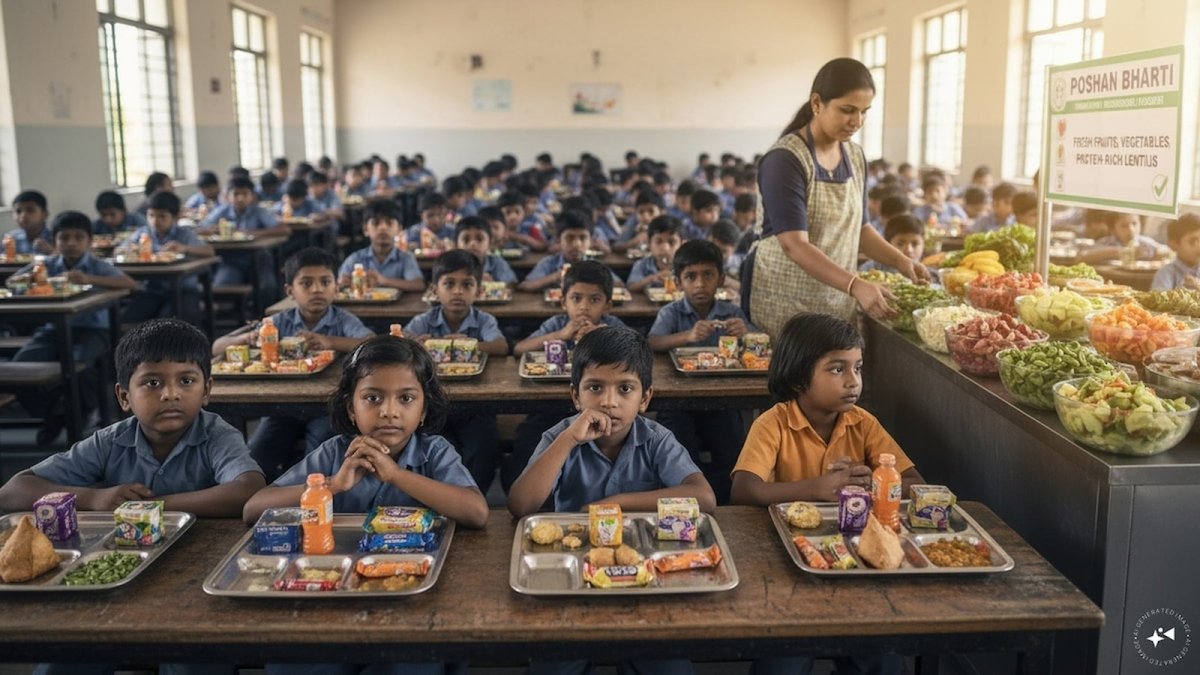
The public health context is stark. The World Obesity Atlas 2026 estimates that nearly 41 million Indian children aged 5-19 are overweight or obese as of 2025. If current dietary trends continue unchecked, India is projected to account for more than 11% of the global childhood obesity burden by 2030. This is not merely a cosmetic concern. Childhood obesity tracks into adulthood, driving India's dual nutrition burden — persistent undernutrition alongside a rapidly rising tide of obesity-related non-communicable diseases like type 2 diabetes, hypertension, and cardiovascular disease. The economic implications are severe: a generation of Indians entering the workforce with chronic health conditions will strain the public healthcare system and reduce productivity. The FSSAI draft, by targeting the school food environment, addresses the most controllable variable in this equation. Children spend a significant portion of their waking hours in school, and the food available there shapes their dietary preferences and habits for life.
The ICMR-NIN Push and the "Let's Fix Our Food" Consortium
The FSSAI draft did not emerge in a vacuum. On July 22-23, 2026, the ICMR-National Institute of Nutrition (NIN) released a policy document titled "Priority Policy Actions to Promote Healthier Diets and Food Environments for Children and Adolescents in India," launched through the "Let's Fix Our Food" (LFOF) Consortium at a Dissemination and Consultation Workshop in New Delhi. The workshop was inaugurated by Dr. M. Srinivas, Member (Health), NITI Aayog. That policy document recommended four key actions: front-of-pack nutrition labels, stricter marketing restrictions on HFSS (high in fat, sugar, salt) foods to children, healthier school food environments, and a health tax on unhealthy foods. The FSSAI draft follows this ICMR-NIN push within weeks — a remarkably short turnaround for government action. This suggests a coordinated policy effort at the highest levels of the health establishment, with NITI Aayog's involvement signalling that childhood obesity is now a national priority, not just a health ministry concern.
Industry Impact: Reformulation or Exit
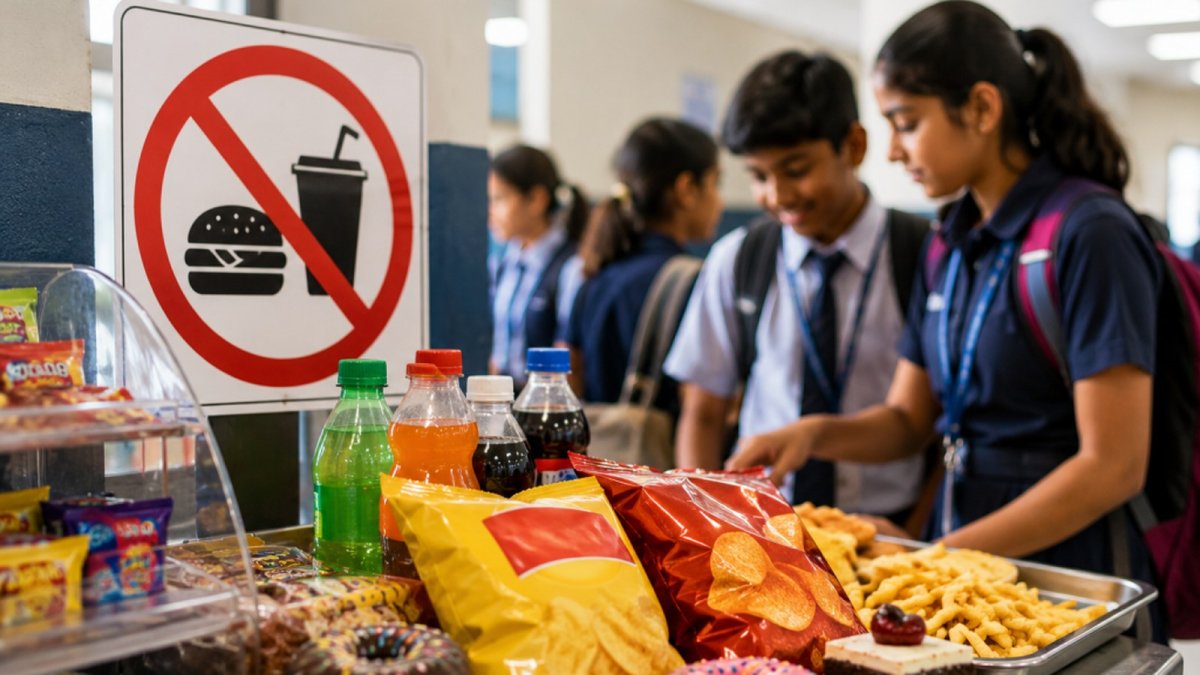
The implications for the packaged food industry are substantial. Products like flavoured milk and sweetened biscuits, staples of school canteen shelves, would be immediately non-compliant under the proposed thresholds. Deep-fried snacks like samosas and vada pav, staples of many school canteens, would need to be reformulated or removed entirely. The industry faces a choice: reformulate products to meet the new standards, or exit the school channel. Reformulation is not trivial — it requires research and development investment, changes to supply chains, and consumer acceptance testing. But the alternative is losing access to a captive market of millions of schoolchildren. The precedent from the 2015 Maggi crisis, where FSSAI's actions led to a complete overhaul of Nestlé's quality assurance processes in India, suggests that large players will adapt. Smaller regional players may struggle, potentially consolidating the market in favour of larger companies with deeper pockets for reformulation.
Enforcement: The Historical Weak Point and the Path Forward
Enforcement has always been the Achilles' heel of Indian food regulation. State-level bans have existed for years — Maharashtra's Food and Drug Administration enforced a 50-metre junk food ban around schools in 2025, and Karnataka banned HFSS foods near schools citing childhood obesity. But compliance has been inconsistent, with vendors often ignoring the rules and local authorities lacking the resources or will to enforce them. The new draft's numeric benchmarks give enforcement officers objective, measurable standards, but they do not solve the resource problem. State food safety departments remain under-resourced relative to the scale of the task, making comprehensive monitoring difficult across a fragmented retail landscape. The FSSAI will need to leverage technology, perhaps through mobile testing labs and digital reporting platforms, to make the standards meaningful. Parental involvement is also crucial, as the India Today video description notes. Parents must be educated about these thresholds so they can advocate for compliance at their children's schools and make informed choices about packed lunches.
The Bottom Line
The FSSAI draft notification represents a genuine paradigm shift in Indian food regulation — from subjective, unenforceable language to precise, testable standards grounded in ICMR's scientific guidelines. The 60-day comment window is now open, and the food industry, public health advocates, schools, and parents will all have their say. But the direction is clear: India is serious about addressing its childhood obesity crisis, and the school canteen is the frontline. With 41 million children already affected and projections of more than 11% of the global childhood obesity burden by 2030, the cost of inaction is simply too high. The question is no longer whether India will regulate school food — it is whether the industry will reformulate fast enough, and whether enforcement will finally match the ambition of the rules. For Indian parents, teachers, and children, this draft is a promise that the food environment in schools is about to become measurably healthier. The next 60 days will determine how that promise is kept.
— By Dr. Raj Patel, Staff Writer
This article was produced with AI-assisted research and editorial support. Reporting is based on sources cited in the article.
What's Your Reaction?
 Like
0
Like
0
 Dislike
0
Dislike
0
 Love
0
Love
0
 Funny
0
Funny
0
 Wow
0
Wow
0
 Sad
0
Sad
0
 Angry
0
Angry
0

India/South Asia Correspondent at Global1.News. Analytical voice with a background in science and health journalism. Based in New Delhi, covering Indian politics, education, healthcare, technology, and policy. Breaks down complex data into clear, actionable reporting.













Comments (0)