
Filipino Fugitive in $650M Fraud Case Lands on FBI's Most Wanted List
In a recent ANC 24/7 report, the FBI’s newly launched Most Wanted Fraudsters list has a distinctly Filipino flavor — and not in a way that brings pride to the homeland. Rey E. Grabato II, a former real estate investment executive with deep ties to both New Jersey and the Philippines, is now the subject of a global manhunt, accused of orchestrating a staggering $650 million Ponzi scheme that bilked thousands of investors, including many Filipino Americans who trusted him...
In a recent ANC 24/7 report, the FBI’s newly launched Most Wanted Fraudsters list has a distinctly Filipino flavor — and not in a way that brings pride to the homeland. Rey E. Grabato II, a former real estate investment executive with deep ties to both New Jersey and the Philippines, is now the subject of a global manhunt, accused of orchestrating a staggering $650 million Ponzi scheme that bilked thousands of investors, including many Filipino Americans who trusted him with their retirement savings and hard-earned money.
Filipino Fugitive in $650-M Fraud Case Lands on FBI's Most Wanted List
Manila, Philippines – Friday — The FBI has placed Rey E. Grabato II, a Filipino former real estate executive, on its Most Wanted Fraudsters list, accusing him of running a massive Ponzi scheme that defrauded approximately 2,000 investors of more than $650 million. The announcement, made public this week, marks a significant escalation in a case that has been building since federal prosecutors in New Jersey first charged Grabato in October 2022. For Filipino families back home and in the US diaspora, the case is a stark reminder of how investment fraud can cross oceans and devastate communities that rely on remittances and overseas earnings.

The Story — A $650 Million House of Cards
Grabato, the former president and majority owner of National Realty Investment Advisors LLC (NRIA), based in Secaucus, New Jersey, is wanted on federal securities fraud and wire fraud charges, plus conspiracy to defraud the United States in connection with taxes. The US Attorney's Office for the District of New Jersey alleges that Grabato and his co-conspirator, Thomas Nicholas Salzano, used false and misleading representations to persuade people to invest in the NRIA Partners Portfolio Fund I LLC, a real estate fund that promised lucrative returns on property development projects.
According to federal prosecutors, the scheme ran from February 2018 to January 2022, during which time NRIA conducted an aggressive nationwide marketing campaign. The company flooded the airwaves and inboxes with thousands of emails, TV and radio advertisements, billboard placements, and polished investor presentations. Potential investors were led to believe that NRIA was financially sound and generating significant profits from real estate ventures. In reality, prosecutors say, the company generated little to no profit and operated as a classic Ponzi scheme, relying on money from new investors to pay returns to earlier ones.
The FBI's investigation revealed that Grabato and his associates misappropriated millions of dollars in investor funds for personal use. A federal arrest warrant was issued for Grabato on October 12, 2022, after he was charged in the US District Court for the District of New Jersey in Newark. Salzano was arrested that same month, but Grabato remained at large. The FBI says Grabato has used several aliases, including Rey Encarnacion Grabato II, Rey Grabato II, and Rey Li Encarnacion Grabato, and has been identified as being from both Hoboken, New Jersey, and the Philippines.
Philippine Context — A Familiar Name in an Unfamiliar Spotlight
For Filipinos, the name Grabato may not ring immediate bells, but the pattern is painfully familiar. The Philippines has seen its share of investment scams, from the infamous Aman Futures Group collapse in 2012 that left thousands of Visayan investors holding worthless paper, to the more recent KAPA-Community Ministry International scandal in Mindanao that siphoned billions from evangelical followers. What makes Grabato's case different is the scale and the international dimension — this is a Filipino citizen who allegedly built his scheme on American soil, targeting US-based investors, many of whom were likely Filipino immigrants and dual citizens looking for a secure place to park their savings.
The FBI's Most Wanted Fraudsters list, launched on June 4, 2026, is a new tool in the agency's arsenal to highlight fugitives accused or convicted of major fraud offenses. Grabato's inclusion places him in the company of other high-profile financial criminals, but his Filipino ties make this a uniquely Philippine story. Authorities have confirmed that Grabato has connections to the Philippines and may be living there, which raises questions about extradition, bilateral cooperation, and the ability of Philippine law enforcement to track down a fugitive who knows the local terrain well.
This is not the first time a Filipino has landed on an FBI wanted list. Apollo Quiboloy, the self-styled "Appointed Son of God" and founder of the Kingdom of Jesus Christ, is currently detained in Pasig City Jail facing US charges related to sex trafficking and fraud. Quiboloy's case has already tested the limits of US-Philippine legal cooperation, and Grabato's situation may follow a similar trajectory — though with far less media attention and public scrutiny.
Impact on Filipinos — When Trust Becomes a Trap
The human toll of Grabato's alleged scheme cannot be overstated. The FBI says approximately 2,000 investors were defrauded, including hundreds in New Jersey alone. For Filipino Americans, many of whom work as nurses, caregivers, and healthcare professionals in the US, the loss of retirement savings is not just a financial setback — it is a betrayal of trust that can take decades to recover from. Many of these investors likely sent money back home to support families in the Philippines, and the loss of those funds has ripple effects that extend far beyond the individual victims.
In the Philippines, where remittances from overseas Filipino workers (OFWs) account for nearly 10% of the country's GDP, the specter of investment fraud is a constant threat. Scammers often target OFWs and their families, promising high returns on real estate, foreign exchange, or cryptocurrency schemes. The Grabato case serves as a cautionary tale for Filipino investors both at home and abroad: if an investment opportunity sounds too good to be true, it probably is. The NRIA fund promised significant profits from real estate development, but prosecutors say the company was essentially a shell that used new investor money to pay off old investors, a textbook Ponzi structure.
For Filipino families in Manila, Cebu, Davao, and beyond, the case also highlights the importance of due diligence. Many Filipino investors rely on word-of-mouth recommendations from friends, relatives, or community leaders, which can make them particularly vulnerable to fraud. The FBI's reward of up to $150,000 for information leading to Grabato's arrest and conviction may encourage people in the Philippines to come forward, but it also underscores the seriousness of the case and the lengths to which US authorities are willing to go to bring him to justice.
Reactions and Responses — Authorities Speak
The FBI has been clear in its messaging: Grabato is a fugitive, and they want him found. "The FBI is offering a reward of up to $150,000 for information leading to Grabato's arrest and conviction," the agency announced in a statement accompanying his addition to the Most Wanted Fraudsters list. The FBI is asking anyone with information about Grabato's whereabouts to contact a local FBI office or the nearest US embassy or consulate, which in the Philippines would be the US Embassy in Manila or the US Consular Agency in Cebu.
The US Attorney's Office for the District of New Jersey has described the case in stark terms, calling it a "$650 million Ponzi scheme" that preyed on ordinary investors. The indictment against Grabato and Salzano alleges that the two men "used false and misleading representations" to lure investors into the NRIA fund, and that they "misappropriated millions of dollars in investor funds" for their own benefit. Salzano, who was arrested in October 2022, is presumably facing trial, though details of his case have not been widely publicized.
In the Philippines, there has been no official statement from the Department of Justice or the National Bureau of Investigation regarding Grabato's case. However, given the FBI's assertion that Grabato has ties to the Philippines and may be living there, it is likely that Philippine authorities are aware of the situation and may be coordinating with their US counterparts. The lack of public comment is not unusual in such cases, as extradition proceedings and fugitive investigations are often conducted quietly to avoid tipping off the subject.
The Wider Pattern — Filipinos on the FBI's Radar
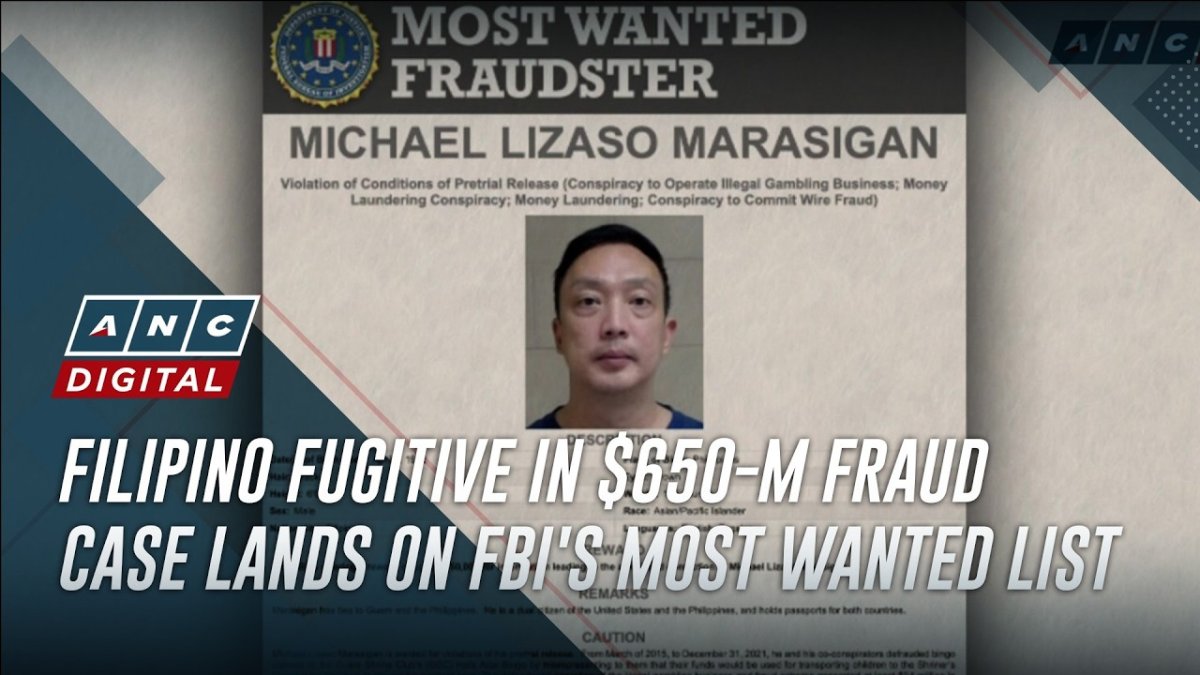
Grabato is not the only Filipino on the FBI's Most Wanted Fraudsters list. Michael Lizaso Marasigan, a Filipino and US dual citizen with ties to Guam and the Philippines, was convicted in May 2025 on charges of illegal gambling, money laundering, and wire fraud. Marasigan's case involved a large-scale illegal gambling operation that allegedly laundered millions of dollars through shell companies and cryptocurrency exchanges. His conviction and subsequent placement on the list highlight the growing scrutiny of financial crimes involving Filipino nationals, particularly those who operate across borders.
Also on the list are John Michael Dimitrion and Julieanne Baldueza Dimitrion, a couple who pleaded guilty in 2009 to running a mortgage fraud scheme in Hawaii. They failed to appear for sentencing in July 2010 and have remained fugitives ever since. The Dimitrions' case is older but no less significant, as it demonstrates that the FBI's interest in Filipino-linked fraud extends back more than a decade. The inclusion of multiple Filipinos on the list suggests a pattern that US authorities are paying close attention to, and it raises questions about whether the Philippines is doing enough to address financial crimes that originate from or involve its citizens.
The broader context is also important. The FBI's Most Wanted Fraudsters list was launched on June 4, 2026, as part of a broader effort to crack down on white-collar crime. The list includes fugitives accused or convicted of major fraud offenses, ranging from securities fraud to mortgage fraud to money laundering. By placing Grabato on the list, the FBI is signaling that it considers him a significant threat and is willing to devote resources to his capture. For the Philippines, this means that Grabato's case is likely to remain in the spotlight, and any attempt to hide or evade justice will be met with international pressure.
What to Watch For
The immediate question is whether Grabato will be apprehended. The FBI's reward of up to $150,000 is a significant incentive for anyone with information to come forward, and the agency's reach extends globally. If Grabato is indeed in the Philippines, the US Embassy in Manila and the FBI's legal attaché office will likely work with Philippine authorities to track him down. Extradition proceedings, if they occur, could take months or even years, given the complexities of US-Philippine legal agreements and the potential for legal challenges.
For Filipino investors who may have been affected by the NRIA scheme, the path to recovery is uncertain. The FBI and the US Attorney's Office have not announced any plans for restitution, and in cases of this magnitude, victims often recover only a fraction of their losses. The Securities and Exchange Commission in the Philippines has not commented on the case, but it is possible that Filipino victims could seek recourse through the Philippine legal system, though the chances of recovering funds from a fugitive are slim.
In the meantime, the case serves as a reminder of the importance of financial literacy and due diligence. For Filipino families, whether in Manila or in the diaspora, the lesson is clear: before investing in any opportunity, verify the credentials of the people behind it, check with regulatory authorities, and be wary of promises of high returns with little risk. The Grabato case is a cautionary tale that transcends borders, and its impact will be felt for years to come.
As the FBI continues its manhunt, the Filipino community both at home and abroad will be watching closely. The outcome of this case will not only determine Grabato's fate but also send a message about the consequences of financial fraud — and the lengths to which authorities will go to protect investors. For now, the most important thing is that justice is served, and that the victims of this massive scheme are not forgotten.
By Bella Reyes, Staff Writer
This article was produced with AI-assisted research and editorial support. Reporting is based on sources cited in the article.
What's Your Reaction?
 Like
0
Like
0
 Dislike
0
Dislike
0
 Love
0
Love
0
 Funny
0
Funny
0
 Wow
0
Wow
0
 Sad
0
Sad
0
 Angry
0
Angry
0

Philippines/Southeast Asia Correspondent at Global1.News. Manila-based journalist covering Philippine politics, environment, maritime security, and social issues. Passionate about marine conservation and the communities protecting the Philippines' natural heritage.















Comments (0)