
FESPACO 2027: Africa's Biggest Film Festival Turns 30
FESPACO, the Pan-African Film and Television Festival of Ouagadougou, has never been cancelled since its founding in 1969 — not for coups, not for economic crisis, and not for the jihadist insurgency that has tested Burkina Faso in recent years.
FESPACO, the Pan-African Film and Television Festival of Ouagadougou, has never been cancelled since its founding in 1969 — not for coups, not for economic crisis, and not for the jihadist insurgency that has tested Burkina Faso in recent years. Now Africa's oldest and largest film festival is counting down to a landmark moment: its 30th edition, scheduled for February 27 to March 6, 2027, in the Burkinabè capital. For filmmakers, festival-goers and a continent that has made Ouagadougou its cinematic home, the milestone is both a celebration of endurance and a promise of renewal.
FESPACO 2027: Africa's Biggest Film Festival Turns 30
Ouagadougou, Burkina Faso — The countdown is officially on for the 30th edition of FESPACO, the biennial gathering that has defined African cinema for more than half a century. Organisers confirmed the dates in a February 2026 press conference, and by the summer of 2026 calls for applications were already circulating for the festival's Yennenga Coproduction and Yennenga Academy workshops. The theme announced for the milestone edition — "African Cinemas and Endogenous Development" — signals an ambition that goes beyond red carpets and screenings, placing cinema at the heart of the continent's cultural sovereignty and economic future.
A Festival That Refuses to Be Silenced
When the 28th edition of FESPACO opened on February 25, 2023, in Ouagadougou, the air was thick with more than just harmattan dust. Burkina Faso was in the grip of a jihadist insurgency that had displaced hundreds of thousands and tested the nation's resolve. Yet the festival opened anyway, as it always has, and as it always will. The decision to hold the edition on schedule was confirmed by interim President Ibrahim Traoré on December 1, 2022, a statement of intent that resonated far beyond the country's borders.
The festival's record is remarkable: never cancelled since its launch in 1969, through coups, through economic hardship, through the darkest days of the insurgency. More than 15,000 visitors were expected at the 2023 opening, including stars of Nigerian cinema who crossed the border to celebrate the continent's storytelling. The Palais des Sports de Ouaga 2000 was packed for the opening ceremony, which featured "I have a dream" by choreographer Serge Aimé Coulibaly, with Burkinabè Prime Minister Apollinaire Joachim Kyélem de Tambèla and Malian Prime Minister Choguel Kokalla Maïga giving the opening clap together.
General delegate Alex Moussa Sawadogo, the man at the helm of FESPACO, spoke of the festival's deeper meaning in times of crisis. "It's a form of resilience and resistance for the Burkinabe, for the filmmakers," he said, adding that peace "concerns everybody, the artists, the filmmakers, the producers." His words captured the spirit of a festival that has become synonymous with the nation's refusal to bow to fear.
The government backed its words with action, ramping up security across Ouagadougou and making a "secure FESPACO" pledge that allowed filmmakers and visitors to move through the city with confidence. Checkpoints were visible, but so were the crowds, the colours, the music. The festival became a statement that culture would not be a casualty of conflict.
And beyond the security arrangements, there was something simpler and more profound at work. As one organiser put it, the festival was about social cohesion — about poulet bicyclette roasting on street corners, about bissap flowing in plastic cups, about people meeting again after years of fear and separation. In a country under pressure, FESPACO was a reminder that joy is also a form of resistance.
African Cinema and the Culture of Peace
The theme of the 28th edition, "African Cinema and Culture of Peace," could not have been more apt. Burkina Faso was fighting for its soul, and cinema was being called upon to help heal the wounds. The films selected for competition reflected that urgency, none more so than "Sira" by Burkinabè director Apolline Traoré, a front-runner that told the story of a woman's survival after being kidnapped by jihadis in the Sahel.
Traoré's film was born of personal pain. She spoke openly about the Yirgou massacre, a tragedy that shook her homeland and left her searching for a way to process the horror. "We need to use our art to share what we are feeling, and this is exactly what I did," she said. Her words echoed the sentiment of many filmmakers at the festival, who saw their craft as both witness and therapy.
The official 2023 poster featured Sarraounia — Hausa for "queen" — the Nigerien leader who opposed the Voulet-Chanoine mission, a symbol of African pride, resistance and resilience. The choice was deliberate, a nod to the continent's history of standing firm against overwhelming odds. It was also a reminder that African women have always been at the forefront of resistance, a theme that ran through the festival's programming.
Some 100 films from 35 African countries and the diaspora were shortlisted to compete, a testament to the breadth and depth of the continent's cinematic output. From the Sahel to the Cape, from the Maghreb to the Horn, filmmakers brought their stories to Ouagadougou, creating a space to process trauma and imagine peace.
The festival became more than a competition; it became a collective act of healing. In screenings, in panel discussions, in the corridors of the Palais de la Culture, conversations turned to how cinema could contribute to peacebuilding. The theme was not just a slogan but a call to action, and the filmmakers answered.
A Continent on Screen
The scale of FESPACO is staggering. For the 28th edition, 170 films were selected from about 1,200 submissions, competing across 11 categories including fiction, documentary, short film, TV series and animation. The selection committee had its work cut out, sifting through a mountain of stories to find the ones that would define African cinema for the next two years.
The feature fiction competition alone was a continent-spanning affair, with films from Egypt, Tunisia, Nigeria, Kenya, Morocco, Algeria, Angola, Mauritius, Mozambique, Cameroon and even the Dominican Republic. Notable titles included Mami Wata, The Blue Caftan, Ashkal, Shimoni and Our Lady of the Chinese Shop, each bringing a distinct voice and vision to the screen.
Mali was announced as guest country of honour after a last-minute change from Togo. The organisers explained the switch with characteristic frankness: "In view of challenges of the moment, there is no better partner than Mali." The decision reflected the deepening ties between Burkina Faso and its northern neighbour, both facing similar security challenges and both committed to cultural solidarity.
The estimated budget for the 28th edition was about 2 billion CFA francs, a significant investment for a country under economic strain. But the organisers argued that the return was immeasurable — in cultural pride, in international visibility, in the simple fact of the festival happening at all.
For filmmakers, FESPACO remains the ultimate stage. It is where careers are made, where deals are struck, where the continent's cinematic future is shaped. And for the audiences of Ouagadougou, it is a biennial feast of images and sounds from across Africa and the diaspora.
Women Behind the Camera
One of the most striking developments at the 28th edition was the prominence of women behind the camera. Nearly half of the 2023 fiction competition was directed by women, and 8 of the 15 feature fiction films in the official selection were made by women. The numbers represented a seismic shift in a continent where the film industry has long been male-dominated.
The results spoke for themselves. Kenya's Angela Wamai took the Bronze Standard for Shimoni, a powerful drama that showcased her distinctive visual style. Apolline Traoré's Sira won the Silver Standard, cementing her place as one of Africa's most important directors. These were not token gestures but genuine recognition of extraordinary work.
The significance of this moment cannot be overstated. Female directors and producers are reshaping African storytelling, bringing new perspectives, new subjects and new approaches to the craft. They are telling stories that have been marginalised or ignored, and they are doing so with confidence and skill.
This is not a recent phenomenon. Across the continent, women have been building their presence in film industries for decades, often against considerable odds. But FESPACO 2023 marked a tipping point, a moment when the balance visibly shifted and the industry began to reflect the diversity of the continent it serves.
The impact extends beyond the screen. Women are also taking on leadership roles in production companies, in distribution, in festival programming. They are mentoring the next generation, creating networks of support, and ensuring that the gains of this moment are not lost. The road to 2027 will be shaped by their vision.
The Golden Stallion and the Road to 2027
The Étalon d'Or de Yennenga — the Golden Stallion — is the festival's top prize, the ultimate recognition for African filmmakers. Named after the legendary princess who founded the Mossi kingdom, the stallion symbolises strength, endurance and the power of storytelling. Winning it can transform a career.
At the 28th edition, Tunisia's Ashkal by Youssef Chebbi took the Golden Stallion, a dark and atmospheric thriller that impressed the jury with its ambition and craft. The film's victory was celebrated across the continent, a recognition of North African cinema's continued vitality within the broader African landscape.
The 29th edition, held from February 22 to March 1, 2025, saw Chad as guest of honour and the legendary Souleymane Cissé honoured for his lifetime of achievement. Burkinabè filmmaker Dani Kouyaté won the Golden Stallion for "Katanga, la danse des scorpions" (Burkina Faso/Sweden, 113 minutes), a home victory that delighted the crowds in Ouagadougou.
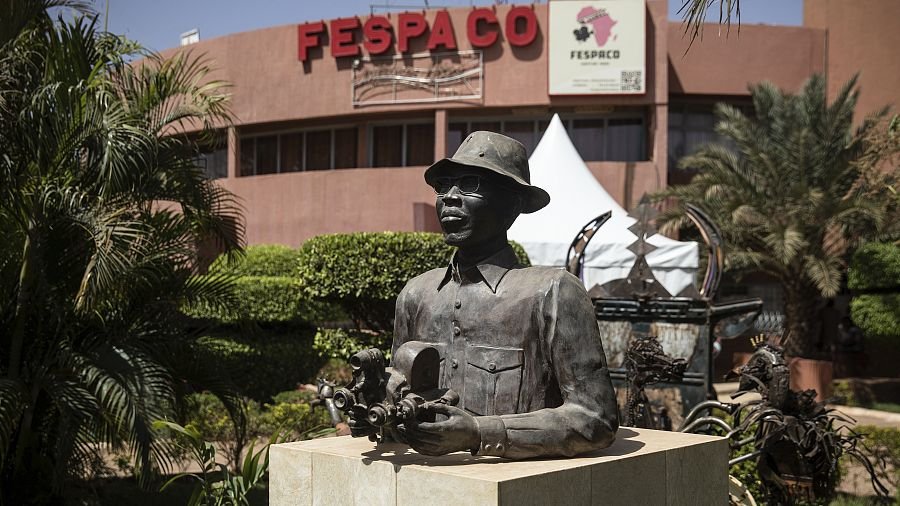
The festival has also been investing in its own legacy. A bust of Ousmane Sembène, the Senegalese pioneer often called the father of African cinema, was unveiled at FESPACO headquarters on the centenary of his birth. Statues of Malian filmmaker Cheick Oumar Sissoko and Nigerien filmmaker Oumarou Ganda were also inaugurated in Ouagadougou, ensuring that the giants of African cinema are remembered and honoured.
These gestures are not merely symbolic. They are a statement that African cinema has a history worth preserving, a lineage worth celebrating, and a future worth building. As the festival approaches its 30th edition, it does so with a deep sense of its own past and a clear vision for what comes next.
Building the Industry of Tomorrow
FESPACO is not just about screenings and awards; it is also about building the infrastructure of African cinema. The launch of the Yennenga Workshops was a significant step, supporting post-production for films that need technical and financial assistance to reach their full potential. The first Yennenga Coproduction market, dedicated to French-speaking African feature projects, selected 17 projects for development, connecting filmmakers with potential partners and funders.
The festival has also reached beyond Ouagadougou. Free open-air screenings were organised for people displaced by terrorism in Kaya and in Ouagadougou districts, bringing cinema to those who need it most. Mini-FESPACO events in Bobo-Dioulasso and Banfora extended the festival's reach, ensuring that the celebration of African cinema is not confined to the capital.
For the 30th edition, the organisers have announced a series of market reforms designed to modernise the festival and strengthen its commercial impact. These include streamlined accreditation, a digital marketplace for African content, and stronger partnerships with international film markets. The goal is to make it easier for African filmmakers to find buyers, co-producers and distributors.
The potential is enormous. African cinema is gaining global attention, and FESPACO is the gateway. A modernised market could connect African stories with audiences and investors around the world, creating sustainable careers for filmmakers and building a genuine industry across the continent.
The reforms are also a recognition that the festival must evolve to remain relevant. The world has changed since 1969, and FESPACO is changing with it — embracing digital platforms, new business models and new ways of connecting creators with audiences.
What to Watch For
The 30th edition of FESPACO, scheduled for February 27 to March 6, 2027, promises to be the biggest and most significant yet. The theme, "African Cinemas and Endogenous Development," places cinema at the centre of the continent's cultural sovereignty and economic future. It is a bold statement of intent, a declaration that African stories will be told on African terms.
Calls for applications are already open for the third Yennenga Coproduction workshop and the Yennenga Academy, giving emerging filmmakers the chance to develop their projects with the support of the festival. The response has been enthusiastic, a sign of the hunger for opportunity that exists across the continent.
The 2027 edition builds on the legacy of 1969 and the 29 editions that followed. It is a milestone that honours the pioneers who created FESPACO and the generations of filmmakers who have sustained it. But it is also a look forward, a vision of what African cinema can become.
For young filmmakers from Dakar to Lagos, Nairobi to Johannesburg, FESPACO remains the dream. It is where they hope to screen their films, to win the Golden Stallion, to be recognised by their peers and their continent. The 30th edition will be their stage.
The festival's role in connecting African cinema to global audiences and markets has never been more important. As the world increasingly looks to Africa for stories, for perspectives, for creativity, FESPACO is the bridge. The countdown to 2027 has begun, and the continent is watching.
This article was produced with AI-assisted research and editorial support. Sources: africanews, FESPACO official website (fespaco.bf), Film Resource Africa, Seneweb.
By Amara Diop, Staff Writer
What's Your Reaction?
 Like
0
Like
0
 Dislike
0
Dislike
0
 Love
0
Love
0
 Funny
0
Funny
0
 Wow
0
Wow
0
 Sad
0
Sad
0
 Angry
0
Angry
0

West Africa/Sahel Correspondent at Global1.News. Dakar-based journalist covering politics, security, climate, and development across Francophone and Anglophone West Africa. Tells the stories of a region undergoing profound transformation.











Comments (0)