
Nepal's Bhote Koshi Catastrophe: 579 Dead, 288 Indians Missing, and a Warning for India's Own Glacial Lakes
The Bhote Koshi River, a transboundary torrent that originates on the Tibetan plateau and slices through Nepal's Rasuwa district before joining the Trishuli, has become the site of South Asia's deadliest glacial flood disaster in recent memory.
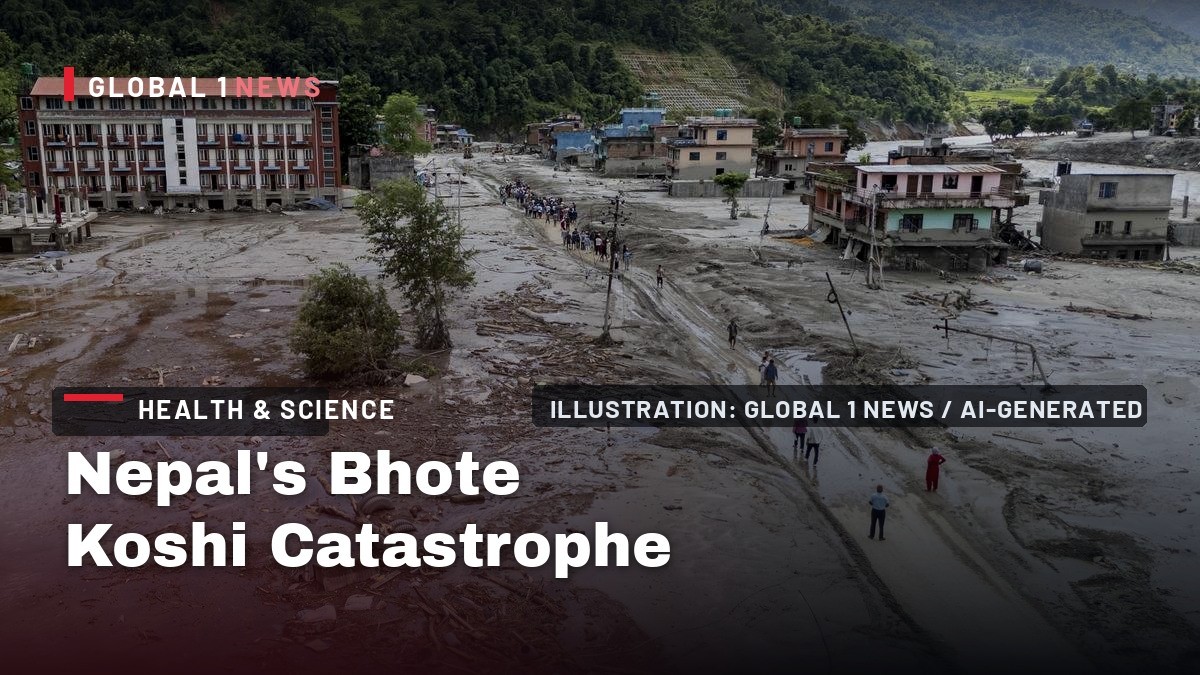
The Bhote Koshi River, a transboundary torrent that originates on the Tibetan plateau and slices through Nepal's Rasuwa district before joining the Trishuli, has become the site of South Asia's deadliest glacial flood disaster in recent memory. As of Friday, August 28, 2026, Nepal's Disaster Risk Reduction and Management Authority (NDRRMA) has confirmed 579 deaths, with nearly 1,900 people still unaccounted for, while Indian authorities report that 85 Indian nationals have been rescued and at least 288 remain missing.
Nepal's Bhote Koshi Catastrophe: 579 Dead, 288 Indians Missing, and a Warning for India's Own Glacial Lakes
Kathmandu, Nepal – August 28, 2026 — The scale of the disaster that began on Wednesday, August 26, when a wall of water and debris surged down the Bhote Koshi River from China's Tibet Autonomous Region, is still being measured in body bags and desperate family reunions. The flood, which Nepal's officials believe was triggered by a glacial lake outburst or an ice avalanche possibly set off by seismic activity near the border, has devastated five Nepali districts in a cascade of destruction that now threatens to spill across the Indian border.
The Catastrophe: How the Bhote Koshi Unleashed
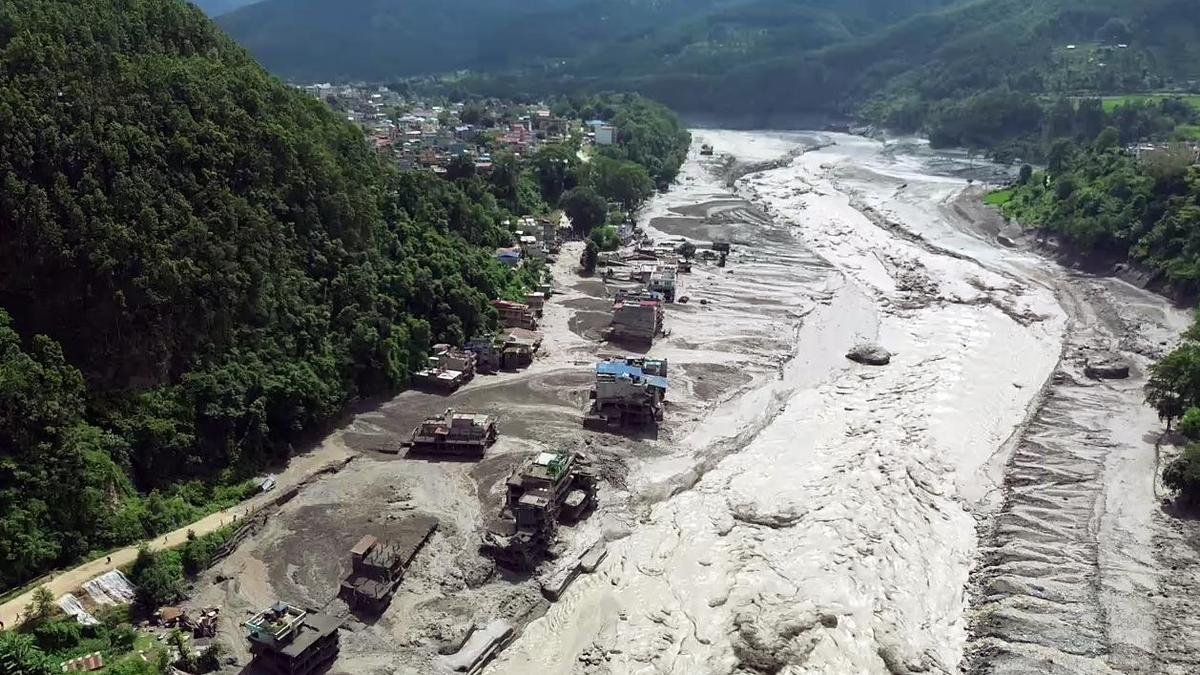
The sequence of events is now clear from satellite imagery and ground reports. On the morning of August 26, a massive volume of water, sediment, and boulders was released from a glacial lake near the Nepal-Tibet frontier. The surge entered the Bhote Koshi at Rasuwa district with little warning, overwhelming riverbanks and sweeping away settlements, bridges, and infrastructure in its path. Within hours, the flood had cascaded downstream through Nuwakot, Dhading, Gorkha, and Chitwan districts, transforming the Trishuli River — a major tributary of Nepal's Narayani system — into a conveyor belt of destruction.
Nepal's NDRRMA has not yet established the exact cause, and officials on both sides of the border are investigating whether seismic activity in Tibet destabilised an already fragile glacial moraine. What is not in dispute is the ferocity of the event. The Bhote Koshi, which normally carries a manageable volume of snowmelt, swelled dramatically within hours, according to preliminary hydrological data shared with Nepali authorities. The floodwaters carried boulders the size of cars, scouring riverbanks and demolishing bridges, roads, and infrastructure along the corridor, including hydropower sites in Rasuwa.
The Human Toll: 579 Dead, Nearly 1,900 Missing
The human cost is staggering and still climbing. NDRRMA's official death toll stood at 579 on Friday morning, up from 359 on Thursday and 538 by Thursday evening. More than 480 bodies have been recovered, many from debris fields kilometres downstream of where victims were last seen. The missing figure is even more alarming: Nepali officials now estimate that nearly 1,900 people are unaccounted for, a sharp revision upward from earlier estimates of 977 to 1,500. The discrepancy reflects the difficulty of accounting for migrant workers, seasonal labourers, and informal settlements along the river corridor.
Among the missing are at least 288 Indian nationals, according to India's Ministry of External Affairs (MEA). The Nepal Tourism Board confirmed on August 28 that 85 Indians were among 121 foreign travellers rescued so far, but 517 foreign nationals remain missing overall. The Indian Embassy in Kathmandu has opened an emergency helpline and is working with Nepali authorities to trace the missing. For the families of those 288 Indians, the wait is agonising, and the MEA has said its immediate focus is on providing humanitarian aid as per Kathmandu's request, rather than mounting a separate Indian rescue operation inside Nepal.
India's Response: 37.5 Tonnes of Aid and an Open Border
India's response has been swift and substantial. New Delhi has airlifted 37.5 tonnes of relief material, including food, medicines, and critical supplies, to Kathmandu. Prime Minister Narendra Modi issued a statement on Thursday saying, "The people of India stand in solidarity with their sisters and brothers in Nepal at this difficult time." The MEA has confirmed that India is coordinating with Nepal's National Disaster Risk Reduction and Management Authority and has offered additional support, including NDRF teams, should Nepal request them.
Nepal, however, has declined foreign rescue teams, stating that its own security agencies — more than 14,000 personnel have been mobilised — can handle the operation. About 3,742 people have been rescued so far, according to Nepali officials. The decision to refuse international rescue teams is consistent with Nepal's post-2015 earthquake policy of managing disasters with domestic capacity, but it has drawn criticism from some humanitarian experts who argue that the scale of this disaster warrants additional specialised search-and-rescue assets. The EU has pledged 2 million euros in aid, and China, the United States, and the World Bank have all offered support.
What This Means for India: Himalayan GLOF Risk at Home
For India, this disaster is not a distant tragedy; it is a preview of a threat that looms over its own Himalayan states. The Bhote Koshi feeds the Sun Kosi, a major tributary of the Ganga, which flows through Bihar and Uttar Pradesh before reaching the plains. While the immediate flood pulse has largely dissipated by the time it reaches Indian territory, the sediment load and riverbed aggradation could alter drainage patterns and increase flood risk in downstream districts for years. Indian hydrologists are already monitoring the Kosi and Gandak systems for secondary effects.
More directly, India's own glacial lakes are ticking time bombs. The October 2023 South Lhonak glacial lake outburst flood in Sikkim killed dozens and severely damaged the Teesta III hydropower dam, a stark reminder of the vulnerability of India's mountain infrastructure. The February 2021 Chamoli disaster in Uttarakhand, triggered by a rock and ice avalanche, killed over 200 people and destroyed two hydropower projects. Himachal Pradesh and Ladakh face similar exposure, with more than 2,000 glacial lakes identified across the Hindu Kush Himalaya region that are classified as potentially dangerous.
India's National Disaster Management Authority has mapped high-risk glacial lakes and installed early warning systems in Sikkim and Uttarakhand, but the coverage is far from complete. The Bhote Koshi disaster underscores the need for a comprehensive, transboundary early warning framework with China and Nepal, covering the entire Ganga-Brahmaputra basin. India's NDRF and State Disaster Response Forces (SDRF) are among the best-equipped in the region, but they can only respond to disasters; they cannot prevent them. The investment required in upstream monitoring, satellite-based lake volume estimation, and community-level warning systems is a fraction of the cost of a single hydropower dam, yet it remains underfunded.
The Health Emergency Hidden in the Mud
As the floodwaters recede, a second disaster is unfolding: a public health emergency. The Red Cross has stated that at least 93,000 people are "in great need" of assistance, including clean water, sanitation, and shelter. The flood has destroyed or contaminated water sources across the affected districts, creating ideal conditions for waterborne infections. Cholera, typhoid, and leptospirosis are immediate threats, particularly in temporary camps where displaced families are congregating. Vector-borne diseases, including dengue and malaria, are also a concern as stagnant pools of floodwater become breeding grounds for mosquitoes in the subtropical lowlands of Chitwan.
Skin infections and respiratory illnesses are already being reported among rescue workers and survivors who have spent days in mud and contaminated water. The mental health toll is equally severe. Survivors who lost family members, homes, and livelihoods in a matter of minutes are at high risk of post-traumatic stress disorder, depression, and anxiety. Relief workers, many of whom are Nepali security personnel working 18-hour shifts, are also vulnerable to burnout and secondary trauma. India's experience in managing the health response after the 2013 Uttarakhand floods and the 2023 Sikkim GLOF offers a template, but the scale of this disaster — with nearly 1,900 missing and over 93,000 in need — will test Nepal's health system to its limits.
Early Warnings and Transboundary Cooperation
The Bhote Koshi disaster raises uncomfortable questions about early warning systems in the Hindu Kush Himalaya. The flood was triggered by a glacial lake outburst, a phenomenon that is becoming more frequent as climate change accelerates glacial melt. Yet, despite years of scientific warnings and the establishment of the International Centre for Integrated Mountain Development (ICIMOD) in Kathmandu, there was no effective warning to communities downstream. The lake that burst was in Tibet, and the data sharing between China and Nepal on glacial lake conditions remains inadequate.
India has a direct stake in improving this cooperation. The Ganga basin, which supports over 400 million people in India, is fed by rivers that originate in Nepal and Tibet. A GLOF in the upstream reaches of any of these rivers — the Kosi, Gandak, Karnali, or Teesta — could have catastrophic consequences for Indian states. The India-Nepal disaster-management cooperation framework, established after the 2015 earthquake, provides a mechanism for joint training and information sharing, but it has not been extended to real-time hydrological data exchange. The time has come for a trilateral India-Nepal-China agreement on glacial lake monitoring and early warning, modelled on the transboundary flood forecasting systems that already exist for the Brahmaputra.
The Bottom Line
The Bhote Koshi flood is a tragedy of immense proportions, but it is also a warning. As the death toll climbs and the search for the missing continues, the governments of Nepal, India, and China must confront an uncomfortable truth: the Hindu Kush Himalaya is warming faster than the global average, and its glacial lakes are growing in both size and number. The 579 dead in Nepal are not an anomaly; they are a harbinger of what awaits if the region's disaster preparedness does not keep pace with its climate vulnerability.
For India, the immediate priority is the safety of its 288 missing citizens and the provision of humanitarian aid to Nepal. But the longer-term priority must be a comprehensive national programme to monitor and mitigate glacial lake outburst flood risk across the Indian Himalaya, from Ladakh to Arunachal Pradesh. The NDRF can rescue the living, and the MEA can airlift supplies, but only sustained investment in early warning systems, transboundary cooperation, and climate adaptation can prevent the next Bhote Koshi from becoming a recurring nightmare.
— By Dr. Raj Patel, Staff Writer
This article was produced with AI-assisted research and editorial support. Sources: NDTV, Reuters, Associated Press, Nepal Disaster Risk Reduction and Management Authority, Nepal Tourism Board, Ministry of External Affairs, The Kathmandu Post, ReliefWeb.
What's Your Reaction?
 Like
0
Like
0
 Dislike
0
Dislike
0
 Love
0
Love
0
 Funny
0
Funny
0
 Wow
0
Wow
0
 Sad
0
Sad
0
 Angry
0
Angry
0

India/South Asia Correspondent at Global1.News. Analytical voice with a background in science and health journalism. Based in New Delhi, covering Indian politics, education, healthcare, technology, and policy. Breaks down complex data into clear, actionable reporting.















Comments (0)