
EU Removes Billionaires Usmanov and Fridman From Sanctions List
The European Union’s decision on 22 September 2026 to delist Russian oligarchs Alisher Usmanov and Mikhail Fridman marks a rare concession in a sanctions regime that has otherwise remained tightly coordinated among member states.
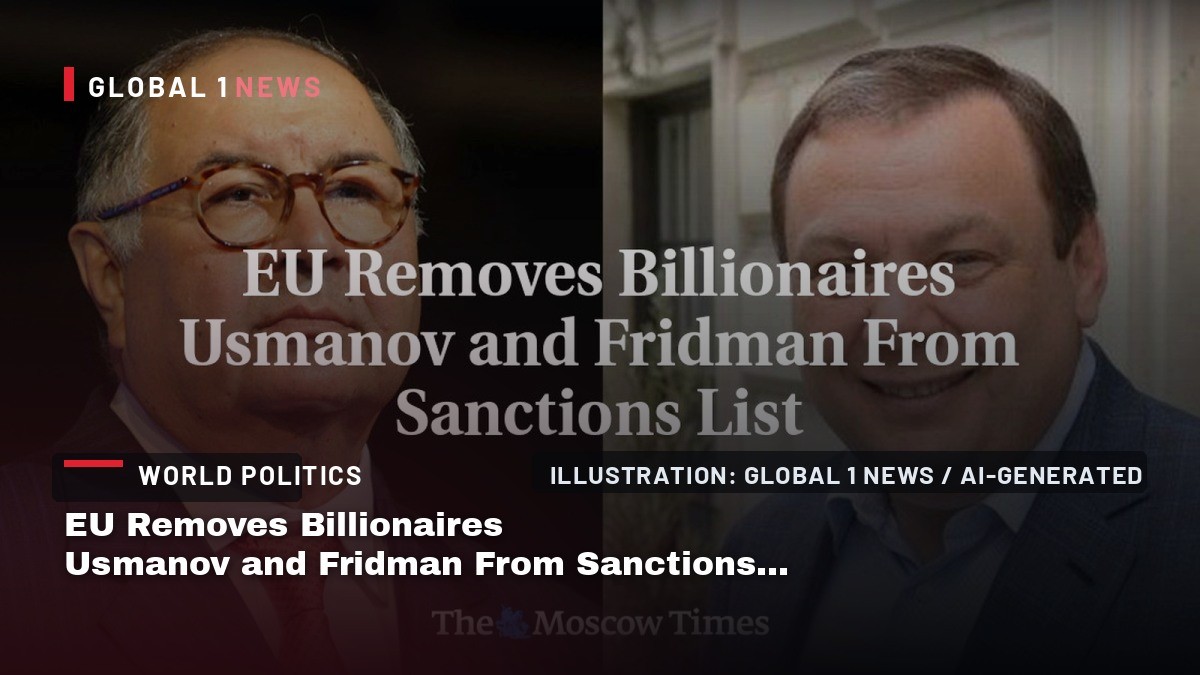
The European Union’s decision on 22 September 2026 to delist Russian oligarchs Alisher Usmanov and Mikhail Fridman marks a rare concession in a sanctions regime that has otherwise remained tightly coordinated among member states. The move, secured after intense diplomatic bargaining, not only reshapes the personal fortunes of two of Moscow’s most prominent financiers but also reveals the fault lines within the EU’s collective approach to Russia, the influence of third‑party states, and the strategic calculations of individual member governments.
Background to the delisting
Usmanov and Fridman were placed on the EU’s Russia sanctions list in 2022, following the full‑scale invasion of Ukraine. The sanctions comprised travel bans, asset freezes and prohibitions on transactions with EU entities, effectively cutting the billionaires off from the European financial system. The list currently covers roughly 3,000 individuals and entities, a figure that the EU agreed to roll over for another three years as part of the latest compromise.
The delisting was not a spontaneous reversal. In early September, France, citing national security concerns, advocated for the removal of Usmanov, a metals magnate with significant holdings in Uzbekistan. Luxembourg followed suit, pressing for Fridman’s removal after he launched a multibillion‑dollar legal claim against the Grand Duchy. Both positions forced the EU to confront a dilemma: maintain a unified sanctions front or accommodate the divergent priorities of its members.
The diplomatic bargain
EU envoys reached a compromise that paired the removal of the two oligarchs with a three‑year extension of sanctions on the remaining 3,000 listed subjects. This extension deviates from the usual six‑month renewal cycle, effectively lengthening the punitive regime for the broader list while granting a narrow reprieve to Usmanov and Fridman. The agreement required unanimity among the 27 member states; Latvia’s abstention—rather than a vote against—allowed the deal to pass under the EU’s written procedure, a formal mechanism for adopting decisions without a full council vote.
Latvia’s role was pivotal. The Baltic state had previously taken legal action to preserve sanctions on Fridman and his Russian‑Latvian associate Petr Aven, whose ties to Moscow have long been a point of contention. By abstaining, Latvia enabled the compromise while signaling its intent to impose national restrictions on the two men, a stance echoed by Ukraine’s foreign minister Andrii Sybiha, who condemned the delisting as “shameful and unjustifiable” and called on individual EU countries to enact their own measures.
National interests and external pressure
France’s push for Usmanov’s removal was reportedly linked to pressure from Azerbaijan, where two French nationals are detained. French diplomats indicated that Baku was using Usmanov as a bargaining chip, a claim that Azerbaijan denied. This episode illustrates how third‑party states can influence EU sanctions policy by leveraging personal connections to Russian elites. Similarly, Luxembourg’s demand for Fridman’s delisting coincided with his $16 billion claim against the country, suggesting that economic litigation can translate into diplomatic leverage within the EU framework.
The broader context includes Hungary’s recent government change, which had raised hopes for a more cohesive European stance on Russia. Former Prime Minister Viktor Orbán had repeatedly obstructed sanctions and aid to Kyiv, and his departure left a vacuum that other members, notably France and the Baltic states, sought to fill. The need to accommodate divergent national agendas—security concerns, legal disputes, and bilateral pressures—ultimately shaped the final compromise.
Implications for the sanctions regime
By extending the sanctions on the larger list for three years, the EU signals a willingness to maintain a long‑term punitive posture against Russia‑linked actors. However, the willingness to grant exemptions to high‑profile oligarchs may embolden other sanctioned individuals to seek similar concessions through legal or diplomatic channels. The precedent set by Luxembourg’s and France’s successful lobbying could encourage additional member states to pursue tailored deals, potentially fragmenting the sanctions architecture.
Moreover, the process underscores the EU’s reliance on unanimity for sanctions decisions. The requirement for all 27 members to agree creates opportunities for individual states to extract concessions by threatening to block renewals. In this case, Latvia’s abstention was enough to break a deadlock, but it also revealed how a single member can influence the outcome without directly voting against the measure.
Reactions from Moscow and Kyiv
Ukraine’s foreign ministry reacted sharply, labeling the delisting as a victory for Moscow. Andrii Sybiha posted on X that the decision was “shameful and unjustifiable,” urging EU countries to impose their own national restrictions. The statement reflects Kyiv’s broader concern that any weakening of the sanctions regime undermines its ability to pressure Russia and hold its elite accountable for the war.
From Moscow’s perspective, the removal of Usmanov and Fridman is a diplomatic win. Both men have close ties to the Kremlin, and their delisting allows them to resume limited financial activities within the EU, potentially funneling resources back into Russia’s economy. While the Kremlin has not issued an official comment, the removal aligns with its long‑standing strategy of leveraging personal networks to mitigate the impact of Western sanctions.
Legal and financial dimensions
Fridman’s $16 billion claim against Luxembourg highlights the intersection of sanctions and international litigation. Although the claim’s specifics were not disclosed, its magnitude suggests that the billionaire is seeking compensation for assets frozen under EU sanctions. Such legal actions raise complex questions about the enforceability of sanctions when contested in foreign courts and the potential for sanctions to be challenged on the basis of property rights.
Usmanov’s involvement in the metals sector, particularly in Uzbekistan, adds another layer. France’s justification for his delisting cited “national security concerns,” implying that his business activities intersect with broader European strategic interests, perhaps in energy or raw materials supply chains. The exact nature of these concerns remains undisclosed, but the reference indicates that sanctions can be calibrated in response to perceived economic dependencies.
Future outlook and strategic considerations
The EU’s three‑year renewal of the broader sanctions list suggests a shift toward a more stable, long‑term punitive framework, reducing the administrative burden of frequent renewals. However, the compromise also signals that the bloc remains vulnerable to internal dissent and external lobbying. As member states navigate their own national interests—whether legal claims, bilateral disputes, or security concerns—they may continue to seek carve‑outs that dilute the collective pressure on Russia.
For policymakers in Brussels, the challenge will be to balance the need for a unified front with the realities of a heterogeneous union. Strengthening the written procedure to limit the scope of exemptions, enhancing transparency around national security justifications, and developing a coordinated response to third‑party pressure could help preserve the integrity of the sanctions regime. Meanwhile, Kyiv will likely intensify its diplomatic outreach to ensure that any concessions are offset by additional measures, such as increased military aid or alternative economic sanctions.
In sum, the delisting of Usmanov and Fridman is a micro‑cosm of the broader contest over how Europe confronts Russian aggression. It reveals the interplay of national interests, external influence, and the structural constraints of unanimity within the EU. As the sanctions list remains in force for the next three years, the episode serves as a reminder that the battle over Russia’s financial lifelines is as much a diplomatic chess game as it is an economic one.
This article was produced with AI-assisted research and editorial support. Reporting is based on the source material cited below. Sources: The Moscow Times; themoscowtimes.com; Global1.News (24 September 2026).
By Irina Volkov, Staff Writer
What's Your Reaction?
 Like
0
Like
0
 Dislike
0
Dislike
0
 Love
0
Love
0
 Funny
0
Funny
0
 Wow
0
Wow
0
 Sad
0
Sad
0
 Angry
0
Angry
0
Russia/Eastern Europe Correspondent at Global1.News. Covering Russian politics, energy, security, and the shifting dynamics of the post-Soviet space. Provides clear-eyed analysis on one of the world's most opaque regions.










Comments (0)