
Envision claims to be running the world's first 800VDC data center in Ulanqab, China
Envision’s claim of running the world’s first 800 VDC data centre in Ulanqab, Inner Mongolia, is the latest flash‑in‑the‑pan hype that masks a very real engineering challenge: how to feed ever‑growing AI workloads without drowning in layers of power conversion.
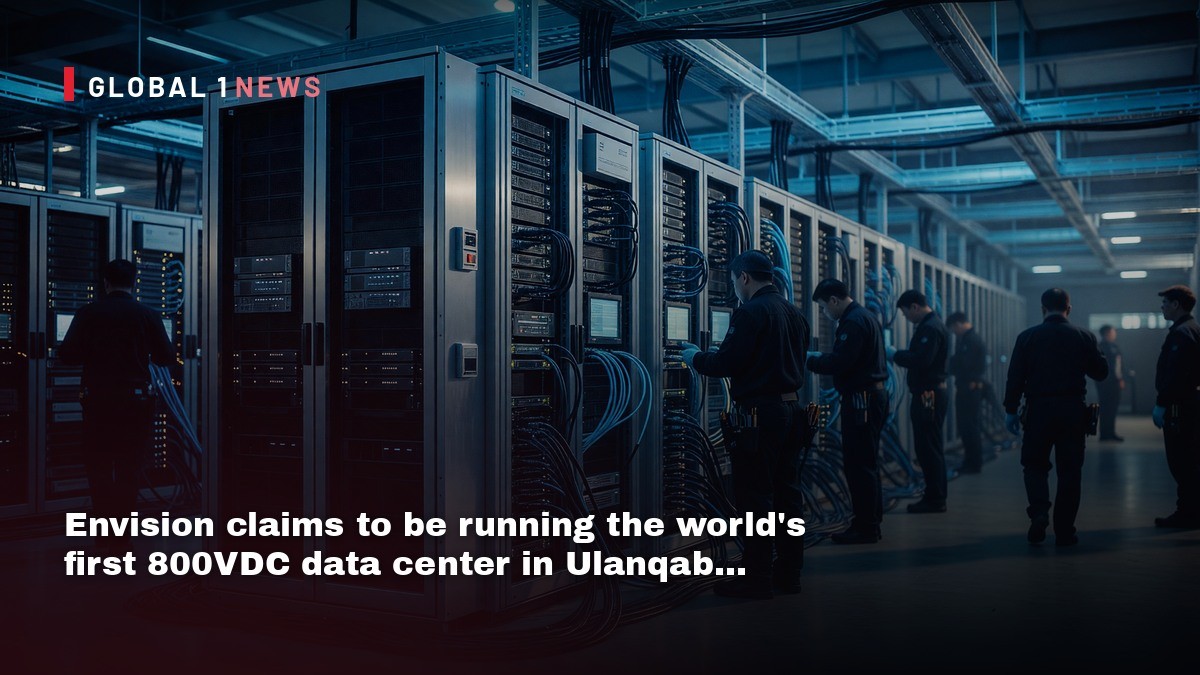
Envision’s claim of running the world’s first 800 VDC data centre in Ulanqab, Inner Mongolia, is the latest flash‑in‑the‑pan hype that masks a very real engineering challenge: how to feed ever‑growing AI workloads without drowning in layers of power conversion. As a founder who has spent a decade wiring up production servers from the ground up, I can tell you the promise of a single AC‑to‑DC conversion sounds sweet, but the devil is in the details of reliability, cost and real‑world load‑swing handling.
Why 800 VDC Matters – and Why It’s Not a Silver Bullet
The traditional data‑centre power chain is a circus of conversions: grid AC to DC for UPS batteries, back to AC for distribution, then down to DC again at the rack. Envision’s 800 VDC system chops that down to one conversion – AC to DC at the point of entry – and then runs a high‑voltage busbar straight to the servers. In theory that cuts losses and frees up space for more power‑hungry AI chips.
But “single conversion” also means you’re putting a lot of voltage on the same busbars and cables that used to carry 400 V or less. That raises the stakes for insulation, connector design and fault detection. In my own shops, moving from 400 V to 800 V meant re‑engineering the entire rack power distribution board, a costly exercise that most independent providers can’t afford without a deep pocket or a hyperscaler partnership.
The Envision Stack – Solid‑State Transformers and Real‑Time Control
Envision’s architecture leans on solid‑state transformers (SST) to step down 10 kV medium‑voltage AC from the grid to the 800 VDC busbar. The SST is paired with a battery energy storage system (BESS) and a controller they call “Dubhe”, backed by an AI model of the same name. Dubhe supposedly coordinates the SST and batteries in real time, matching supply to demand and smoothing sudden load spikes.
From a risk perspective, that sounds impressive, but it also adds a layer of software‑driven control that must be rock‑solid. In my experience, any AI‑based controller that sits in the power path becomes a single point of failure unless you have redundant paths and rigorous validation. The article doesn’t say how many redundant SSTs or BESS units are in place, so the claim of “live compute workloads” needs a healthy dose of scepticism until we see uptime stats.
Scale Claims – 3 GW Capacity and One Million AI Accelerators
Envision says the Galaxy AI data centre spans 120,000 sqm and is designed for a planned capacity of 3 GW, enough to host up to one million AI accelerators. Those numbers are eye‑catching, but the article admits the actual size of the 800 VDC system in the facility has not been disclosed. Without knowing the current load, it’s impossible to gauge whether the 800 VDC bus is truly the bottleneck‑breaker it’s billed as.
For independent providers, the lesson is clear: headline‑grabbing capacity figures don’t translate into immediate ROI unless you have customers who can actually consume that power. Most of us are still chasing the sweet spot of 100‑200 kW per rack, not the multi‑gigawatt scale that only the biggest hyperscalers can justify.
Renewable Energy Integration – 80 % Green Power
Envision touts an 80 % renewable energy mix for the Ulanqab site, aligning with the broader industry push to decarbonise AI compute. The integration of renewables, BESS and the SST is the real differentiator here – it shows a path to run high‑power AI workloads without a massive carbon footprint.
However, the article gives no detail on how the BESS is sized relative to the 800 VDC bus or the variability of the renewable feed. In practice, you need a battery bank that can smooth out the intermittency of wind or solar for at least several minutes to protect the servers from sudden drops. That adds capital cost and operational complexity, something many boutique data‑centre operators simply can’t swallow.
Industry Context – OCP 400 VDC and the Race to Higher Voltage
The Open Compute Project (OCP) has been pushing a 400 VDC design via the Mount Diablo rack sidecar, which Microsoft and Meta have championed. Envision’s 800 VDC approach essentially doubles that voltage, promising even higher power density. The trade‑off is clear: higher voltage means higher risk and higher engineering overhead.
What we’re seeing is a fragmentation of standards – 400 VDC on one side, 800 VDC on the other – which could lock customers into specific vendors. For a founder, that’s a red flag. Betting on a single‑vendor high‑voltage solution can backfire if the ecosystem doesn’t coalesce around a common bus and connector spec.
Business‑Risk Takeaways for Independent Providers
First, the 800 VDC hype does not erase the fundamentals of power reliability. You still need redundant UPS paths, robust monitoring and a clear maintenance plan for solid‑state transformers, which are still relatively new in the field. Second, the capital outlay for SSTs and BESS is non‑trivial; unless you have deep‑pocketed investors or a guaranteed pipeline of AI workloads, the ROI horizon stretches well beyond typical data‑centre payback periods.
Third, the lack of disclosed system size or performance metrics means you’re buying into a promise rather than a proven solution. Independent operators should demand transparent benchmarks – uptime, conversion efficiency, fault‑recovery time – before committing to 800 VDC. Until those numbers surface, the safest route is to stick with proven 400 VDC or even traditional AC‑to‑DC architectures that you can scale incrementally.
Actionable Advice – How to Navigate the 800 VDC Wave
If you’re considering a high‑voltage upgrade, start with a pilot. Deploy a single SST‑powered rack in a non‑critical zone and instrument it heavily. Compare the total‑cost‑of‑ownership against your existing AC‑based setup, factoring in the cost of BESS, controller licensing and the extra engineering labour. Use the data to decide whether the efficiency gains offset the added complexity.
Second, keep an eye on the emerging standards around busbars, connectors and safety protocols. The OCP white paper on 800 VDC mentioned busbars and mixed cabling – that’s the direction the industry is heading, but it’s still early days. Align your hardware purchases with vendors that are actively participating in those standard‑setting bodies.
Finally, hedge your renewable exposure. Even with an 80 % green mix, you’ll need firm capacity from the grid or on‑site generation to meet the strict uptime SLAs that enterprise customers demand. A hybrid approach – renewable plus conventional backup – remains the pragmatic path for most founders.
In short, Envision’s 800 VDC showcase is a bold technical statement, but it’s not a turnkey answer for every data‑centre. The hype is real, the engineering challenges are real, and the business risk is very real. As a founder, you have to weigh the promise of higher power density against the cost, complexity and reliability penalties. Stay grounded, test at scale, and don’t let a flashy voltage number dictate your roadmap.
— Allan Ali, Founder
This article was produced with AI-assisted research and editorial support. Reporting is based on the source material cited below. Sources: Data Center Dynamics; datacenterdynamics.com; Global1.News (02 November 2026).
By Allan Ali, Global1.News
What's Your Reaction?
 Like
0
 Dislike
0
 Love
0
 Funny
0
 Wow
0
 Sad
0
 Angry
0

Publisher of Global1.News. Automation architect, systems builder, and the guy making sure the truth gets published.











Comments (0)