
Fire at HPCL's Flagship Visakh Refinery Unit, Ten Months After Commissioning
The newest unit at HPCL's Visakh Refinery in Visakhapatnam caught fire late on Monday. Fire tore through the pitch tower of the Residue Upgradation Facility, the world's first LC-Max unit, commissioned in January. No casualties were reported and a technical committee will investigate the cause.
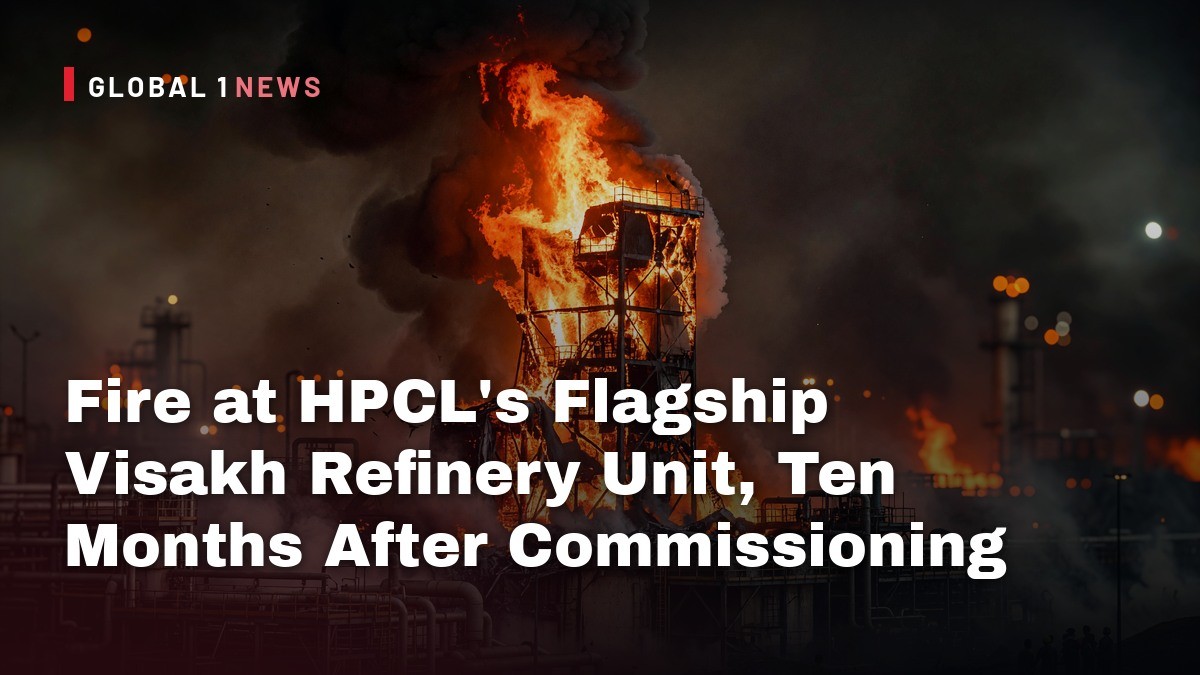
The newest unit at India's oldest refinery on the east coast caught fire on Monday night, and it caught fire in its pitch tower. The Residue Upgradation Facility at Hindustan Petroleum Corporation Limited's Visakh Refinery in Visakhapatnam was commissioned in January 2026, at the end of its modernisation programme, and it was presented to the country as the world's first and largest facility of its kind. No one has been reported killed or injured, Malkapuram police said.
Fire at HPCL's Flagship Visakh Refinery Unit, Ten Months After Commissioning
Visakhapatnam, India — The fire was reported late on Monday, 2 November, in the pitch section of the refinery at Malkapuram, near the Yarada Hills, where heavy vacuum residue is held before it is upgraded. Pitch is what remains at the bottom of the barrel once the lighter fractions have been taken off. HPCL officials confirmed the incident to The Hindu and said a technical committee would investigate the exact cause. The same report said structural damage inside the pitch unit is "expected to be significant", a phrase worth reading twice. It is an expectation, not an assessment, and it is the most specific thing anyone has said about the condition of the plant.
The Pitch Tower at Ten Fifteen
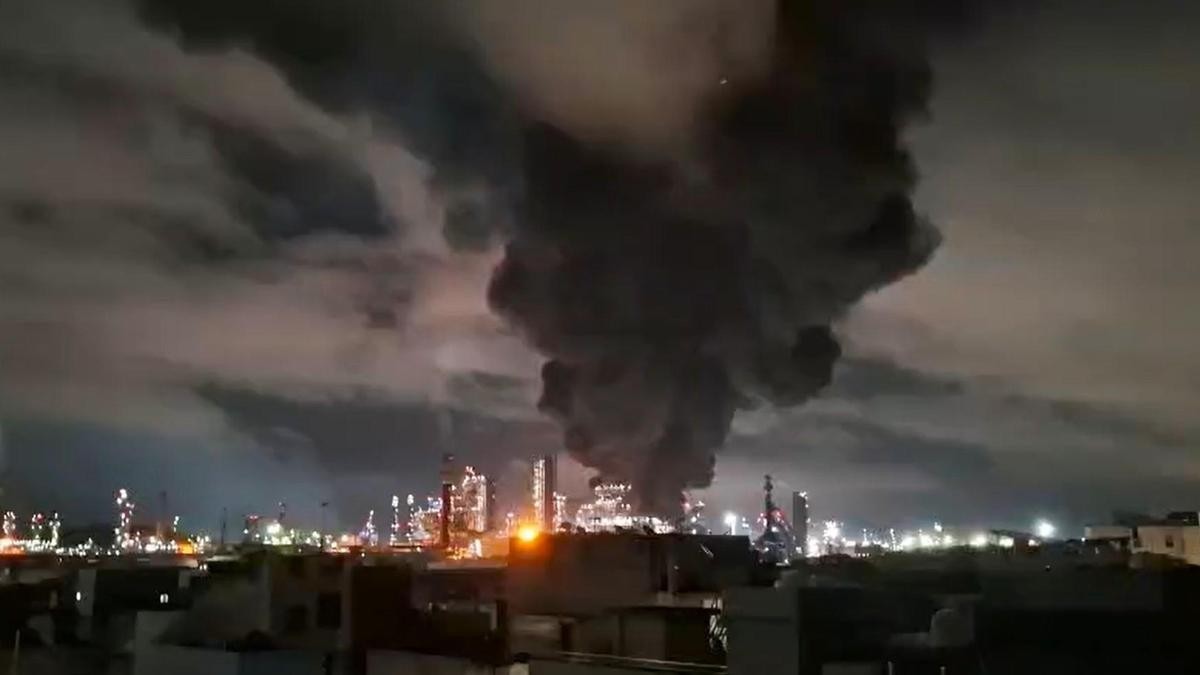
At about 10.15 pm, the fire broke out inside the plant. The Hindu reported that the sudden explosion and intense flames caused brief panic among residents in neighbouring localities, and that automated safety protocols allowed on-duty personnel to be evacuated while firefighting teams isolated the unit, keeping the flames off adjacent facilities.
The Malkapuram Inspector of Police, E. Narasimha Rao, issued a voice message that night saying the situation was under control. He said HPCL's internal Fire and Safety Department had responded immediately with its own fire tenders, which removed the need for external fire engines.
That is the official sequence: a fire, a containment, no casualties. It does not describe the thing that burned. The pitch tower is where the intractable end of the barrel sits hot and dense before it is cracked into something saleable.
A Unit the Government Called a Masterpiece
When the facility was commissioned in the first week of January 2026, ANI reported a Union minister's post describing it as "a masterpiece of indigenous engineering". The post put the scale in numbers: three LC-Max reactors of 2,200 tonnes each, "ranking among the world's heaviest engineering blocks, and all fabricated and assembled within India". Capacity was given as 3.55 million tonnes a year, using residue hydrocracking to convert 93 per cent of bottom-of-the-barrel oils into high-value products.
The same announcement carried the money: Rs 31,407 crore for the Visakh Refinery Modernisation Project, which lifted the refinery from 8.33 million tonnes a year to 15 million.
"Masterpiece" is a press-office word. The engineering behind it is not in doubt, but the phrase was never a warranty, and nothing about a January ribbon-cutting tells you how a plant behaves in its first year of full operation.
What the Residue Upgradation Facility Does
The facility's job is to take what the refinery cannot sell and make something it can. The RUF processes heavy vacuum residue into high-value clean fuels such as diesel and petrol, work that happens at high operating temperatures and with dense petroleum pitch moving through the train.
Affairs Cloud, reporting the commissioning, described it as India's first residue hydrocracking unit and named the technology LC-Max. The principle is straightforward even where the metallurgy is not: the leftover is heated, put under pressure and driven through the reactors until the long, heavy molecules break into lighter ones.
The consequence of that heat and density was visible in the smoke. An HPCL official told The New Indian Express that the smoke was particularly thick because of the high viscosity of the product stored in the tank.
Two Seats of Fire and Five Tenders
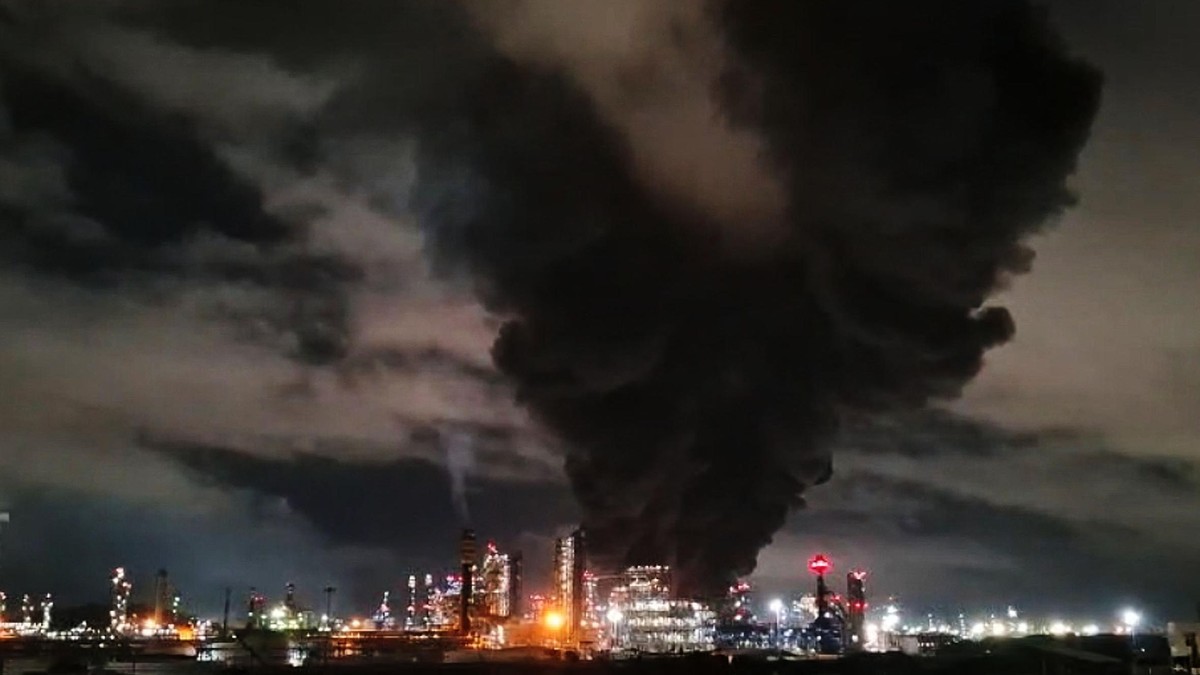
The picture on the ground was never as tidy as the word "controlled". Deccan Chronicle quoted deputy inspector of factories V. Suresh saying five HPCL fire tenders had been deployed, that the fire had been brought under control, and that smoke was still billowing from the pitch, causing concern among employees and the public.
The regional fire officer, Niranjan Reddy, said fires were still burning at two locations and that crews were using foam to put them out.
Both statements stand. "Under control" in firefighting means the fire has been stopped from spreading and has a boundary around it. It does not mean the fire is out, and a pitch fire is stubborn precisely because the material holds heat. The Police Commissioner, Shankhabrata Bagchi, confirmed the incident and said the blaze was confined to the tank, with no threat to other sections of the refinery.
What HPCL Has Confirmed and What It Has Not
On the record, the company has said three things. It confirmed that the fire happened. It said a technical committee would investigate the cause. And it said the primary processing units remain operational and that fuel supply chains will not be affected.
Notice what that covers. Primary processing is crude distillation and the units around it. The RUF is not a primary processing unit; it is the downstream unit that upgrades the residue those primary units produce. A statement that primary processing is running says nothing about whether the RUF is running, and no order to shut the facility has been announced.
There is also no damage estimate. An HPCL official told The New Indian Express that the extent of property damage would be assessed the next day. Until it is, the company's assurance addresses the supply chain and leaves the plant itself unaddressed.
An Overhead Line, Possibly
Deccan Chronicle reported that preliminary reports suggested an overhead electrical line might have triggered the fire. That sentence carries two hedges and both should be read: "preliminary" and "might have". No cause has been established, and no finding has been published.
What is recorded is what people heard. The regional fire officer said employees had heard a blast before the fire broke out. A blast is not the same as a tank explosion, and Munsif Daily reported that preliminary information from HPCL sources indicated the possibility of a tank explosion was low.
An overhead line, if that is what it was, would raise its own questions about the plant's electrical infrastructure and about how a conductor comes to fail above a pitch unit. Those questions belong to the committee. Until it reports, the line stays a possibility.
The Smoke Over Malkapuram
Smoke is what the neighbourhood got. Munsif Daily reported that the fire triggered panic in the industrial areas of Malkapuram and Sriharipuram, that the flames rose high enough to draw the attention of commuters on nearby roads, and that the videos recorded on those phones circulated widely.
The geography explains the alarm. The refinery sits on a large parcel of land near the Yarada Hills, 723 acres by NS Energy's count, roughly 5 kilometres from Visakhapatnam airport and 6.5 kilometres from the city's railway station. Malkapuram is not a buffer zone. It is next door.
Thick black smoke from burning pitch is unpleasant by any measure, and no pollution-control notice or resident evacuation order has been reported. The smoke was the part of the fire the city could see.
A Refinery That Has Burned Before
The record is not clean. In September 1997 an LPG release at the refinery produced a vapour cloud explosion that destroyed administrative buildings, LPG storage vessels, processing units and an adjacent petroleum terminal; the blast was heard more than 20 kilometres away, according to a Texas A&M case study. The official loss of life was declared at 56. The Hindu, writing in 2013, described that explosion as having claimed 60 lives. Both are recorded figures.
In 2013 a blast at the refinery's cooling tower killed one person and left others with critical burns, following a fire that had burned Crude Distillation Unit-3 on 16 May of that year without casualties.
On 25 May 2021, HPCL issued a statement after a fire in one of its crude distillation units: the unit was shut down safely, the fire was put out with six fire tenders, and there were no casualties and no risk to the public. That unit had a capacity of 3.5 MMTPA. None of it establishes anything about this week.
The Oldest Refinery on the East Coast
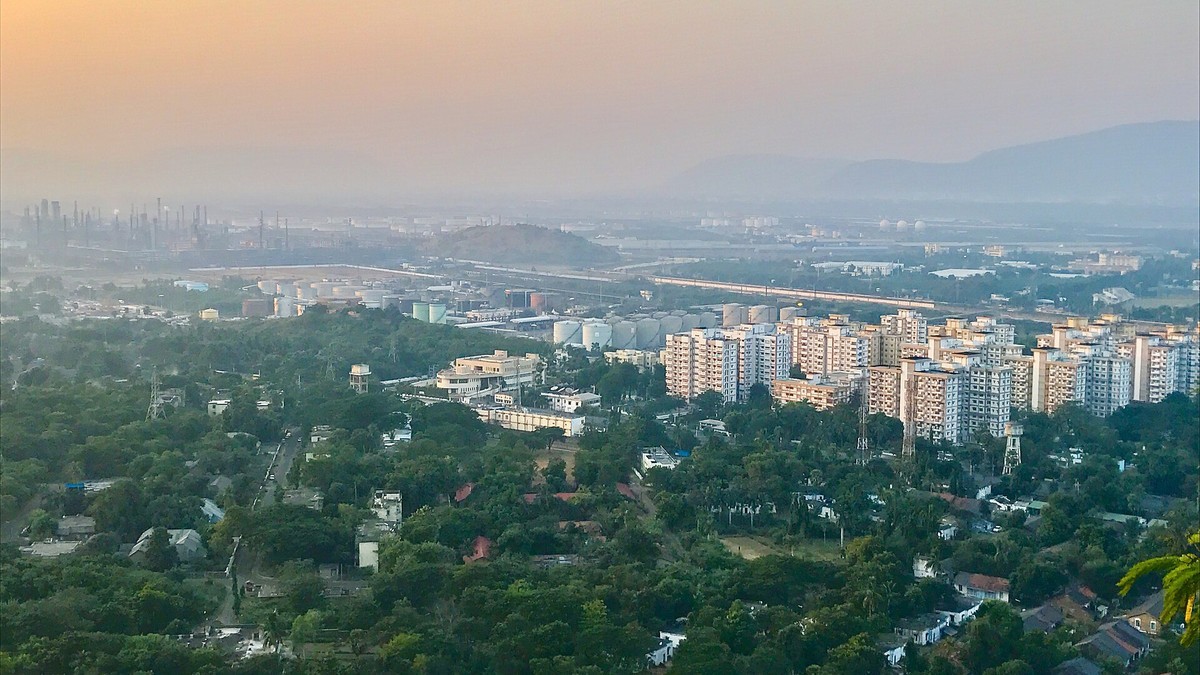
The Ministry of Petroleum and Natural Gas dates the refinery's commissioning to 1956, when it ran as Caltex Oil Refining India Ltd with a capacity of 0.65 MMTPA. Bhaskar English records the start of operations as 1957. The government took the plant over in 1976 and merged it with HPCL in 1978, the year NS Energy gives for the beginning of the company's ownership.
Expansion came in stages, in 1985 and again in 1999, with a revamp in 2010, before the modernisation programme that produced the RUF.
The plant's recent performance is why so much rides on it. HPCL's 2024-25 annual report records the Visakh refinery's highest annual throughput, 15.31 million tonnes, at 111.8 per cent capacity utilisation, with a gross refining margin of $5.63 per barrel. A refinery running above nameplate is a refinery with no slack.
The Questions the Committee Has to Answer
The first question is the ignition source: whether the overhead line was refinery equipment, what it was doing above the pitch tower, and whether the fire began at the line or somewhere else and brought the line down.
The second is structural. "Expected to be significant" is not a finding, and the distance between scorched insulation and a distorted support under a reactor is the distance between a restart and a rebuild. The third is status: whether the RUF is intact, idled or damaged, and how the refinery will handle its residue in the meantime.
The fourth is the one the public statement does not touch. Fuel supply chains are a national concern. The people in Malkapuram and Sriharipuram have a local one. They live beside a plant that has stood on this ground since the 1950s, and its newest unit burned in its first year. The refinery's record and their evenings are the same question.
By Jessica Ali, Staff Writer
This article was produced with AI-assisted research and editorial support. Sources: The Hindu, Deccan Chronicle, The New Indian Express, Munsif Daily, Bhaskar English, ANI, Affairs Cloud, the Ministry of Petroleum and Natural Gas, HPCL's annual report, NS Energy, and a Texas A&M case study of the 1997 explosion. Photographs: Deccan Chronicle (by arrangement), The Hindu (by arrangement) and IM3847 via Wikimedia Commons, CC BY-SA 4.0. Cover: Global 1 News editorial image.
What's Your Reaction?
 Like
0
 Dislike
0
 Love
0
 Funny
0
 Wow
0
 Sad
0
 Angry
0

Editor-in-Chief at Global1.News. Atlanta-based journalist who cuts through the BS and tells it like it is. Lead anchor, host, and the voice you hear when the spin stops and the truth starts.











Comments (0)