
China’s AI Expansion Turns Inner Mongolia’s Potato Fields into Data Centres
In a recent video report released by CNA on 21 November 2026, correspondents highlighted a striking transformation unfolding in Inner Mongolia’s Ulanqab region, long known as China’s “potato capital”.
In a recent video report released by CNA on 21 November 2026, correspondents highlighted a striking transformation unfolding in Inner Mongolia’s Ulanqab region, long known as China’s “potato capital”. The footage documents a rapid shift from traditional agriculture and grazing to the construction of large‑scale artificial intelligence (AI) computing facilities. While the burgeoning data‑centre industry promises new economic opportunities, the report also raises concerns about water sustainability in a region already vulnerable to drought and the broader impact on local livelihoods. This development bears relevance for Japan’s own AI and semiconductor strategies, as well as for regional cooperation on resource management and technology policy.
From Potato Fields to AI Hubs: The Physical Shift
The video opens with aerial shots of expansive potato farms that have characterised Ulanqab for decades. These fields, once the backbone of the local economy, are now interspersed with the skeletal frames of data‑centre buildings. According to the CNA correspondents, the construction boom is evident in the number of new structures rising across the landscape, signalling a deliberate pivot toward digital infrastructure.
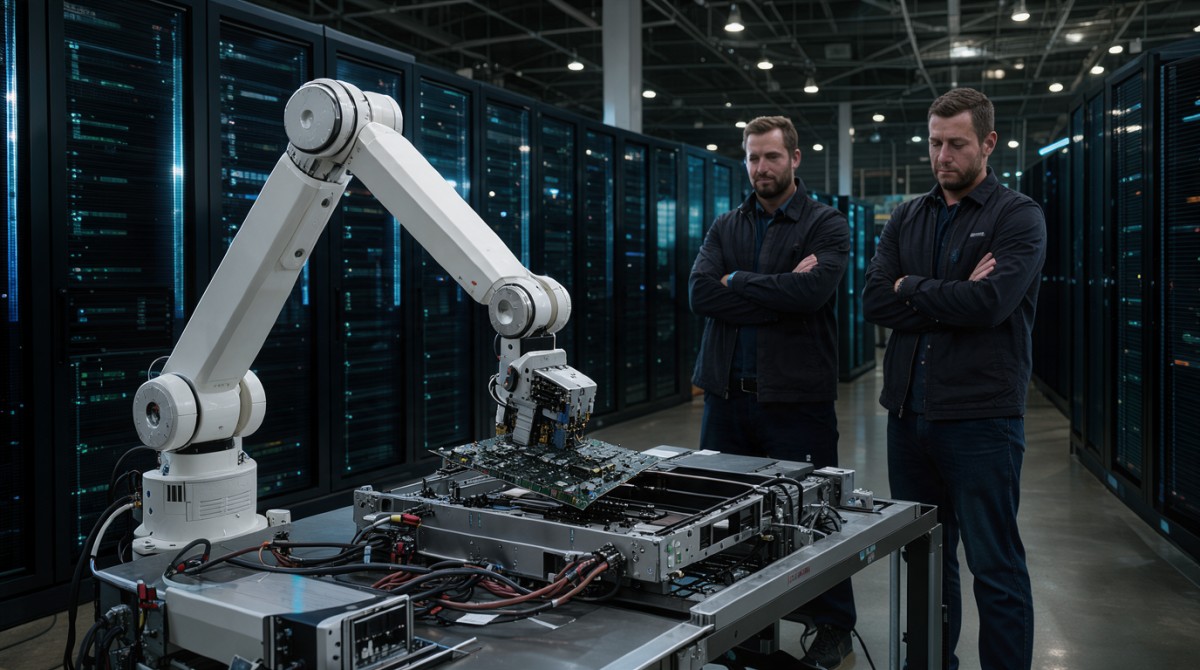
In the footage, workers are seen installing racks of servers and cooling equipment, a stark contrast to the agricultural machinery that previously dominated the scene. The report notes that the transition is driven by the region’s strategic location and the availability of relatively inexpensive land, factors that have attracted major Chinese tech firms seeking to expand their AI computing capacity.
While the video does not provide precise figures, it conveys a sense of scale through visual comparison: rows of potato plots are now flanked by rows of server racks. This juxtaposition underscores the speed at which the AI computing sector is reshaping the physical environment of Inner Mongolia.
For Japan, which is actively pursuing AI integration across industries, the Ulanqab example illustrates how geographic and economic considerations can accelerate the deployment of high‑performance computing facilities. Observers in Tokyo may watch this development as a case study for balancing industrial diversification with existing agricultural assets.
Economic Opportunities Emerging from the AI Boom
The CNA report highlights that the data‑centre construction has generated new jobs, ranging from construction labor to technical positions required for operating and maintaining AI hardware. Local officials, as depicted in the video, have expressed optimism that the influx of technology firms will diversify the regional economy, which has historically relied heavily on agriculture and animal husbandry.
In addition to direct employment, the presence of data centres is expected to stimulate ancillary services, such as logistics, security, and facility management. The video suggests that local businesses are beginning to adapt, offering catering, accommodation, and transportation services to the growing workforce associated with the AI projects.
From a policy perspective, the report implies that regional authorities are actively courting AI investments, positioning Inner Mongolia as a competitive site for computing infrastructure. This aligns with broader national strategies to expand China’s AI capabilities, as outlined in recent policy documents that emphasize the development of domestic data‑centre capacity.
Japan’s Ministry of Economy, Trade and Industry (METI) has long advocated for the creation of regional AI clusters to mitigate concentration in major metropolitan areas. The Inner Mongolian experience may provide useful insights for Japanese prefectures seeking to attract similar investments while managing local socioeconomic impacts.
Water Sustainability Concerns in a Drought‑Prone Region
A central theme of the CNA footage is the strain that data‑centre cooling systems place on water resources. The report notes that Inner Mongolia is already prone to drought, and the increased demand for water to cool server farms raises questions about long‑term sustainability.
Visual evidence in the video shows cooling towers drawing water from local sources, with the correspondents pointing out the limited capacity of existing water infrastructure. The report does not quantify the additional consumption, but the emphasis on “concerns” suggests that local authorities are aware of potential conflicts between the needs of the AI industry and agricultural water use.
In the broader context of climate change, the water issue mirrors challenges faced by other regions where data‑centre expansion is underway. Japanese policymakers, particularly within the Ministry of the Environment, have been examining water‑intensive cooling technologies and the adoption of alternative methods such as air‑side economizers and liquid immersion cooling.
The Inner Mongolian case underscores the importance of integrating environmental impact assessments into the planning stages of AI infrastructure projects. As Japan continues to promote data‑centre growth, lessons from Ulanqab could inform stricter water‑use regulations and the promotion of greener cooling solutions.
Impact on Local Livelihoods and Cultural Landscape
The video captures interviews with local farmers who express mixed feelings about the transformation of their surroundings. While some acknowledge the economic benefits of new jobs, others voice apprehension about the loss of arable land and the erosion of traditional agricultural practices.
In particular, the report highlights that potato cultivation, a cultural hallmark of the region, is being displaced as farms are repurposed for data‑centre construction. The footage shows abandoned fields and equipment, symbolising a shift away from the agrarian way of life that has defined Ulanqab for generations.
These social dynamics resonate with concerns raised in Japan about the balance between technological advancement and the preservation of local communities. The Ministry of Agriculture, Forestry and Fisheries (MAFF) has emphasized the need to protect rural livelihoods while embracing digital transformation, a policy tension mirrored in Inner Mongolia.
For Japanese think tanks analyzing the socioeconomic implications of AI expansion, the Inner Mongolian experience offers a concrete illustration of how rapid infrastructure development can alter community structures, potentially prompting migration, changes in employment patterns, and shifts in cultural identity.
Strategic Implications for Regional Technology Competition
China’s push to develop AI computing hubs in regions such as Inner Mongolia reflects a broader strategic aim to achieve self‑sufficiency in high‑performance computing. By situating data centres away from coastal megacities, the Chinese government appears to be diversifying its technological geography, reducing vulnerability to potential geopolitical pressures.
The CNA report implies that this decentralisation also serves to tap into lower land and energy costs, thereby enhancing the cost‑effectiveness of AI research and deployment. For Japan, which relies heavily on imported semiconductor equipment and is seeking to bolster its own AI ecosystem, the emergence of new Chinese computing clusters presents both competitive pressure and potential collaboration opportunities.
Japanese corporations, particularly those in the semiconductor and robotics sectors, may need to consider the implications of a more distributed Chinese AI infrastructure on global supply chains and talent flows. The Ministry of Economy, Trade and Industry has highlighted the importance of maintaining a robust domestic AI hardware base to ensure competitiveness.
Furthermore, the development in Inner Mongolia could influence regional standards and norms around AI data handling, cybersecurity, and cross‑border data flows. Japan’s Ministry of Internal Affairs and Communications (MIC) is actively engaged in shaping international AI governance frameworks, and the evolving Chinese landscape will be a key factor in those discussions.
Future Outlook and Policy Recommendations
Based on the observations presented in the CNA video, the trajectory of Inner Mongolia’s transformation appears to be accelerating. The report suggests that, unless mitigated, the water sustainability issue could become a more acute constraint on further data‑centre expansion.
For Japanese policymakers, the following considerations emerge: first, the need to develop comprehensive environmental impact assessments for AI infrastructure projects, incorporating water usage, energy consumption, and climate resilience. Second, the importance of fostering dialogue with regional authorities in China to share best practices on sustainable data‑centre operation.
Third, the Japanese government could support domestic regions seeking to attract AI investments by offering incentives tied to green technology adoption, such as subsidies for low‑water‑use cooling systems. This approach would align with Japan’s broader commitments to carbon neutrality and resource efficiency.
Finally, ongoing monitoring of the socioeconomic effects on local communities is essential. The mixed reactions of Inner Mongolian farmers highlight the necessity of integrating social safeguards into technology development strategies. Japan’s experience with rural revitalisation programmes could provide useful models for ensuring that AI-driven economic growth does not undermine traditional livelihoods.
In sum, the CNA footage of Ulanqab’s shift from potato farms to AI data centres offers a vivid illustration of the complex trade‑offs inherent in rapid technological expansion. As Japan navigates its own AI ambitions, the lessons from Inner Mongolia—balancing economic opportunity, environmental stewardship, and social cohesion—will be indispensable for crafting policies that harness AI’s potential while safeguarding the resources and communities that underpin sustainable development.
By Kenji Tanaka, Staff Writer
This article was produced with AI-assisted research and editorial support. Reporting is based on the source material cited below. Sources: CNA video report (21 November 2026); CNA; Global1.News
What's Your Reaction?
 Like
0
 Dislike
0
 Love
0
 Funny
0
 Wow
0
 Sad
0
 Angry
0

Japan Correspondent at Global1.News. Tokyo-based voice covering Japanese politics, technology, economy, and culture. Tracks the intersection of tradition and innovation in one of the world's most dynamic societies.













Comments (0)