
HMS Medway Fires 120 Live Rounds Off the Falklands as Argentina's Oil Case Nears
A British patrol ship fired 120 live rounds off the Falkland Islands on 2 November in what the Royal Navy calls routine training, as Argentina's bid to halt the Sea Lion oil project heads to a tribunal hearing in Hamburg.
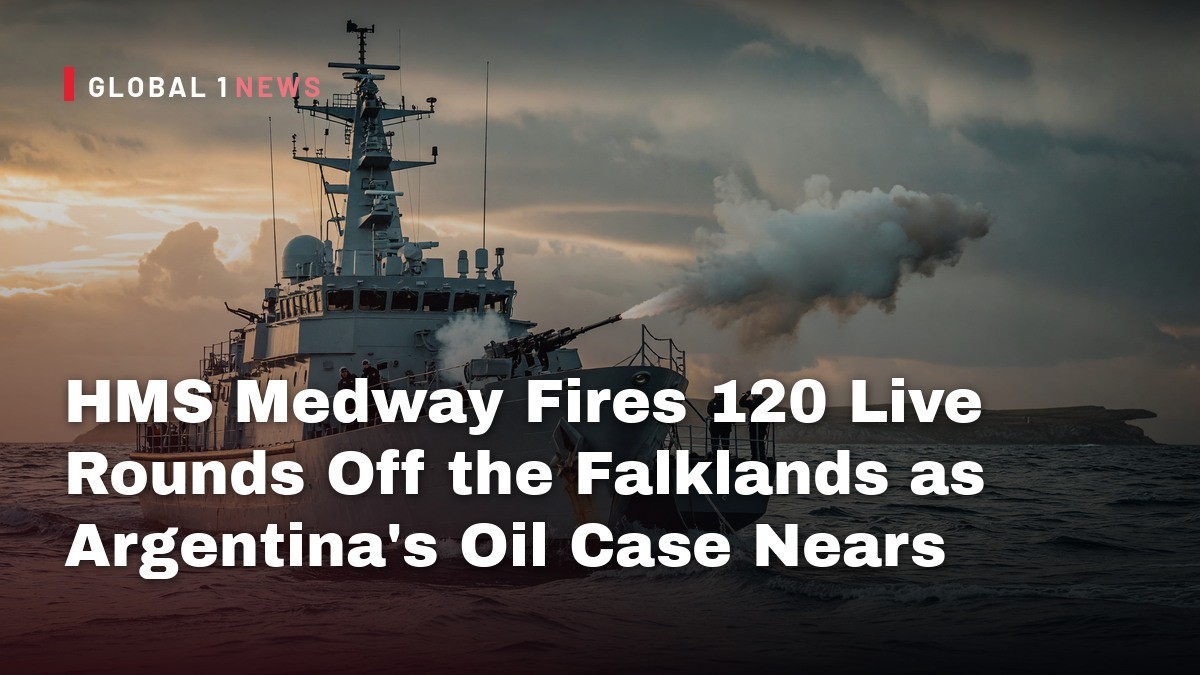
HMS Medway, the British patrol ship permanently stationed in the South Atlantic, fired 120 live rounds from her main gun off the Falkland Islands on 2 November. The crew called it routine training. The salvo came in the middle of a diplomatic fight that has been building all year, and it came ahead of a tribunal hearing in Hamburg where Argentina will try to stop British oil drilling north of the islands.
HMS Medway Fires 120 Live Rounds Off the Falklands as Argentina's Oil Case Nears
London — The 30mm cannon on a 2,000-tonne patrol ship is not a battleship's gun. On 2 November it was being used to certify a crew, not to fight.
What the Ship Fired, and What the Navy Calls It
HMS Medway fired 120 live rounds off the coast of the Falkland Islands on 2 November as part of a military exercise, according to The Independent. The salvo came from the ship's primary 30mm automatic cannon. The Independent describes the firing as taking place "during sea trials designed to certify the crew for front-line operations", and The Mirror describes the exercise as one "designed to put the crew of the HMS Medway through their paces and check the ship is ready for operations". The crew described the drills as routine training, and the ship's company put the result on X: "120 rounds downrange. With @FOST embarked, we took the opportunity for further routine training and put our 30mm Automatic Small Calibre Gun through its paces again. Practice = Precision."
The Gun at the Centre of It
The 30mm Automatic Small Calibre Gun is the main armament of the River class, a stabilised mounting firing a high explosive round out to around two and a half kilometres. According to the UK Defence Journal, it is the weapon a patrol vessel would use against a small craft that failed to comply, and accuracy with it depends on gunners who shoot often. Keeping it working in that climate is a job in itself. Medway said of its weapon engineers: "The Falklands wind doesn't make maintenance any easier! Our Weapon Engineers work hard to keep our equipment ready when it matters, whatever the weather throws at them."
A Crew Being Signed Off for Operations
The letters in the ship's post matter more than the number. FOST is Flag Officer Sea Training, which sends its assessors to sea with warships to put crews through the full range of warfighting serials and certify that a ship is ready for operations, a process most vessels go through in home waters before deploying. The ship has done similar work in these waters this year. Operation Southern Vigilance was a four-day patrol from 26 to 29 July 2026 in which the ship fired mounted machine guns at the edge of the Falkland Islands Conservation Zone and worked through a man overboard exercise alongside an RAF A400M Atlas transport aircraft. The ship has also been exercising with 2nd Battalion, The Parachute Regiment, while seaboat coxswains practised approach and pacing drills in the evenings.
The Only Royal Navy Ship Permanently Down There
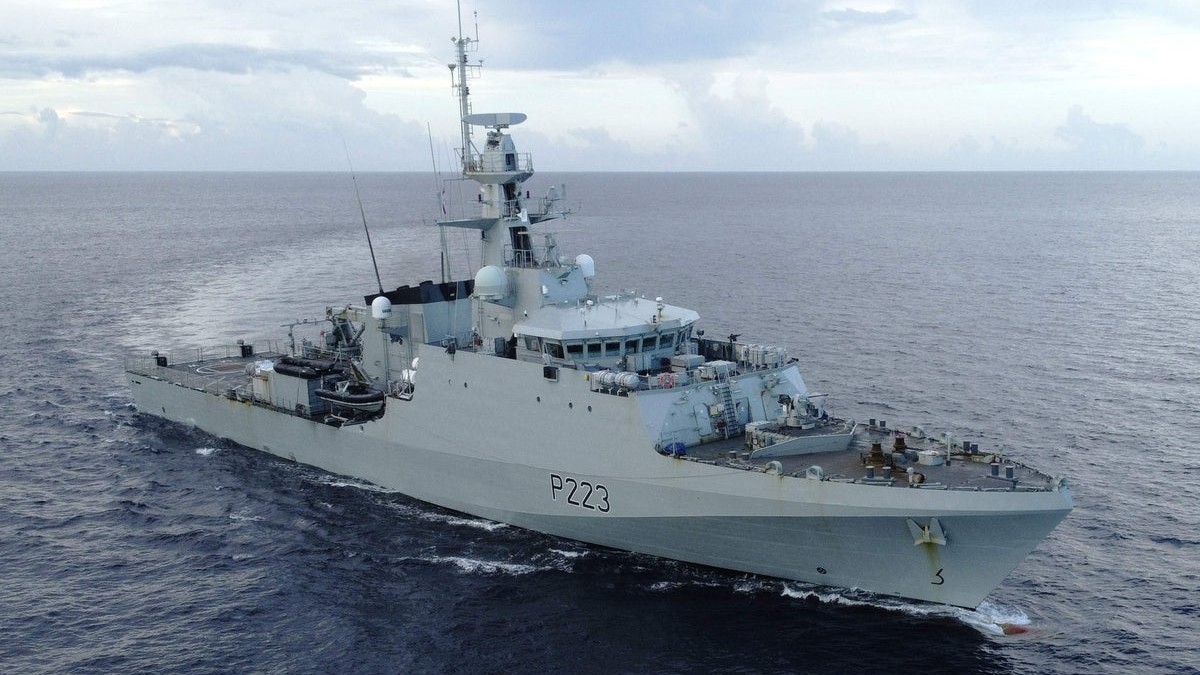
HMS Medway is a River-class offshore patrol vessel, pennant number P223, commissioned in 2019. The class displaces around 2,000 tonnes and carries a 30mm gun, machine guns and a flight deck able to take a Merlin, with an endurance suited to long independent patrols in remote waters. She took over the South Atlantic Patrol Task from HMS Forth, which held the role for several years after replacing HMS Clyde, and she remains the only Royal Navy vessel permanently stationed in the region. She carries a Rigid Raider in addition to two Pacific 24 seaboats, so she can land personnel and equipment ashore. The Royal Navy's own description of her role reads: "She provides support to Britain's overseas territories in the region, acting as a reassuring presence, providing support and humanitarian aid, and working side-by-side with regional law enforcement, helping to stop the flow of illegal drugs from South America to Europe and North America."
The Garrison Behind Her at Mount Pleasant
The ship is one part of a permanent British presence. The garrison at RAF Mount Pleasant on East Falkland includes Typhoon fighter jets, Sky Sabre air defence batteries and a permanent infantry detachment, with A400M and Voyager aircraft and a radar station on Mount Byron. British Forces South Atlantic Islands has described such deployments as an essential visible deterrent, intended to demonstrate London's "enduring commitment" to defending the overseas territory against any potential adversaries by maintaining a visible presence and a capable force. That is the command's description of its posture in general, not of the 2 November gunnery. On 27 September the ship's company welcomed more than 200 Falklands residents aboard for an open day.
What Buenos Aires Says About These Patrols
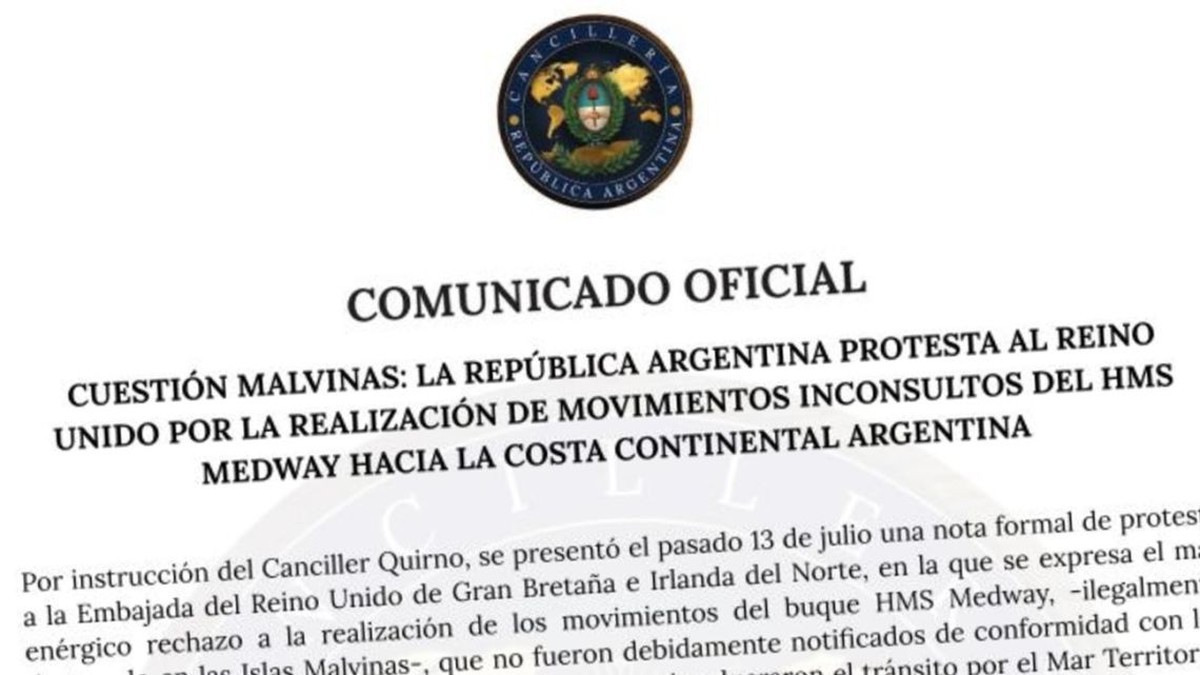
Argentina calls the islands the Malvinas, and President Javier Milei has described their status as a "national cause". Argentine officials have repeatedly protested against British military movements in the region, branding UK patrols an illegal provocation. On 13 July 2026 Argentina's Foreign Ministry delivered a formal note of protest to the British Embassy in Buenos Aires expressing the government's "strongest rejection" of HMS Medway's movements, saying they "were not properly notified in accordance with existing bilateral agreements and declarations" and that they "involved transit through Argentine territorial waters". Argentina said the incident occurred between 1 and 2 July, when the ship sailed through waters claimed by Buenos Aires en route to the Chilean city of Punta Arenas, and that its navy detected and tracked her. The note said the voyage had "heightened tensions in the South Atlantic" and formed part of a pattern of unilateral British actions that Buenos Aires called incompatible with United Nations resolutions. The statement was released hours after Argentina beat England at the 2026 World Cup, a match the Buenos Aires Times describes as the semi-finals. The ministry said the note was presented on the instruction of Foreign Minister Pablo Quirno.
The Oilfield That Turned a Dispute Into a Case
Sea Lion is a 1.7-billion-barrel deposit north of the islands, due to begin extraction in 2028. It is a joint venture between Israel's Navitas Petroleum and Britain's Rockhopper Exploration, and the Associated Press describes it as a $2.2-billion project. The Lowy Institute puts the licences at approximately 107 nautical miles north of the islands, covering 541 square kilometres. The Associated Press describes the field as about 220 km north and says it could transform the small, fishing-dependent economy. Milei set a two-week deadline for the project to be scrapped, saying that if it was not met he had "instructed the Foreign Ministry and legal teams to initiate international arbitration" over what he called "the illegal plundering of our resources", and his government has imposed sanctions on people and firms involved in exploration around the islands. At the UN General Assembly he said the world body had "looked the other way" on the Malvinas: "Argentina is not going to sit around waiting for the UN and the international community to live up to their own mandate... We're going to take matters into our own hands."
The Hearing in Hamburg, on 10 and 11 November
Argentina opened arbitral proceedings against the UK under Annex VII of the UN Convention on the Law of the Sea on 28 September 2026, then filed a request for provisional measures with the International Tribunal for the Law of the Sea in Hamburg on 13 October under Article 290(5) of the convention. Tribunal president Judge Maurice K. Kamga fixed 10 and 11 November by an order dated 20 October. The hearing is in the main courtroom, open to the public and to be broadcast on the tribunal's website. Until the arbitral tribunal is constituted, ITLOS may prescribe provisional measures if it finds the arbitral tribunal would have prima facie jurisdiction and that the situation is urgent.
What Argentina Is Asking the Tribunal to Order
Argentina wants ITLOS to order the UK to prevent the start or continuation of hydrocarbon exploitation on the continental shelf in the North Malvinas basin; to refrain from using information obtained in exploring the disputed areas against Argentina's rights; to stop preventing Argentina from meeting its marine-environment obligations under Articles 192 and 194; and to take no other step that could aggravate the dispute, in particular granting new permits. Its underlying case is that the UK is illegally exploiting the shelf, that Sea Lion will cause environmental damage and that issuing the licences aggravates the dispute. Rulings are legally binding, but the tribunal has no way to enforce one if a country refuses to comply.
London's Answer: Lawful, and Whatever It Takes
UK Foreign Office minister Uma Kumaran told the House of Commons that Argentina was attempting to use "measures beyond its jurisdiction" as economic coercion: "The Sea Lion field lies on the Falkland Islands' continental shelf. The project is lawful and regulated by the democratically elected Falkland Islands government. Argentina has no jurisdiction over it." She added: "This government will not stand by while Argentina uses economic coercion against the people of the Falkland Islands. We will do whatever it takes to support them." Prime Minister Andy Burnham has said he will do "whatever it takes" to keep the islands British, and told the United Nations: "We will defend the right of the Falkland Islanders to self-determination and to remain British." Defence Secretary Wes Streeting has dismissed Argentina's threats, saying it "lacks the ability" to seize the islands by force. The British delegation to the United Nations said efforts to deny the islanders' right of self-determination "is not the behaviour we expect of a democracy".
What Comes Next, and the Case Argentina Must First Win
The Lowy Institute notes that Argentina's claim could fall at the first hurdle because of the underlying territorial dispute, but that ITLOS has generally been reluctant to take a narrow view of its jurisdiction: in the Chagos Archipelago case, a matter between Mauritius and the Maldives proceeded to a full determination while the sovereignty dispute between Mauritius and the UK remained unresolved. Lowy adds that, absent the underlying territorial dispute, the questions Argentina has raised would all be legitimate issues for the tribunal to determine. Lowy also notes that Milei may be seeking to provoke nationalist pride ahead of 2027 presidential elections in which he is expected to run, and that US President Donald Trump indicated in September that the US may shift its position away from supporting the UK claim. Argentina and the UK fought a war over the islands in 1982 that killed 649 Argentine and 255 British servicemen. HMS Medway, meanwhile, remains the only Royal Navy vessel permanently stationed in the region.
By Jessica Ali, Staff Writer
This article was produced with AI-assisted research and editorial support. Sources: The Independent, The Mirror, UK Defence Journal, Portsmouth News, World Oil, Associated Press, Lowy Institute, El Pais, Buenos Aires Times.
What's Your Reaction?
 Like
0
 Dislike
0
 Love
0
 Funny
0
 Wow
0
 Sad
0
 Angry
0

Editor-in-Chief at Global1.News. Atlanta-based journalist who cuts through the BS and tells it like it is. Lead anchor, host, and the voice you hear when the spin stops and the truth starts.












Comments (0)