
After Secret CIA Moscow Visit, Putin Escalates Ukraine Strikes as Drones Swarm Russian Capital
CIA Director John Ratcliffe made an unannounced trip to Moscow the week of Aug. 24, 2026, marking the first known visit by a U.S. spy chief to the Russian capital since William Burns met with Vladimir Putin in November 2021, roughly three months before the full-scale invasion of Ukraine. The secret mission, first reported by The Wall Street Journal and confirmed by CNN, was intended to deliver a blunt warning: do not stage an attack on NATO territory.
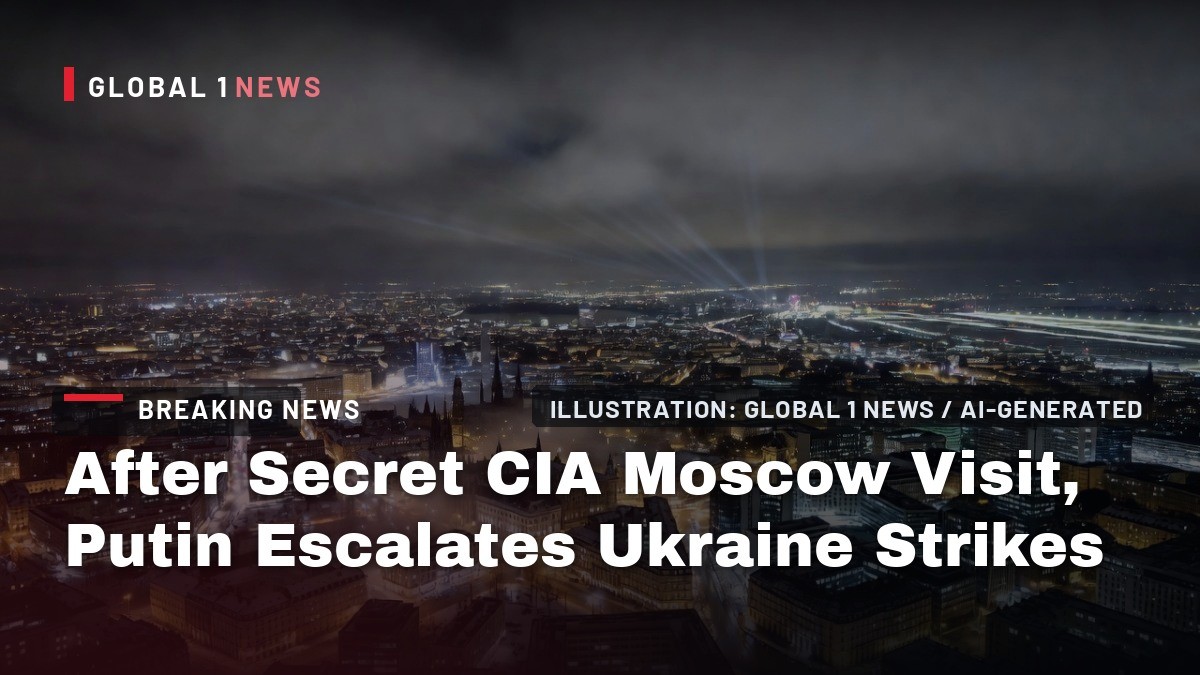
CIA Director John Ratcliffe made an unannounced trip to Moscow the week of Aug. 24, 2026, marking the first known visit by a U.S. spy chief to the Russian capital since William Burns met with Vladimir Putin in November 2021, roughly three months before the full-scale invasion of Ukraine. The secret mission, first reported by The Wall Street Journal and confirmed by CNN, was intended to deliver a blunt warning: do not stage an attack on NATO territory. Instead, the war has escalated sharply on both sides, with Moscow now under the largest drone siege of the conflict and Putin vowing massive retaliatory strikes on Ukraine's energy grid.
A Warning Carried to Moscow
Ratcliffe, President Donald Trump's intelligence chief, used the trip to warn Russia against any military action in NATO territory and to encourage Moscow to cut off economic and military support for Iran as the administration chokes off Tehran financially, according to CNN, which cited two people familiar with the matter. The CIA declined to comment on the visit. Kremlin spokesman Dmitry Peskov neither confirmed nor denied the meeting, telling Reuters that Putin did not plan to meet Ratcliffe.
The timing of the visit was no accident. U.S. intelligence assessed before the trip that Russia was in an increasingly weak position in the war, a condition that could prompt Moscow to take military action against NATO to raise the stakes of Western support for Ukraine and force a negotiated settlement favorable to the Kremlin. That strategy, known inside the intelligence community as "escalate to de-escalate," has long been a concern for Western planners.
There was no specific intelligence of an imminent attack, but weeks of warnings indicated Moscow might increase sabotage efforts, cyber or drone attacks, or even a more severe action like a land grab in Europe. At least one intelligence report assessed that Putin likely believes the United States will not risk another conflict because of American public opinion, a calculation that makes the Russian leader harder to deter.
Why Washington Sent Its Top Spy
The decision to send the CIA director to Moscow reflects a growing urgency inside the U.S. government about the trajectory of the war. A source familiar with the situation told CNN that Russia is "bogged down on the frontlines" and increasingly suffering economically from Western sanctions and Ukrainian attacks on its energy infrastructure. "They are on their heels," the source said.
But the rare trip appears to have failed in its core objective. The Washington Post reported Sept. 4, 2026, that the visit did not persuade Putin to stop the war and may have hardened the Russian leader's resolve to seek military victory. Instead of de-escalation, the days following Ratcliffe's departure brought the most intense drone assault on Moscow since the war began.
The message from Washington was clear: the United States does not want a broader conflict with Russia, but it also will not tolerate an attack on NATO soil. Ratcliffe's warning was meant to draw a line, but Putin appears to have interpreted it as a sign of weakness rather than strength, according to the Post's reporting. The Russian leader, emboldened by what he sees as Western fatigue, is doubling down on a strategy of attrition.
Moscow Under Drone Siege
Between 8 a.m. Sept. 2 and noon Sept. 3, Moscow Mayor Sergei Sobyanin said 548 Ukrainian drones flew toward the wider Moscow region, with most intercepted at a distance and 143 destroyed on the approaches to the capital, according to a statement on Russia's Max messaging service carried by TASS. Sobyanin also claimed that 8,670 drones flew toward the Moscow region during August 2026, with 795 destroyed on the approaches.
The scale of the assault disrupted daily life in the Russian capital. Flightradar24 data showed 21 flights canceled and 235 delayed at Sheremetyevo airport on the night of Sept. 2, with 22 canceled and 94 delayed at Vnukovo. By Sept. 3, almost all afternoon flights at Sheremetyevo were delayed or canceled, stranding travelers and underscoring the reach of Ukraine's new drone campaign.
On the ground, the damage was visible. An apartment building was damaged in Pavlovsky Posad, and a drone reportedly crashed at a factory in Bolshoye Bunkovo near the Kubinka military airfield, starting a fire. Monitoring channels also reported an apparent fire at the Black Sea port of Sochi after another drone attack, though local officials did not confirm that incident.
Russia's Defense Ministry said on the night of Sept. 4 that 490 Ukrainian drones were shot down over 20 Russian regions. In Bashkortostan's Sterlitamak, an industrial zone was attacked with explosions and a fire reported. Thirty-five drones were shot down approaching Moscow. In the Belgorod region's Shebekino, shelling and drone attacks killed five people, including two paramedics, and wounded seven others.
'The Russian Sky Is Becoming Completely Dangerous'
Ukrainian President Volodymyr Zelensky has made no secret of the strategy behind the drone campaign. On Sept. 1-2, he warned airlines and insurers that Ukrainian drones had made Russian skies dangerous. "Today, we want to warn every airline that uses Russian airspace, every insurer, everyone who still uses key Russian airports: the Russian sky is becoming completely dangerous," Zelensky said.
Ukraine has formalized that warning at the international level. Foreign Minister Andrii Sybiha announced that Ukraine had officially notified the International Civil Aviation Organization (ICAO) that Russian airspace is not safe for civilian aviation because of increased military activity. "We urge everyone to avoid it," Sybiha said.
The warnings are already having an effect. Zelensky said Thursday that the first airlines had begun suspending flights to Russian airports, a development that could further isolate Russia economically and diplomatically. The threat to civilian aviation is a new front in the war, one that carries significant risks for both sides.
Putin's 'State Terrorism' Response
Putin responded with characteristic defiance. He called Zelensky's airspace warning a "declaration of state terrorism," adding that "one does not negotiate with terrorists." The Russian leader confirmed that his forces were instructed to prepare massive strikes on Ukraine's energy infrastructure as retaliation for Ukrainian attacks on Russian energy sites, warning that the coming strikes would be "far more destructive than anything Ukraine had experienced in the current campaign."
Speaking at the Shanghai Cooperation Organisation (SCO) summit in Bishkek, Kyrgyzstan, on Sept. 1, Putin struck a confident tone, saying Russia was winning and advancing toward Sloviansk and Kramatorsk. "I have no doubt the enemy will crumble," he told reporters.
Moscow has also preemptively defined civilian-aviation threats as a red line. In the event of an incident involving a civilian aircraft with deliberate Ukrainian involvement established, the Kremlin said Zelensky would be regarded not as a negotiation participant but as "the organizer of a terrorist act." That framing sets the stage for potential escalation if a commercial airliner is hit, a scenario that would echo the 2014 downing of Malaysia Airlines Flight 17.
Kyiv Bears the Brunt
While Moscow faces an unprecedented drone siege, Ukraine continues to absorb punishing strikes of its own. On the night of Sept. 2-3, the eighth consecutive day of Russian attacks, strikes killed five people and injured 67 across Ukraine, with damage reported in 13 oblasts and drones targeting western regions. The previous night, drones struck central Kyiv for a seventh straight day, hitting the National University of Food Technology, a residential building and a medical facility, wounding at least 13 people.
The toll on the capital has been severe. A recent Russian strike killed 12 people in Kyiv, part of six straight days of intense assaults on the city. In Boryspil, in the Kyiv region, one person was killed and nine, including a child, were injured. The attacks have forced residents into shelters on a near-nightly basis and stretched the city's emergency services to their limits.
On Sept. 4, Russia struck logistics centers, port infrastructure and energy facilities supporting Ukraine's military. Ukraine's Air Force reported a Kh-31P anti-radar missile plus 121 attack drones and decoys in the latest wave. The sustained campaign is designed to degrade Ukraine's ability to sustain its own drone operations and military logistics, even as Kyiv's forces press their advantage in the air.
Ukraine's Air Force said that in August 2026 it destroyed more than 4,600 aerial targets, including 25 Kh-101 cruise missiles, 8 Iskander-M/KN-23 ballistic missiles, 8 Kalibr cruise missiles and about 3,300 Shahed-series attack drones. Those numbers reflect the intensity of the air war and the scale of resources both sides are committing to it.
What Comes Next
The escalation has drawn a broader response from NATO and neighboring countries. NATO's Baltic air policing mission scrambled jets in response to the increased activity, and Finland and Latvia restricted air and maritime traffic near Russia. Border crossings into Romania were also affected as Russia targeted Ukraine's Izmail region, a key hub for grain exports.
The situation remains volatile, with both sides showing little appetite for de-escalation. Ratcliffe's warning to Moscow appears to have been ignored, and Putin's promise of massive strikes on Ukraine's energy grid suggests the coming weeks will bring more destruction, not less. The drone siege over Moscow has demonstrated Ukraine's growing capability to strike deep inside Russian territory, but it has also given Putin a pretext for even harsher retaliation against Ukrainian civilians and infrastructure.
For now, the war is entering a new and more dangerous phase. The secret CIA visit was meant to prevent a wider conflict, but the opposite may be happening. With Putin convinced that the United States will not intervene directly and Zelensky determined to make the Russian sky as dangerous as the Ukrainian ground, the risk of miscalculation is rising. The next few weeks will test whether either leader is willing to step back from the brink, or whether the escalation spiral will continue unchecked.
By Jessica Ali, Staff Writer
This article was produced with AI-assisted research and editorial support. Sources: Reuters, CNN, The Washington Post, The Wall Street Journal, The Independent, Kyiv Post, TASS.
What's Your Reaction?
 Like
0
Like
0
 Dislike
0
Dislike
0
 Love
0
Love
0
 Funny
0
Funny
0
 Wow
0
Wow
0
 Sad
0
Sad
0
 Angry
0
Angry
0

Editor-in-Chief at Global1.News. Atlanta-based journalist who cuts through the BS and tells it like it is. Lead anchor, host, and the voice you hear when the spin stops and the truth starts.














Comments (0)