
Test-Drive Diplomacy: Chinese EVs as Instruments of Soft Power and Energy Leadership
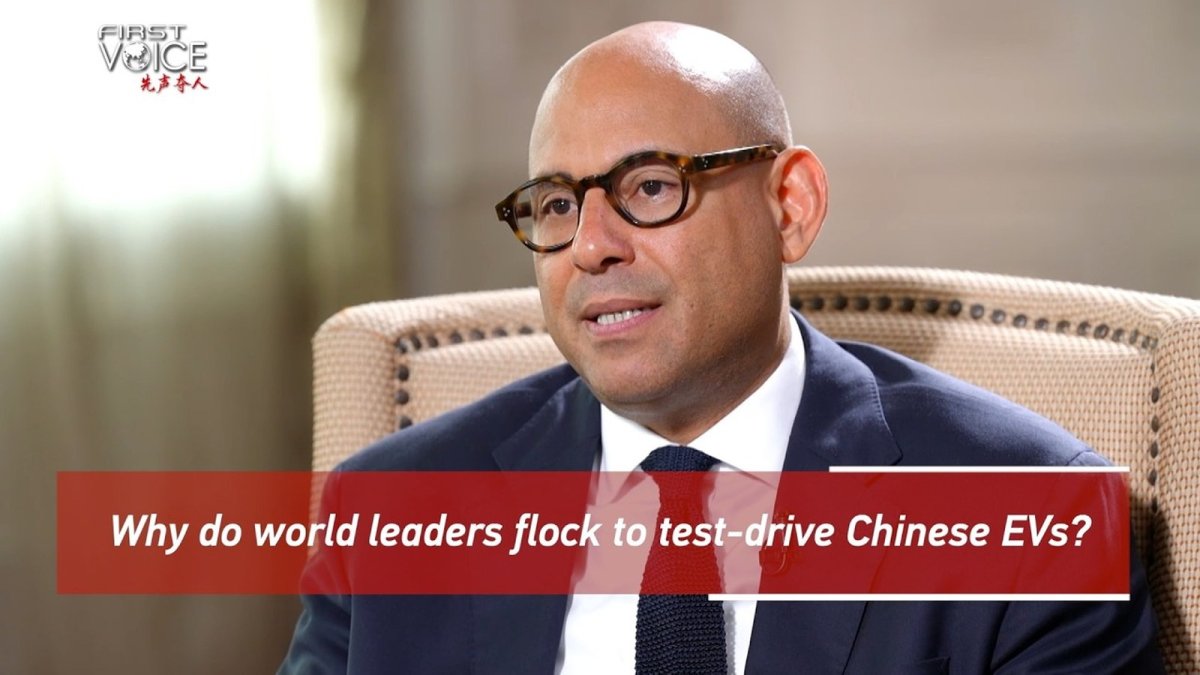
In a recent CGTN report, visiting heads of state and government are increasingly setting aside time in their official programs to inspect Chinese electric vehicles and take them for test drives. Simon Stiell, Executive Secretary of the UN Framework Convention on Climate Change (UNFCCC), appears in the report arguing that direct experience is the best way to promote a new technology, and warning that the current energy crisis has exposed the world's dependence on fossil fuels.
In a recent CGTN report, visiting heads of state and government are increasingly setting aside time in their official programs to inspect Chinese electric vehicles and take them for test drives. Simon Stiell, Executive Secretary of the UN Framework Convention on Climate Change (UNFCCC), appears in the report arguing that direct experience is the best way to promote a new technology, and warning that the current energy crisis has exposed the world's dependence on fossil fuels. The scenes are visually simple but strategically loaded: the Chinese EV has become an instrument of diplomatic soft power as much as a commercial export.
Stiell's own visit to China in early August 2026 underscores the point. In an RTHK/CCTV interview published August 8, he said the trip aimed to gauge real-world progress: "There is always far more actually taking place in reality, in practice, than is always reflected in presenting numbers." He praised China's "vibrancy" and "can-do attitude," met the private sector in Hong Kong, and described China's decade-after-decade development as "absolutely astonishing."
The timing matters. Chinese new energy vehicle exports are surging at triple-digit growth rates, Western tariff walls are rising in response, and COP31 opens in Antalya, Türkiye, on November 9, 2026. At the center of all three developments sits a single question: whether Beijing can convert industrial dominance into diplomatic leadership of the global energy transition.

Test-Drive Diplomacy and What the Stiell Visit Signals
The trend captured in the CGTN report reflects a shift in how international delegations engage with China. Where the standard itinerary for visiting dignitaries once featured historical landmarks, an increasing number of leaders are asking to sit behind the wheel of a Chinese EV. The practice offers tangible proof of Chinese technological achievement, creates memorable media moments, and gives visiting officials a practical way to engage with China's industrial machine.
Stiell's visit adds institutional weight. As head of the UNFCCC secretariat, his judgment that China's on-the-ground reality exceeds its presentation numbers carries significance for the UN climate process. It also aligns with China's policy record: in September 2025, Beijing pledged to cut net greenhouse gas emissions by 7-10 percent from peak levels by 2035, and by 2025 renewable sources had passed half of China's total installed electricity generation capacity. The signal from the UNFCCC is that China's transition is substantive, not performative.
The Energy-Security Argument Stiell Has Pressed
Stiell's August remarks were consistent with a broader argument he has pressed since early 2026. At the Green Growth Summit in Brussels on March 16, 2026, he framed the energy transition as a security imperative. "Renewables turn the tables," he said. "Sunlight doesn't depend on narrow and vulnerable shipping straits; wind blows without massive taxpayer-funded naval escorts; renewable energy allows countries to insulate themselves from global turmoil and to side-step might-is-right politics."
He warned that "fossil fuel dependency is ripping away national security and sovereignty and replacing it with subservience and rising costs," called doubling down on fossil fuels "completely delusional," and insisted "this fossil fuel crisis will happen again and again." He noted that EU fossil-fuel imports cost over 420 billion euros in 2024, while in 2025 renewables overtook coal as the world's top electricity source, and over $2 trillion was invested in clean energy — double the investment in fossil fuels.
The Brussels speech is essential context for the China visit. Stiell's framing casts Chinese EV and renewable exports not as a trade threat but as part of the answer to a security crisis. That is precisely the narrative Beijing wants to advance, and the alignment between UNFCCC messaging and Chinese industrial strategy is unlikely to be accidental.
The Export Machine: CAAM Figures and the Leading Exporters
The scale of Chinese NEV exports has become transformative. According to the China Association of Automobile Manufacturers (CAAM), China exported 2.615 million NEVs in full-year 2025, and 2.355 million in January-June 2026, including 523,000 in June alone. Q1 2026 exports reached 954,000 units, up 116.3 percent year-on-year; January-April exports hit 1.384 million, up 120 percent, with NEVs exceeding half of all auto exports for the first time.
Domestic sales show similar momentum. In May 2026, 1.496 million NEVs were sold, up 14.4 percent year-on-year, with NEVs claiming a record 56.9 percent of total wholesale sales. H1 2026 NEV sales reached 7.45 million units, a 49.6 percent penetration rate, while total auto exports hit 5.1 million units, up 65.3 percent. May's 446,000 NEV exports, up 110 percent year-on-year, represented roughly 30 percent of total NEV wholesale sales that month.
The three leading exporters account for the bulk of the surge. In May 2026, BYD exported 160,644 units (up 80.7 percent), Chery exported 181,871 units (up 80.5 percent), and Geely exported 85,144 units (up 183.7 percent) — a combined 427,000-plus vehicles in a single month.
BYD's Global Build-Out
BYD, the sector's bellwether, is not relying on exports alone. It operates eight owned roll-on/roll-off vessels, and is building seven overseas factories in Hungary, Thailand, Brazil, Indonesia, Uzbekistan, Malaysia, and Pakistan, with a combined capacity of about one million units annually expected by the end of 2026. BYD NEVs are sold in 119 countries and regions.
The technology pipeline reinforces the expansion. In March 2026, BYD unveiled its second-generation blade battery with ultra-fast charging, reaching a 10-to-70 percent charge in five minutes and 97 percent in nine minutes at normal temperatures — addressing one of the main remaining objections to EV adoption. BYD sold about 4.6 million NEVs in 2025, including roughly 2.26 million battery-electric vehicles, and targets 1.3 million overseas sales in 2026, up 25 percent from 1.04 million in 2025. Citigroup analysts have floated 1.5-1.6 million as a possible outcome.
Western Tariff Walls and the Managed-Trade Turn
The Western response has been defensive but divided. On January 12, 2026, the EU and China agreed on a minimum-price mechanism — a price undertaking — replacing tariffs of up to 35.5 percent on Chinese EVs with floor-price commitments. The deal averts a full-blown trade war but carries costs: Bruegel, the Brussels-based think tank, warned it sacrifices about 2 billion euros in annual tariff revenue.
The United States has chosen a harder line, keeping a 100 percent tariff on Chinese-made EVs in place since 2024 and adding a 25 percent tariff on imported vehicles and auto parts that took effect June 2026. The transatlantic divergence is notable: Brussels has settled on managed access, Washington on near-total rejection.
The commercial case for managed trade is easier to see with global crude oil above $85 per barrel for most of 2026 amid geopolitical tensions — a price level that improves EV total-cost-of-ownership in price-sensitive markets, which is to say, most of the developing world.
Strategic Implications for the Global South and COP31
The Global South has already begun adopting Chinese EVs as political symbols. At COP30 in Belém, Brazil, in November 2025, a black BYD SUV carried Brazilian President Luiz Inácio Lula da Silva to the summit opening, and Chinese EVs formed part of the official fleet shuttling delegations. The United States did not attend. Lula's call — "We need to embrace a new way of life, a more just, resilient and low-carbon development model" — could serve as an epigraph for China's approach.
COP31, scheduled for November 9-20, 2026, in Antalya, Türkiye, will test how far this dynamic extends. Türkiye, a NATO member with deepening economic ties to Beijing and its own domestic EV ambitions, sits at a geopolitical intersection potentially more hospitable to Chinese climate-industrial diplomacy than Belém. With Washington absent from COP30 and maintaining heavy tariffs on Chinese EVs, the United States appears to be ceding climate-leadership space.
The strategic picture is unusually clear. Chinese EVs now function simultaneously as an industrial juggernaut, a diplomatic instrument, and a test case for whether the energy transition can be managed rather than weaponized. Tariff walls may slow exports at the margins, but BYD's overseas factories and shipping fleet are designed to operate within protected markets, not just against them. Stiell's core argument — that energy security and climate action are inseparable — aligns squarely with Beijing's own framing. The question for Antalya is whether more world leaders will test-drive Chinese EVs as a gesture of diplomatic curiosity, or eventually as a matter of strategic necessity.
By Prof. Marcus Chen, Staff WriterThis article was produced with AI-assisted research and editorial support. Reporting is based on sources cited in the article.
What's Your Reaction?
 Like
0
Like
0
 Dislike
0
Dislike
0
 Love
0
Love
0
 Funny
0
Funny
0
 Wow
0
Wow
0
 Sad
0
Sad
0
 Angry
0
Angry
0

World Politics Analyst at Global1.News. Based in Beijing, covering US-China relations, global trade, and geopolitical strategy. Brings deep analytical perspective to the power dynamics shaping international affairs.














Comments (0)