
China's Neutrino Pioneer Wang Yifang Takes Center Stage at ICBS 2026
Professor Wang Yifang, who led China's Daya Bay and JUNO neutrino experiments, takes center stage as the 2026 International Congress of Basic Science opens in Beijing this weekend, where a Nature cover result sharpens the race to determine the neutrino mass ordering against Japan's Hyper-Kamiokande.
CGTN released a documentary interview titled "What is the universe made of? Chinese physicist Wang Yifang on the search for answers" on August 7, 2026. The video features Professor Wang Yifang, an academician of the Chinese Academy of Sciences and researcher at the Institute of High Energy Physics. It arrives ahead of the 2026 International Congress of Basic Science, which is scheduled to open on August 9 in Beijing.
The timing positions the interview as a preview for one of the premier global gatherings in basic science. The congress will run from August 9 to 21, 2026, at Huairou Science City under the theme "Advancing Basic Science for Humanity." Organizers expect broad international participation, building on the 2025 edition that drew over 1,000 scholars including four Fields Medalists, three Nobel laureates, and two Turing Award winners.
Beijing Congress Puts Neutrino Physics in the Spotlight
The 2026 International Congress of Basic Science places neutrino research at center stage through its recognition of leading scientists. The inaugural ICBS Medals and 2026 Frontier Science Awards were announced at a press conference at Tsinghua University on May 18, 2026. The medal ceremony will accompany the August congress in Huairou Science City.
Wang Yifang received the 2026 ICBS Samuel C.C. Ting Medal in Physics for his pioneering discovery of a new type of neutrino oscillation and the first precise measurement of the mixing angle theta-13. He shares the physics medal with Prof. Andrea J. Liu and Prof. Xiao-Gang Wen. The ICBS citation highlights how this work catalyzed understanding of neutrino oscillation patterns and propelled the field into a new paradigm.
China's broader push in fundamental physics includes facilities such as the LHAASO cosmic-ray observatory. These projects form part of national ambitions to expand big-science infrastructure alongside high-energy synchrotron sources. The congress provides a platform to discuss how such investments intersect with international efforts in particle physics.
Wang Yifang: From Daya Bay to Jiangmen
Wang Yifang's landmark contribution came through the co-discovery of the neutrino mixing angle theta-13 via the Daya Bay Reactor Neutrino Experiment. In 2012 the collaboration announced the first precise measurement of this parameter, establishing a value near 0.09 and confirming a previously uncertain element of the neutrino mixing matrix. This result shifted the scientific community's approach to neutrino studies by providing the first precise value for one of the oscillation parameters. The finding opened pathways for subsequent experiments to map the full pattern of neutrino mixing.
Following that success, Wang led construction of the Jiangmen Underground Neutrino Observatory, known as JUNO. The project aims to determine the neutrino mass ordering and explore potential new physics beyond the Standard Model. Leadership of the JUNO Collaboration rests with the Institute of High Energy Physics under the Chinese Academy of Sciences.
Wang's career trajectory reflects China's growing role in large-scale particle physics projects. His work builds on earlier reactor-based experiments and now focuses on underground detection techniques that require exceptional precision in radiopurity and energy resolution.
Inside JUNO: A Detector Built 700 Meters Underground
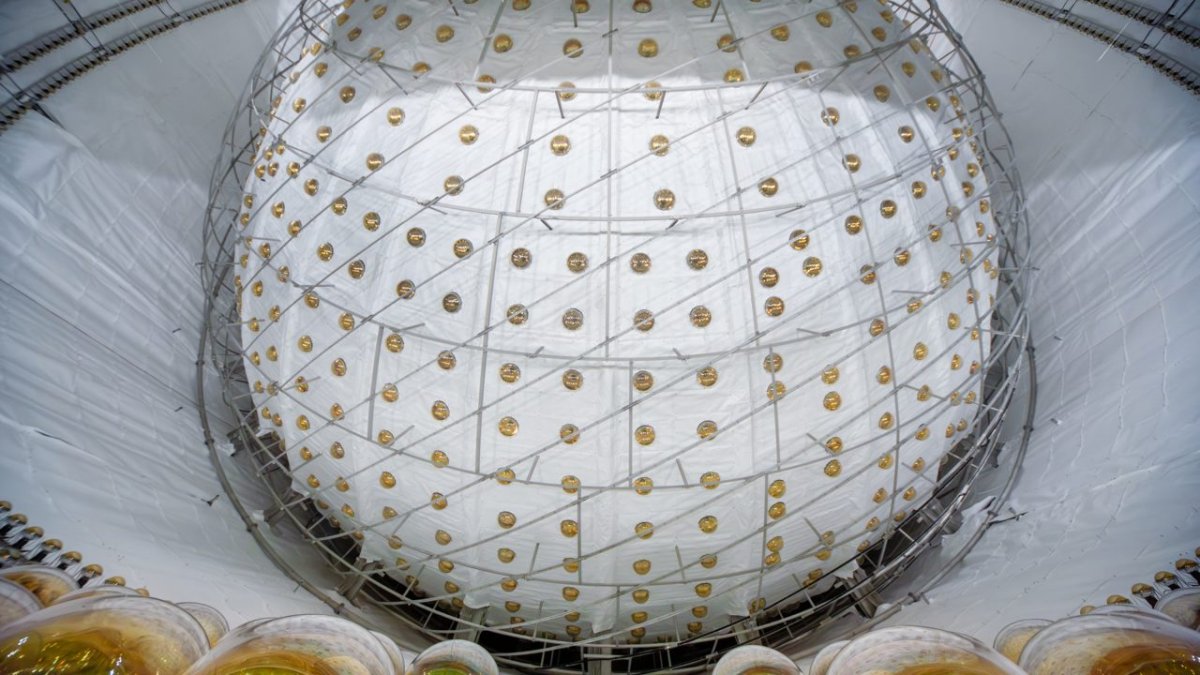
JUNO is located 700 meters underground in Kaiping, Jiangmen, in south China's Guangdong Province. The detector centers on a 20,000-tonne liquid scintillator contained within a 35.4-meter-diameter acrylic sphere. This sphere sits immersed in a 44-meter-deep water pool and is supported by a stainless-steel structure measuring 41.1 meters in diameter.
The facility uses 20,000 20-inch photomultiplier tubes and 25,000 3-inch photomultiplier tubes to detect flashes of light produced when neutrinos interact with the liquid scintillator. These components enable the high energy resolution required for the experiment's physics goals. Construction and commissioning were completed under the direction of the Institute of High Energy Physics.
Data-taking at JUNO began in August 2025. The underground location shields the detector from cosmic-ray backgrounds, a design choice shared with other major neutrino observatories worldwide. Researchers have reported smooth operations over the initial nine months of running.
A Nature Cover Result After 59 Days
On June 10, 2026, Nature published JUNO's debut physics result as a cover article titled "Precise Measurement of Two Neutrino Oscillation Parameters." The paper drew on 59 days of validated data collected between August 26 and November 2, 2025. The JUNO Collaboration achieved precision levels 1.6 times better than the combined results of multiple experiments conducted over several decades.
The study reduced uncertainties in two fundamental neutrino oscillation parameters. It also confirmed that a discrepancy known as the solar neutrino tension persists, with previous measurements via solar versus reactor neutrinos differing by about 1.5 standard deviations. Nature's News and Views section described the first result as marking the dawn of the next era of precise neutrino oscillation measurements.
Nobel laureate Arthur McDonald, who shared the 2015 Nobel Prize in Physics for the discovery of solar neutrino oscillation, commented on the outcome. He stated that JUNO has met its design objectives, achieving exceptional radiopurity, energy resolution, and detector stability. The experiment is fully operational and ready to pursue its ambitious physics goals, including determining the neutrino mass ordering.
Why Neutrinos Matter: The Universe's Ghost Particles
Neutrinos are electrically neutral particles with extremely small masses that interact only through the weak nuclear force. This property gives them extraordinary penetrating power, allowing vast numbers to pass through Earth and human bodies without leaving a trace. They rank among the least understood of the known fundamental particles.
The primary goal of JUNO is to determine the neutrino mass ordering. The experiment is also designed to measure three of the six neutrino oscillation parameters with better than 1 percent precision. Additional objectives include studies of supernova neutrinos, geoneutrinos, solar neutrinos, and atmospheric neutrinos.
Determining the mass ordering carries direct consequences for cosmology because it influences models of the early universe and the formation of large-scale structure. A normal ordering would align with certain predictions in grand unified theories, while an inverted ordering could point to new mechanisms beyond the Standard Model. The result also affects interpretations of neutrinoless double-beta decay searches and the role of neutrinos in supernova dynamics. These measurements address open questions about the composition of the universe and the behavior of matter at its most fundamental level. Progress in neutrino physics has implications for cosmology, astrophysics, and potential extensions to the Standard Model of particle physics.
Global Rivalry: China, Japan and the Mass Ordering Race
Japan's Super-Kamiokande detector in Hida, Gifu Prefecture, and the T2K long-baseline neutrino experiment running from J-PARC to Kamioka have led global neutrino physics for decades. The 2015 Nobel Prize in Physics went to Arthur McDonald and Takaaki Kajita for establishing neutrino oscillation, a discovery made possible by Super-Kamiokande data. The planned Hyper-Kamiokande successor forms a central element of Japan's science strategy. The race to determine neutrino mass ordering stands as one of the most closely watched competitions in fundamental physics. China's JUNO and Japan's Hyper-Kamiokande now compete directly to be first to resolve the ordering, with each experiment employing different detection methods and baselines.
China's JUNO project enters this competition with distinct technical advantages in detector scale and radiopurity. The United States maintains involvement through various university groups and funding channels, adding to the international dimension of the field. Asia-Pacific cooperation in particle physics continues alongside these national programs.
In July 2026, Chinese mathematicians Deng Yu and Wang Hong became the first Chinese nationals to win Fields Medals at the International Congress of Mathematicians in Philadelphia. This achievement parallels developments in experimental physics facilities such as LHAASO and underscores China's expanding presence across multiple branches of basic science.
What to Watch For
Researchers expect a series of new results from JUNO beginning in summer 2026. The experiment's ability to resolve the neutrino mass ordering will depend on continued accumulation of high-quality data over the coming years. Any resolution of the solar neutrino tension would represent a significant advance for the field.
The 2026 International Congress of Basic Science will provide a forum for updates on these developments. Discussions at Huairou Science City are likely to address how JUNO's findings integrate with results from Super-Kamiokande, T2K, and future Hyper-Kamiokande operations. International collaboration remains essential for interpreting the full picture of neutrino properties.
Wang Yifang's interview with CGTN offers an accessible entry point for audiences interested in these questions. The documentary frames China's contributions within the broader global effort to understand the universe's fundamental building blocks.
By Kenji Tanaka, Staff Writer
This article was produced with AI-assisted research and editorial support. Reporting is based on sources cited in the article.
What's Your Reaction?
 Like
0
Like
0
 Dislike
0
Dislike
0
 Love
0
Love
0
 Funny
0
Funny
0
 Wow
0
Wow
0
 Sad
0
Sad
0
 Angry
0
Angry
0

Japan Correspondent at Global1.News. Tokyo-based voice covering Japanese politics, technology, economy, and culture. Tracks the intersection of tradition and innovation in one of the world's most dynamic societies.














Comments (0)