
China's Information Control in the Gyirong Floods: A Study in Stability over Transparency
China has kept dramatic footage of the Gyirong Port flash floods off its censored internet while mounting a massive rescue operation, exposing Beijing's priority of stability over transparency in Tibet. Premier Li Qiang visited the disaster zone as cadres were mobilized to maintain social order.
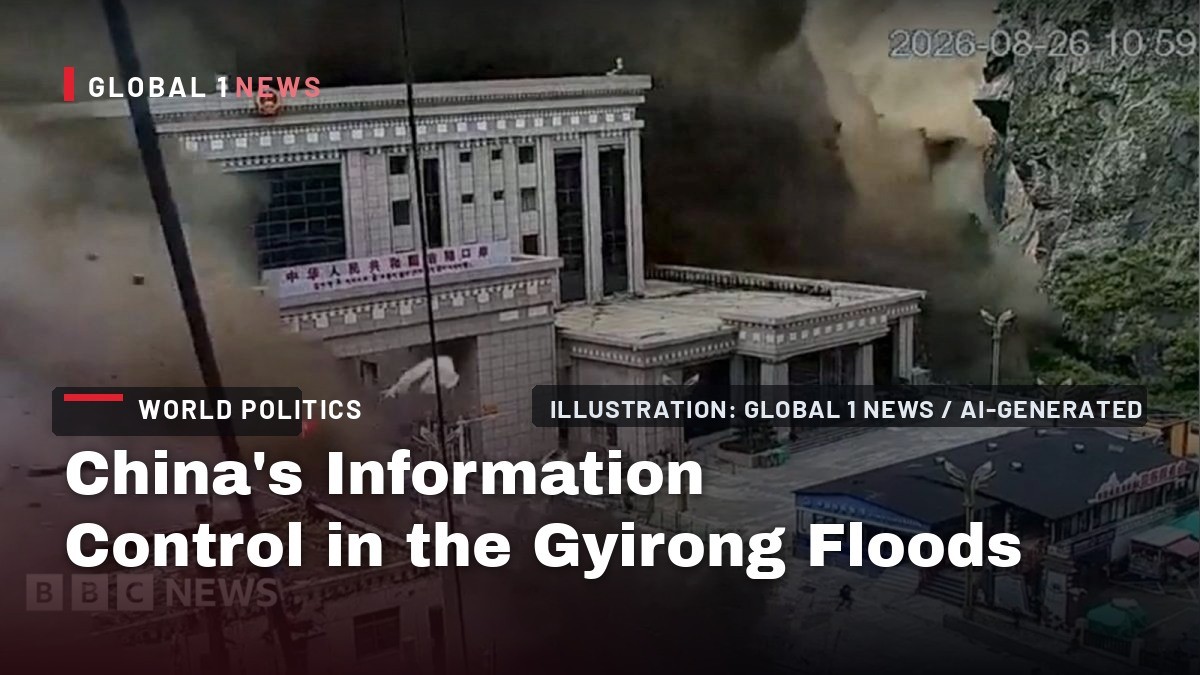
On Wednesday, 26 August 2026, a catastrophic glacial collapse unleashed a torrent of water through Gyirong Port, one of the principal border crossings between Nepal and the Tibet Autonomous Region. The flash flood swept away everything in its path as hundreds of residents fled for their lives. While the world watched dramatic CCTV footage of the disaster spread rapidly across social media and international news screens, the scene inside China has been markedly different. The state-run flagship news bulletin has broadcast only a single still-frame shot of the event, and the video remains exceptionally difficult to locate on China's heavily censored internet.
This disparity between the global and domestic information environments offers a rare, unobstructed view of Beijing's operational priorities in a moment of acute crisis. The response is not one of denial—Beijing has launched a massive rescue operation and President Xi Jinping has chaired emergency meetings—but rather one of meticulous, centralized narrative control. For the Chinese Communist Party (CCP), the management of information surrounding a disaster of this magnitude is as critical as the physical rescue effort itself, reflecting a deeply ingrained doctrine that prioritizes social stability above all else.
The Visible Hand of the Firewall
The contrast in information flow could not be starker. As global headlines led with the devastation in the Himalayan valley, China's state broadcaster opened its main evening bulletin on Thursday night not with the floods, but with the launch of President Xi Jinping's new book, a selection of his "most important and fundamental works." This editorial decision, made at the highest level of state media, signals a deliberate attempt to frame the national narrative around leadership and ideological continuity rather than a disruptive natural catastrophe.
On China's domestic internet, the search for user-generated footage or survivor accounts yields almost nothing. The "Great Firewall" has become more visible than ever, scrubbing videos and stifling voices within hours of the event. A BBC journalist on the ground noted the extreme difficulty of reporting, stating, "As a journalist who has covered North Korea, it has often been easier for me to contact interviewees in Pyongyang than it is in the Tibetan capital, Lhasa." This operational reality underscores the extent to which Tibet remains a sealed information zone, particularly during moments of vulnerability.
The Strategic Calculus of Silence
The reason for what the world might perceive as a muted response is rooted in a singular objective: the preservation of stability. For the CCP, a disaster of this scale in Tibet carries profound political risks. The party fears that unfiltered coverage could fuel discontent, either directed at the adequacy of the emergency response or at the lack of foresight in preventing the glacial collapse in the first place. Such sentiment, if allowed to fester online, could reignite latent grievances in a region that has long resisted rule from Beijing.
Tibet, which Beijing annexed in the 1950s, has a history of quashed protests and accusations of grave rights violations. The party's calculus is that a tightly controlled information environment prevents the disaster from becoming a catalyst for dissent. By limiting the flow of graphic imagery and personal stories, Beijing aims to contain the emotional and political fallout, ensuring that the tragedy does not translate into a challenge to its authority in the region.
Official Response and the Politics of Rescue
Despite the information blackout, the physical response has been substantial. Beijing has launched a massive rescue operation involving hundreds of emergency workers, a continuing effort that has been documented in state media. On Saturday, new footage showed rescue teams wandering through a wasteland of mud and rock, calling out to anyone trapped beneath the debris. This coverage serves a dual purpose: it demonstrates the state's capacity for action while simultaneously controlling the narrative of the state as the sole provider of relief and order.
Premier Li Qiang was quickly despatched to the region, where he was seen inspecting debris removal. This rare visit by the country's second-most important leader so soon after a major disaster is a calculated signal. It projects an image of high-level concern and governmental competence, aimed at both domestic audiences and international observers. The presence of top leadership on the ground is intended to pre-empt criticism of negligence and to reinforce the party's role as the indispensable guardian of the people.
Mobilizing the Party Machine
Just hours after the disaster struck, the CCP's grassroots machinery was activated. A notice from the local party office urged members to step up and assist in disaster relief efforts, providing emotional guidance and psychological support to affected residents. The directive contained a key line instructing members to "make every effort to maintain social order and ensure stability and public confidence in the disaster areas." This is not merely a call to humanitarian action; it is a political mobilization.
The notice further stipulated that those who performed well would be rewarded, while those who did poorly "would be held accountable." This framework transforms disaster relief into a test of political loyalty and organizational discipline. It ensures that local officials and party members are aligned with the central leadership's priority of maintaining control, even in the chaos of a humanitarian emergency. The emphasis on "public confidence" reveals the underlying anxiety: a loss of faith in the party's ability to protect its citizens could have cascading political consequences.
International Scrutiny and Domestic Denial
The International Campaign for Tibet, while praising the work of first responders, has accused Beijing of removing videos and other first-hand information from social media. The group has called on Chinese authorities to "disclose complete and verifiable information about the damage and casualties." This international pressure, however, is unlikely to alter Beijing's approach. The party's response to external criticism has historically been to double down on its sovereignty claims and to dismiss such groups as instruments of foreign interference.
Beijing denies violating Tibetans' rights and points to heavy investments in the region aimed at boosting tourism and integrating it with the rest of the country. This narrative of developmental benevolence is central to the party's legitimacy in Tibet. However, Tibetan groups abroad have expressed concern over increasing Chinese control, particularly new education laws that they say aim to weaken the role of monasteries and the Buddhist faith. The floods have provided a new flashpoint for these long-standing tensions, even if the domestic discourse remains silent on them.
The Human Cost and the Information Void
According to earlier reporting, the catastrophic glacial collapse and flash flooding killed at least 547 people and left nearly 1,000 unaccounted for. These figures, reported internationally, stand in stark contrast to the sparse detail available within China. There are no accounts from survivors in Tibet and almost no user-generated footage showing the deadly moments or their aftermath. The daily updates provided by Beijing focus on rescue operations and the dangers posed by a barrier lake at risk of overflowing—technical details that frame the event as a manageable engineering challenge rather than a human tragedy.
For the people of China, the reality of what happened in Gyirong Port remains largely unknown. The information void is a deliberate construct, designed to shield the domestic population from the raw, unfiltered consequences of a natural disaster in a politically sensitive region. The party's control over the narrative is absolute, and the cost is a citizenry that is informed only to the extent that the state deems necessary for the maintenance of order.
Conclusion: Stability as the Ultimate Priority
The handling of the Gyirong floods offers a definitive case study in the CCP's crisis management doctrine. The party's primary concern is not the global perception of its response, but the preservation of internal stability. By controlling the flow of information, mobilizing party cadres, and projecting an image of decisive leadership, Beijing seeks to ensure that a natural disaster does not become a political liability. The strategy is coherent, effective, and deeply revealing of the regime's priorities.
As the rescue operation continues and the world seeks answers about the missing and the dead, the information environment inside China remains sealed. The party's message is clear: stability is paramount, and transparency is a secondary consideration. For the international community, the floods have exposed not only the physical vulnerabilities of the Himalayan region but also the enduring political logic that governs China's approach to governance, crisis, and control.
By Prof. Marcus Chen, Staff Writer
This article was produced with AI-assisted research and editorial support. Sources: BBC News
What's Your Reaction?
 Like
0
Like
0
 Dislike
0
Dislike
0
 Love
0
Love
0
 Funny
0
Funny
0
 Wow
0
Wow
0
 Sad
0
Sad
0
 Angry
0
Angry
0

World Politics Analyst at Global1.News. Based in Beijing, covering US-China relations, global trade, and geopolitical strategy. Brings deep analytical perspective to the power dynamics shaping international affairs.















Comments (0)