
China Evacuates One Million as Typhoon Dolphin Slams Eastern Coast
Typhoon Dolphin, the strongest storm to hit China this year, made landfall in Zhejiang on Sunday evening, forcing more than one million people to evacuate as Shanghai recorded its second-wettest day in 150 years and more than 1,300 flights were cancelled.
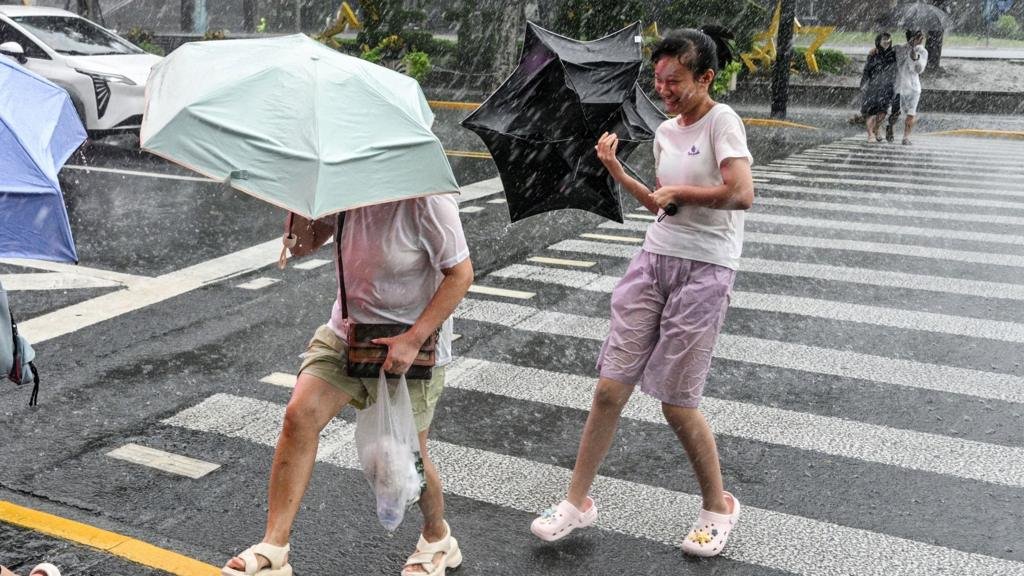
Typhoon Dolphin, the most powerful tropical cyclone to strike China this year, crashed into the country's densely populated eastern seaboard on Sunday evening, forcing more than one million people from their homes and subjecting Shanghai, the nation's financial capital, to one of its heaviest rainfall days in 150 years of records. The storm made landfall near Yuhuan in Zhejiang province with winds of approximately 151 kilometres per hour, triggering one of the largest evacuation operations of the 2026 typhoon season. Yet with the system expected to stall inland, forecasters warn that the greatest danger — flooding on an almost basin-wide scale — may still lie ahead.
China Evacuates One Million as Typhoon Dolphin Slams Eastern Coast
Shanghai, China — Typhoon Dolphin made landfall on Sunday evening, and the storm's aftermath continues to unfold across eastern China.
Typhoon Dolphin Makes Landfall
Dolphin came ashore on the evening of August 9 after days of intensification over the warm waters of the Western Pacific, striking the coast of Zhejiang province with hurricane-force winds measured at roughly 151 kilometres per hour. Meteorological authorities had earlier issued the country's top-level red alert, and the storm delivered on the warning: wind-driven rain lashed eastern China through the night, uprooting trees, overturning vehicles, and flooding streets in coastal cities from Wenzhou to the outskirts of Shanghai.
By 5am on Monday, August 10, the system had weakened rapidly to tropical-storm strength as it moved inland — a common trajectory for typhoons that make landfall on this stretch of coast. But the meteorological reprieve is deceptive. Weakened storms that stall over China's interior frequently produce the deadliest outcomes, converting kinetic energy into prolonged, torrential rainfall across river basins far from the point of landfall.
One Million Evacuated: The Machinery of Response
The scale of the pre-emptive evacuation — more than one million people moved to safety across Zhejiang province and Shanghai by Sunday evening — reflects the disciplined, top-down mobilization that defines China's disaster-response system. Provincial and municipal emergency-management offices, operating under the coordination framework of the Ministry of Emergency Management, ordered school closures, suspended public transport, and opened thousands of shelters in advance of the storm's arrival.
This is not improvisation. Over the past two decades, Beijing has invested heavily in a standing disaster-response architecture: pre-positioned relief supplies in provincial warehouses, dedicated emergency-management cadres at the county level, and early-warning systems that push alerts directly to mobile phones. The evacuation of a million people in a single weekend is, in organizational terms, a formidable logistical achievement — one that China's disaster managers regard as routine rather than exceptional. The harder test, officials and analysts alike acknowledge, comes in the days after the winds die down, when flooding, landslides, and infrastructure failures determine the true human cost.
Shanghai Under Water: A Financial Hub's Stress Test
No city faced a more consequential test than Shanghai. The metropolis of more than 24 million people recorded roughly 220 millimetres of rain — its second-wettest day in 150 years of meteorological record-keeping. The city's two airports cancelled more than 1,300 flights, grounding one of Asia's busiest air-transport networks at the height of the summer travel season, while ferry services, metro lines, and rail connections were suspended or curtailed across the Yangtze River Delta.
The economic stakes extend well beyond the immediate disruption. Shanghai anchors the Yangtze River Delta, a region that generates a substantial share of China's GDP and serves as a critical node in global supply chains — for semiconductors, automobiles, chemicals, and consumer goods. Every hour of port slowdown ripples outward to factories, freight forwarders, and retailers across Asia and beyond. For global companies with just-in-time logistics, the storm is a reminder that the world's most efficient manufacturing corridors remain hostage to the region's most violent weather.
The Rainfall Threat: Four River Systems on Alert
Forecasters had predicted that some areas could receive 200 to 400 millimetres of rainfall over the coming days, and the storm's decision to stall over the interior has concentrated that threat. Hydrological authorities are monitoring four major river systems at elevated risk of flooding, with waterlogged catchments and saturated soils raising the spectre of landslides in the mountainous hinterland of Zhejiang and Fujian provinces.
Urban waterlogging is a parallel concern. Despite decades of investment in drainage infrastructure — including the much-publicised "sponge city" pilot programme that began in 2015 — megacities across eastern China remain vulnerable to rainfall of this intensity. The 220-millimetre deluge in Shanghai, arriving within a single day, would test any drainage system in the world; the coming days will reveal how much of that water the city's engineered defences can absorb and how much will spill into streets, basements, and metro tunnels.
Historical Context: Typhoons and China's Coastal Megacities
Typhoons are woven into the history of China's eastern seaboard. The coastal provinces that now host the country's wealthiest cities have been struck by devastating cyclones for centuries, and the collective memory of catastrophic floods shapes both public caution and government policy. What has changed is the exposure: the population and economic value concentrated along this coastline today are orders of magnitude greater than in any previous era, which means that even storms of comparable meteorological intensity now carry vastly larger potential consequences.
Chinese authorities have responded with an increasingly sophisticated playbook — zoning restrictions in flood-prone areas, reservoir management coordinated across provincial boundaries, and an expanding network of meteorological satellites and radar that extends forecast lead times. The evacuation of more than one million people before Dolphin's arrival is itself evidence of how far that system has come. The question that hangs over this and future storms is whether infrastructure investment can keep pace with a climate that is making extreme rainfall events more frequent and more intense.
Beyond the Border: The Philippines and Regional Ripples
Dolphin's footprint was never confined to China. Before the storm reached the Chinese coast, its outer circulation enhanced the southwest monsoon across the Philippines, unleashing severe flooding in parts of Metro Manila and western regions of the archipelago. The Philippines, which sits astride the Western Pacific typhoon belt, has endured a succession of destructive storms in recent years, and the monsoon-enhanced deluge is a reminder that a single cyclone can impose cascading costs across multiple countries.
The regional dimension carries diplomatic undertones. Disaster response has long been one of the more constructive arenas of East Asian cooperation — a domain where rivalries are set aside in favour of practical coordination, early-warning data sharing, and mutual assistance. For China, demonstrating an effective, humane response to domestic disasters also serves a strategic purpose: it projects competence and solidarity to neighbours who are simultaneously watching Beijing's military posture with unease. Humanitarian capacity, in this reading, is itself a form of regional influence.
Climate Signals: A Warming Western Pacific
Dolphin's intensity and rainfall are consistent with the broader trends documented by climate scientists studying the Western Pacific. Warmer sea-surface temperatures supply tropical cyclones with more energy and more moisture, and the evidence of recent years points toward storms that intensify more rapidly, carry heavier rainfall, and — in some regions — linger longer over land. The 220-millimetre day in Shanghai, the strongest storm of the year hitting China's economic heartland, and the enhanced monsoon flooding in the Philippines all fit this pattern.
China's own meteorological service has been explicit about the stakes, incorporating climate projections into infrastructure standards and urban planning in the country's most exposed provinces. But adaptation is a race against a moving target. Every record rainfall, every unprecedented evacuation, recalibrates what "extreme" means — and the gap between the climate the infrastructure was designed for and the climate now arriving is one of the central vulnerabilities of the region's coastal megacities.
Strategic Implications
The full impact of Typhoon Dolphin will take days to assess, as floodwaters recede and the damage to homes, farms, and infrastructure is counted. For Beijing, the immediate priorities are unambiguous: preventing further loss of life in flood-affected areas, restoring transport and power, and managing the economic fallout in the country's most productive region. The evacuation of one million people — and the discipline with which it appears to have been executed — is a signal of institutional capacity that carries weight well beyond the emergency itself.
For the wider region and the global economy, the storm is a sobering case study in cascading risk. A single weather system shut down two of Asia's busiest airports, tested the drainage of the world's most ambitious urban infrastructure projects, threatened four major river systems, and flooded a Southeast Asian capital a thousand kilometres away. As the Western Pacific grows warmer and storms grow more volatile, the countries of the region — China, the Philippines, Japan, and their neighbours — face a shared strategic problem: how to build resilience not just against the storms of today, but against the stronger storms that climate projections say are coming. The answers they develop, individually and collectively, will shape the economic and human security of Asia for decades.
This article was produced with AI-assisted research and editorial support. Sources: BBC News, Reuters, The Associated Press, The Guardian, Al Jazeera.
By Prof. Marcus Chen, Staff Writer
What's Your Reaction?
 Like
0
Like
0
 Dislike
0
Dislike
0
 Love
0
Love
0
 Funny
0
Funny
0
 Wow
0
Wow
0
 Sad
0
Sad
0
 Angry
0
Angry
0

World Politics Analyst at Global1.News. Based in Beijing, covering US-China relations, global trade, and geopolitical strategy. Brings deep analytical perspective to the power dynamics shaping international affairs.












Comments (0)