
The Quiet Alumni Network Reshaping Asia's Diplomatic Landscape
On June 23, 2026, South Korean Prime Minister Kim Min-seok walked onto the campus of Tsinghua University in Beijing, returning to the institution where he earned a law degree in 2010. His remarks to his hosts were notably personal. "I believe that my time studying at Tsinghua University will remain one of the most beautiful memories of my life, forever cherished and held close to my heart," he said, recalling early morning flights from Seoul to make it to class on time.
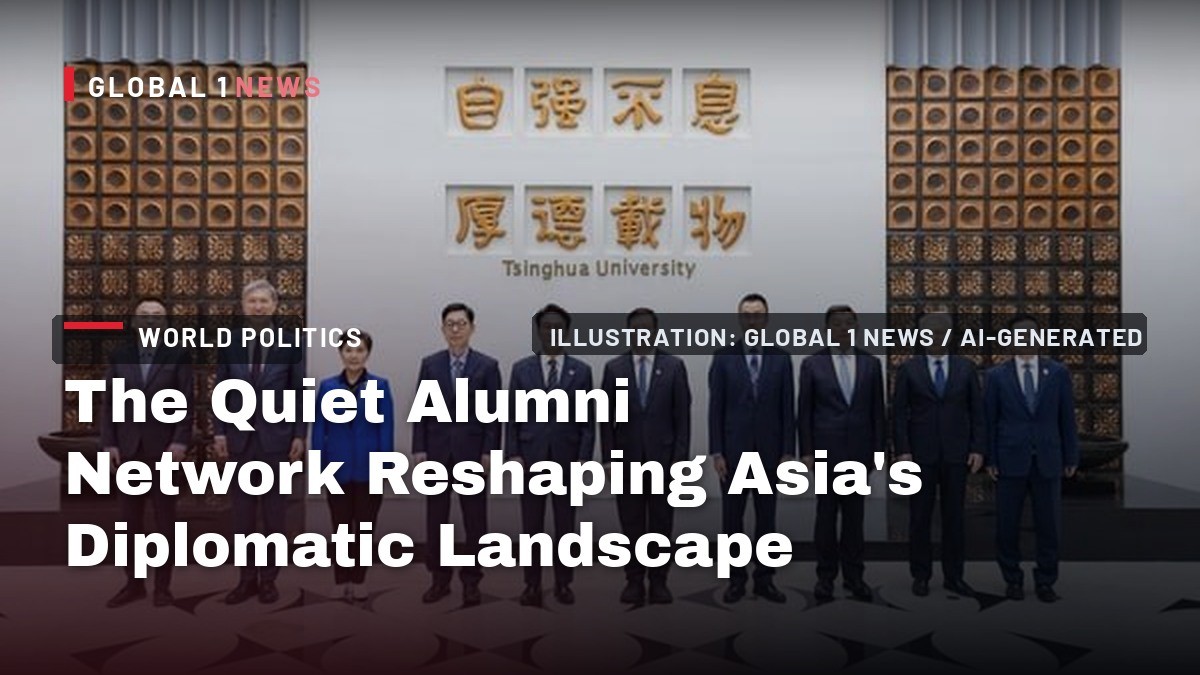
On June 23, 2026, South Korean Prime Minister Kim Min-seok walked onto the campus of Tsinghua University in Beijing, returning to the institution where he earned a law degree in 2010. His remarks to his hosts were notably personal. "I believe that my time studying at Tsinghua University will remain one of the most beautiful memories of my life, forever cherished and held close to my heart," he said, recalling early morning flights from Seoul to make it to class on time. The visit carried a particular poignancy given that Kim has since resigned from office to become the chair of the ruling Democratic Party, a position that places him at the center of South Korean political life.
Kim was not alone in making a pilgrimage to a Chinese alma mater. Three weeks earlier, Lao President Thongloun Sisoulith had stood in the dormitory room at the Central Party School where he had lived during a month-long program in 2000. "Though the campus has undergone some changes," he observed, "the places where I lived and studied remain just the same." These two visits, occurring within weeks of each other, highlight a remarkable trend: four neighboring countries—South Korea, Laos, Kazakhstan, and Vietnam—now have top leaders who studied in China. This convergence raises a question that sits at the intersection of education policy and international relations: does a Chinese education sway Asia's leaders, and by extension, their foreign policy?
A Regional Pattern of Chinese Educations
The cohort of Asian leaders with Chinese academic credentials is more substantial than casual observers might assume. Kassym-Jomart Tokayev, the president of Kazakhstan, studied at the Beijing Linguistic Institute—now known as the Beijing Language and Culture University—in 1983-84 and speaks fluent Mandarin, a rare skill for a Central Asian head of state. In April 2026, Le Minh Hung took office as Vietnam's prime minister; in 1996, he had completed a training course on market economy and financial analysis at Shanghai University of Finance and Economics. Each of these leaders represents a different era of Chinese educational outreach, from the early reform period of the 1980s to the post-Tiananmen opening of the 1990s and the contemporary era of globally ranked universities. The question posed by analysts examining this pattern is whether it marks a new phase in Chinese educational diplomacy in its periphery or is little more than a biographical curiosity. The distinction matters for policymakers in Seoul, Tokyo, Washington, and other capitals that must calibrate their responses to Chinese influence. If these educational ties are merely personal details, they warrant little attention. If they represent a systematic strategy of cultivating future leaders, they demand a more considered response.Three Forces Behind the Growing Cohort
The Diplomat's analysis identifies three structural forces that explain the growing cohort of Asian leaders who spent time at Chinese schools. The first is the dramatic rise of Chinese universities in global rankings. In the 2026 U.S. News Best Global Rankings, Tsinghua—a public institution that traces its roots back to 1911—placed sixth globally, accompanied by ten other mainland institutions in the top 100. This represents a remarkable ascent for a higher education system that was largely closed to international students just a few decades ago. For ambitious students across Asia, Chinese universities now offer a credible alternative to Western institutions that have traditionally dominated global higher education. The second force is sustained education investment. China has maintained public education spending at or above 4 percent of GDP since 2012, a benchmark enshrined in national policy and actively monitored. Between 2021 and 2024, China invested $539 billion in higher education, building what is now the world's largest higher education system. This investment has transformed Chinese campuses into world-class facilities with research capabilities that rival leading Western institutions. The scale of this commitment signals that education is not merely a domestic priority but a strategic asset in China's foreign policy toolkit. The third force is widening access for both Chinese and foreign students. Chinese government scholarships have expanded opportunities for international students, making Chinese universities increasingly accessible to talented individuals from across the developing world and beyond. This combination of rising quality, sustained investment, and expanded access has created a pipeline of future leaders with direct experience of Chinese society, institutions, and perspectives.The Korean Angle: A Tsinghua Degree in Seoul Politics
For South Korea, the emergence of a ruling party chair with a Tsinghua law degree is a development of considerable political significance. South Korea's alliance with the United States remains the anchor of its security policy, a commitment that has endured through multiple administrations of both conservative and progressive orientation. Yet Korean domestic politics is acutely sensitive to perceptions of China ties, and a major political figure with a Chinese law degree inevitably invites scrutiny about where his loyalties lie. The Kim case illustrates the complexity of these alumni networks. His Tsinghua education provides him with a familiarity with Chinese perspectives and a personal network of contacts that could prove valuable in managing the delicate Korea-China relationship. At the same time, his political position requires him to navigate a domestic environment where public opinion toward China has cooled considerably in recent years, particularly regarding issues such as the THAAD missile defense system and China's economic retaliation against Korean businesses. The personal warmth he expressed toward Tsinghua must be balanced against the structural realities of Korean security policy, which remains firmly anchored in the U.S. alliance. This tension between personal experience and structural interests is central to understanding the broader phenomenon. Alumni ties create access and familiarity, but leadership decisions are usually driven by structural interests, alliance commitments, and domestic politics rather than personal nostalgia. A leader who studied in Beijing may understand Chinese positions more intuitively and may be more willing to engage in dialogue, but that does not mean they will abandon their country's core security arrangements.Education as Soft Power: The Scholarly Framework
The academic literature on international relations has long treated education as a soft power resource. Joseph Nye's concept of soft power emphasizes co-optation rather than coercion, the ability to attract through values, culture, and institutions rather than to compel through military or economic might. Higher education is a classic long-horizon channel for this kind of influence, building relationships and shaping perspectives over decades rather than years. China's positioning of its higher education sector as an apparatus of influence toward Southeast Asia is well documented in scholarly work on China's soft power strategy. The systematic review literature on education and foreign policy notes that higher education in the foreign policy of states has been increasing significantly in order to generate soft power. This is not unique to China; the United States, the United Kingdom, France, and other major powers have long used educational exchange programs as instruments of diplomatic influence. The Fulbright Program, the British Council, and the German Academic Exchange Service all represent efforts to build long-term relationships with future leaders. China's approach follows this established pattern, but with distinctive characteristics: the scale of investment, the speed of university advancement, and the concentration on regional neighbors. The scholarly caveat is equally important. Research on alumni networks and foreign policy suggests that while educational ties can create access and familiarity, they rarely determine policy outcomes. Leaders make decisions based on national interests, security calculations, and domestic political pressures. A Chinese education may make a leader more receptive to Chinese perspectives and more skilled at navigating Sino-relations, but it does not override the fundamental interests of their own state.Implications for Northeast Asia and the U.S. Alliance System
The long-term implications of this trend extend well beyond the current cohort of leaders. As Chinese universities continue to climb global rankings and more future Asian leaders pass through Chinese campuses, the region's diplomatic landscape will be shaped by a generation of policymakers with direct experience of China. This has particular significance for Northeast Asia, where the U.S. alliance system—anchored by the Korea-U.S. and Japan-U.S. alliances—has been the foundation of regional security for seven decades. For Korea-Japan-U.S. coordination, the emergence of China-educated leaders in the region presents both challenges and opportunities. The challenge is that these leaders may be more inclined to seek accommodation with China on issues where the alliance system has traditionally taken a firmer line. The opportunity is that they may be better equipped to manage the inevitable frictions in the Korea-China and Japan-China relationships, reducing the risk of miscalculation and escalation. The thesis advanced in The Diplomat's analysis is that foreign policy patterns predate these specific leaders—and their Chinese education—and continue today. This is a crucial point. The structural forces shaping Asian diplomacy—the rise of China, the U.S. alliance system, economic interdependence, historical grievances—operate independently of any individual leader's biography. A Tsinghua-educated Korean prime minister will still face the same security dilemmas as his predecessors, the same alliance commitments, and the same domestic political constraints. Yet the article also concludes that studying in China does matter for diplomacy. This is the more nuanced and ultimately more useful finding. Educational ties do not determine policy, but they do shape the environment in which policy is made. They create channels of communication, reservoirs of trust, and frameworks of understanding that can facilitate diplomatic engagement. In a region where historical animosities and security tensions frequently complicate interstate relations, these personal connections may prove valuable in maintaining dialogue and managing crises. As the cohort of China-educated Asian leaders grows, the region will need to develop a more sophisticated understanding of how these educational ties interact with structural interests. The answer is unlikely to be either alarmist or dismissive. Chinese educational diplomacy is a real phenomenon with real effects, but those effects are mediated by the enduring realities of national interest, alliance politics, and domestic governance. The leaders who studied in Beijing will return to their capitals with new perspectives, but they will also return to the same geopolitical constraints that have shaped Asian diplomacy for generations. This article was produced with AI-assisted research and editorial support. Sources: The Diplomat, U.S. News Best Global Rankings, academic literature on educational soft power. By Prof. David Park, Staff WriterWhat's Your Reaction?
 Like
0
Like
0
 Dislike
0
Dislike
0
 Love
0
Love
0
 Funny
0
Funny
0
 Wow
0
Wow
0
 Sad
0
Sad
0
 Angry
0
Angry
0

Prof. David Park
East Asia/Technology Correspondent at Global1.News. Seoul-based voice covering Korean politics, technology, business, and culture. Analyzes how technology and geopolitics intersect across East Asia.












Comments (0)