
Guyana’s Carolyn Rodrigues-Birkett Poised to Make History as First Caribbean, Indigenous UN Secretary-General
PORT OF SPAIN — From the banks of the Moruca River in the remote Arawak village of Santa Rosa to the marble halls of the United Nations, Carolyn Rodrigues-Birkett’s journey is one that resonates deeply across the Caribbean.
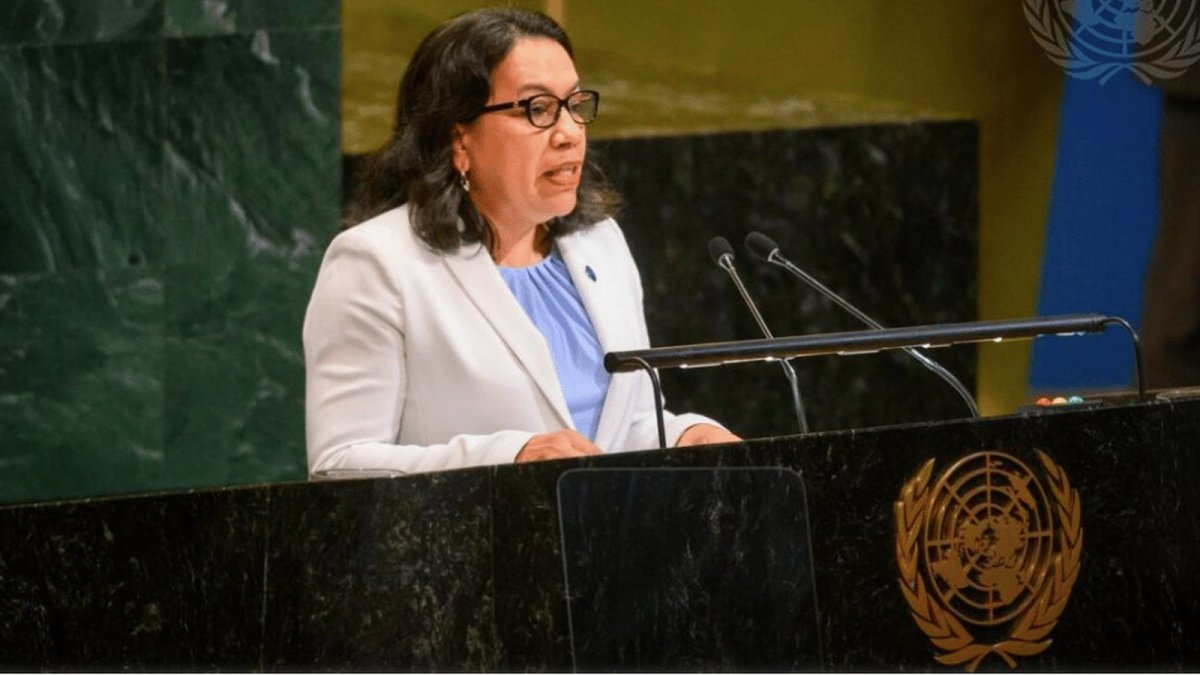
PORT OF SPAIN — From the banks of the Moruca River in the remote Arawak village of Santa Rosa to the marble halls of the United Nations, Carolyn Rodrigues-Birkett’s journey is one that resonates deeply across the Caribbean. As the UN Security Council enters formal consultations to select the next Secretary-General, the woman who could shatter the glass ceiling of global diplomacy carries the hopes of a region that has long waited for its voice at the highest table. With the term of current Secretary-General António Guterres ending on 31 December 2026, the window for a historic Caribbean bid is now open, and Rodrigues-Birkett, Guyana’s Permanent Representative to the UN, has emerged as a formidable contender.
Her candidacy, formally announced by President Dr Irfaan Ali in a national address on 12 June 2026, represents a confluence of firsts: the first woman, the first indigenous person, and the first candidate from a Caribbean state to be formally nominated for the post. For a region of small island developing states (SIDS) that has historically been on the periphery of global power structures, the prospect is nothing short of transformative.
From Santa Rosa Village to the World Stage
Born on 16 September 1973 in the Amerindian village of Santa Rosa in Region One (Barima-Waini), Rodrigues-Birkett’s rise has been anything but conventional. She is Arawak, a specialist in Amerindian Affairs, and a community worker by training — credentials that have shaped her approach to diplomacy with a grounded, people-first perspective. Her political career began in earnest in 2001 when she was appointed Guyana’s Minister of Amerindian Affairs, a portfolio she held while advocating for the rights of indigenous communities often overlooked in national development plans.
In 2008, she transitioned to the role of Minister of Foreign Affairs, a position she held until 2015. During those years, she navigated Guyana’s complex relations with its neighbours, including the long-standing border controversy with Venezuela, and championed the cause of Caribbean unity within CARICOM. Since 2 October 2020, she has served as Guyana’s Permanent Representative to the United Nations, where she has been a vocal advocate for climate justice and the reform of international financial institutions.
Her personal story is one that many in the Caribbean can relate to — a journey from a small, close-knit community to the centre of global power, without losing sight of where she came from. When she presented herself to the world on 18 June 2026 as a candidate determined to break the mould, she noted pointedly that the UN has been led by men for 80 years. That observation, delivered with characteristic warmth but unmistakable resolve, has become a rallying cry for supporters across the region and beyond.
CARICOM’s United Front
The regional bloc has rallied behind her candidacy with a cohesion rarely seen in Caribbean diplomacy. At a CARICOM summit held in St Lucia, leaders formally endorsed her bid, signalling that the expanded regional bloc is prepared to use its collective weight in the selection process. The endorsement was not merely symbolic; it represents a coordinated diplomatic push to ensure that the Caribbean’s interests are represented in the highest office of global governance.
The Jamaica Gleaner, in an editorial published on 11 August 2026, urged CARICOM states to step up their support as the UN Security Council enters consultations. The editorial argued that the region cannot afford to be complacent, noting that while Rodrigues-Birkett’s advantage is real, the opposition of permanent members of the Security Council cannot be ruled out. The editorial’s urgency reflects a broader understanding that the selection process, which involves both the Security Council and the General Assembly, is as much about political manoeuvring as it is about merit.
On 23 July 2026, Rodrigues-Birkett topped a UN town hall poll ahead of the secretary-general selection, a clear indication that her candidacy has captured the imagination of diplomats and civil society alike. Her vision, presented in forums including a UNA-UK conversation in July 2026, emphasises peace and security, the role of civil society, human rights, and climate change — issues that resonate deeply with Caribbean realities.
A Voice for Small Island Developing States
For the Caribbean, a successful bid would give SIDS a voice at the highest level of global diplomacy on issues that have life-or-death consequences for the region. Climate change is not an abstract concept for the people of Trinidad and Tobago, Guyana, Jamaica, or Barbados — it is the rising sea lapping at coastal communities, the more intense hurricane seasons that threaten homes and livelihoods, and the flooding that disrupts agriculture and infrastructure. A Secretary-General from the Caribbean would bring an understanding of these challenges that no previous occupant of the office has possessed.
Debt relief is another critical issue. Many Caribbean nations carry heavy debt burdens, often exacerbated by natural disasters and the economic fallout of the COVID-19 pandemic. The region has long argued that the international financial architecture is ill-suited to the needs of small states, and Rodrigues-Birkett has been a consistent advocate for reform. Her candidacy offers the possibility of a leader who understands, from lived experience, the constraints that SIDS face in accessing affordable financing for development.
The reform of international financial institutions is a theme she has woven into her public statements, alongside a call for greater representation of developing countries in global decision-making. For a region that has often been treated as an afterthought in global negotiations, the prospect of having one of their own at the helm of the UN is deeply significant.
The Road Ahead: Security Council Consultations
The selection process for the next Secretary-General is now underway, with the UN Security Council in consultations. The term of the next Secretary-General begins on 1 January 2027, and the coming weeks will be critical in determining whether Rodrigues-Birkett can secure the necessary support. The process involves a series of straw polls, in which the five permanent members — the United States, Russia, China, France, and the United Kingdom — hold significant sway. While no permanent member has publicly opposed her candidacy, the possibility of a veto remains a shadow over the proceedings.
Diplomatic observers note that her candidacy has generated genuine enthusiasm, particularly among non-aligned nations and developing countries. Her performance in the town hall poll, where she outpaced other contenders, suggests that she has the ability to build bridges across regional and ideological divides. However, the path to the 15th floor of the UN Secretariat is fraught with complexity, and the Caribbean community is watching with bated breath.
For Trinidad and Tobago, the outcome carries particular resonance. As a fellow CARICOM member, the twin-island republic has a vested interest in seeing a Caribbean national assume the world’s top diplomatic post. The region’s diaspora, spread across the United States, Canada, and the United Kingdom, has also mobilised in support, recognising that a Caribbean Secretary-General would elevate the region’s profile and influence on the global stage.
A Historic Moment for Indigenous Peoples
Beyond the Caribbean, Rodrigues-Birkett’s candidacy holds profound significance for indigenous peoples worldwide. As the first indigenous person to be formally nominated for the post, she carries the hopes of communities that have historically been marginalised and excluded from positions of power. Her Arawak heritage is not a footnote to her career; it is central to her identity and her vision of inclusive, equitable governance.
In her public engagements, she has spoken about the importance of recognising the rights of indigenous peoples, protecting their lands and cultures, and ensuring that they are included in decisions that affect their lives. These are not abstract principles for her; they are the lived realities of her family and community in Santa Rosa. Her candidacy represents a break from the tradition of career diplomats and politicians who have dominated the UN’s leadership, offering instead a perspective shaped by community, tradition, and resilience.
The symbolism of an indigenous woman from a small village in Guyana leading the United Nations would be powerful, not just for the Caribbean but for the world. It would signal that the UN is serious about its commitments to diversity, inclusion, and the representation of underrepresented groups. It would also serve as an inspiration to young people across the region, particularly those from rural and indigenous communities, who would see in her a reflection of their own potential.
What This Means for the Caribbean
The practical implications of a Rodrigues-Birkett victory would be felt across the region. A Caribbean Secretary-General would bring attention to the vulnerabilities of SIDS, from climate change to the economic shocks of global crises. The region’s priorities — disaster risk reduction, climate adaptation financing, debt restructuring, and the reform of global governance — would gain a powerful advocate at the highest level.
There is also the matter of regional pride. The Caribbean has produced world-class athletes, artists, and intellectuals, but its presence in the upper echelons of global diplomacy has been limited. A successful bid would be a moment of collective achievement, a recognition that the region’s voice matters and that its leaders can compete on the world stage. For the people of Trinidad and Tobago, who share a deep cultural and historical connection with Guyana, the prospect is particularly meaningful.
As the Security Council continues its consultations, the region waits with a mixture of hope and anxiety. The road ahead is uncertain, and the opposition of permanent members remains a real possibility. But whatever the outcome, Rodrigues-Birkett’s candidacy has already achieved something historic: it has placed the Caribbean firmly on the map of global leadership and given the region a reason to dream.
For a region that has known its share of struggles — from colonial legacies to economic challenges to the ever-present threat of natural disasters — the possibility of seeing one of its own at the helm of the United Nations is a powerful reminder of what can be achieved through determination, unity, and vision. The world may soon witness history being made, and the Caribbean will be watching, hoping, and standing behind one of its own.
By Sharon Sahatoo, Staff Writer
This article was produced with AI-assisted research and editorial support. Sources: Caribbean360, News Room Guyana, Guyana Chronicle, Jamaica Gleaner.
What's Your Reaction?
 Like
0
Like
0
 Dislike
0
Dislike
0
 Love
0
Love
0
 Funny
0
Funny
0
 Wow
0
Wow
0
 Sad
0
Sad
0
 Angry
0
Angry
0
Caribbean Correspondent at Global1.News. Based in Port of Spain, Trinidad, covering Caribbean politics, economy, energy, climate, and culture. Amplifying the voices and stories of the Caribbean region.










Comments (0)