
Can "Super Coral" and Cooler Seas Save the World's Reefs - and Latin America's?
The ocean is running a fever, and the patient is dying. From the crystal waters of Palau to the life-giving banks of Brazil's Abrolhos, the vibrant cities of the sea are turning bone-white, a spectral warning of an ecosystem in collapse.
The ocean is running a fever, and the patient is dying. From the crystal waters of Palau to the life-giving banks of Brazil's Abrolhos, the vibrant cities of the sea are turning bone-white, a spectral warning of an ecosystem in collapse. For decades, scientists have watched with growing alarm as rising temperatures have pushed coral reefs to the brink of biological annihilation. But now, a new narrative is emerging from the laboratories and coral gardens of the Pacific—a story of resilience, innovation, and a desperate, brilliant fight to save the world's most biodiverse marine habitats. The question is no longer whether we can save the reefs, but whether we can do it in time, and whether the lessons learned in the remote islands of Palau can be transplanted to the frontlines of Latin America.
Can "Super Coral" and Cooler Seas Save the World's Reefs — and Latin America's?
Rio de Janeiro, Brazil – Aug 31, 2026 — The answer to that question is being forged in the unlikeliest of places: a cheap picnic cooler on a boat in Palau, and in the misty clouds above Australia's Great Barrier Reef. As the fourth global bleaching event finally subsides, the scientific community is pivoting from documenting the catastrophe to engineering a solution. For Latin America, home to the second-largest barrier reef on Earth and the most biodiverse coral ecosystem in the South Atlantic, this pivot is not an academic exercise—it is a matter of survival for coastal economies, fisheries, and millions of people. The innovations coming out of the Pacific offer a blueprint, but they also demand a hard look at the unique vulnerabilities and strengths of our own reefs.
The Ocean's Rainforests Under Siege
To understand the scale of the challenge, we must first confront the grim arithmetic of the recent past. The National Oceanic and Atmospheric Administration (NOAA) and the International Coral Reef Initiative confirmed the 4th Global Coral Bleaching Event on April 15, 2024. This wasn't just another hot summer; it was a planetary-scale thermal assault that ran from early 2023 through late 2025, marking it as the most widespread and destructive stress event ever recorded. The numbers are staggering. From January 1, 2023, to September 30, 2025, bleaching-level heat stress hit approximately 84.4% of the world's coral reef area. Mass bleaching was documented in at least 83 countries and territories, a sobering statistic that underscores the global nature of this crisis.
This event was supercharged by a strong El Niño in 2023, layered on top of oceans that were already record-warm from decades of fossil fuel emissions. The consequences are not merely aesthetic. With roughly 6,000 coral species worldwide, reefs are home to more than 4,000 species of fish and about 25% of global marine life. They are the nurseries of the ocean, the protective barriers for coastlines, and the economic engines for countless communities. Australia's Great Barrier Reef, the world's largest, suffered its sixth mass bleaching since 2016 in 2025—only the second time it has bleached in consecutive years. The pattern is clear: the intervals between bleaching events are shrinking, leaving reefs with no time to recover. This is the backdrop against which the new science of hope is being written.
Super Coral: Palau's Cooler-Box Revolution
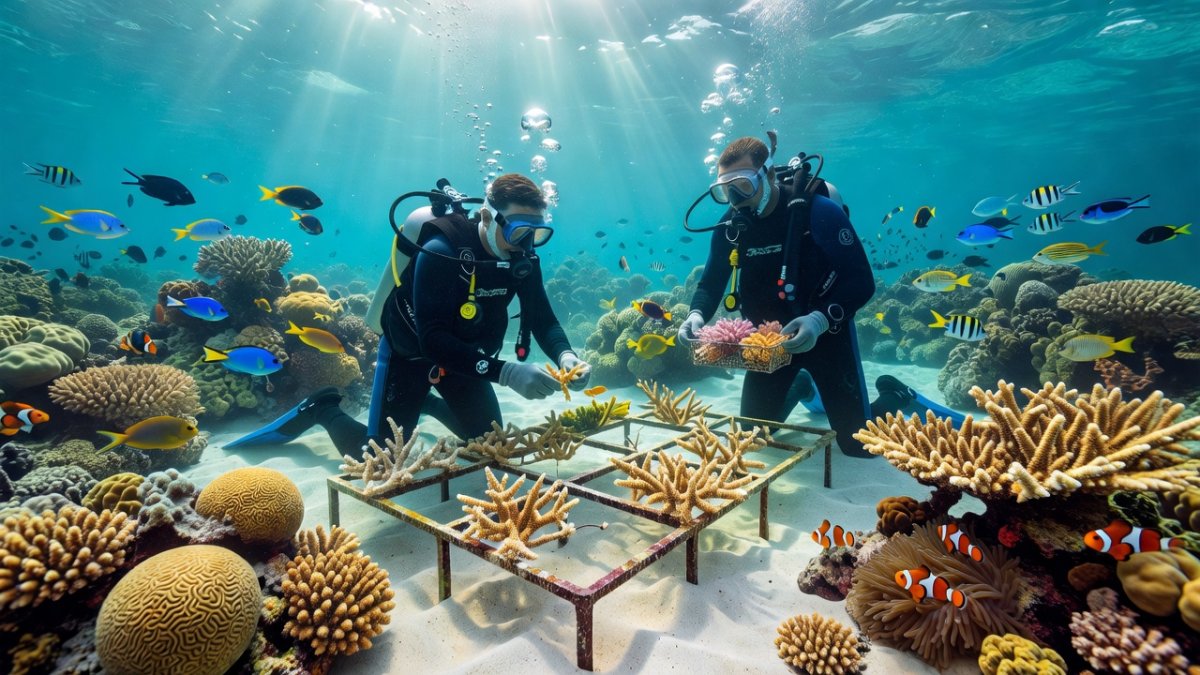
In the remote island nation of Palau, a revolution is brewing, and it looks suspiciously like a family picnic. Scientists there have turned cheap, store-bought picnic coolers into portable coral incubators. The process is elegantly simple yet profoundly important. They collect coral fragments and place them in these coolers, subjecting them to heat stress to identify which fragments can withstand the warming water. These survivors, dubbed 'super coral,' are then cultivated in offshore coral gardens, creating a bank of heat-tolerant genetics that can be used to repopulate degraded reefs. This low-tech, high-impact approach is a cornerstone of the MSC Foundation's Super Coral Reefs Programme, which aims to identify and cultivate hardy coral species for their ability to withstand extreme heat, developing a scalable model for reef restoration.
This is not just about finding a lucky strain; it's about actively breeding for resilience. Conservationist Austin Bowden-Kerby has been a pioneer in this field, growing corals in ocean nurseries around Fiji and the Pacific, effectively 'gardening' heat-tolerant corals. The Palau method democratizes the science—it doesn't require a multi-million dollar laboratory, just a keen eye, a cooler, and a commitment to the reef. For Latin America, this is a game-changer. The Mesoamerican Reef, stretching over 1,126 kilometers, is a mosaic of different microclimates and genetic diversity. The ability to identify local 'super corals'—those that have already survived extreme heat events—and propagate them cheaply could be the most effective strategy for building resilience from the bottom up. It is a strategy that empowers local communities and scientists, rather than relying solely on top-down technological fixes.
Cooling the Sea: The Cloud-Brightening Gamble
While super corals offer a genetic solution, another approach tackles the problem at its source: the heat itself. Marine Cloud Brightening is a geoengineering technique that aims to shade the reef from the sun's relentless rays. Southern Cross University in Australia runs the world's leading program in this field. The concept involves ships spraying a fine mist of salt water into low-lying clouds, making them brighter and more reflective. This, in turn, casts a cooling shadow over the reef beneath, reducing the thermal stress that triggers bleaching. Supported by the Reef Restoration and Adaptation Program and the Australian government's Reef Trust Partnership, this is a high-stakes gamble on our ability to manipulate local weather patterns to protect a specific ecosystem.
The science is promising, but it is not without controversy and significant logistical hurdles. The scale of the operation required to cool a reef system like the Mesoamerican Barrier is immense. However, the potential payoff is equally immense. In summer 2023, sea-surface temperatures on the Mesoamerican Reef reached a record 34 degrees Celsius, provoking widespread bleaching of hard-coral colonies. The 2024 summer, the hottest ever recorded, devastated some of the region's most iconic reef sites. For Latin America, cloud brightening could be a critical tool in the emergency kit, a way to buy precious time for corals to adapt and for other restoration efforts to take hold. It is a targeted intervention, a shield against the worst of the heat, but it is not a cure for the underlying disease of climate change. It is a bridge, not a destination.
Coral IVF and the Larval Army
Beyond identifying resilient adults, scientists are also learning to create them on a massive scale. Coral IVF, pioneered by Professor Peter Harrison of Southern Cross University, is a technique that gives nature a helping hand in the most intimate of moments. During the brief, synchronized mass spawning nights, scientists collect coral spawn from healthy colonies. They then rear millions of larvae in carefully controlled tanks, protecting them from predators and giving them a head start in life. Once the larvae are ready, they are settled onto degraded reef sections, effectively seeding new colonies where natural recruitment has failed. What began as a modest trial site in 2016 has now evolved into a sophisticated restoration strategy.
The scale of this effort is about to increase dramatically. In January 2026, the Great Barrier Reef Foundation announced a new 'larval seedbox' tool designed to help millions of baby corals settle across the reef. This innovation, combined with the cloud brightening research, has led Australian media to report in May 2026 that 'coral IVF meets cloud brightening' as the two flagship interventions funded on the Great Barrier Reef. This combination of approaches—genetic selection, larval propagation, and environmental shading—represents a multi-pronged attack on the crisis. For Latin America, where the Mesoamerican Reef Fund (MAR Fund) is already offering grants for restoration, these techniques offer a proven playbook. The challenge is scaling them up from research projects to operational reality, a transition that requires funding, political will, and the active participation of coastal communities.
Latin America in the Crosshairs
While the Pacific has captured the headlines, Latin America is on the front lines of this crisis. The Mesoamerican Barrier Reef System, also known as the Great Mayan Reef, is the largest transboundary reef in the Western Hemisphere and the world's second-largest barrier reef system. Stretching about 1,126 kilometers along the Caribbean coasts of Mexico, Belize, Guatemala, and Honduras, it is a biological treasure trove and an economic lifeline. The region's coastal and marine protected areas cover more than nine million hectares, encompassing 18 key protected areas. Yet, this vast network is under siege. The record-breaking heat of 2023 and 2024 has left its scars, and the regional reef 'report card' paints a grim picture of decline.
Further south, the situation is equally dire. The Abrolhos reefs in Brazil are the most biodiverse coral ecosystem in the South Atlantic. However, researchers in Rio de Janeiro told Reuters on April 29, 2026, that coral cover there has fallen about 15% over 18 years because of climate change and human activity. A March 2026 study in the journal *Coral Reefs* warned that Brazil's fire corals may be undergoing a 'silent extinction' as marine heatwaves intensify. The threats are compounded by local stressors: runaway tourism, poor coastal planning, and massive sargassum blooms that smother reefs and deplete oxygen. The crisis in Latin America is not a future scenario; it is a present-day emergency. The science from Palau and Australia offers hope, but it must be adapted to the specific ecological and social contexts of our own reefs, where community involvement is not just beneficial, but essential.
Voices from the Ground: Belize, Honduras and the Reef Builders
In the fight for the Mesoamerican Reef, the most powerful weapons are often the people who live alongside it. In Belize, the Super Reefs program, supported by The Nature Conservancy, is identifying corals in Belizean waters with the highest chance of surviving warming. This is not a purely scientific endeavor; it is a community-driven effort that relies on local fishers and dive operators who know the reef intimately. In April 2026, Belizean conservationists joined a Super Reefs learning exchange in the Dominican Republic to learn climate-smart restoration strategies and best practices for selecting and propagating heat-resilient corals. This cross-pollination of ideas is vital, creating a network of practitioners who can share successes and failures.
The spirit of resilience is also alive in Honduras. The Bay Islands hold an enormous living stand of staghorn coral between two cruise-ship ports, a seemingly impossible oasis of life in a heavily trafficked area. A Honduran reef recently 'stumped' conservationists with its unlikely resilience, as reported by Mongabay in May 2025. This mystery offers a glimmer of hope and a crucial research question: what makes this reef so tough? The answer could hold the key to restoration efforts elsewhere. Organizations like CoralMAR and the MAR Restoration Research Network are linking restoration groups across Mexico, Belize, Guatemala, and Honduras, creating a unified front. The MAR Fund's Reef Rescue Initiative, offering grants of up to US$33,000, is prioritizing bleaching response and monitoring of Stony Coral Tissue Loss Disease (SCTLD), a devastating pathogen that is sweeping through the region. These are the grassroots efforts that will determine the fate of the reef.
The Bottom Line — What Comes Next
The story of the world's coral reefs is not yet written. The innovations emerging from Palau, Australia, and the laboratories of the world's leading marine biologists offer a tangible path forward. The combination of super coral selection, larval propagation, and localized cooling strategies provides a toolkit that can be adapted and deployed across the globe. For Latin America, the path is clear but urgent. We must invest in identifying our own super corals, scaling up coral IVF and larval seedbox techniques, and exploring innovative cooling methods to protect our most valuable reef assets. This requires a massive mobilization of resources, not just from governments, but from the private sector, NGOs, and the millions of people whose livelihoods depend on healthy reefs.
But we must be clear-eyed about the limitations of these interventions. They are not a substitute for aggressive climate action. They are a lifeline, a way to preserve biodiversity and ecosystem function while the world transitions away from fossil fuels. The super corals are not invincible; they have their limits. The cloud brightening is a temporary shield, not a permanent solution. The real bottom line is that we are in a race against time. The reefs are telling us they are dying, and we are finally listening. The question now is whether we can act fast enough and at a scale large enough to make a difference. For the sake of the Mesoamerican Reef, the Abrolhos, and all the communities that depend on them, we must not fail.
This article was produced with AI-assisted research and editorial support. Sources: Al Jazeera English 101 East, NOAA Coral Reef Watch, Reuters, Mongabay.
By Elena Vasquez, Staff Writer
What's Your Reaction?
 Like
0
Like
0
 Dislike
0
Dislike
0
 Love
0
Love
0
 Funny
0
Funny
0
 Wow
0
Wow
0
 Sad
0
Sad
0
 Angry
0
Angry
0

Latin America Correspondent at Global1.News. Based in Mexico City, covering politics, economics, energy, and culture across the region. Brings an on-the-ground perspective to stories spanning from the Rio Grande to Patagonia.















Comments (0)