
Cambricon H1 Revenue Soars 108% on China's AI Chip Boom
Chinese AI chip giant Cambricon reported a 108% surge in first-half revenue to 5.996 billion yuan, with net profit up 122.6% to 2.311 billion yuan, as Beijing's tech self-sufficiency drive fuels domestic accelerator demand amid US export controls.
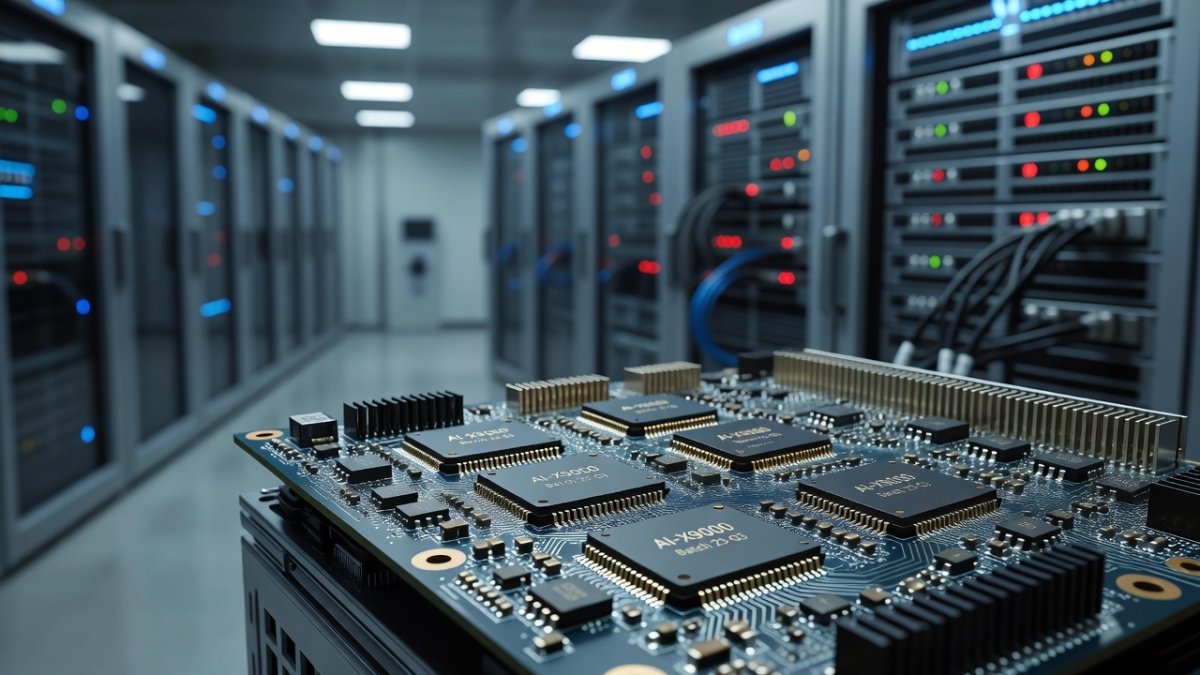
Cambricon's Record Half Caps a Surge in China's AI Chip Sector
Chinese artificial intelligence chip giant Cambricon Technologies reported a 108 per cent surge in first-half revenue on Friday, as the company capitalises on a sweeping domestic push to replace foreign AI hardware. The chipmaker's revenue for the first six months of the year reached 5.996 billion yuan (US$890 million), while net profit jumped 122.6 per cent year on year to 2.311 billion yuan, according to a stock exchange filing.
Tags: Cambricon, AI chips, China technology, semiconductor industry, STAR Market, AI infrastructure, tech self-sufficiency, Moore Threads, Hygon, artificial intelligence, China economy, export controls
Earnings Beat Comes as Domestic AI Hardware Demand Surges
In the second quarter, Cambricon's revenue reached 3.1 billion yuan, in line with the consensus estimate of 3 billion yuan predicted by a Bloomberg poll. Net profit hit 1.3 billion yuan, up from 1 billion yuan in the previous quarter, while basic earnings per share stood at 3.68 yuan, up 119 per cent year on year. Non-GAAP net profit rose 137.3 per cent to 2.166 billion yuan, according to the filing.
The company attributed the surge to a steady increase in demand for AI computing power during the first six months. "Leveraging our core competitiveness in AI chips, we continued to strengthen in-depth cooperation with leading enterprises in the finance and internet sectors," it said in the filing. The results underscore a broader boom in China's AI chip sector, fuelled by Beijing's push for technological self-sufficiency and a monumental AI infrastructure buildout across the nation.
US Export Controls Reshape the Competitive Landscape
With US export controls largely cutting off China's access to advanced AI accelerators from companies such as Nvidia, domestic designers are rushing to fill the market vacuum. Cambricon's Shanghai-listed stock closed up 2.7 per cent at nearly 1,200 yuan ahead of the earnings release on Friday. The company was the most valuable stock on Shanghai's tech-focused STAR Market until July, when it was overtaken by memory chipmaker ChangXin Memory Technologies (CXMT) following its blockbuster market debut.
The policy backdrop has been decisive. Washington's restrictions on advanced semiconductor exports have accelerated procurement of Chinese-made accelerators by cloud providers, state-backed research institutes and financial institutions. Cambricon, founded in 2016 and backed by the Chinese Academy of Sciences, has emerged as one of the clearest commercial beneficiaries of this forced substitution, transitioning from a loss-making research pioneer into a profitable supplier of high-performance computing products.
The scale of the shift is visible across the market. Chinese enterprises are increasingly directing AI-accelerator budgets towards locally made chips, with industry surveys cited in earnings coverage pointing to a sustained preference for domestic suppliers in sectors ranging from telecommunications to state-owned cloud platforms. That preference is not simply patriotic procurement: the combination of export-control uncertainty, supply security and policy incentives has made domestic chips a rational risk-management choice for many large buyers, even where imported hardware retains a raw-performance edge.
Sector-Wide Momentum Ripples Across China's Chip Industry
The momentum lifting Cambricon is also rippling across the rest of the domestic AI chip sector. Beijing-based Moore Threads expected its first-half revenue to rise up to 149 per cent year on year to 1.75 billion yuan, citing strong demand for its MTT S5000 graphics processing unit and rapid commercialisation of its intelligent computing clusters. Hygon Information Technology, another leader in the domestic AI processor sector, forecast first-half revenue of up to 9.3 billion yuan, a year-on-year increase of 70 per cent.
The collective surge points to a structural shift rather than a one-off quarter. Each of the leading designers has carved out a different niche: Cambricon concentrates on training and inference accelerators for data centres, Moore Threads targets GPU-computing workloads with its MTT line, and Hygon's x86-compatible processors serve enterprise and government deployments. Together, they are building what analysts describe as a layered domestic supply base capable of absorbing demand across the AI stack, even as each company races to secure foundry capacity and advanced packaging from Chinese and non-US partners.
Ambition Scales to 100 Billion Yuan Revenue Target
Cambricon has outlined ambitious plans to dramatically scale its operations. In July, the company set a target of generating more than 100 billion yuan in revenue over the three years to 2028 — a nearly 20-fold increase from its previous plan set three years earlier, which aimed for 4.6 billion yuan of cumulative revenue between 2024 and 2026. The higher target was set as part of the firm's roll-out of a new staff stock incentive plan.
In the filing, Cambricon said it was developing a next-generation intelligent processor microarchitecture and instruction set — though it did not disclose a launch date — as well as optimising systems on the software side. The company's unaudited results also showed an inventory build and a sharp fall in operating cash flow, a detail analysts have flagged as the next test for a company scaling production faster than its customer base has historically absorbed. The filing's disclosure of a 3.68 yuan basic earnings per share figure, up 119 per cent year on year, underlined how quickly the once loss-making designer has moved into sustained profitability at scale.
Japan and the Asia-Pacific AI Hardware Race
For Japan, the Cambricon results sharpen an uncomfortable strategic picture. Tokyo is pursuing its own advanced-chip ambitions through Rapidus, the government-backed foundry venture targeting 2-nanometre production, but Japan has largely relied on imported AI accelerators for its data-centre buildout. As China's domestic chip ecosystem scales revenue and profitability, Japanese policymakers and corporate buyers face a choice between deepening ties with US suppliers and hedging across the Pacific's increasingly bifurcated hardware market.
The contrast is instructive: Japan's strengths in materials, precision equipment and advanced packaging remain world-class, but its AI accelerator procurement remains heavily dependent on Nvidia and other foreign vendors. Chinese suppliers, by contrast, are building an integrated domestic chain from chip design to deployment, even if it remains behind the global technological frontier in raw performance. For Japanese trading houses and systems integrators serving China-facing businesses, the growing availability of domestic accelerators also changes the commercial calculus for joint projects in third markets, where Chinese partners may increasingly specify home-grown silicon for data-centre contracts.
What to Watch For
Analysts expect Cambricon to face mounting challenges amid fierce domestic competition. "Competition is likely to intensify as peers launch new products in the second half of 2026, testing Cambricon's relative performance and price-to-performance positioning," Morgan Stanley analysts said in a research note last week. The delivery of next-generation processors, inventory management and the pace of customer adoption will determine whether the 100 billion yuan revenue target is credible.
For Asia-Pacific readers, the second half of 2026 will show whether China's AI chip boom translates into durable commercial leadership or becomes a capacity race with thinning margins. Japan's own semiconductor strategy, and the positioning of Taiwanese and Korean suppliers in the AI supply chain, will be shaped by how quickly Chinese accelerators close the performance gap. Cambricon's record half is a milestone — but the inventory test that follows will be just as telling.
By Kenji Tanaka, Staff Writer
This article was produced with AI-assisted research and editorial support. Sources: South China Morning Post, company filings, Bloomberg, Morgan Stanley research.
What's Your Reaction?
 Like
0
Like
0
 Dislike
0
Dislike
0
 Love
0
Love
0
 Funny
0
Funny
0
 Wow
0
Wow
0
 Sad
0
Sad
0
 Angry
0
Angry
0

Japan Correspondent at Global1.News. Tokyo-based voice covering Japanese politics, technology, economy, and culture. Tracks the intersection of tradition and innovation in one of the world's most dynamic societies.














Comments (0)