
Burundi Writer Brings Kirundi Tales to Young Readers
Aïta Chancella Kanyange is writing Burundi's children back into their own stories. The 33-year-old author's trilingual collection "Harabaye: Once Upon a Time" has become a quiet cultural landmark in a country where children's books in Kirundi, French and English remain rare — and where a mother's frustration at finding only foreign tales for her son grew into a publishing mission.
Aïta Chancella Kanyange is writing Burundi's children back into their own stories. The 33-year-old author's trilingual collection "Harabaye: Once Upon a Time" has become a quiet cultural landmark in a country where children's books in Kirundi, French and English remain rare — and where a mother's frustration at finding only foreign tales for her son grew into a publishing mission. Her vividly illustrated books for readers aged two to ten are now drawing families to reading sessions across Bujumbura.
Burundi Writer Brings Kirundi Tales to Children's Bookshelves
Bujumbura, Burundi — When Aïta Chancella Kanyange had her first son, she searched for books to introduce him to reading and found only volumes published abroad — stories that, in her words, "depicted a life that had nothing to do with the lives of children here in Burundi." So she decided to write the books she could not find. Two volumes of her collection "Harabaye: Once Upon a Time" are now in circulation, written in Kirundi, French and English, and inspired by Burundian culture.
A Mother's Discovery: When Children Could Not See Themselves
Kanyange's journey began not in a publishing house but in the quiet, ordinary moments of early motherhood. As a lifelong reader and now a mother of two, she assumed that the world of children's literature would welcome her son with open arms. Instead, she found shelf after shelf stocked with translations and imports — cheerful books from Paris, Brussels and beyond, filled with snow-covered landscapes, foreign schoolyards and characters whose names and daily rituals bore no resemblance to life in Bujumbura.
The gap troubled her deeply. "These stories depicted a life that had nothing to do with the lives of children here in Burundi," she recalled in the africanews "This Is Culture" report that aired on April 15, 2026, with photos by Francine Sinarinzi. Her son, like countless Burundian children, was learning to love reading through stories that silently told him his own world was not worth writing about. That realisation, she said, was the spark that turned frustration into a mission.
So Kanyange sat down to write the books she could not find. She wanted stories set in Burundi, featuring Burundian children, families and landscapes — tales that would let her son and his peers recognise themselves on the page. The result was "Harabaye: Once Upon a Time" (in French, "Harabaye : Il était une fois"), a collection designed for children aged two to ten, written in the three languages that shape modern Burundian life: Kirundi, French and English.
For Kanyange, the trilingual approach was never a gimmick. It was a reflection of how Burundian children actually live — switching between Kirundi at home, French at school and English in an increasingly connected world. By embedding all three languages in the same book, she hoped to reinforce values and foster good reading habits from the earliest age, while giving parents a tool to guide their children's moral and intellectual growth.
She is also unflinching about the responsibilities of parenthood. In the report, she advised parents not to leave children in front of the TV, insisting that upbringing is primarily the parents' responsibility. A book, she argued, demands something a screen never will: a lap, a voice, a shared moment of attention. That human connection, she believes, is where a child's love of learning truly begins.
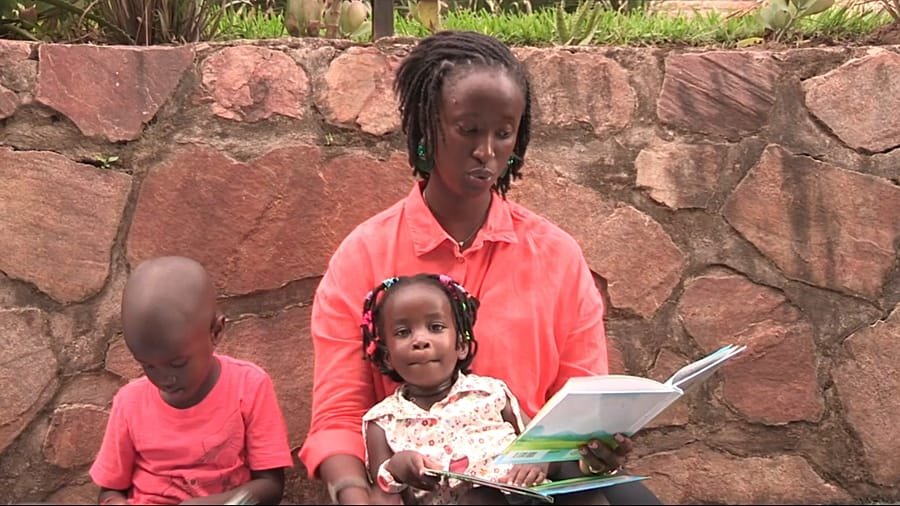
Harabaye: Once Upon a Time in Three Languages
The name "Harabaye" itself carries the weight of tradition. In Kirundi, it is the classic opening of a folktale — the equivalent of "once upon a time" — and it signals to children that what follows is both story and lesson. Kanyange's collection draws directly on Burundian culture, weaving tales that echo the country's hills, its drumming traditions, its proverbs and its family structures into narratives designed for the very young.
The books are published by Editions Gusoma, a local Burundian publishing house that has become a quiet engine of literary revival. Gusoma's catalogue now spans several distinct collections: Harabaye for novels and short stories, Le Souffle for poetry and theatre, Visages for biographies, Abana for children's literature and Sens for essays. Each collection, Kanyange noted, serves a different readership, but Abana — the children's line — holds a special place in the house's mission.
The significance of this work cannot be overstated. For years, few children's educational materials existed in Kirundi apart from government-produced school textbooks. Storybooks, picture books and leisure reading in the national language were almost nonexistent. Children learned to read from primers, but they learned to love reading — if at all — from foreign imports. Kanyange's books are part of a deliberate effort to change that equation.
Burundi has a strong oral tradition that relays history and life lessons through storytelling, poetry and song. Grandmothers and grandfathers have long been the keepers of tales, passing down wisdom around evening fires. Kanyange sees her books not as a replacement for that tradition but as its written extension — a way to ensure that the stories survive in a world where screens increasingly compete for children's attention.
By publishing in three languages, Gusoma and Kanyange are also making a practical bet: that Burundian children can be bilingual or trilingual without losing their cultural footing. The books allow a child to read a story in Kirundi, then revisit it in French or English, reinforcing vocabulary and comprehension across all three. It is an ambitious model, and one that is already drawing attention beyond Burundi's borders.
Why Pictures Speak First: The Power of Illustration
Ask Kanyange why her books look the way they do, and she will tell you a simple truth: "Children learn best through visual cues. These images speak to them more than words do." The vividly coloured illustrations that fill her pages are not decoration — they are the heart of the reading experience, especially for the youngest readers who cannot yet decode a single word.
For children aged two to five, a picture book is often their first encounter with the idea that marks on a page can carry meaning. The illustrations in "Harabaye" show Burundian children playing, families sharing meals, animals from the region and landscapes that any child in Bujumbura would recognise. The images do the work of storytelling before the words arrive, building a bridge between the child's world and the world of text.
This visual-first approach is also a response to the reality of modern childhood. As Evelyne Nkunzimana, a mother who brings her children to reading sessions, put it: "Our children are exposed to screens. So, as a parent, I love the fact that in Harabaye, it's not just the words that speak, but the images too. And for children, images speak just as clearly as words." Nkunzimana's observation points to a deeper truth about early literacy: children raised on screens are already fluent in visual language, and books that speak that language can meet them where they are.
Kanyange is careful, however, to distinguish between the passive consumption of screen images and the active engagement that a picture book demands. A screen shows a child images that move and change without effort; a book invites a child to linger, to point, to ask questions, to connect the image on one page to the story unfolding across the next. That slower, more deliberate engagement is precisely what builds the neural pathways of reading.
The balance between words and pictures is delicate. Too many words, and a young child loses interest; too few, and the story lacks substance. Kanyange's books calibrate that balance carefully, using illustrations to carry the emotional weight while the text introduces vocabulary and structure. For parents who are not confident readers themselves, the images also provide a scaffold — a way to tell the story even if the words are challenging.
Reading Sessions: Families Are Listening
Across Bujumbura, families are gathering for reading sessions built around Kanyange's books. Parents bring children who can barely hold a book upright, and older siblings who are just learning to read aloud. The sessions are part storytelling, part literacy workshop, part community gathering — and they are drawing crowds that surprise even the organisers.
Evelyne Nkunzimana is one of the parents who has made these sessions a regular part of family life. Her words from the africanews report capture the mood: "Our children are exposed to screens. So, as a parent, I love the fact that in Harabaye, it's not just the words that speak, but the images too. And for children, images speak just as clearly as words." For Nkunzimana, the books are not just entertainment — they are a counterweight to the relentless pull of phones and tablets.
Kanyange hopes the books provide a "solid" educational foundation for the children who grow up with them. She speaks of literacy not as a school subject but as a life skill, one that shapes how a child will think, dream and navigate the world. A child who learns to love books at three, she argues, is a child who will be ready to learn at six, at ten, at twenty.
The screen-time debate is not unique to Burundi — it is playing out in Dakar, Lagos, Nairobi and Accra, where parents wrestle with the same anxieties about digital distraction. But in Bujumbura, the response has been notably proactive. Rather than simply banning screens, parents like Nkunzimana are actively seeking alternatives, and they are finding them in locally produced books that speak to their children's reality.
There are early signs of cultural change. Parents who grew up without Burundian children's books are now buying them for their own children, and grandparents are discovering that the stories they once told orally have found their way into print. The reading sessions are becoming intergenerational spaces, where the old and the young meet over pages that honour both.
Building a Book Industry: Gusoma and the Push for Local Publishing
Kanyange's books are part of a wider movement to build Burundi's book industry from the ground up. Editions Gusoma has been at the centre of this push, organising a week dedicated to books and reading that brought together authors, publishers, educators and government officials. The message was consistent: Burundi needs its own literary ecosystem, not just imported books.
Pierre Nkurikiye, a lieutenant-colonel who serves as a ministry spokesman and is himself a writer, put the case bluntly. "Contrary to the common opinion, the Burundians want to read," he said, citing his own Kirundi proverbs collection, which has seen growing demand. Nkurikiye's point is that the appetite for reading exists — what has been missing is the supply of relevant, accessible, locally produced material.
Professor André Nduwimana, director general of curricula, offered a stark assessment of the status quo. He noted that institutions spent large sums publishing textbooks abroad, a practice that drained resources while failing to build local capacity. He called Gusoma "a durable solution to support" — a homegrown answer to a problem that foreign publishers could never fully solve.
The momentum extends beyond Gusoma. Young author Alain Pascal Niyonzima has published a trilingual short story collection, "Dusome," with Gusoma's help, adding another voice to the growing chorus of Burundian writers. Meanwhile, the Association of Burundian Writers and Book Promoters (ABEPL), led by Jeanne d'Arc Nduwayo, has sent a memorandum to the government outlining the sector's needs and demands.
Among those demands is the restoration of the culture fund that existed before the 1993 crisis, a period of civil conflict that devastated Burundi's institutions, including its literary infrastructure. The government has signalled its intention to restore the fund, and Gusoma has already taken symbolic steps — donating books to Burundi's National Library — to demonstrate the sector's commitment to the public good.
What to Watch For: A New Generation of Readers
Kanyange's work is far from finished. With two volumes of "Harabaye" in circulation, she is already thinking about what comes next — possible third volumes, new stories, deeper explorations of Burundian culture. Each new book is an opportunity to reach another child, another family, another classroom.
The wider momentum is unmistakable. Across the continent, African children's literature is enjoying a renaissance, with trilingual publishing emerging as a powerful tool for cultural preservation and educational access. The same weeks that brought Kanyange's story to international attention also saw Conakry host the 18th "72 Hours of the Book" festival in late April 2026, and Nigeria's aso-oke weaving tradition gain global spotlight in April 2026 — reminders that African cultural production, in all its forms, is claiming its place on the world stage.
For African languages, local publishing is a lifeline. Kirundi, like many African languages, faces the constant pressure of globalisation, with English and French dominating education, media and commerce. Books like Kanyange's are a declaration that Kirundi is not just a language of the home — it is a language of literature, of imagination, of the future.
What can readers across the continent learn from Burundi's example? Perhaps the most important lesson is that change begins with a single person noticing a gap and deciding to fill it. Kanyange did not wait for a publisher to commission her; she wrote the books she wanted to exist. Gusoma did not wait for foreign investment; it built a local infrastructure. Parents did not wait for a government programme; they showed up to reading sessions.
The reading revival in Burundi is still young, and its long-term success is not guaranteed. But the ingredients are in place: passionate writers, committed publishers, engaged parents and a government that is beginning to listen. If the trajectory holds, the children who are now learning to love books in Bujumbura will grow into adults who demand more — more stories, more languages, more of their own culture on the page.
And that, perhaps, is the most hopeful sign of all. A generation of Burundian children is learning that their stories matter, that their language is worthy of print, that their world is a place where adventures happen. They are being written back into their own stories — and they are reading.
By Amara Diop, Staff Writer
This article was produced with AI-assisted research and editorial support. Reporting is based on sources cited in the article.
What's Your Reaction?
 Like
0
Like
0
 Dislike
0
Dislike
0
 Love
0
Love
0
 Funny
0
Funny
0
 Wow
0
Wow
0
 Sad
0
Sad
0
 Angry
0
Angry
0

West Africa/Sahel Correspondent at Global1.News. Dakar-based journalist covering politics, security, climate, and development across Francophone and Anglophone West Africa. Tells the stories of a region undergoing profound transformation.











Comments (0)