
Moscow Court Sentences Former Zelensky Adviser to 11 Years in Absentia
Former Ukrainian presidential adviser Oleksiy Arestovych was sentenced in absentia by a Moscow military court to 11 years in prison for spreading false information about the Russian military and calling for terrorism. The closed-door trial verdict also barred him from managing websites for four y...
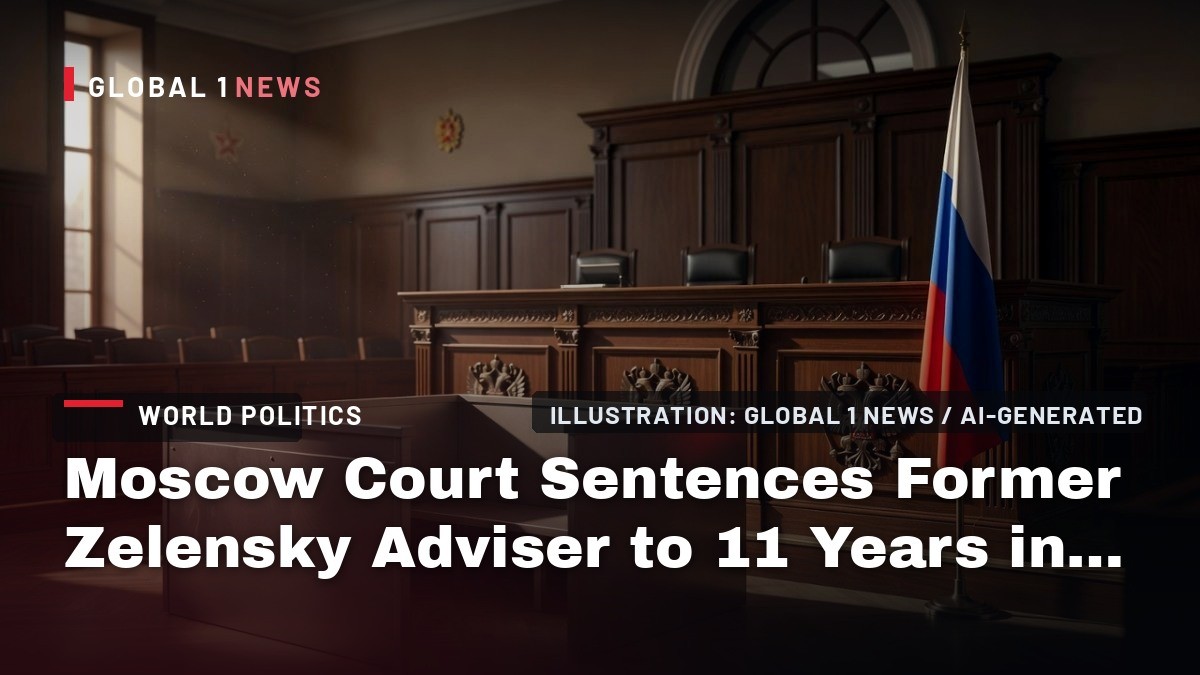
Moscow Court Sentences Former Zelensky Adviser to 11 Years in Absentia
A judge in Moscow on Friday sentenced Oleksiy Arestovych, a former adviser to the Ukrainian president's office, to 11 years in prison in absentia after finding him guilty of spreading false information about the Russian military and publicly calling for terrorism. The verdict, delivered by the Second Western District Military Court following a closed-door trial, also banned Arestovych from managing websites for four years.
Prosecutors had requested a sentence of 15 years, according to the exiled news outlet Mediazona. Arestovych, who now lives outside Ukraine and maintains a significant YouTube following as a critic of the Ukrainian government, responded on Telegram: "What a sophisticated cover-up operation."
The Kramatorsk Station Attack and the Charges of False Information
Russian investigators accused Arestovych of publishing false statements about a deadly missile strike on a railway station in the eastern Ukrainian city of Kramatorsk in April 2022. That attack, which occurred on April 8, 2022, killed 63 civilians including nine children and wounded 150 others, including 34 children, according to documentation by Human Rights Watch, which described the strike as an apparent war crime in violation of the laws of war.
The Russian military has consistently denied responsibility for the Kramatorsk strike, and Russian state media have promoted alternative narratives about who was behind the attack. Investigators in Moscow alleged that Arestovych's public statements about the strike constituted the dissemination of deliberately false information about the Russian armed forces, a charge that carries severe penalties under Russia's wartime censorship laws.
Human Rights Watch documented the strike as an apparent war crime, noting that the attack showed no evident military target at the station, which was crowded with civilians attempting to evacuate from the advancing Russian offensive in the Donbas region. The organization's findings have been widely accepted by international bodies, though Russian authorities have rejected them.
Sabotage Allegations and the March 2022 Video
Beyond the Kramatorsk statements, prosecutors accused Arestovych of calling on Ukrainians to sabotage railway lines used to resupply Russian troops in a March 2022 video. According to the charges, Arestovych urged Ukrainians to disrupt rail infrastructure that Russian forces relied upon for logistics and resupply during the early phase of the full-scale invasion.
The sabotage allegation forms the basis of the terrorism charge, a designation that Russia has applied broadly to Ukrainian officials and military figures since the start of the war. Russian authorities added Arestovych to its list of "terrorists and extremists" in May 2023 and placed him on its wanted list in October 2023. Moscow's Basmanny District Court ordered his pre-trial detention in absentia in February 2024.
Legal experts suggest the sabotage charge is notable because it treats calls for resistance against occupying forces as acts of terrorism, a framing that human rights groups say reflects Moscow's broader effort to criminalize any advocacy for Ukrainian self-defense.
Arestovych's Path From Zelensky Adviser to Kremlin Target
Arestovych, born August 3, 1975, is a former Ukrainian military officer who rose to prominence as a political adviser and columnist. He served as an adviser to the head of Ukrainian President Volodymyr Zelensky's office until January 2023, when he resigned after claiming that a Ukrainian air defense missile caused a deadly strike on an apartment building in the central Ukrainian city of Dnipro.
That January 2023 strike killed 44 people. Arestovych suggested on air that the missile had been shot down by Ukrainian air defense, a statement that triggered a public outcry in Ukraine. He resigned shortly afterward, calling his comment a "fundamental mistake." The Russian military has been widely documented as responsible for the Dnipro strike, though Moscow has denied involvement.
Since his resignation, Arestovych has recast himself as a critic of the Ukrainian government, amassing a substantial online following on his YouTube channel. Zelensky sanctioned him last year, a move that reflected the Ukrainian government's view of Arestovych as a destabilizing figure spreading narratives that align with Russian information operations.
Closed-Door Trial and the Sentence
The trial took place behind closed doors at the Second Western District Military Court, a venue that has handled numerous high-profile cases involving Ukrainian figures and Russian opposition activists. The closed-door format is standard for cases involving charges of spreading false information about the military, as Russian courts have increasingly restricted public access to proceedings under wartime legal provisions.
The 11-year sentence falls short of the 15 years prosecutors requested, though it remains a severe penalty under Russian law. The additional four-year ban on managing websites appears designed to limit Arestovych's ability to maintain his online presence, which has remained active despite his exile.
Arestovych's response on Telegram, dismissing the verdict as a "cover-up operation," suggests he views the proceedings as politically motivated. The former adviser has consistently denied the charges, arguing that his statements about the Kramatorsk and Dnipro strikes were based on available information at the time.
The Broader Pattern of In-Absentia Sentencing in Russia
Friday's verdict fits a broader pattern of in-absentia sentencing that has become increasingly common in Russia's wartime justice system. Since the full-scale invasion of Ukraine began, Russian courts have convicted dozens of individuals—many of them Ukrainian officials, military figures, and opposition activists—without their presence in the courtroom.
This approach allows Russian authorities to pursue legal action against individuals who have fled the country or remain in Ukraine, while avoiding the complications of extradition or physical apprehension. The Basmanny District Court, which ordered Arestovych's pre-trial detention in absentia, has been a central venue for such cases, as has the Second Western District Military Court.
Human rights organizations have criticized these proceedings as lacking fundamental due process protections. The closed-door format, the absence of the defendant, and the politically charged nature of the charges have led legal observers to question whether these trials meet basic standards of judicial independence. Russian authorities maintain that the proceedings follow established legal procedures and that defendants are afforded rights under Russian law.
Wartime Speech Laws and the Kremlin's Legal Apparatus
The charges against Arestovych reflect the Kremlin's broader legal crackdown on wartime speech. Russia's laws on "false information" about the military, introduced shortly after the invasion began, have been used to prosecute hundreds of individuals, ranging from opposition politicians to ordinary citizens posting on social media.
These laws carry penalties of up to 15 years in prison, and courts have applied them aggressively. The designation of Arestovych as a "terrorist and extremist" in May 2023 placed him in a category that Russian authorities use to justify enhanced surveillance and prosecution of individuals deemed threats to state security.
For ordinary Russians, the legal environment has created significant risks around discussing the war. For Ukrainians, the in-absentia sentencing represents an attempt by Moscow to project legal authority over individuals it cannot physically reach, a strategy that legal experts suggest is designed to deter criticism and resistance.
What the Verdict Signals for Ukraine and Russia
The sentencing of Arestovych carries symbolic weight for both sides of the conflict. For Moscow, the verdict reinforces the message that Ukrainian figures who speak out against Russian military operations will face legal consequences, even if they remain beyond Russian reach. The timing of the verdict, delivered more than four years after the Kramatorsk strike, suggests a deliberate effort to keep wartime narratives active in the Russian legal system.
For Ukraine, the case highlights the complicated legacy of Arestovych, who remains a controversial figure due to his Dnipro comments and his subsequent criticism of the Zelensky government. His sanctioning by Kyiv last year underscores the distance between the former adviser and the administration he once served.
This could indicate that Moscow is seeking to exploit divisions within Ukrainian political circles by prosecuting figures who have fallen out of favor with the government in Kyiv. Legal experts suggest this signals a broader Russian strategy of using its judicial system to influence perceptions of Ukrainian leadership and to legitimize its own wartime legal framework.
The verdict also raises questions about the effectiveness of in-absentia sentencing as a tool of state policy. While such sentences carry legal weight in Russia, they have no practical effect on individuals living outside Russian jurisdiction. The primary impact appears to be symbolic, reinforcing the Kremlin's narrative that its legal system extends authority over those it considers enemies, regardless of their physical location.
As the war continues into its fifth year, the pattern of in-absentia sentencing is likely to persist, with Russian courts processing cases against Ukrainian officials and military figures at a steady pace. For Arestovych, the 11-year sentence adds another layer to a complex public life that has seen him move from Ukrainian presidential adviser to sanctioned critic to convicted felon in the eyes of Moscow.
This article was produced with AI-assisted research and editorial support. Sources: The Moscow Times, Human Rights Watch, BBC News, Wikipedia.
By Irina Volkov, Staff Writer
What's Your Reaction?
 Like
0
Like
0
 Dislike
0
Dislike
0
 Love
0
Love
0
 Funny
0
Funny
0
 Wow
0
Wow
0
 Sad
0
Sad
0
 Angry
0
Angry
0
Russia/Eastern Europe Correspondent at Global1.News. Covering Russian politics, energy, security, and the shifting dynamics of the post-Soviet space. Provides clear-eyed analysis on one of the world's most opaque regions.











Comments (0)