
Belarus Claims It Foiled ‘Sabotage’ Plot Targeting Russia
The Belarusian KGB announced on Thursday that it had disrupted a sabotage plot aimed at a “strategic facility” inside the Russian Federation. Russia has not yet commented on the Belarusian security service’s claims.
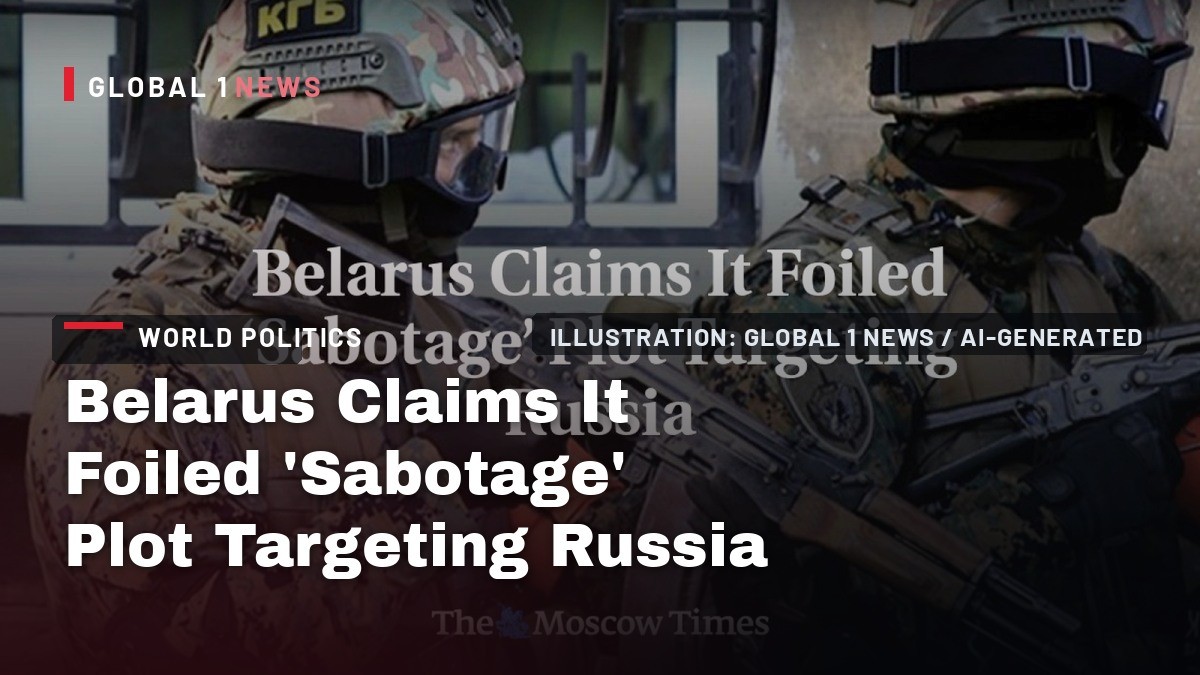
The Belarusian KGB announced on Thursday that it had disrupted a sabotage plot aimed at a “strategic facility” inside the Russian Federation. According to the agency’s statement, the operation was being coordinated from neighboring Ukraine and would have used Belarusian territory as a transit corridor for drones, communications equipment and other supplies destined for operatives inside Russia. While the KGB did not disclose the identities of those arrested, the timing of the arrests, or the specific Russian target, it affirmed that it is working with Russian law‑enforcement agencies to identify any further accomplices. Russia has not yet commented on the Belarusian security service’s claims.
Details of the KGB’s Announcement
The KGB’s brief statement emphasized that the sabotage plan was halted “at the preparation stage.” It described a logistical chain that would have moved “drones, communication equipment and other supplies” through Belarus to reach operatives inside Russia. The agency did not name the individuals detained, nor did it specify when the arrests took place. It also refrained from identifying the Russian facility that was allegedly the intended target of the sabotage operation.
In addition to the operational details, the KGB said it was coordinating with Russian law‑enforcement agencies to trace possible accomplices. This coordination underscores the close security partnership between Minsk and Moscow, a relationship that has deepened since Belarus allowed Russian troops to use its territory as a staging ground during the 2022 invasion of Ukraine.
Ukraine’s Alleged Role
The KGB’s claim that the plot was “coordinated from neighboring Ukraine” places the Ukrainian state or actors operating from Ukrainian territory at the centre of the alleged sabotage network. This accusation aligns with a pattern of Minsk and Moscow attributing subversive activities to Ukrainian influence, a narrative that has been used repeatedly to justify heightened security measures along the Belarus‑Russia border.
By framing the plot as Ukrainian‑directed, the Belarusian authorities reinforce a broader geopolitical narrative that portrays Kyiv as a hostile neighbour seeking to destabilise both Belarus and Russia. This framing also serves to legitimize the continued presence of Russian forces on Belarusian soil, as both capitals present a united front against what they describe as Ukrainian aggression.
Implications for Belarus‑Russia Security Cooperation
The KGB’s statement demonstrates the depth of operational coordination between Belarusian and Russian security services. The joint effort to thwart the sabotage plot reflects a shared security agenda that extends beyond conventional border patrols to include intelligence sharing and joint investigations of cross‑border threats.
Such cooperation is rooted in the 2022 arrangement that allowed Russian troops to use Belarusian territory as a staging ground for the invasion of Ukraine. That precedent established a framework for ongoing joint security operations, and the recent KGB announcement suggests that the partnership continues to function in a coordinated manner, especially in counter‑sabotage and counter‑intelligence activities.
Domestic Context: Press Freedom and State Narrative
In the same period, independent Russian media face intensified repression. The Prosecutor General’s Office has designated The Moscow Times as an “undesirable” organization, criminalising its activities and exposing its staff to prosecution. This designation follows an earlier “foreign agent” label, reflecting a broader state campaign to silence dissenting voices and control the narrative surrounding security incidents.
The Kremlin’s crackdown on independent journalism, exemplified by the actions against The Moscow Times, underscores the regime’s sensitivity to external scrutiny of its security policies. By branding critical outlets as threats to national security, the state seeks to delegitimize alternative accounts of events such as the alleged sabotage plot, ensuring that official narratives dominate public discourse.
Strategic Significance of the Targeted Facility
Although the KGB did not disclose the specific Russian facility at risk, its description of the site as “strategic” suggests it plays a vital role in Russia’s defence or energy infrastructure. Facilities of this nature are often integral to military logistics, communications networks, or energy distribution, making them attractive targets for sabotage aimed at disrupting state operations.
The absence of detail about the facility may be intentional, preserving operational security while still signalling to domestic and foreign audiences that Belarusian authorities are vigilant against threats to critical Russian assets. By publicising the thwarted plot without revealing sensitive specifics, the KGB balances transparency with the need to protect intelligence sources and methods.
Potential Motivations Behind the Plot
If the sabotage plan was indeed coordinated from Ukraine, the motivations could range from weakening Russian military capabilities to signalling resistance against Russian influence in the region. The use of drones and communications equipment indicates a modern, technologically sophisticated approach, reflecting a shift from traditional sabotage tactics toward more agile, remote‑operated methods.
Such tactics align with broader trends in hybrid warfare, where non‑state actors and state‑backed proxies employ low‑cost, high‑impact tools to achieve strategic objectives without direct conventional engagement. The alleged plot, therefore, may represent an evolution in the methods employed by actors seeking to undermine Russian security interests.
Broader Geopolitical Implications
The public disclosure of a foiled sabotage plot adds another layer to the already complex security environment surrounding the Russia‑Belarus‑Ukraine triangle. For Minsk, highlighting the Ukrainian origin of the threat serves to reinforce its alignment with Moscow and justify continued cooperation on security matters. For Moscow, the incident provides an opportunity to underscore the persistent threat posed by Ukraine, reinforcing domestic narratives of external hostility.
Internationally, the episode may influence perceptions of Belarus’s role as a conduit for hostile activities against Russia. While the KGB’s claims remain unverified by independent sources, the publicisation of the plot could be used by both Belarusian and Russian officials to rally domestic support and to solicit further security assistance from allied states. At the same time, the lack of comment from Russian authorities leaves open questions about the depth of the threat and the extent of joint investigative outcomes.
This article was produced with AI-assisted research and editorial support. Reporting is based on the source material cited below. Sources: The Moscow Times; themoscowtimes.com; Global1.News (26 September 2026).
By Irina Volkov, Staff Writer
What's Your Reaction?
 Like
0
Like
0
 Dislike
0
Dislike
0
 Love
0
Love
0
 Funny
0
Funny
0
 Wow
0
Wow
0
 Sad
0
Sad
0
 Angry
0
Angry
0

Russia/Eastern Europe Correspondent at Global1.News. Covering Russian politics, energy, security, and the shifting dynamics of the post-Soviet space. Provides clear-eyed analysis on one of the world's most opaque regions.















Comments (0)