
B.C. Wildfire Crisis: Premier David Eby Promises Response Review as Bald Range Fire Displaces 20,000
In a recent CBC News report, Premier David Eby stood in the smoke-choked air of Penticton on Wednesday and delivered a blunt assessment of a wildfire crisis that has overwhelmed the province's emergency systems.
In a recent CBC News report, Premier David Eby stood in the smoke-choked air of Penticton on Wednesday and delivered a blunt assessment of a wildfire crisis that has overwhelmed the province's emergency systems. The premier met with evacuees and first responders in the morning before facing reporters in the afternoon, acknowledging what many displaced residents had already discovered the hard way: there was a 48-hour period when emergency services were simply not equipped to handle the sheer volume of people fleeing their homes along Okanagan Lake.
Premier confronts 'horrific' fire zone as Bald Range blaze exposes gaps in emergency response
Penticton, B.C. – August 13 — "There's an important set of lessons for us to take about how quickly this moved, and that this may be our new normal for fire speed," Eby said, standing in a region where the Bald Range wildfire has grown from a small ignition to a 184-square-kilometre monster in less than a week. The premier's visit came as more than 20,000 people remain displaced across the south Okanagan, with close to 20,000 under evacuation orders provincewide and another 9,700 on alert.

A fire that moved like 'a bomb going off'
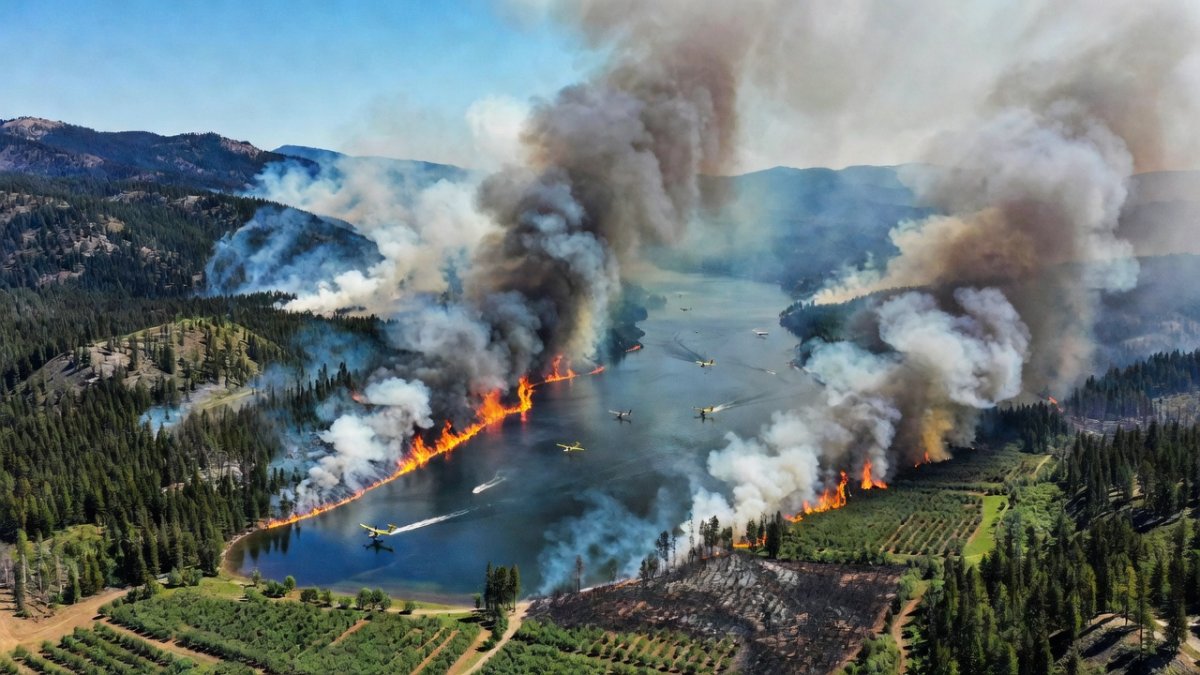
The Bald Range wildfire, designated K51490, ignited last Friday at approximately 5:30 p.m. local time west of Summerland under circumstances that remain under investigation. What happened next defied the experience of even veteran wildfire fighters. Within hours, the blaze had consumed roughly 1,000 hectares. By Saturday morning, it had exploded to between 9,500 and 10,000 hectares — a tenfold increase in a single night. By Wednesday morning, it had grown to approximately 18,450 hectares, adding another 6.5 square kilometres overnight alone.
Eby described the fire's behaviour in stark terms, calling it "horrific" and noting that it moved at a dizzying speed that forced crews to abandon traditional firefighting tactics and pivot to helping residents escape. On Saturday, he offered an even more visceral description, saying the fire was "like a bomb going off in the Summerland region." The blaze grew so intense that it generated its own weather system, complete with lightning strikes that threatened to spark additional fires in the tinder-dry landscape.
Cliff Chapman with the BC Wildfire Service did not mince words when describing the challenge facing his crews. He called the Bald Range fire one of the most difficult the service has ever confronted, adding that "this is many peoples' worst nightmare." Chapman described conditions as "explosive" and said crews were facing "conditions we have never seen before" — a sobering statement from an agency that has battled British Columbia's increasingly severe fire seasons for decades.
Evacuation chaos and a 48-hour gap
The human toll of this disaster became apparent almost immediately. All 12,000 residents of the District of Summerland were ordered to leave late Friday night, followed by approximately 8,000 people in and around nearby Peachland. The evacuations unfolded with frightening speed, and the province's emergency infrastructure struggled to keep pace. Eby acknowledged on Wednesday that there was a 48-hour period where emergency services were not equipped to deal with the influx of people fleeing their homes — a candid admission that has resonated with evacuees who reported chaotic scenes at reception centres and long waits for basic assistance.
Tragically, the crisis has already claimed at least one life. RCMP confirmed that an 80-year-old woman died while attempting to escape the wildfire, a loss that underscores the mortal danger posed by these fast-moving blazes. Dozens of other residents required rescue by helicopter and aircraft, including people airlifted from the Faulder area as flames closed in on their properties.
Kevin Dunbar, a director at the Ministry of Emergency Management, identified accommodation for evacuees as one of the single biggest operational challenges facing the province. With thousands of people suddenly homeless and hotels filling rapidly, the province has had to scramble to find shelter. Kelly Greene, the Minister of Emergency Management and Climate Readiness, said the provincial state of emergency declared on Saturday provides the tools and powers needed to act at a moment's notice, including the ability to commandeer accommodations or impose local travel restrictions.
Review promised as frustration mounts
Eby announced that the province would conduct a full review of its response to the Bald Range wildfire, responding directly to complaints from evacuees about long waits for emergency services. The premier said he would not hesitate to call on the Canadian Armed Forces for assistance if needed, though BC Wildfire Service officials have told him that military support is not required at this stage. Prime Minister Mark Carney has said in a social media post that the federal government "stands ready to help" British Columbia, thanking firefighters and first responders for their efforts.
For many evacuees, the frustration extends beyond the initial response. With full damage assessments still incomplete around Summerland, residents have reported having to turn to social media to determine whether their homes are still standing. Summerland Mayor Doug Holmes said on Tuesday that the municipality "can't even think about" lifting evacuation orders or alerts until the Bald Range fire is under control. Temporary access permits are being triaged for essential personnel such as utilities professionals, according to Deborah Jones-Middleton, protective services manager with the Regional District of Okanagan-Similkameen, but ordinary residents remain locked out of their own neighbourhoods.
The review Eby has promised will need to examine not just the initial 48-hour gap but also the broader question of whether British Columbia's emergency management systems are equipped for what the premier himself called "our new normal." With more than 100 wildfires burning across the province and nearly half of them out of control, the pressure on provincial resources is immense. About 194 firefighters were working the Bald Range fire on Wednesday, supported by an incident management team, heavy equipment, helicopters and approximately 150 structure protection personnel — a substantial deployment that nonetheless represents only a fraction of what would be needed if conditions continue to deteriorate.
Infrastructure under strain across the province
The Bald Range fire is far from the only crisis demanding attention. The Ainslie Creek wildfire, part of the larger Brunswick Complex, has scorched roughly 614 square kilometres, with its northeastern edge now sitting about three kilometres west of Highway 8 near Merritt. The Lower Nicola Indian Band has expanded evacuation alerts for reserve lands as that fire continues to grow. Highway 97 remains closed between Peachland and the Pyramid Picnic Area in Kickininee Provincial Park, with traffic being redirected to Highway 33. Westside Road is also closed due to the Bradley Creek Complex, while Highway 1 north of Hope and Highway 97 north of Cache Creek remain shut down.
These closures have significant economic implications for a region that depends heavily on tourism and agriculture. The Okanagan is one of Canada's premier wine regions and a popular destination for visitors from across the country and around the world. The fire has threatened wineries directly, with vineyards and tasting rooms in the path of the flames, and the broader tourism economy is bracing for a difficult season. Hotels that might normally be filled with summer visitors are now housing evacuees, and the smoke-filled skies are hardly an advertisement for a relaxing getaway.
The provincial state of emergency, declared on Saturday, gives authorities the legal authority to coordinate the response across jurisdictions and to compel action when necessary. Greene said the province needs these powers so it can act at a moment's notice, whether that means commandeering accommodations for evacuees or restricting travel in affected areas. The declaration also facilitates requests for federal assistance, though Eby indicated that the Canadian Armed Forces will not be deployed at this time based on the advice of BC Wildfire Service officials.
Climate realities and the road ahead
The conditions driving this year's fire season are the product of prolonged drought, hot and windy weather, and a changing climate that is making extreme fire behaviour more common. Chapman's description of "conditions we have never seen before" is a warning that British Columbia's firefighting capacity — however skilled and dedicated — may need to be reimagined for a future where fires move faster, burn hotter and create their own weather systems.
For evacuees, the immediate priorities remain practical: finding safe accommodation, securing essential documents and medications, and making plans for pets and livestock. Emergency officials are urging residents to prepare 72-hour emergency kits and to have a plan in place before an evacuation order is issued. The lessons from the Bald Range fire, however, suggest that even the best-prepared residents can be caught off guard when a fire grows from a small ignition to a 10,000-hectare inferno in a matter of hours.
What Happens Next
Eby's promise to review the province's response is a necessary first step, but the premier's own words suggest a deeper reckoning is required. If this is indeed "our new normal," then British Columbia must fundamentally rethink how it prepares for, responds to and recovers from wildfire disasters. That means investing in firefighting capacity, yes, but also in evacuation planning, in communication systems that can reach residents quickly, and in the kind of intergovernmental coordination that ensures no 48-hour gap leaves people stranded when they need help most.
The people of Summerland, Peachland and the surrounding communities are living through that gap right now. They are the ones who waited for hours at reception centres, who scoured social media for news of their homes, who watched from a distance as the fire they fled consumed the landscape they love. The review Eby has promised must be for them — and for the next community that finds itself in the path of a fire that moves like a bomb going off.
By Alex Thompson, Staff Writer
This article was produced with AI-assisted research and editorial support. Reporting is based on sources cited in the article.
What's Your Reaction?
 Like
0
Like
0
 Dislike
0
Dislike
0
 Love
0
Love
0
 Funny
0
Funny
0
 Wow
0
Wow
0
 Sad
0
Sad
0
 Angry
0
Angry
0

Canada Correspondent at Global1.News. Based in Toronto, covering Canadian politics, energy, trade, and US-Canada relations. Provides the Canadian perspective on North American and global affairs.














Comments (0)