
Ancient City Wall and 2,500 Years of Settlement Unearthed in Korat
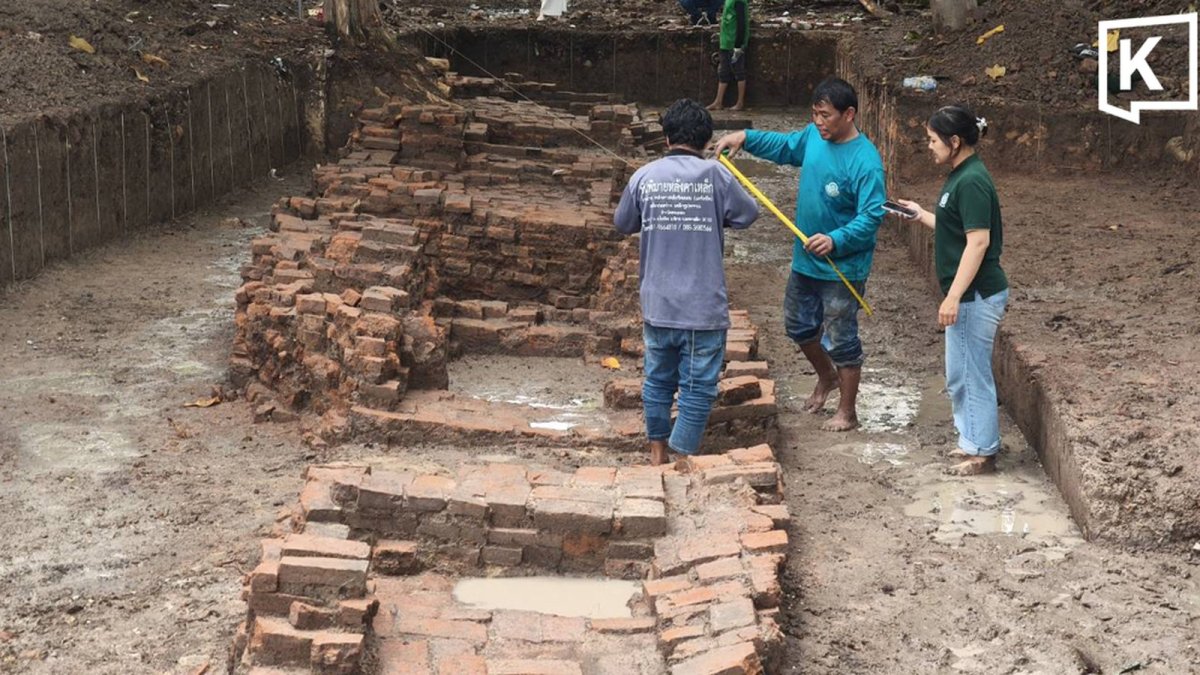
A 20-day excavation at the eastern section of Nakhon Ratchasima's old city wall concluded on Saturday, revealing signs of human life that reach back more than two millennia. Archaeologists working at Phon Lan Gate, along Phon Lan Road, uncovered an Ayutthaya-era city wall together with cultural layers spanning the prehistoric Bronze Age, the Iron Age and the historic period.
Ancient City Wall and 2,500 Years of Settlement Unearthed in Korat
A 20-day excavation at the eastern section of Nakhon Ratchasima's old city wall concluded on Saturday, revealing signs of human life that reach back more than two millennia. Archaeologists working at Phon Lan Gate, along Phon Lan Road, uncovered an Ayutthaya-era city wall together with cultural layers spanning the prehistoric Bronze Age, the Iron Age and the historic period.
The Dig at Phon Lan Gate
The project, jointly conducted by the 10th Regional Fine Arts Office in Nakhon Ratchasima and Nakhon Ratchasima Municipality, ran from 20 July at the site known as Phon Lan Gate or Phon Lan Fort. Archaeologists expanded an excavation pit to 10 by 11 metres to trace the city wall before preparing to backfill it to the original wall level.
Somdet Leelamanotham, director of the Archaeology Group at the 10th Regional Fine Arts Office, and archaeologist Wannaphong Palakawong Na Ayutthaya collected soil samples before backfilling. Students from Nakhon Ratchasima Rajabhat University and young volunteers also took part in the work under the concept "Advancing knowledge, integrating the community."
The discovery of this previously undetected section of the wall, after a survey in 2024 had passed it by, underscores how even well-studied historic cities in Thailand can hold surprises beneath everyday ground. In a region long known as the gateway to Isaan, such finds remind us that layers of the past remain close to the surface, waiting for careful eyes. The joint effort between the Fine Arts Office and the municipality shows the quiet strength of local collaboration in bringing these stories forward.
Scientific dating here relies on simple yet precise steps. Soil taken from beneath the lowest bricks will help establish when the wall rose, and these organic remains carry the memory of the moment the bricks were laid — offering a gentle bridge between the structure and the lives that built it. Students and young volunteers who joined the 20-day dig gained more than knowledge; they touched the continuity of Thai heritage with their own hands, learning patience and respect for each fragment.
Backfilling the 10 by 11 metre pit to the original wall level, while preserving samples, protects the site for future generations. This careful approach ensures that landscape work around the old city moat can proceed only after the evidence has been examined, honouring both the past and the living community that calls Khorat home.
What the Soil Reveals
The dig uncovered evidence of human settlement from the prehistoric Bronze Age through the Iron Age and into the historic period, including animal bones, pottery fragments, charcoal, soot, ash and seashells that show how people lived around 1,500 to 2,500 years ago. Work over the past two years has also uncovered Bronze Age human remains and grave goods dated to around 2,544 to 2,194 years ago, while excavation of the "Non Phon Lan" cultural layers has continued since 2024.
Some parts of the site had been disturbed by land use, including government housing built over ancient cultural layers, yet bricks bearing traces of rice husks were still collected for scientific dating. The samples will help establish the age of the city wall and the cultural layers beneath it, including remains dating to the late prehistoric Iron Age.
The everyday objects uncovered at Phon Lan Gate speak softly of Iron Age life in this corner of Isaan. Seashells among the finds suggest that people gathered food from nearby waters and maintained connections reaching beyond the immediate landscape. Rice husks pressed into the later bricks point to a deep-rooted farming tradition, where the staple grain shaped both daily meals and building practices across centuries.
Bronze Age burials with grave goods, examined through earlier work, reveal a society that honoured its dead with care and meaning. These layers, resting beneath the wall and mixed with ancient Khmer cultural traces, fill important gaps in our understanding of Isaan's long story. They show how prehistoric communities gradually wove together local traditions with influences from neighbouring Khmer worlds, creating the cultural soil from which later historic periods grew.
Settlement evidence spanning the Bronze Age, Iron Age and historic periods tells of continuous human presence here for 1,500 to 2,500 years. Each charcoal fleck, pottery shard and animal bone adds a small, warm thread to the larger tapestry of resilience and adaptation that defines this region's heritage.
A Wall Built to Last
The wall section runs north to south, consistent with historical records, and was identified after 11 days of work. Soil from beneath the lowest bricks is now being dated to determine when it was actually built.
King Rama V-era records describe the old city as roughly rectangular, with east and west sides about 1,000 metres, north and south about 1,600 to 1,650 metres, and a total perimeter of about 5,200 metres. Brick walls stood about 4 metres high and 2.6 metres thick, with an inner walkway and an outer moat about 10 metres wide, along with about 15 round defensive towers and roughly 5,300 battlements.
A 1999 excavation showed the wall was built on foundations of dug and compacted soil layers, each about 60 centimetres thick, with bricks measuring roughly 30 by 15 by 7 centimetres or 25 by 13 by 5 centimetres, joined with earth rather than mortar in alternating patterns.
The engineering reflects the thoughtful skill of Ayutthaya-era builders. Compacted soil foundations laid in roughly 60-centimetre layers supported bricks joined only with earth, arranged in alternating patterns that distributed weight evenly — a simple yet sturdy method that allowed the structure to stand firm as part of a major fortified settlement.
The scale of the defences — fifteen round towers, thousands of battlements and an outer moat some ten metres wide — speaks of a city built to shelter its people. With walls about four metres high and 2.6 metres thick, complete with an inner walkway, the old city offered both protection and a sense of ordered community life during uncertain times.
Although long linked by tradition to the reign of King Narai, the wall has lacked written proof of its exact age. Historical accounts associate it with the Ayutthaya-era monarch, but no surviving document explicitly confirms when it was built. Dating the soil samples will gently settle this question, deepening appreciation for how such fortifications once guarded the gateway to Isaan and the communities within.
Korat's Storied Past
Nakhon Ratchasima, known as Khorat or Korat, serves as the gateway to Thailand's northeastern Isaan region, where the nearby Takhong Canal dates to the Ayutthaya period under King Narai. Cultural layers predating the wall include evidence of ancient Khmer culture and the late prehistoric Iron Age, adding depth to the understanding of continuous settlement in this part of Thailand.
Earlier conservation work included northeastern wall and fort excavations in 1999 and 2000, followed by work on the western section in 2006. The latest find at Phon Lan Gate, identified after 11 days of digging this month, now adds a significant new chapter to that record of study.
A Future as a Living Landmark
The Fine Arts Office plans to meet the Municipality, which owns the site, to develop the area as a historical tourism landmark and public learning site. Wannaphong called the excavation a major discovery in the past 20 years and said archaeological evidence must be examined before any landscape improvements are made around the old city moat.
Nakhon Ratchasima now holds a fresh opportunity to welcome visitors who seek more than passing sights. Turning the Phon Lan Gate area into a landmark of historical tourism and a public learning space will invite school groups and families to walk among the layers of Isaan's past, fostering quiet pride in local heritage while supporting gentle economic growth for the province.
The concept of advancing knowledge while integrating the community comes alive when young Thais can learn archaeology by doing, just as the student volunteers did during the excavation. This hands-on connection turns the site into a living classroom where the values of patience, respect and shared memory are passed forward in the most natural way.
For Korat residents, the discovery strengthens a sense of place rooted in deep time. As Thailand works to preserve and share its national cultural heritage, places like this remind us that protecting the past is also an act of care for the present and for the generations still to come.
By Ann Srisawat, Staff Writer
This article was produced with AI-assisted research and editorial support. Reporting is based on sources cited in the article.
What's Your Reaction?
 Like
0
Like
0
 Dislike
0
Dislike
0
 Love
0
Love
0
 Funny
0
Funny
0
 Wow
0
Wow
0
 Sad
0
Sad
0
 Angry
0
Angry
0

Southeast Asia Correspondent at Global1.News. Based in Bangkok, covering Thai and Southeast Asian politics, economy, technology, and culture. Deep regional perspective on one of the world's most dynamic regions.














Comments (0)