
An Indian Clean Energy Giant Just Ordered 9,000 Nvidia Systems — Because Selling Power Is No Longer Enough
AM Intelligence, backed by Greenko's founders, ordered 9,000 Nvidia Vera Rubin systems for a 30-megawatt Hyderabad AI factory — one of Asia's first frontier compute clusters. A hosting founder on what the electron-to-token era means for the AI buildout.
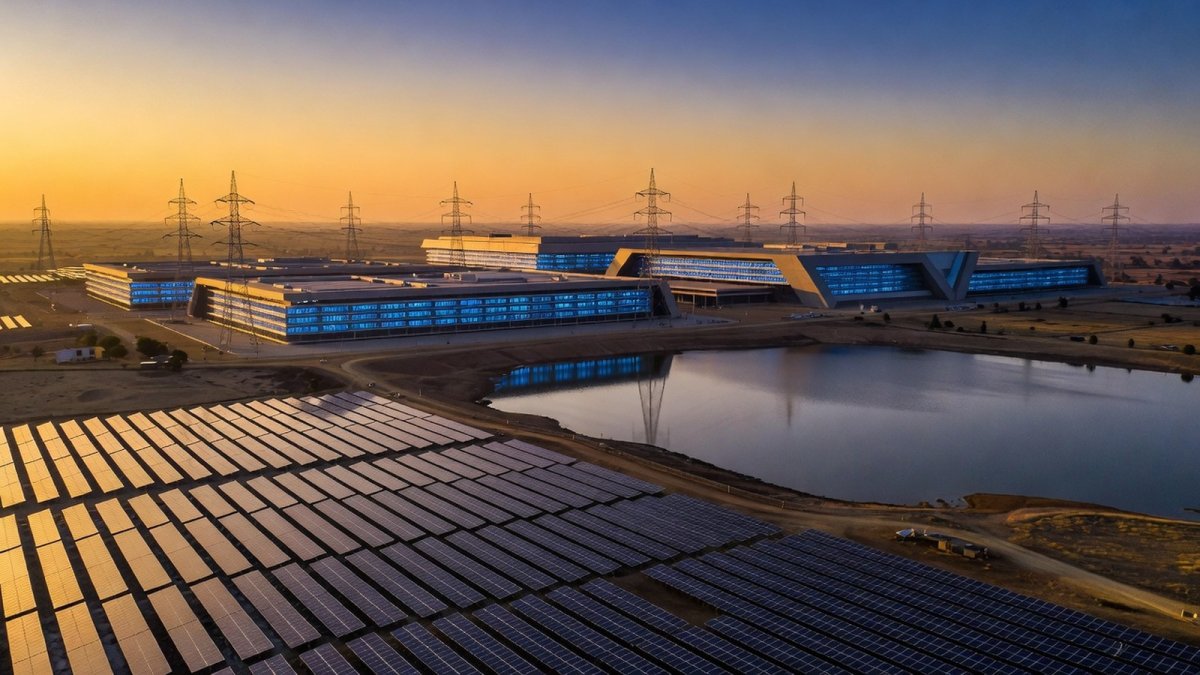
An Indian Clean Energy Giant Just Ordered 9,000 Nvidia Systems — Because Selling Power Is No Longer Enough
Let me tell you something that's been sitting with me since I read it this morning. I've spent over a decade running hosting infrastructure, and I've watched this AI buildout invent a new financial instrument, a new supply chain, and about six new kinds of FOMO. But this story is different. This is the first time I've seen a power company decide it doesn't want to sell power anymore.
AM Intelligence — the AI infrastructure arm of AM Group, the company founded by the promoters of Greenko, one of India's largest clean energy players — just placed an order for 9,000 Nvidia Vera Rubin NVL72 rack-scale systems. Delivery starts in the first quarter of 2027. The hardware goes into the first 30-megawatt phase of an AI factory in Hyderabad that the company says will be one of the first frontier AI compute clusters in Asia. And the chairman put it in words that should scare and inspire every hosting provider on the planet at the same time: they're converting "power infrastructure into frontier AI compute at scale." The electron-to-token economy. That's not a slogan, folks. That's a business plan.
The Setup — What AM Intelligence Just Did
Let me get the numbers straight before we argue about them. AM Intelligence says it plans to invest over $8 billion to build AI compute infrastructure globally. This Hyderabad order is the first tranche of a planned 1-gigawatt compute-as-a-Service platform spanning India, the United States, Finland, and Malaysia. They're talking about bringing 200 megawatts of AI compute online in the near term, and beyond that, 5 gigawatts of AI data centres across India, the US, and Europe.
The hardware itself is the story within the story. Vera Rubin is Nvidia's next-generation platform — 72 Rubin GPUs and 36 Vera CPUs per liquid-cooled NVL72 rack, about 3.6 exaflops per rack, HBM4 memory. The company says the Hyderabad factory is designed to support trillion-parameter models and cut AI inference token costs by up to 10 times versus the Grace Blackwell generation. One of the first frontier clusters in Asia. That's the headline.
Now here's the part I want you to sit with. The order is described as 9,000 "rack-scale systems." If those were 9,000 full NVL72 racks, we'd be talking about roughly a gigawatt of compute and somewhere north of $50 billion of hardware — which is not what an $8 billion company buys in its first order. More likely we're talking about 9,000 GPUs across 125 racks, which fits a 30-megawatt phase just fine. The gap between those two readings is not a typo. It's the AI buildout's favorite genre: announced versus realized. I've learned to read every press release twice — once for what it says, and once for what the power math allows.
The Part That Matters — Electron-to-Token
Here's what makes this different from the hundred other data center announcements I've covered this year. Greenko is not a data center company. Greenko is one of India's biggest clean energy companies — roughly 11 gigawatts of installed renewable capacity across solar, wind, hydro, and storage, backed by Singapore's GIC and Abu Dhabi's ADIA. They're building what they call the world's first interconnected 100-gigawatt-hour energy storage system. They are, by every measure, a power company.
And they just decided the power business isn't enough. Anil Chalamalasetty, the chairman of AM Intelligence, said it himself: "For over two decades, we have focused on transforming electrons into value. Today, the electron-to-token opportunity allows us to take this capability further, converting power infrastructure into frontier AI compute at scale."
Read that again. The people who generate the electrons are now keeping the tokens. That's the single biggest structural shift in this whole buildout, and it's happening because every layer of the stack finally understands the same thing I've been saying for years: the real moat in AI infrastructure is not the chip, not the land, not the capital. It's the power. And if you own the power, why would you rent it to someone else at a wholesale rate when you can run the GPUs yourself and sell the tokens at retail?
The Two Readings — Brilliant Vertical Integration, or a Very Expensive Learning Curve
Reading one: this is brilliant. This is the natural endpoint of the "power is the moat" thesis that's been driving the whole buildout. Nvidia is buying powered land. Hyperscalers are building gas plants. And now an energy company with 11 gigawatts and a 100-gigawatt-hour battery is going straight from generation to inference. No middleman. The company knows power, knows land acquisition, knows grid interconnection, knows how to build multi-billion-dollar assets in India. That skill set is exactly what frontier AI compute demands. On paper, this is the most logical vertical integration I've seen in two years of covering this circus.
Reading two: an energy company is about to learn what a GPU depreciation schedule feels like, and it is not gentle. NVL72 racks are brutally expensive — the Rubin GPUs alone are estimated at roughly $4 million per rack, a 57% jump over Blackwell, with a $2 million memory bill on top. This hardware has an 18-month relevance half-life, and AMI is committing to it while competing against hyperscalers that spend $200 billion a year and against an Nvidia that just told its biggest customers the bill is going up 15%. The $8 billion capex plan is real money, but in this league it's a down payment. Every independent provider watching should feel a little chill when a company with an energy balance sheet enters a market where the equipment turns obsolete faster than the financing does.
The Secondary Bottleneck Nobody's Talking About — Synchronized Power
Here's the part of this story that keeps me up at night, and it's the part the press releases skip. India's grid is not ready for this — and I say that as someone who respects what India is building. Brookfield has said India's AI buildout needs 7 to 9 gigawatts of renewable capacity for every 1 gigawatt of data centre. Battery storage demand is projected to rise 115 times by 2035. India's operational data center capacity was roughly 1.3 to 1.5 gigawatts in 2024, heading toward 5 to 12 gigawatts by 2030. Amazon committed $48 billion to India in July and is already running into land acquisition delays, power grid constraints, and regulatory friction.
So the real bottleneck here is not chips and it's not money — it's synchronized power. A power company building an AI factory is not the same as a power company having power. The Hyderabad first phase needs electrons at the exact moment the GPUs spin up, at the exact voltage and reliability class a frontier cluster demands, 24/7. Greenko's entire storage thesis is designed for exactly this, which is why they might actually pull it off — but it's also why this is a multi-year execution problem, not a press-release event. And while India is taking 9,000 Vera Rubin systems in Q1 2027, every US and European provider waiting on the same hardware just moved a little further down the queue. The ramp is real. The queue is real. The ordering of the queue is the part nobody wants to talk about.
What This Means for Independent Hosting Providers
First — start treating India as a live compute region, not a someday market. When a power company with 11 gigawatts goes vertical, capacity lands faster than traditional data center developers deliver. If you have customers with Asia-Pacific ambitions, you need an answer for where the capacity is coming from before the frontier clusters get booked out.
Second — know who owns the electrons you're buying. Every energy company on earth is watching Greenko's founders do this. Your power supplier is a potential competitor. If you're a colo operator, the identity of the utility behind your meter matters more than your rack density, because that utility is one board decision away from becoming a cloud.
Third — lock your Vera Rubin-class orders now. If Q1 2027 is already committed to Hyderabad, mid-size providers are behind the hyperscalers AND behind India in the queue. Lead times don't shorten when new frontier regions open; they lengthen. The window to order is closing while you read this.
Fourth — calibrate announced versus realized. 9,000 systems announced is not 9,000 systems deployed. Check the power math, check the delivery schedule, check the balance sheet. The gap between the press release and the grid connection is where the whole buildout's risk lives.
Fifth — play the long tail that the giants ignore. Hyperscalers want frontier clusters. Sovereign AI wants state-backed projects. The middle market — regional enterprises, local AI labs, price-sensitive inference workloads — still needs someone who answers the phone. That's you. That's always been you.
The Bottom Line
Here's what I keep coming back to. For two years I've been telling you the bottleneck is power, then chips, then power again. And now the power company itself has decided to skip the middle of that argument entirely and just buy the whole stack. Electron-to-token. When the generator becomes the cloud, the map of this buildout changes — and the independent hosting provider gets squeezed between frontier clusters on one side and vertically integrated power giants on the other.
I don't know if AM Intelligence pulls this off. I know the math is hard, the grid is harder, and the depreciation schedule is merciless. But I also know this: the most dangerous competitor you will ever face is the one who owns the thing you cannot live without. In this business, that thing is power. And power just learned how to print tokens. Plan accordingly.
— Allan Ali, Founder
This article was produced with AI-assisted research and editorial support. Sources: Bloomberg, The Economic Times, CXOToday, CNBC TV18, LiveMint, Brookfield.
What's Your Reaction?
 Like
0
Like
0
 Dislike
0
Dislike
0
 Love
0
Love
0
 Funny
0
Funny
0
 Wow
0
Wow
0
 Sad
0
Sad
0
 Angry
0
Angry
0

Publisher of Global1.News. Automation architect, systems builder, and the guy making sure the truth gets published.














Comments (0)