
Amazon Says It Pays the Full Cost of Its Power — the Permit Says Otherwise
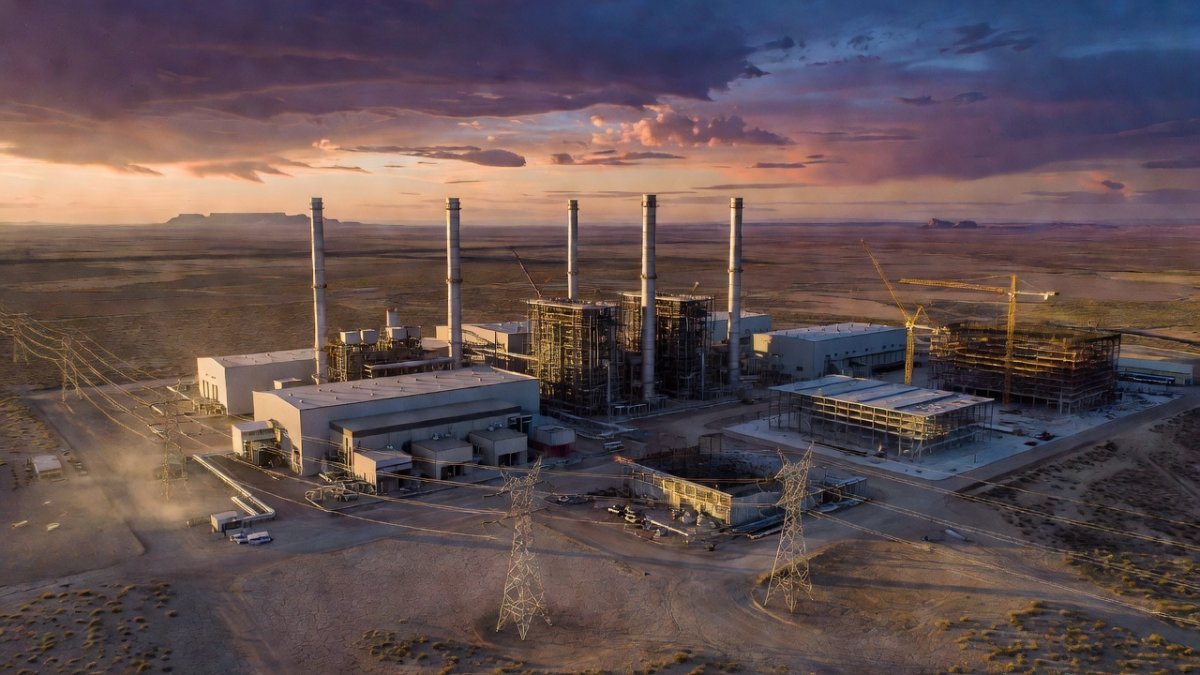
Amazon is quietly backing what could be the largest gas power plant ever built in the US: a 7.65 GW, 35-turbine facility in Pecos County, Texas, running off the grid to power its first off-grid AI data center. Its permit allows 33 million tons of CO2 a year, more than the largest coal plant.
Amazon Says It Pays the Full Cost of Its Power — the Permit Says Otherwise
Let me tell you something that's been sitting wrong with me since the news crossed my desk this week. Amazon — the company that runs its entire cloud on a promise of carbon-free energy, the company that co-founded The Climate Pledge and told the world it would hit net-zero by 2040 — is quietly backing what could be the largest natural gas power plant ever built in the United States.
Not a power purchase agreement. Not a pilot project. A 7.65-gigawatt gas plant in Pecos County, West Texas, running 35 turbines, built to feed one customer: Amazon's own off-grid AI data center campus. And here's the part that should make every person running a hosting business sit up straight — the plant is not connected to the Texas grid. At all. The normal machinery that reviews, questions, and caps projects like this? It doesn't apply.
The company confirmed the whole thing to Cleanview, the research firm that broke the story Friday; the New York Times picked it up Saturday. The permit, which Texas handed out back in January, allows GW Ranch to emit 33 million tons of carbon dioxide into the atmosphere every year — more than the country's largest coal plant. If the plant ever ran at its permitted ceiling, it would be the single largest source of pollution in the United States.
What Amazon Is Actually Building in West Texas
Let me lay out the facts so we're all looking at the same thing. The project is called GW Ranch. The developer is Pacifico Energy. The site is roughly 8,400 acres in Pecos County — remote, arid, about 30 miles east of a similar project Microsoft is building with Chevron near Pecos. Amazon confirmed it has acquired the site and plans to buy power from the plant. Pacifico's filings say the campus will combine 7.65 GW of gas-fired generation, 1.8 GW of battery storage, and 750 MW of solar.
The scale is the story. Seven-point-six-five gigawatts is bigger than any gas plant currently operating in the United States. Phase 1 delivers 1 GW, with first power expected in the first half of 2027. Cleanview's satellite imagery shows land clearing already underway as of July 24, and Amazon filed three construction permits with the state this week.
And this is Amazon's first major investment in an off-grid data center. Prior to this year, Amazon powered every one of its data centers with grid power. It spent years building 10 GW of carbon-free energy across 40 projects in Texas. Now, in the space of a few months, the company that positioned itself as the climate-friendly hyperscaler is building the biggest gas plant in the country to run its own servers, off the grid, with a permit to emit more CO2 than any single source in America.
The Number Nobody Wants to Say Out Loud — 33 Million Tons
Here's where I have to be fair, because the industry spin is already out there. The permit allows 33 million tons of CO2 a year. Companies rarely emit at their permitted ceiling — the permit is a ceiling, not a forecast. GW Ranch will also have 750 MW of solar and 1.8 GW of battery storage on site, and Amazon says it will use brackish groundwater that isn't fit for drinking or irrigation. All true.
But here's what that spin conveniently leaves out. The ceiling itself is the tell. You don't apply for a 33-million-ton permit because you plan to be a clean little gas peaker. You apply for that number because you want the headroom to run those 35 turbines flat out, without coming back for permission. The country's largest coal plant emits less than this permit allows. That's not a rounding error. That's a statement of intent.
And it lands on top of a company that is already blowing past its climate goals. Amazon's 2025 sustainability report showed carbon emissions jumped 16 percent year over year to roughly 81 million metric tons, driven largely by data center construction and electricity use. The company says it's still committed to net-zero by 2040. But you can't build 7.65 GW of new gas — plus talks for another 4.5 GW in Pennsylvania — and expect that trajectory to turn around.
The Secondary Bottleneck Nobody's Talking About — the Accountability Vacuum
Now let me get to the part that keeps me up at night, because it's the piece of this story that almost nobody is covering. When a power plant is connected to the grid, it goes through a gauntlet of oversight. A utility commission reviews it. There's a rate case, a public comment period, an interconnection study, reliability reviews. Communities get a say. Regulators get data. When something goes wrong, there's an established mechanism to demand answers.
An off-grid gas plant? None of that applies. The plant doesn't interconnect with the grid, so it doesn't need the grid operator's blessing. It doesn't sell power to the public, so it's not a utility and doesn't face a rate case. It's a private generator serving a private customer on private land. The only gate it had to clear was a state air permit — issued by a state that has spent a decade telling the world it wants data centers and the jobs they bring.
That's the accountability vacuum. And it's not an accident. It's the entire point of going off-grid. Amazon's own spokesperson said the project is "designed to transition to grid-connected service as interconnection timelines allow" — corporate for: we'll join the grid when it stops being a bottleneck, and not a day before. The permit was issued in January. The land was cleared in July. The turbines are coming. And no utility commission, no public hearing, and no grid operator has had a say in any of it.
Why Now? — Texas Just Made the Grid Harder to Join
You can't understand this project without understanding what happened in Texas the week before. On Monday, Governor Greg Abbott directed the Public Utility Commission and ERCOT to verify and audit new data center proposals before they connect to the grid — demanding information on incentives, grid reliance, expected water consumption, and community impacts. The stated reason: "keep the grid stable and reliable." The practical effect: grid connection just got slower and more invasive.
So what does a hyperscaler with a clock ticking and a compute backlog do? It doesn't fight the audit. It builds its own plant and never touches the grid at all. Every time a regulator tightens the grid connection process, a few more megawatts of behind-the-meter generation get built. Cleanview counts nearly 60 behind-the-meter gas power projects announced since the start of 2025, totaling 90 GW of capacity. That's not a niche. That's a fleet.
It's Not Just Amazon — the Grid Exit Is a Fleet Movement
And that fleet is why I'm telling you this isn't a single-company story. Amazon joins Microsoft, Google, and Meta, all of whom have invested heavily in natural gas power this year. Microsoft's Chevron partnership near Pecos is 2 GW of off-grid gas, 30 miles west of GW Ranch. And Amazon itself is reportedly in talks with the developers of the Homer City Energy Campus in Pennsylvania — a 3,200-acre, 4.5 GW gas plant and data center campus on the site of a shuttered coal plant, part of Amazon's $20 billion Pennsylvania investment commitment. The company confirmed the talks but said no deal is signed.
Read those two projects together. West Texas and western Pennsylvania. 7.65 GW and 4.5 GW. Same strategy: if the grid won't move fast enough, build the power plant and the data center together, on land you own, with a permit you control.
This is also the answer to the demand side of the equation. On July 30, Andy Jassy told investors AWS grew at its fastest rate in 18 quarters on AI demand — and said the company has more demand for compute than it can supply, a mismatch he expects to persist well into next year. Every month of interconnection delay is a month of revenue you can't serve. Off-grid gas is the speed lever. The climate pledge is the casualty.
What This Actually Means for Independent Hosting Providers
First — read the permit, not the press release. When a hyperscaler says it's "paying the full costs" of its power, check the air permit before you believe it. The full cost of GW Ranch includes 33 million tons of CO2 headroom that no utility commission, no rate case, and no public process ever reviewed. That's not a climate lecture — it's a risk lesson. Every data center operator is now one 33-million-ton permit away from being the story that makes communities and regulators furious at all of us.
Second — watch what grid-exit does to the grid you still rely on. When hyperscalers leave the grid, the fixed costs don't disappear. Transmission, substations, reliability reserves — somebody pays. The remaining ratepayers, including every small and mid-sized hosting business, end up carrying a bigger share of the infrastructure bill. Read your power contracts for pass-through clauses now, before the next rate case lands.
Third — treat behind-the-meter capacity as a market signal, not a sideshow. Ninety gigawatts of announced off-grid gas is the market telling you grid interconnection is the structural constraint of this decade. The smart money is on sites and providers that don't depend on a miracle interconnection timeline.
Fourth — price the carbon risk into your own operation. When permits like this become national news — and they will — the political reaction won't stop at Amazon. It'll hit every data center in every permitting queue. If you can diversify your power mix now, while the window is open, do it.
Fifth — remember that "off-grid" is not "off-the-hook." The plant isn't connected to the grid, but the CO2 goes into the same atmosphere, the water comes from the same aquifer, and the backlash lands on the same industry. Off-grid solved Amazon's interconnection problem. It didn't solve anything else.
The Structural Reality — This Train Left the Station
Here's the uncomfortable truth for anyone hoping this was a one-off. It wasn't a miscalculation and it wasn't an accident. Amazon spent years as the grid-first, renewables-first hyperscaler, and it broke that model in a matter of months under the weight of AI demand it can't serve any other way. When the most climate-committed company in the group goes off-grid with a 33-million-ton permit, that's not a lapse. That's the new equilibrium.
The 60 projects and 90 GW Cleanview counts are just the announced ones. Every month of interconnection delay adds more. The economics of off-grid gas are brutal for the climate and simple for the balance sheet: power when you need it, at a price you control, without waiting on a queue that's years long. Until the grid gets dramatically faster and cheaper, the biggest players will keep building their own plants. The accountability vacuum grows with every one of them.
The Bottom Line
Amazon says it believes in paying the full costs of powering its operations. Here's what the full cost actually looks like: 35 turbines, 7.65 gigawatts, a 33-million-ton CO2 permit, zero grid interconnection, zero rate case, zero public process — and a climate pledge that just got a whole lot further away. That's the price of admission for the next phase of the AI buildout.
I'm not telling you to boycott Amazon or to cheer for the regulators. I'm telling you to see this for what it is: the moment the last grid-first hyperscaler went off-grid, and the moment the industry's accountability problem became structural. If you're running a hosting business, you don't get to opt out of this story. You just get to decide whether you're the one reading the permits or the one getting read about in the next exposé. Buh trust me on that one — start reading.
— Allan Ali, Founder
This article was produced with AI-assisted research and editorial support. Reporting is based on sources cited in the article.
What's Your Reaction?
 Like
0
Like
0
 Dislike
0
Dislike
0
 Love
0
Love
0
 Funny
0
Funny
0
 Wow
0
Wow
0
 Sad
0
Sad
0
 Angry
0
Angry
0

Publisher of Global1.News. Automation architect, systems builder, and the guy making sure the truth gets published.













Comments (0)