
AI Stocks Power China's Market Revival Amid Uneven Recovery
China's tech-heavy Star Market 50 has rebounded more than 9 per cent in August after a 26 per cent July slump, as analysts say a K-shaped recovery will keep investors betting on AI hardware. Beijing is also steering mainland insurers toward Hong Kong-listed ETFs.
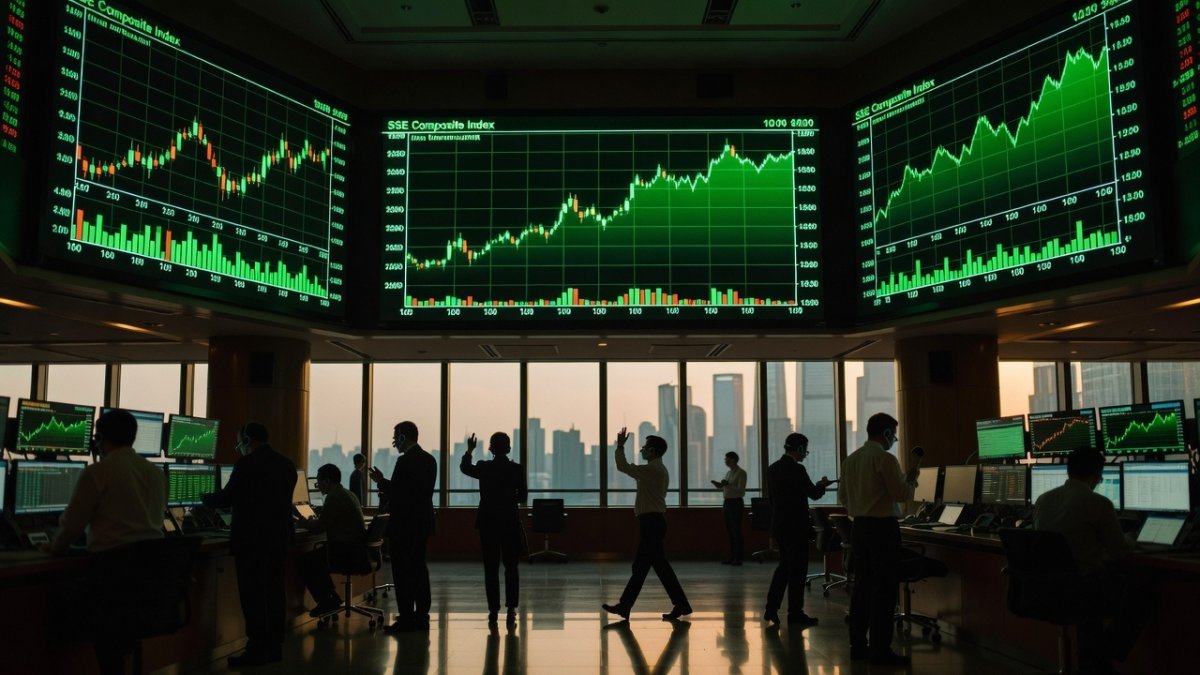
Star Market Rebounds as Investors Rotate Back Into AI Hardware
Hong Kong - China's K-shaped economic recovery is drawing investors back into artificial-intelligence stocks, with the tech-heavy Star Market 50 index rebounding more than 9 per cent in August after a punishing 26 per cent slump in July, according to analysts and exchange data.
The divergence between China's fast-growing technology sectors and its struggling consumer and property engines has become the defining feature of its equity market this year. Manufacturing output for industrial robots, electric vehicles and semiconductors each grew at least 20 per cent year on year in July, official statistics show, even as retail sales and fixed-asset investment fell short of economists' estimates.
Tags: China AI stocks, Star Market 50, K-shaped recovery, Chinese tech shares, Hong Kong ETFs, Stock Connect, semiconductor stocks, AI hardware, southbound flows
The Numbers Behind the Rotation
Official data published this week painted a two-speed picture of the world's second-largest economy. Retail sales rose just 0.6 per cent in July, slowing from 1.0 per cent in June and well below the 1.5 per cent consensus forecast, while the decline in fixed-asset investment deepened to 6.7 per cent in the January-July period from 5.7 per cent in the first half.
By contrast, output in the sectors Beijing has prioritised under its tech self-reliance strategy - industrial robots, EVs and semiconductors - grew at least 20 per cent year on year in July. Barclays estimates that consumption and the housing market still account for roughly 70 per cent of the economy, a structural weight that helps explain why the AI trade has become the market's main engine of returns.
From Global Sell-Off to Renewed Buying
The rebound follows a punishing July, when a global risk-off wave drove the Star Market 50 - an index predominantly made up of chipmakers trading on Shanghai's STAR board - to its steepest monthly decline. The correction also flushed out leverage: UBS Group said the worst of the sell-off was already behind after the outstanding balance of margin trading and share prices both dropped to levels not seen since April.
"It may be time for investors to return to China AI technology hardware stocks after a sharp correction reduced leverage and brought valuations closer to historical averages," said James Wang, head of China strategy at UBS. With valuations "only slightly above the historical average while earnings per share continue to be upgraded, we think it is time to get back in," he said.
Hua An Securities analyst Zheng Xiaoxia echoed the cautious optimism. "There's a big chance that technology stocks will revisit their highs of June and there's more room for the rebound to run," she said, adding that the resilience of the tech industry would be confirmed in interim reports due in late August.China's rebound is also riding a global AI trade revival. After July's worldwide de-risking, technology shares from Tokyo to New York have recovered, and the Star Market 50 closed last week up 6.6 per cent even before this week's gains, according to exchange data. The synchronised recovery underscores how deeply China's chip-heavy benchmark is now wired into global AI sentiment.
Beijing's New Capital Channel: Insurers and Hong Kong ETFs
Alongside the market rotation, Beijing is widening the pipeline for state-linked capital into equities. The National Financial Regulatory Administration (NFRA) voiced support on Tuesday for mainland insurance funds investing in Hong Kong-listed exchange-traded funds through Stock Connect, during a meeting with Hong Kong officials in Beijing.
The meeting brought together NFRA vice-minister Xiao Yuanqi, Hong Kong's Secretary for Financial Services and the Treasury Christopher Hui Ching-yu, Securities and Futures Commission Executive Director Elisa Ng, and Hong Kong Exchanges and Clearing CEO Bonnie Chan Yiting. "Enabling mainland insurance funds to invest in Hong Kong-listed ETFs via the Stock Connect is a key step in deepening market connectivity between the two places, and it brings new momentum to Hong Kong's asset management industry," Hui said.
The policy carries real weight: mainland insurers held total assets of 41.31 trillion yuan (US$6.1 trillion) at the end of last year. Southbound net inflows to Hong Kong surged to a one-month high of HK$14 billion (US$1.78 billion) on Tuesday, while average daily ETF turnover in the city reached HK$40.6 billion in the first seven months of 2026, up 22 per cent from a year earlier.
State Capital, Consumer Exit and the AI Rerating
The flow of funds is already visible in index composition. A CSI gauge of information technology stocks has risen about 30 per cent this year, while a measure of consumer stocks has dropped 18 per cent, with state-backed funds even exiting industry giants such as Kweichow Moutai. In a sign of how far the rerating has run, memory-chip maker CXMT overtook Tencent on Aug 13 to become China's most valuable listed company, roughly two weeks after its market debut.
The NFRA initiative extends the pattern: by channelling insurance assets - among the largest pools of long-term capital in China - into Hong Kong's ETF market, policymakers gain a new mechanism to support valuations while deepening the city's role as an offshore wealth and asset-management centre. Hong Kong Financial Secretary Paul Chan Mo-po called the initiative a "win-win", and Chief Executive John Lee Ka-chiu thanked the central government for its support.
What It Means for Japan and Asia-Pacific Investors
For investors in Japan and the wider Asia-Pacific region, the revival of China's AI trade carries both opportunity and risk. Japanese semiconductor-equipment and materials suppliers remain deeply embedded in China's chip buildout, so a sustained recovery in STAR-board hardware names tends to feed through to the regional supply chain even as Tokyo's own AI beneficiaries - from chip testers to power utilities - trade on separate drivers.
The divergence between the People's Bank of China's easing bias and the Bank of Japan's normalisation path also shapes the flows. The July sell-off that hit the Star Market 50 was part of a global de-risking that began with the yen carry trade, underscoring how closely China's tech complex is now correlated with global liquidity conditions. Regional allocators watching the rotation will be weighing whether the K-shaped dynamic is a durable structural shift or a momentum trade vulnerable to the next global shock.
What to Watch For
Three signposts will test the AI stock revival over the coming weeks. First, interim earnings due in late August will show whether the 20 per cent-plus output growth in robots, EVs and semiconductors is translating into profits. Second, follow-through on the ETF channel - including southbound flow data and any expansion of the 31 ETFs currently eligible under Stock Connect, which had a combined market capitalisation of HK$343.6 billion as of July - will show how serious Beijing is about using insurance capital to support markets. Third, the trajectory of global yields and the yen will determine whether the August rebound can hold against the forces that triggered July's slide.
For now, the market's message is clear: in a K-shaped economy, the fastest-growing earnings are in the sectors Beijing backs most. That is a powerful tailwind for China's AI hardware complex - and for the regional supply chain tied to it.
By Kenji Tanaka, Staff Writer
This article was produced with AI-assisted research and editorial support. Sources: South China Morning Post, UBS Group, Barclays, National Financial Regulatory Administration.
What's Your Reaction?
 Like
0
Like
0
 Dislike
0
Dislike
0
 Love
0
Love
0
 Funny
0
Funny
0
 Wow
0
Wow
0
 Sad
0
Sad
0
 Angry
0
Angry
0

Japan Correspondent at Global1.News. Tokyo-based voice covering Japanese politics, technology, economy, and culture. Tracks the intersection of tradition and innovation in one of the world's most dynamic societies.















Comments (0)